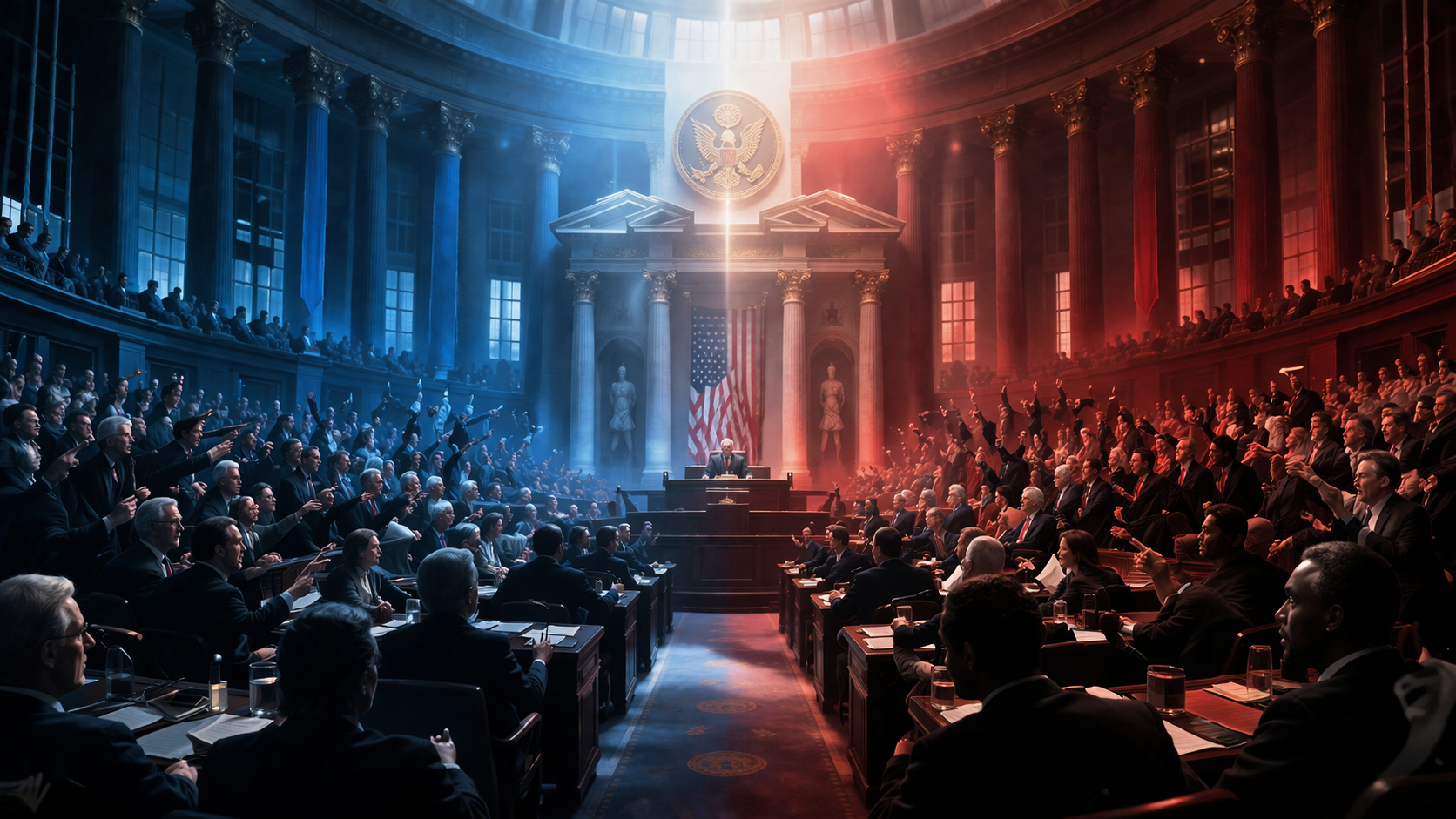
Struggle, Mediation, and the Paradox of Political Life
When we turn on the news, politics often appears as noise—
raised voices, accusations, and endless division.
Yet behind every conflict, there is always a promise:
to solve problems, to serve the public, to move society forward.
This contradiction raises a deeper question:
If politics is meant to manage collective problems,
why does political life so often appear to intensify the conflicts it is supposed to mediate?
1. Politics as the Institutionalization of Conflict
A Plural Society Cannot Avoid Disagreement
No society operates with a single voice.
Individuals and groups hold different values, interests, and priorities.
Politics exists precisely because of these differences—
it provides a structured way to manage conflict rather than eliminate it.
Conflict Without Violence
Political theorist Bernard Crick argued that politics becomes necessary when different groups and interests must coexist under common institutions.
For Crick, politics offers a way of reconciling competing interests through negotiation and compromise rather than relying primarily on violence or coercion.
In this sense, conflict is not a failure of politics,
but its very starting point.
The real issue is not whether conflict exists,
but how it is handled.
2. Why Political Conflict Can Turn Opponents into “Enemies”
Visibility and Mobilization
Politics depends on attention and support.
Political competition rewards visibility, clear differences, and the ability to mobilize supporters.
Under these conditions, political actors may sometimes frame complex disagreements in simplified “us versus them” terms, especially when polarization helps strengthen group identity or mobilize support.
The Simplicity of Division
This strategy simplifies complex policies into emotional narratives.
By drawing sharp boundaries between political camps, leaders can strengthen solidarity among supporters and make complex disagreements easier to communicate.
But when political opponents are treated as illegitimate enemies rather than legitimate adversaries, polarization can deepen and democratic dialogue can become more difficult.
3. Politics is built on Compromise
The Myth of Complete Solutions
We often expect politics to deliver definitive answers.
In pluralistic societies, politics frequently requires negotiation, compromise, and temporary settlements among competing interests.
In a society with competing interests,
a perfect solution is rare.
The Cycle of Temporary Agreements
What is resolved today
may return as conflict tomorrow.
Politics, therefore, is not a destination
but an ongoing process of negotiation and adjustment.
This explains the paradox:
politics promises solutions,
yet continuously revisits problems.
4. The Productive Role of Conflict
Conflict as a Driver of Change
Not all conflict is destructive.
Debates between ideological positions,
generational disagreements, and policy disputes
can help societies refine their direction.
Politics as an Alternative to Force
Without political processes,
conflicts might be resolved through coercion or violence.
Politics allows disagreement to be expressed,
contested, and reshaped within a shared framework.
The question, then, is not whether politics involves conflict—
but whether that conflict is productive.
From the perspective of democratic citizenship, this distinction is crucial.
Democracy does not require citizens to eliminate disagreement or reach consensus on every issue. It requires institutions and civic practices that allow people with conflicting values and interests to continue living together as political equals.
This means learning how to disagree without denying the legitimacy of opponents, how to defend one’s convictions while listening to competing claims, and how to accept temporary political outcomes without treating disagreement as permanent hostility.
Political conflict becomes democratically productive when it creates opportunities for participation, deliberation, negotiation, and peaceful change rather than exclusion or violence.
Conclusion: Making Political Conflict Productive
Politics is a constant balancing act
between conflict and resolution.
At times, conflict is amplified for strategic purposes.
At others, it reflects genuine attempts to reconcile differences.
Political disillusionment can deepen when citizens perceive conflict as strategic performance rather than genuine disagreement over public problems.
Yet politics remains the space
where collective life is negotiated.
Conflict is its starting point.
Adjustment is its method.
So perhaps the real question is not:
“Why does politics create conflict?”
But rather:
Where does that conflict lead us—and who does it ultimately serve?
Reader Question
Do you believe political conflict is a necessary part of democracy— or has it become a tool that undermines it?
Related Reading
The challenge of managing political conflict becomes especially visible when societies must balance competing claims about equality, freedom, and public responsibility. In Social Justice and the Welfare State: How Much Should Governments Reduce Economic Inequality?, we examine how disagreements over redistribution and social welfare reflect deeper conflicts over what a fair society should require.
References
- Crick, B. (1962). In Defence of Politics. London: Weidenfeld and Nicolson.
→ Crick presents politics as a means of accommodating diverse interests through compromise and conciliation rather than coercion, providing a central foundation for understanding political conflict as a normal feature of plural societies. - Arendt, H. (1970). On Violence. New York: Harcourt, Brace & World.
→ Arendt distinguishes political power from violence and examines the relationship between authority, collective action, and coercion, helping clarify why democratic politics seeks to contain conflict without allowing it to become violent. - Mouffe, C. (2000). The Democratic Paradox. London: Verso.
→ Mouffe argues that conflict cannot simply be eliminated from democratic life. Her approach helps explain why democracy must transform antagonism between enemies into legitimate political contestation among adversaries. Verso — The Democratic Paradox https://www.versobooks.com/products/1696-the-democratic-paradox - Habermas, J. (1996). Between Facts and Norms: Contributions to a Discourse Theory of Law and Democracy. Cambridge, MA: MIT Press.
→ Habermas connects democratic legitimacy with communication, law, and public deliberation, offering an important counterpoint to more conflict-centered theories of democratic politics. LawCat - Tilly, C. (2003). The Politics of Collective Violence. Cambridge: Cambridge University Press.
→ Tilly examines how contentious politics can develop into collective violence, helping distinguish ordinary political conflict from forms of contention that cross into coercion and violence.