Tag: psychology of memory

  • Has the Past Really Passed?

    Has the Past Really Passed?

    Memory, Emotion, and the Time That Still Lives Within Us

    A song you have not heard in years suddenly plays on the radio.

    A familiar scent passes by.

    A street, a face, a fragment of light—
    and for a moment, time returns.

    You thought that moment was gone.

    But suddenly, the feeling, the expression, the atmosphere of that time stands beside you again.

    The past seems distant on the calendar,
    yet strangely alive within you.

    So we begin with a quiet question:

    Has the past really passed?

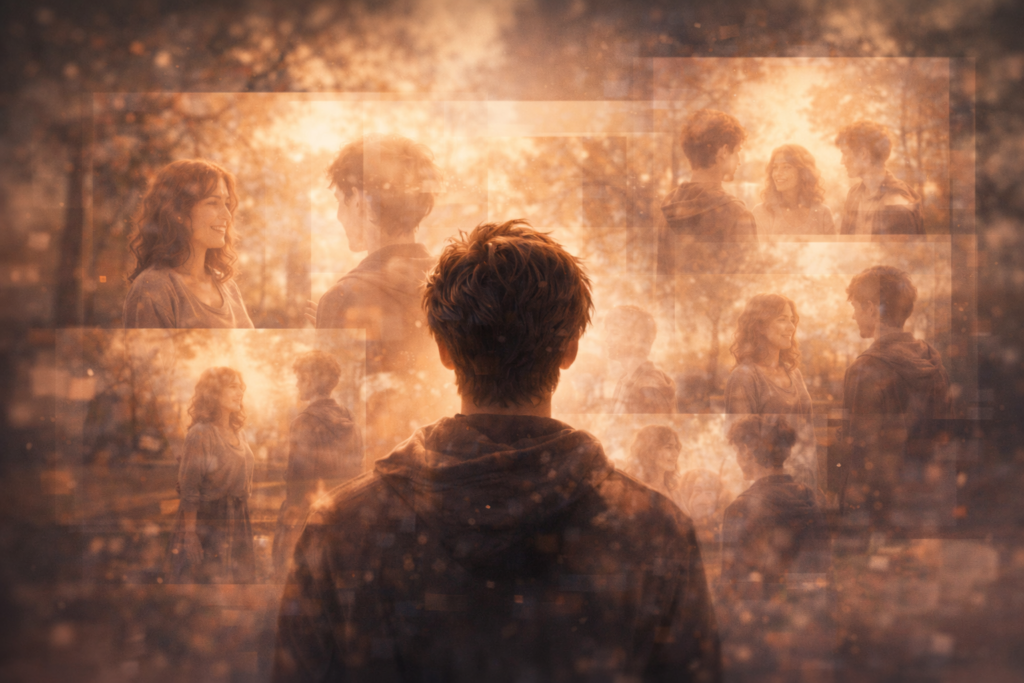
    old music bringing back memories

    1. We Feel Safe When Time Moves Forward

    We usually understand time as a straight line.

    Past → present → future.

    This order helps us feel that life is moving forward.
    It tells us that what has passed should be left behind, and what lies ahead should be faced.

    We often say:

    “That is in the past.”
    “Move on.”
    “Look forward.”

    But perhaps this belief also protects us.

    If the past has truly passed, then pain can become distant.
    Regret can lose its power.
    Loss can become something we survived.

    Yet human experience is rarely that simple.

    The past may disappear from the calendar,
    but not always from the heart.

    2. Memory Brings Time Back Into the Present

    We return to the past many times a day.

    Through a photograph.
    Through someone’s voice.
    Through a place we did not expect to remember.

    Psychologists often describe memory not as playback,
    but as reconstruction.

    Memory is not a perfect recording stored in the mind.
    It is rebuilt each time we recall it.

    The person we are now reshapes the past we remember.

    This means that the past is never simply “behind” us.
    It continues to live inside the present, changing its meaning as we change.

    3. Emotion Does Not Follow the Calendar

    time frozen inside emotion

    Some wounds still hurt years later.

    A person may speak about something that happened long ago
    and suddenly cry as if it happened yesterday.

    Why?

    Because emotion does not obey chronological time.

    A memory may be old,
    but the feeling attached to it can remain immediate.

    In this sense, some moments do not pass completely.
    They remain suspended within us, waiting to be awakened.

    When a song brings back a lost season of life,
    it is not only memory returning.

    It is time becoming emotional again.

    4. The Past Is Not a Place We Leave Completely

    To say that the past remains alive does not mean we must live trapped inside it.

    There is a difference between being imprisoned by the past
    and carrying it with care.

    Some memories need distance.
    Some need forgiveness.
    Some need to be retold until they become less painful.

    But none of them vanish completely.

    They become part of the inner structure of who we are.

    The past shapes our fears, our hopes, our tenderness,
    and even the way we love.

    Conclusion: Time Flows on the Calendar, but Not Always in the Heart

    The past has passed in one sense.

    Dates move forward.
    Years accumulate.
    Life continues.

    But inside the human heart, time does not always move in a straight line.

    It returns.
    It trembles.
    It speaks again.

    Perhaps maturity is not about forgetting the past,
    but learning how to live with the time that still remains within us.

    The past is not simply gone.

    It is one of the quiet forces
    that continues to make us who we are.

    A Question for Readers

    Have you ever felt that a memory from long ago was suddenly alive again in the present?

    Related Reading

    The past often returns not only through memory, but through the pressure of comparison and the feeling that time is moving differently for everyone.
    In Am I Falling Behind? — How Comparison Distorts Our Sense of Time, the emotional experience of time reveals how memory, anxiety, and identity shape the way we experience the present.

    At the same time, memory is deeply connected to emotion and moral meaning.
    In Are Emotions a Barrier to Moral Judgment—or Its Foundation?, the relationship between emotion and human judgment shows why certain moments remain emotionally alive long after they are supposed to be “past.”

    References

    1. Bergson, H. (1910). Time and Free Will: An Essay on the Immediate Data of Consciousness. George Allen & Unwin.
      → Bergson distinguishes physical time from lived duration, showing how inner time can remain fluid and emotionally present rather than simply chronological.
    2. Heidegger, M. (1927/1962). Being and Time. Harper & Row.
      → Heidegger understands time not merely as sequence, but as part of how human beings experience existence, memory, and meaning.
    3. Ricoeur, P. (1984). Time and Narrative, Vol. 1. University of Chicago Press.
      → Ricoeur explains how humans organize time through narrative, suggesting that the past continues to live through the stories we tell about ourselves.
    4. Tulving, E. (1985). Memory and consciousness. Canadian Psychology, 26(1), 1–12.
      → Tulving’s work on episodic memory shows how remembering allows us to mentally travel through time and experience the past as part of present consciousness.
    5. Casey, E. S. (2000). Remembering: A Phenomenological Study. Indiana University Press.
      → Casey explores memory as an embodied and emotional experience, emphasizing how places, sensations, and feelings can bring the past back into the present.

  • If Memory Can Be Manipulated, What Can We Really Trust?

    If Memory Can Be Manipulated, What Can We Really Trust?

    Truth, Technology, and the Fragility of Human Memory

    Have you ever argued with someone about the same event—
    both of you completely certain, yet remembering it differently?

    “I clearly remember it happening this way.”
    “No, that’s not what happened.”

    What if memory is not a fixed record—
    but something constantly rewritten?

    In the age of AI and deepfake technology,
    memory is no longer shaped only by the human mind.

    If what we remember can be altered or fabricated,
    what can we truly trust?


    1. Memory Is Not Stored—It Is Reconstructed

    overlapping reconstructed memories scene

    Scientific research shows that memory does not function like a recording.
    Each time we recall an event, we reconstruct it.

    Emotions, context, and present beliefs reshape the past.

    This explains why two people can remember the same moment differently.
    Memory is not pure truth—it is a narrative continuously rewritten.


    2. Digital Memory: The Externalization of the Self

    person viewing digital memories floating

    Today, memory is no longer confined to the brain.

    Photos, messages, and videos stored in digital systems act as extensions of ourselves.
    Yet these memories are not fully under our control.

    Algorithms select what we see. Platforms reshape how we remember.

    Even a simple “memory reminder” can reinterpret the past.


    3. Deepfakes and False Memory

    The rise of AI introduces a more dangerous possibility: fabricated memory.

    Deepfake technology can create events that never happened—
    yet appear completely real.

    If people begin to “remember” things that never occurred,
    truth itself becomes unstable.

    Memory is no longer just personal—it becomes a social vulnerability.

    For example, in several widely discussed cases, manipulated videos have led people to believe events occurred that never actually happened, demonstrating how easily false memories can spread.


    4. Can We Protect Truth?

    Perfect memory may be impossible.
    But we can resist manipulation.

    • Verify sources
    • Practice critical thinking
    • Compare multiple perspectives
    • Demand transparency in AI systems

    Truth may not be absolute—but it must be actively defended.

    face morphing deepfake distortion

    Conclusion

    “I saw it.”
    “I remember it clearly.”

    These statements feel certain—but may be fragile.

    Memory can be altered.
    But that does not mean truth disappears.

    It means we must search for it more carefully.

    Memory is not just about the past—
    it shapes the reality we live in.

    And in a world where memory can be manipulated,
    the responsibility to question, verify, and reflect becomes more important than ever.

    A Question for Readers

    Have you ever been absolutely certain about a memory—
    only to later realize it might not have been true?


    Related Reading

    The fragility of memory becomes even more complex when we consider how truth itself is interpreted.
    In Is There a Single Historical Truth—or Many Narratives?, the tension between objectivity and interpretation reveals how collective memory can shape what we accept as reality.

    At the same time, the limits of human judgment are further explored in Why We Excuse Ourselves but Blame Others, where cognitive biases demonstrate how our perception of events—and fairness—is often influenced more by perspective than by objective truth.

    The way we remember and interpret reality is also shaped by the systems we use to search and filter information (see How Search Boxes Shape Thinking).

    If even our memories can be shaped and reconstructed, then the freedom we believe we exercise through choice may also be more fragile than it seems (see Is Freedom an Expansion of Choice — or an Expansion of Anxiety?).


    References

    1. Loftus, E. F. (2005). Planting misinformation in the human mind: A 30-year investigation of the malleability of memory. Learning & Memory, 12(4), 361–366.
      → This study summarizes decades of research on false memory formation, showing how easily external information can alter personal recollection. It provides strong experimental evidence that memory is reconstructive rather than fixed.
    2. Schacter, D. L. (2001). The Seven Sins of Memory: How the Mind Forgets and Remembers. Boston: Houghton Mifflin.
      → Schacter identifies systematic patterns of memory distortion, including misattribution and suggestibility. The book demonstrates that memory errors are not random but structured features of human cognition.
    3. Hirst, W., & Echterhoff, G. (2012). Remembering in conversations: The social sharing and reshaping of memories. Annual Review of Psychology, 63, 55–79.
      → This research explains how memory is socially constructed through communication and interaction. It highlights how collective memory emerges and changes within groups.
    4. Chesney, R., & Citron, D. K. (2019). Deep Fakes: A Looming Challenge for Privacy, Democracy, and National Security. California Law Review, 107, 1753–1819.
      → This paper examines the societal risks of deepfake technology, including its potential to distort public memory and undermine trust in visual evidence.
    5. Vaccari, C., & Chadwick, A. (2020). Deepfakes and Disinformation: Exploring the Impact on Trust in News. Social Media + Society, 6(1), 1–13.
      → This study investigates how manipulated media affects public trust and perception. It shows how deepfakes can contribute to collective false memories and misinformation.