Why does paying nothing sometimes make us want something more?
I recently found myself adding one more item to an online shopping cart.
I did not particularly need it.
In fact, a few minutes earlier, I had no intention of buying it at all.
Then a message appeared:
“Add $8 more to qualify for free shipping.”
Suddenly, spending more money felt strangely preferable to paying a small delivery fee.
I paused for a moment.
Why was I willing to buy something I did not need simply to avoid paying for shipping?
The numbers were easy enough to understand.
My reaction was not.
That small moment reveals something surprisingly powerful about human decision-making.
When a price becomes zero, we do not always treat it simply as a lower price. “Free” can change the way we think.

1. The Magic of Free: The Belief That We Lose Nothing
From an economic perspective, “free” does not necessarily mean beneficial.
A free offer can encourage us to acquire something we never intended to have—or even spend more money elsewhere in order to obtain it.
Yet psychologically, zero has a peculiar attraction.
When something costs even a small amount, we tend to consider the trade-off:
Is it worth the price?
When the price disappears, that calculation can weaken.
The word FREE seems to remove the possibility of loss, leaving only the feeling of gain.
Behavioral economist Dan Ariely, together with Kristina Shampanier and Nina Mazar, demonstrated this phenomenon through experiments involving chocolate.
Participants chose between a more desirable chocolate at a higher price and a less expensive chocolate at a very low price. When both prices were reduced by the same amount—but the cheaper chocolate became free—preferences shifted disproportionately toward the free option.
The monetary difference had changed only slightly.
Psychologically, however, crossing the boundary from almost nothing to nothing changed the decision dramatically.
Researchers describe this as the zero-price effect.
2. The Psychological Reward Behind Free
Why is zero so powerful?
One explanation is that free offers do more than save money.
They also create positive emotion.
Getting something without paying can feel like a small victory. There is no obvious financial sacrifice to weigh against the pleasure of receiving it.
Consider free shipping.
Suppose delivery costs $2.50, but an online store offers free shipping once the order reaches a certain amount.
A shopper may add an unnecessary item costing considerably more than $2.50 simply to avoid the delivery charge.
From a purely financial perspective, this makes little sense.
Yet emotionally, paying for shipping can feel like a loss, while receiving “free shipping” feels like winning.
The strange result is that we may spend more in order to feel that we paid less.
3. The Hidden Costs of Free
Of course, many things described as free still involve an exchange.
A free app may require us to watch advertisements.
A free digital service may collect information about our behavior.
A free trial may lead automatically to a paid subscription unless we remember to cancel it.
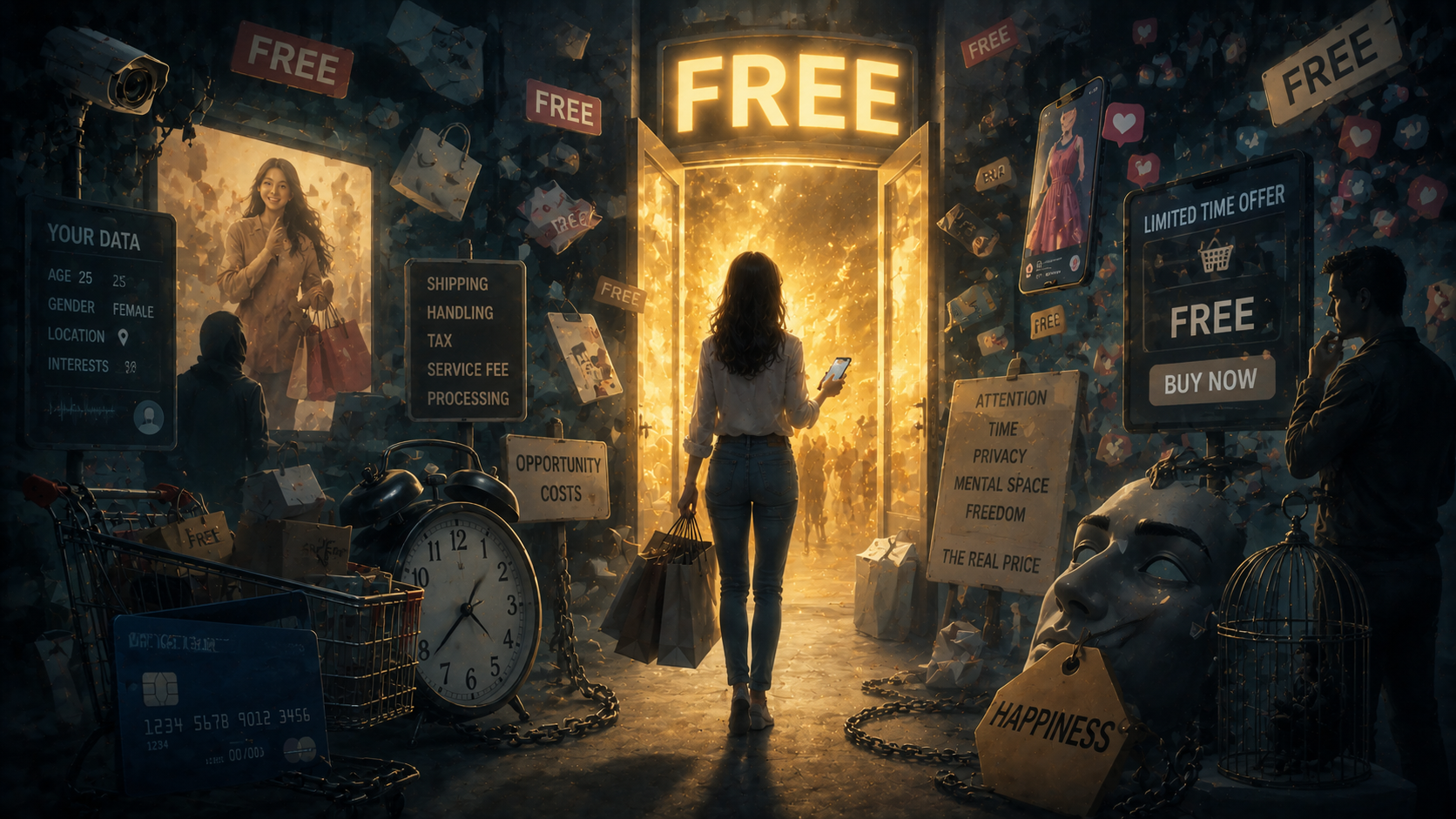
What disappears as monetary cost can reappear as attention, data, time, or future commitment.
This does not mean that every free service is deceptive.
Many free products and services provide genuine value.
The important question is different:
What am I giving in return?
Sometimes the answer really is very little.
Sometimes the cost is simply hidden somewhere other than the price tag.
4. When “Free” Enters Social Relationships
There is another kind of free offer that operates through a somewhat different psychological mechanism.
Imagine walking through a store and receiving a free sample from a salesperson.
After accepting it, you may suddenly feel slightly more inclined to listen to the sales pitch—or even purchase something.
Here the effect is not simply the attraction of a zero price.
It can also involve what psychologist Robert Cialdini describes as the principle of reciprocity: when someone gives us something, we often feel an impulse to give something back.
A gift therefore carries psychological meaning even when no repayment has been requested.
This helps explain why free samples, complimentary trials, and small promotional gifts can be commercially effective.
The product costs us nothing.
But receiving it may subtly change the relationship between giver and receiver.
5. How Can We Think More Clearly About “Free”?
We live surrounded by free trials, free shipping, free apps, free samples, and free content.
There is nothing inherently wrong with enjoying them.
The challenge is simply to prevent the word FREE from ending our thinking.
Three questions can help:
- Would I want this if it were not free?
- What am I giving up besides money—time, attention, data, or future commitment?
- Am I choosing this because it is valuable to me, or because zero makes it feel valuable?
These questions do not eliminate the psychological attraction of free.
But they restore something important: a moment of reflection between the offer and the decision.
Conclusion
The most interesting thing about “free” is not that it saves us money.
It is that zero can change the way value itself feels.
A product we barely wanted can suddenly become attractive. A shipping fee we could easily afford can persuade us to spend even more. A small gift can create an unexpected sense of obligation.
This does not mean that free offers are traps.
Sometimes free really is a good deal.
But perhaps the wisest response is to remember the question I should have asked when that free-shipping message appeared on my screen:
If this were not free, would I still want it?
The moment we ask that question, zero loses some of its magic.
And our decision becomes ours again.
A Question for You
Have you ever bought something unnecessary
simply because a “free” offer made it feel worthwhile?
Related Reading
Everyday experiences of perceived value, delay, and fairness are also discussed in The Sociology of Waiting in Line.
At a political level, this economic logic feeds into debates about freedom and responsibility in The Minimal State: An Ideal of Liberty or a Neglect of the Common Good?
Human decision-making is deeply influenced by reward systems and emotional reinforcement.
Why Is Candy a Symbol of Reward for Children? explores how simple rewards shape behavior and emotional expectation from an early age.
References
- Ariely, D. (2008). Predictably Irrational: The Hidden Forces That Shape Our Decisions.
Explains the “zero price effect” and how free offers distort rational decision-making. - Cialdini, R. B. (2006). Influence: The Psychology of Persuasion.
Introduces the principle of reciprocity and why people feel compelled to respond to free gifts. - Shampanier, K., Mazar, N., & Ariely, D. (2007).
Zero as a Special Price: The True Value of Free Products. Marketing Science, 26(6), 742–757.
Empirically demonstrates why free products trigger emotional rather than rational responses.