Tag: productivity culture

  • Why Do We Always Feel Busy? The Social Pressure of Time

    “I have no time.”

    “Today flew by.”

    “I didn’t even get a moment to rest this weekend.”

    Most of us say these things almost automatically.
    Yet, when we look closely, our schedules are not always as full as our exhaustion suggests.

    So a question arises:
    Why do we feel busy even when we are not doing that much?


    1. Time Is a Feeling: Psychological Time vs. Clock Time
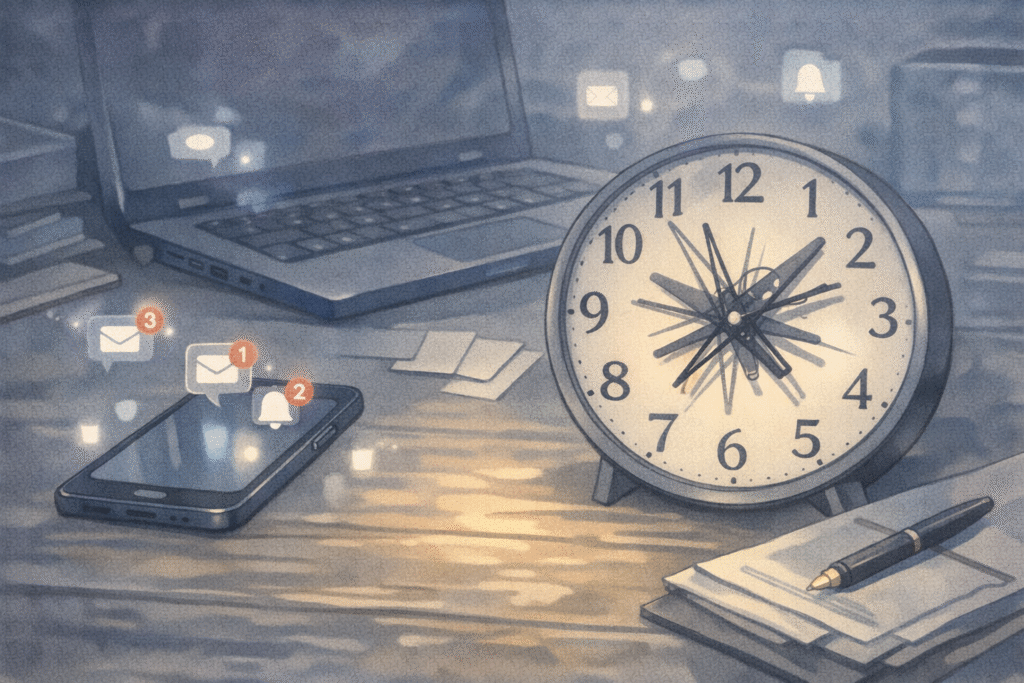
    Fragmented time and constant distractions in modern life

    1.1 The Difference Between Measured and Lived Time

    The time we experience is not the same as the time measured by clocks.
    Psychologists distinguish between physical time and perceived time.

    An hour spent watching a favorite movie can pass in an instant, while ten minutes of worrying about unfinished tasks can feel unbearably long.

    1.2 Why Modern Time Feels Fragmented

    Our sense of time is shaped by emotion, attention, and environment.
    Constant notifications, emails, messages, and social media alerts repeatedly interrupt our focus.

    Even without completing many tasks, our attention becomes fragmented.
    As a result, the day feels scattered, unproductive, and exhausting — leaving us with the impression that we were “busy” all along.


    2. Saying “I’m Busy” as Social Self-Defense

    2.1 Busyness as a Social Signal

    When asked, “How are you doing?”, many people instinctively answer, “I’m busy.”

    This response is not just a factual update.
    Psychologists describe it as a form of social self-presentation.

    Busyness as a social identity in everyday life

    2.2 When Busyness Equals Competence

    In competitive societies, busyness is often equated with usefulness and capability.
    To appear busy is to appear productive, valuable, and responsible.

    Conversely, appearing relaxed or unoccupied can feel risky — as if it signals laziness or irrelevance. Over time, we internalize this script and begin to believe we are busy even when we are not.


    3. More “Shoulds” Than Actual Tasks

    3.1 The Pressure to Always Be Doing Something

    We may not have many urgent tasks, but our minds are filled with things we feel we should be doing.

    Scrolling through social media can trigger thoughts like:
    “Everyone else is exercising.”
    “Everyone else is improving themselves.”
    “I should be doing more.”

    3.2 FOMO and Constant Mental Tension

    This pressure is closely linked to FOMO (Fear of Missing Out).
    Even without taking action, we remain mentally alert, comparing ourselves and anticipating future demands.

    The result is a constant state of tension — a feeling of being chased by time without actually moving.


    4. “Time Is Money”: Addiction to Efficiency

    4.1 When Every Moment Must Be Useful

    From an early age, many of us learn that time should never be wasted.
    This belief, rooted in industrial and capitalist values, turns time into a resource that must always generate value.

    Even rest is evaluated:
    “Is this productive rest?”
    “Is this helping me improve?”

    4.2 When Efficiency Becomes Exhausting

    An efficiency-centered view of time makes stillness uncomfortable.
    It keeps us asking, “Am I doing enough?” — a question that never truly ends.

    In this way, busyness becomes less about tasks and more about identity.


    Conclusion: Recovering Slowness

    Quiet moment of slowing down without productivity pressure

    Feeling busy is not simply a scheduling problem.
    It is a psychological state shaped by social expectations, time culture, and self-worth.

    The solution, therefore, is not only to reduce tasks, but to rethink how we relate to time.

    Allowing moments where nothing needs to be done.
    Accepting rest as a meaningful outcome.
    Remembering that moving slowly does not mean falling behind.

    These small shifts can loosen the grip of constant busyness.

    If you feel busy all the time, today, being slow is allowed.

    Related Reading

    The social construction of productivity is analyzed in Sleep: A Fundamental Human Right or a Tool for Productivity?Sleep: A Fundamental Human Right or a Tool for Productivity?, which challenges the moralization of efficiency.

    A structural perspective on modern comparison culture appears in How Social Media Amplifies Feelings of Lack and ComparisonHow Social Media Amplifies Feelings of Lack and Comparison, highlighting how digital environments intensify temporal anxiety.


    References

    1.Rosa, H. (2013). Social Acceleration: A New Theory of Modernity. New York: Columbia University Press.
    Rosa analyzes how modern societies experience constant acceleration, showing that feelings of time pressure are rooted in structural and cultural change rather than individual failure.

    2.Southerton, D. (2009). “Re-ordering Temporal Rhythms: Coordinating Daily Practices in the UK.” Time & Society, 18(1), 91–113.
    This study examines how social scheduling and fragmented daily rhythms contribute to chronic feelings of busyness and time scarcity.

    3.Wajcman, J. (2015). Pressed for Time: The Acceleration of Life in Digital Capitalism. Chicago: University of Chicago Press.
    Wajcman explores how digital technologies reshape attention and time perception, explaining why modern individuals feel increasingly busy despite technological convenience.


  • Sleep: A Fundamental Human Right or a Tool for Productivity?

    A person resting peacefully at night, symbolizing sleep as a fundamental human right

    A question raised in the age of efficiency

    Global temperatures are not the only thing rising in modern society—so are working hours, performance pressure, and expectations of constant availability.
    In this context, sleep is no longer taken for granted. It is measured, optimized, shortened, and often sacrificed.

    This raises a fundamental question:
    Is sleep a natural human right, or merely a tool for maximizing productivity?

    This tension is not new. More than a century ago, the Swiss philosopher and legal scholar Karl Hilty (1833–1909) warned against a life dominated by relentless activity and efficiency. His reflections on sleep offer a powerful lens through which to examine our present condition.


    1. Karl Hilty and the philosophical meaning of sleep

    1.1 Sleep as a foundation of moral life

    Karl Hilty, best known for his writings on happiness and practical wisdom, believed that a meaningful life begins with respecting fundamental human needs.
    For him, sleep was not a mere biological function. It was a moral and spiritual necessity.

    Hilty argued that without sufficient rest, human beings lose emotional balance, ethical clarity, and inner freedom. Fatigue, in his view, dulls moral judgment and erodes character.

    1.2 A growing tension in modern society

    In contrast, contemporary society treats sleep as something to be managed rather than respected.
    Smartwatches track sleep cycles, apps quantify sleep quality, and individuals are encouraged to function on minimal rest while maintaining peak performance.

    In this shift, sleep becomes caught between two competing interpretations:

    • a natural human right, or
    • a resource to be optimized for productivity.

    2. Hilty’s position: Sleep as a natural right

    Hilty famously described sleep as “one of God’s greatest gifts to humanity.”
    This perspective frames sleep not as indulgence, but as an essential condition for a dignified human life.

    2.1 Physical and psychological restoration

    Adequate sleep restores both body and mind.
    Hilty warned that chronic sleep deprivation leads not only to physical illness but also to irritability, poor judgment, and ethical decline.

    2.2 Inner peace and spiritual balance

    For Hilty, nighttime rest allowed the human soul to regain equilibrium. Sleep prepared individuals for reflection, self-control, and moral responsibility.

    2.3 An inalienable human right

    From this standpoint, sleep cannot be subordinated to economic or social demands.
    It is a natural right, inseparable from human dignity and therefore not subject to negotiation.


    3. The modern view: Sleep as a tool of productivity

    Smart devices measuring sleep, representing productivity-driven sleep management

    In contemporary capitalist societies, however, sleep is increasingly framed as a variable to be controlled.

    3.1 The ideology of performance

    Popular narratives suggest that “successful people sleep less.”
    Wakefulness is celebrated as discipline, while sleep is portrayed as inefficiency.

    This logic transforms sleep into a sacrifice rather than a right.

    3.2 The rise of the sleep industry

    Ironically, as sleep is shortened, it has also become commodified.
    Sleep medications, tracking devices, and optimization programs turn rest into a marketable product—one that must be purchased back.

    3.3 Self-optimization culture

    Morning routines, productivity hacks, and biohacking trends reinforce the idea that sleep exists primarily to fuel work.
    Rest becomes valuable only insofar as it enhances output.


    4. The core conflict: Right versus instrument

    At the heart of this debate lies a philosophical clash:

    • Rights-based view:
      Sleep is essential to moral agency, mental health, and human dignity.
    • Instrumental view:
      Sleep is a means to economic efficiency and personal achievement.

    The question is unavoidable:
    Do we respect sleep as part of what it means to be human, or do we treat it as a tool to be engineered?


    5. Contemporary implications

    5.1 Sleep as a social responsibility

    Organizations such as the International Labour Organization (ILO) and the World Health Organization (WHO) warn that chronic sleep deprivation violates basic human rights.
    Long working hours and insufficient rest are increasingly recognized as structural, not individual, problems.

    5.2 The need for balance

    Productivity cannot be ignored. Yet reducing human beings to machines optimized for output risks erasing what makes life meaningful.

    5.3 Hilty’s enduring question

    Hilty’s philosophy leaves us with a profound inquiry:
    Do we sleep merely to work better tomorrow, or to live more deeply today?

    An individual standing between rest and work, symbolizing the ethical debate on sleep

    Conclusion: Sleep at the crossroads of humanity

    Karl Hilty’s reflections remind us that sleep is not a luxury, nor a weakness.
    It is a cornerstone of ethical life and inner freedom.

    Modern society, however, increasingly treats sleep as a tool to be managed in service of productivity.

    The question therefore remains open—and urgent:

    Is sleep a fundamental human right, or a resource to be optimized?

    How we answer this question will shape not only our sleeping habits, but our understanding of what it means to be human.


    Related Reading

    The culture of acceleration and digital exhaustion is analyzed in Digital Aging: When Technology Moves Faster Than We Do, reflecting on how technological tempo alters human rhythms.

    The existential dimension of rest and reflection emerges in A Night Sky Narrative — A Quiet Story Told by Starlight, where slowing down becomes a philosophical act.

    References

    1. Hilty, K. (1901/2002). Happiness: Essays on the Meaning of Life. Kessinger Publishing.
      → A foundational text outlining Hilty’s philosophy of simplicity, rest, and moral life, offering deep insight into his view of sleep as a human necessity.
    2. Williams, S. J. (2011). Sleep and Society: Sociological Ventures into the (Un)known. Routledge.
      → Examines sleep as a social and cultural phenomenon, exploring its transformation from a private need into a managed social practice.
    3. Wolf-Meyer, M. J. (2012). The Slumbering Masses: Sleep, Medicine, and Modern American Life. University of Minnesota Press.
      → Analyzes how sleep has become medicalized and regulated in modern society, contrasting sharply with humanistic perspectives like Hilty’s.
    4. Kushida, C. A. (Ed.). (2007). Sleep Deprivation: Clinical Issues, Pharmacology, and Sleep Loss Effects. CRC Press.
      → Provides scientific evidence on the physical and psychological consequences of sleep deprivation, supporting arguments for sleep as a fundamental right.
    5. Crary, J. (2013). 24/7: Late Capitalism and the Ends of Sleep. Verso Books.
      → A critical examination of how late capitalism erodes sleep, framing rest as one of the last frontiers of resistance against total productivity.