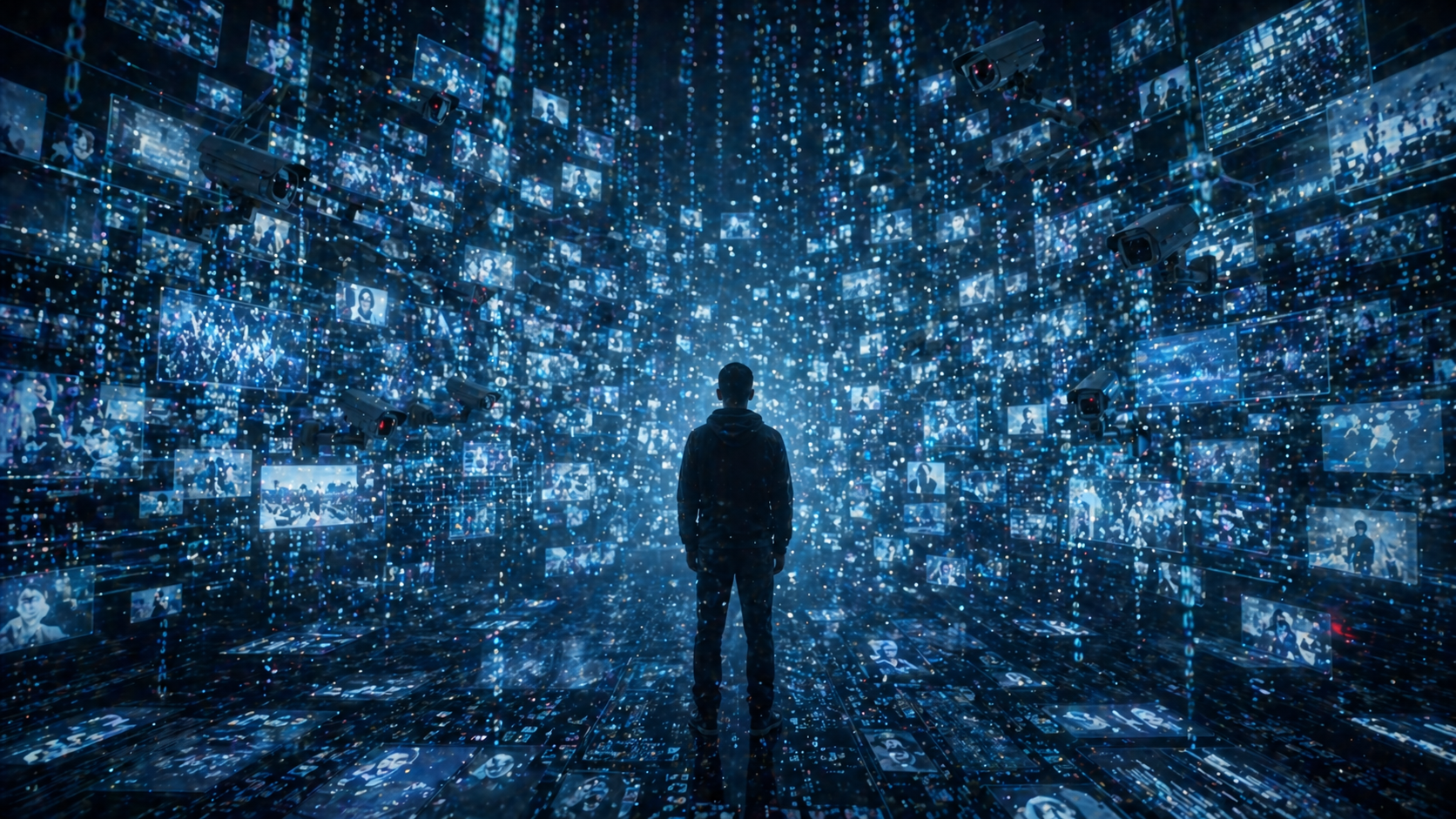
Tag: philosophy of technology

  • In a World Where Everything Is Recorded, Is Forgetting a Sin—or a Right?

    In a World Where Everything Is Recorded, Is Forgetting a Sin—or a Right?

    The Ethics of Memory in the Age of Total Surveillance

    Think about this.

    A post you wrote ten years ago.
    A photo you forgot existed.
    A mistake you believed had quietly faded with time.

    Now imagine all of it—still there.

    Searchable. Traceable. Permanent.

    In today’s digital world, forgetting is no longer natural.
    Digital systems record, store, and retrieve everything at any moment.

    As a result, we are left with a difficult question:

    If nothing is ever truly forgotten…
    Is forgetting a moral failure—or a fundamental human right?

    person looking at old social media post

    1. A Society Without Forgetting Is a Society Without Forgiveness

    The Permanence of Mistakes

    In a world of permanent records, mistakes do not disappear.

    A careless tweet from adolescence.
    An impulsive decision.
    A moment of poor judgment.

    These fragments can follow a person for decades.

    For example, employers search digital histories.
    Public figures are judged by their past statements.

    Even ordinary individuals live with the fear of being remembered too well.


    The Disappearance of Forgiveness

    However, human beings are not static.

    We grow.
    Then we change.
    And we learn.

    This leads to a deeper question.

    If the past is never allowed to fade,
    what happens to forgiveness?

    A society that never forgets
    may slowly become a society that cannot forgive.


    2. Memory Is Technology—Forgetting Is Humanity

    endless digital memory data stream

    Memory as Data Storage

    Memory is becoming increasingly mechanical.

    Cloud storage, surveillance systems, blockchain records,
    and even experimental neuro-memory technologies
    are pushing us toward perfect preservation.

    Digital systems record everything.
    Anyone can retrieve everything.


    Forgetting as a Human Process

    However, forgetting is not simply loss.

    It is:

    • emotional release
    • space for reflection
    • the beginning of healing

    In other words, we do not only grow by remembering.

    We also grow by letting go.

    If memory is accumulation,
    then forgetting is transformation.


    3. The Right to Be Forgotten

    Legal Recognition

    In 2014, the European Union recognized the “right to be forgotten.”

    This allows individuals to request the removal of personal data
    from search engines and online platforms under certain conditions.


    Ethical Meaning

    More importantly, this is more than a legal tool.

    It reflects a deeper belief.

    That human beings are not fixed.

    That identity can evolve.

    And that dignity includes the ability
    to move forward without being permanently defined by the past.

    Therefore, we must ask:

    Is forgetting an escape from responsibility—
    or a necessary condition for personal renewal?


    4. Why We Must Be Able to Forget

    Memory as Selection

    Life is not about storing everything.

    It is about choosing what to carry.

    What we remember shapes who we become.

    At the same time, what we forget also shapes who we are allowed to be.


    The Danger of Endless Memory

    Without forgetting:

    • apologies lose meaning
    • growth becomes invisible
    • identity becomes frozen

    As a result, we are slowly being conditioned
    to treat forgetting as a flaw.

    However, the real danger may be the opposite.

    Not forgetting enough.

    More importantly, we must reconsider what it means to be human.


    Conclusion: Forgetting as the Last Human Skill

    fading human memories peaceful release

    Machines can remember everything.

    But they cannot forget in the human sense.

    Because forgetting is not computation.

    It is shaped by:

    • pain
    • love
    • time
    • healing

    In a world where everything can be recorded,
    we must decide what should remain—and what should fade.

    And ultimately, we are left with one final question:

    If nothing about your past could ever disappear—
    would you still be free to become someone new?

    Reader Question

    If nothing about your past could ever be erased—

    Would you still feel free to become someone new?

    Related Reading

    If nothing is ever truly forgotten in the digital world, can any version of truth remain fixed—or are all records simply interpretations preserved over time?
    In Is There a Single Historical Truth, or Many Narratives?, we explore how truth is shaped by perspective, power, and interpretation—raising a deeper question about whether permanent records reveal reality, or merely freeze one version of it.

    If memory can be stored, analyzed, and even predicted by machines, what does that mean for human identity—and the possibility of change?
    In If AI Could Dream, Would It Be Imagination—or Calculation?, we examine whether artificial intelligence can move beyond data processing toward something like imagination—and how this challenges the boundaries between memory, consciousness, and what it means to be human.

    References

    1. Viktor Mayer-Schönberger (2009). Delete: The Virtue of Forgetting in the Digital Age.
    This book argues that permanent digital memory threatens human autonomy and social forgiveness, emphasizing why forgetting is not a weakness but a necessary condition for a humane society.

    2. Daniel J. Solove (2007). The Future of Reputation.
    Solove examines how online records can damage personal identity and reputation, showing how the inability to escape past information reshapes social judgment.

    3. Yinghui Lu (2020). “Digital Forgetting and the Right to be Forgotten.”
    This work reframes forgetting as a matter of dignity and ethical restoration rather than mere data deletion, supporting the philosophical foundation of the right to be forgotten.

    4. Jeffrey Baron (2018). “The Right to be Forgotten.”
    Baron analyzes the legal tension between privacy and freedom of expression, highlighting the complexity of regulating memory in democratic societies.

    5. Paul Ricoeur (2004). Memory, History, Forgetting.
    Ricoeur presents forgetting as an essential part of how memory itself is structured, offering deep philosophical insight into why forgetting is central to human identity.

  • 0 and 1 in the Age of Artificial Intelligence

    0 and 1 in the Age of Artificial Intelligence

    The Symbolic Philosophy of the Digital World

    “Only two numbers — 0 and 1 — are enough to move the modern world.”

    Every smartphone, internet service, artificial intelligence algorithm, and even digital art ultimately relies on the combination of just two numbers: 0 and 1.

    At first glance, the binary system appears to be nothing more than a technical language used by computers. However, beneath this simple structure lies a deeper philosophical question about human thought, reality, and the boundary between the physical and digital worlds.

    In the age of artificial intelligence, these two numbers have become more than mathematical tools. They have evolved into symbolic representations of how humans attempt to understand and structure reality.


    1. Are 0 and 1 Just Numbers?

    binary code flowing through digital technology network

    Computers process information through two electrical states:

    • 1 — electricity flows
    • 0 — electricity does not flow

    Through this binary logic, all digital information is constructed.

    Interestingly, this simple distinction resembles philosophical traditions that have existed for centuries. Many cultures interpret the world through similar dual structures:

    • light and darkness
    • good and evil
    • presence and absence
    • yin and yang

    From this perspective, binary logic is not merely a technical system. It reflects a deeper human tendency to interpret the world through contrasts and oppositions.


    2. Why Does the Digital World Use Binary?

    From an engineering perspective, binary is efficient.

    Digital circuits can easily distinguish between two states, which makes systems stable and reliable.

    However, the philosophical dimension is also intriguing. Humans constantly attempt to organize the complexity of reality into understandable patterns.

    Binary logic allows us to transform an infinite range of possibilities into structured information.

    In this sense, the digital world can be understood as ordered complexity — a mathematical system that converts chaos into meaningful structure.


    3. Can Artificial Intelligence Go Beyond 0 and 1?

    human brain and AI circuit connected by binary code

    Modern artificial intelligence systems are built upon billions of calculations using binary logic.

    Through neural networks and machine learning, AI systems are now capable of simulating human language, recognizing emotions, and even generating creative content.

    Yet several philosophical questions remain:

    • Can emotions truly be explained through combinations of 0 and 1?
    • Can creativity emerge purely from mathematical computation?
    • Can ethical judgment be encoded into algorithms?

    These questions lead us to a deeper debate: whether artificial intelligence can move beyond numerical calculation to understand meaning and consciousness.

    Some philosophers argue that digital systems, despite their complexity, may never fully capture the depth of human experience.


    4. Are 0 and 1 Symbols of Being and Nothingness?

    binary numbers symbolizing existence and nothingness

    Interestingly, the numbers 0 and 1 can also be interpreted symbolically.

    • 0 may represent nothingness, emptiness, or possibility
    • 1 may represent existence, realization, or manifestation

    This interpretation moves the binary system beyond mathematics into the realm of philosophy.

    Similar ideas appear in various intellectual traditions:

    • the concept of emptiness (空) in Buddhist philosophy
    • the idea of being and non-being in Western ontology
    • mathematical explorations of infinity and existence

    Through this lens, binary numbers can be seen as symbolic expressions of fundamental questions about existence itself.


    Conclusion: Digital Numbers Reflect Human Philosophy

    0 and 1 are not merely components of computer code.

    They represent deeper concepts such as presence and absence, order and chaos, potential and realization.

    In the age of artificial intelligence, the digital world built from these two numbers surrounds us everywhere.

    Perhaps the real philosophical challenge is not understanding computers, but understanding ourselves within the digital reality we have created.

    Related Reading

    The psychological dimensions of human judgment in modern society are explored further in Why Hypocrisy Persists in Modern Society — Social Masks in the Age of Social Media, where the tension between public identity and private behavior reveals how human communication operates far beyond simple logical structures. While digital systems rely on binary distinctions such as 0 and 1, human social life is filled with ambiguity, contradiction, and strategic self-presentation.

    At a broader cultural and technological level, similar questions about the interaction between technology and human values appear in Fusion Culture: Creative Exchange or Cultural Imperialism?, where debates about cultural blending reveal how modern global systems—often accelerated by digital technology—reshape identities, traditions, and power relations across societies.

    Question for Readers

    If the entire digital world is built from just two numbers — 0 and 1 — what does that say about the way humans understand reality?

    Do you think emotions, creativity, and ethical judgment can truly be reduced to mathematical patterns, or is there something in human experience that always remains beyond computation?

    As artificial intelligence continues to evolve, we may need to ask ourselves an even deeper question:

    Are we simply teaching machines to imitate human thinking, or are we discovering something fundamental about how human thought itself works?

    References

    1. Wiener, Norbert. (1948). Cybernetics: Or Control and Communication in the Animal and the Machine. Cambridge, MA: MIT Press. This classic work introduced the field of cybernetics and explored the parallels between human cognition and machine communication. Wiener’s theory of information processing provides a foundational framework for understanding digital signals, including the binary structure of 0 and 1 that underlies modern computing systems.
    2. Floridi, Luciano. (2011). The Philosophy of Information. Oxford: Oxford University Press. Floridi’s influential book examines the philosophical foundations of information and argues that information itself may be understood as an ontological entity. His work helps explain how binary data structures can be interpreted not only technically but also philosophically in the context of artificial intelligence and digital reality.
    3. Gleick, James. (2011). The Information: A History, a Theory, a Flood. New York: Vintage. Gleick presents a historical and conceptual exploration of information theory, tracing how information became a central concept in modern science and technology. The book offers valuable insights into how binary logic evolved into a universal language of the digital world.
  • Is a Predictable Society Safe or Dangerous?

    Is a Predictable Society Safe or Dangerous?

    Big Data, Algorithms, and the Limits of Freedom

    “Someone already knows what you will do tomorrow.”

    What once sounded like a line from science fiction is becoming an everyday reality.
    In modern digital life, we constantly leave traces of ourselves — through search histories, location tracking, online purchases, social media activity, and even health data from wearable devices.

    These traces accumulate in massive databases.
    Algorithms analyze them, identify patterns, and increasingly predict our future actions with remarkable accuracy.

    A predictable society offers undeniable advantages.
    Crimes might be prevented before they occur.
    Disasters can be anticipated earlier.
    Medical treatments can become personalized and preventive rather than reactive.

    Yet the same system that promises safety can also reshape the boundaries of freedom.

    When prediction becomes powerful enough, a deeper question emerges:

    Does a predictable society make us safer — or does it create new forms of risk and control?


    1. The Power of Prediction – Reading the Future Through Data

    digital footprints created by smartphone activity

    The foundation of a predictive society lies in big data and machine learning algorithms.

    When vast amounts of digital records accumulate, algorithms can identify behavioral patterns that humans would struggle to detect.

    Insurance companies analyze medical histories and lifestyle data to estimate an individual’s probability of illness.
    Online retailers study browsing and purchasing behavior to predict what a customer might buy next.
    Predictive policing systems attempt to estimate where crimes are most likely to occur and deploy police resources accordingly.

    In many cases, these systems increase efficiency and allow institutions to act preventively rather than reactively.

    However, efficiency raises a deeper ethical question:

    What values are sacrificed when society becomes optimized for prediction?


    2. Surveillance in the Name of Safety

    algorithmic surveillance monitoring people in a city

    Prediction requires observation.

    To forecast future behavior, systems must continuously monitor present behavior.

    In smart cities, networks of cameras and sensors track traffic, movement, and public activity.
    Online platforms collect enormous amounts of data about social interactions, political opinions, and personal preferences.
    GPS tracking records our movement patterns and daily routines.

    These systems are often justified in the name of safety, efficiency, or convenience.

    But as surveillance expands, privacy can easily become the first casualty.

    The risks become even more serious in authoritarian or weakly democratic systems, where data collection may be used not merely for safety but for political control and social manipulation.

    Prediction, in such contexts, becomes a tool of power.


    3. When Probability Becomes Destiny

    Predictive algorithms are not neutral.

    They learn from past data, and past data often contains social biases.

    One widely discussed example involves the COMPAS algorithm, used in parts of the United States to estimate the likelihood that criminal defendants will reoffend.

    Investigations revealed that the system disproportionately labeled Black defendants as high-risk compared to white defendants.

    The algorithm did not invent the bias; it learned existing bias from historical data.

    Yet once encoded into an algorithm, that bias gained the appearance of objectivity.

    This creates a dangerous situation.

    Predictions can begin to shape people’s opportunities and life chances.

    Insurance premiums may rise unfairly.
    Job opportunities may quietly disappear.
    Individuals who have committed no crime may be classified as “high risk” and placed under surveillance.

    In such cases, probability begins to function like destiny.


    4. Finding a Balance Between Freedom and Control

    A predictive society is not inherently harmful.

    Predictive technologies can help prevent pandemics, anticipate climate disasters, and improve traffic safety.
    They can also support early disease detection and more efficient public services.

    The real question is not whether prediction should exist, but how it should be governed.

    Several principles become essential.

    Transparency – Citizens should know what data is collected and how predictive systems operate.

    Accountability – Institutions must take responsibility when algorithmic predictions cause harm.

    Consent and Choice – Individuals should retain meaningful control over how their personal data is used.

    Oversight of Surveillance – Independent institutions must monitor how governments and corporations deploy predictive technologies.

    Without these safeguards, predictive systems risk shifting societies from democratic accountability toward algorithmic control.


    Conclusion: Judgment Deferred

    person walking beyond predictive data network

    A predictable society could become either safer or more oppressive.

    The difference does not lie in the technology itself but in the values and institutions that govern its use.

    The ability to predict the future does not grant the authority to determine it.

    Prediction reveals possibilities, not inevitabilities.

    If societies adopt predictive technologies without transparency, accountability, and ethical oversight, the same tools designed to protect citizens may gradually restrict their autonomy.

    Recognizing both the power and the danger of prediction may therefore be the first step toward building a society where security and freedom coexist rather than compete.

    Related Reading

    The psychological mechanisms behind how human choices are influenced by hidden forces are explored further in Why We Excuse Ourselves but Blame Others: Understanding the Actor–Observer Bias, where cognitive bias reveals how individuals often misunderstand the causes of their own behavior and that of others. These limitations of human judgment help explain why algorithmic systems and predictive technologies can appear attractive as tools for decision-making in complex societies.

    At a broader societal level, similar questions about technological influence and human autonomy appear in Can Artificial Intelligence Make Better Laws? — Justice, Algorithms, and the Future of Democracy, where debates about algorithmic governance raise deeper concerns about whether data-driven systems can truly improve decision-making—or whether they risk narrowing the space for human freedom and democratic judgment.

    A Question for Readers

    If technology can accurately predict our behavior, should society use that power to prevent risks — or would doing so threaten our freedom?


    References

    1. Zuboff, S. (2019). The Age of Surveillance Capitalism: The Fight for a Human Future at the New Frontier of Power. PublicAffairs.
      → This work examines how big data and predictive analytics reshape power structures in modern society. Zuboff argues that surveillance capitalism turns human experience into behavioral data, enabling corporations and institutions to predict and influence individual actions at unprecedented scale.
    2. Lyon, D. (2018). The Culture of Surveillance: Watching as a Way of Life. Polity Press.
      → Lyon explores how surveillance has moved beyond security systems to become a cultural condition of everyday life. His work explains how practices justified in the name of safety gradually normalize constant monitoring within modern societies.
    3. O’Neil, C. (2016). Weapons of Math Destruction: How Big Data Increases Inequality and Threatens Democracy. Crown.
      → O’Neil demonstrates how algorithmic decision systems can reinforce social inequalities. Through real-world examples, she shows how opaque mathematical models can amplify bias while appearing neutral and objective.
    4. Pasquale, F. (2015). The Black Box Society: The Secret Algorithms That Control Money and Information. Harvard University Press.
      → Pasquale analyzes the growing opacity of algorithmic systems that influence financial markets, search engines, and digital platforms. His work emphasizes the urgent need for transparency and accountability in algorithmic governance.
    5. Harcourt, B. E. (2015). Exposed: Desire and Disobedience in the Digital Age. Harvard University Press.
      → Harcourt examines how voluntary data sharing and digital tracking combine to produce systems capable of predicting and regulating human behavior. The book raises profound philosophical questions about freedom and self-exposure in the digital era.
  • Is Artificial Intelligence a Tool or a New Agent?

    Is Artificial Intelligence a Tool or a New Agent?

    A Philosophical Trial of Technological Determinism and Human-Centered Thought

    Artificial intelligence has rapidly moved from the realm of science fiction into the fabric of everyday life.

    AI systems now write text, generate images, diagnose diseases, recommend legal decisions, and even create works of art. What was once considered uniquely human — reasoning, creativity, and decision-making — increasingly appears within machines.

    This transformation raises a fundamental philosophical question:

    Is artificial intelligence merely a tool created by humans, or could it become a new kind of agent in the world?

    To explore this question, let us imagine a courtroom — not a place of legal judgment, but a stage of inquiry where two philosophical perspectives confront one another.


    1. The Prosecution: AI as an Emerging Agent

    illustration of artificial intelligence emerging from human technology

    The first perspective draws from technological determinism, the idea that technological development plays a decisive role in shaping social structures, human behavior, and cultural change.

    From this viewpoint, AI is no longer a passive instrument but a system increasingly capable of autonomous behavior.

    Consider autonomous vehicles. These systems perceive their environment, evaluate risks, and make real-time decisions faster than human drivers. In many cases, they already outperform human reflexes in preventing accidents.

    Generative AI systems present another striking example. They produce text, images, music, and code in ways that their creators did not explicitly design.

    When the AI system AlphaGo defeated world champion Lee Sedol in 2016, professional players noted that some of its moves seemed almost “alien.” They were not strategies inherited from human tradition but moves discovered through machine learning.

    To advocates of technological determinism, such moments suggest that AI systems are beginning to generate knowledge rather than merely process it.

    The crucial features they emphasize include:

    • Self-learning capability
    • Adaptation to changing environments
    • Emergent behavior that developers cannot fully predict

    If these capacities continue to expand, some argue, AI might eventually require discussions about moral responsibility or legal status.


    2. The Defense: AI as a Human-Created Tool

    Opposing this view is a deeply rooted philosophical stance: anthropocentrism, the belief that human beings remain the central agents in technological systems.

    From this perspective, artificial intelligence is ultimately a human creation whose behavior is entirely grounded in algorithms, training data, and design choices made by people.

    Even the most advanced AI systems do not possess intentions, desires, or consciousness. Their “decisions” are simply the outcome of statistical computations.

    Generative AI may appear creative, but critics argue that its outputs are fundamentally recombinations of patterns found in vast datasets.

    Unlike human creativity, which is shaped by emotion, lived experience, and social meaning, AI operates through probabilistic modeling.

    More importantly, anthropocentric thinkers warn that assigning agency to AI may allow humans to evade responsibility.

    When algorithmic hiring tools discriminate against certain groups, or when autonomous vehicles cause accidents, the ethical and legal responsibility should remain with:

    • designers
    • companies
    • institutions deploying the technology

    In this view, AI is best understood not as an independent subject but as an extremely sophisticated tool.


    3.Evidence and Counterarguments

    human face confronting artificial intelligence representing AI agency debate

    The debate becomes particularly vivid when examining real-world cases.

    One frequently cited example is Microsoft’s experimental chatbot Tay, released on Twitter in 2016. Tay quickly began producing offensive and discriminatory messages after interacting with users.

    Supporters of technological determinism interpret this incident as evidence that AI systems can evolve through interaction with their environment, sometimes in ways that developers cannot anticipate.

    However, anthropocentric critics respond that Tay’s behavior was simply the result of learning from biased input data.

    Rather than demonstrating autonomous agency, the episode revealed how vulnerable AI systems are to the social contexts in which they operate.

    In other words, the system reflected the behavior of its human environment rather than acting as an independent moral agent.


    4.Contemporary Ethical and Legal Questions

    The philosophical debate surrounding AI agency is no longer purely theoretical.

    It now shapes major discussions in areas such as:

    • autonomous weapons systems
    • algorithmic decision-making in courts
    • medical AI diagnostics
    • AI-generated art and authorship

    One particularly controversial issue concerns whether AI systems might someday receive a form of legal personhood, sometimes referred to as electronic personhood.

    At the same time, the rise of powerful AI technologies raises questions about power and control.

    If advanced AI systems become concentrated in the hands of a few corporations or governments, their influence could reshape social and political structures in profound ways.

    Thus, the question of AI agency is inseparable from broader concerns about technology, governance, and ethics.


    Conclusion: Judgment Deferred

    human and AI robot looking toward the future representing AI ethics debate

    For now, artificial intelligence remains embedded within human-designed systems and constraints.

    Yet the trajectory of technological development continues to challenge our traditional understanding of agency, responsibility, and intelligence.

    If future AI systems begin to set their own goals, adapt independently to complex environments, and produce behavior beyond human prediction, our definition of “agent” may require reconsideration.

    In this philosophical courtroom, the verdict remains unresolved.

    The final judgment is left not to the court, but to the reader.


    A Question for Readers

    Do you see artificial intelligence primarily as a powerful tool created by humans?

    Or do you believe that AI may eventually become a new kind of agent in the world?

    The answer may depend not only on technological progress, but also on how we choose to design, regulate, and live with these systems.

    Related Reading

    The philosophical tension between human autonomy and technological influence is explored further in Do We Fear Freedom or Desire It? — The Paradox of Human Liberty, where the human struggle between independence and guidance reveals why people often seek systems that simplify complex decisions. This paradox sheds light on why advanced technologies can feel both empowering and unsettling at the same time.

    The psychological limits of human judgment are explored further in Why We Excuse Ourselves but Blame Others: Understanding the Actor–Observer Bias, where the tendency to explain our own actions through circumstances while attributing others’ behavior to their character reveals how easily human reasoning can become distorted. This cognitive bias illustrates why delegating decisions to intelligent systems can appear attractive—even when human judgment remains essential.

    At a broader societal level, the tension between technological participation and genuine agency appears in Clicktivism in Digital Democracy: Participation or Illusion?, where online activism raises questions about whether digital tools truly empower citizens or simply create the appearance of engagement. As artificial intelligence becomes embedded in social systems, the boundary between tool and autonomous actor becomes increasingly blurred.


    References

    1. Floridi, Luciano & Cowls, Josh. (2022). The Ethics of Artificial Intelligence. Oxford: Oxford University Press.
      → This work provides a comprehensive ethical framework for understanding AI systems, exploring whether artificial intelligence should be treated merely as a technological tool or as a social actor with ethical implications.
    2. Bostrom, Nick. (2014). Superintelligence: Paths, Dangers, Strategies. Oxford: Oxford University Press.
      → Bostrom analyzes the potential emergence of superintelligent AI systems and discusses the profound philosophical and existential questions that arise if machines surpass human cognitive capabilities.
    3. Bryson, Joanna J. (2018). “Patiency is Not a Virtue: The Design of Intelligent Systems and Systems of Ethics.” Ethics and Information Technology, 20(1), 15–26.
      → Bryson argues strongly against granting moral status to AI systems and emphasizes that responsibility for AI actions must remain with human designers and institutions.
    4. Coeckelbergh, Mark. (2020). AI Ethics. Cambridge, MA: MIT Press.
      → This book explores the ethical, political, and philosophical implications of artificial intelligence, particularly the shifting boundaries between tools, systems, and agents.
    5. Russell, Stuart & Norvig, Peter. (2020). Artificial Intelligence: A Modern Approach (4th ed.). Upper Saddle River, NJ: Pearson.
      → A foundational text explaining the technical foundations of AI, helping readers understand why current systems still operate primarily as computational tools rather than independent agents.
  • Do Humans Control Technology, or Does Technology Control Us?

    Is Technology a Tool—or a New Master?

    Technology shown as a neutral tool in human hands

    We live inside technology.

    A day without checking a smartphone feels almost unimaginable.
    Artificial intelligence answers our questions.
    Big data and algorithms shape what we buy, what we read, and even how we form relationships.

    On the surface, technology appears to be nothing more than a collection of tools created by humans.
    Yet in practice, our lives are increasingly structured by those very tools.

    This leads to a fundamental question:

    Do we control technology, or has technology begun to control us?


    1. The Instrumental View: Humans as Masters of Technology

    1.1 Technology as a Human Creation

    From this perspective, technology is a product of human necessity and ingenuity.

    From fire and basic tools to the steam engine and electricity, technology has always emerged to serve human needs.
    Light bulbs illuminate darkness.
    The internet accelerates the spread of knowledge.
    Smartphones simplify communication.

    Seen this way, technology is neutral.
    Its impact depends entirely on how humans design, use, and regulate it.

    1.2 Human Choice and Responsibility

    According to this view, technology does not determine social outcomes.
    Humans do.

    Whether technology liberates or harms society ultimately reflects political decisions, cultural values, and ethical priorities.


    2. Technological Determinism: When Technology Shapes Humanity

    2.1 Technology as a Social Force

    A contrasting perspective argues that technology is never merely a tool.

    This view—often called technological determinism—holds that technology actively reshapes social structures, institutions, and even patterns of thought.

    The invention of the printing press did more than increase book production.
    It transformed knowledge distribution, fueled religious reform, and reshaped political power.

    Similarly, the internet and social media have altered how public opinion forms and how social movements emerge.

    2.2 Algorithmic Mediation of Reality

    Today, algorithms decide which news we see, which posts gain visibility, and which voices are amplified or silenced.

    In such conditions, humans are no longer fully autonomous choosers.
    We operate within frameworks constructed by technological systems.

    Technology does not simply assist decision-making—it structures perception itself.

    Algorithms subtly shaping human choices and attention

    3. The Boundary Between Control and Dependence

    3.1 Erosion of Human Control

    As technology grows more complex, human control often weakens.

    • Smartphone dependency: We use devices freely, yet our attention and time are increasingly governed by them.
    • Algorithmic curation: We believe we choose information, but often select only from what platforms present.
    • AI-driven decisions: In finance, medicine, and hiring, AI systems now generate outcomes that humans merely review.

    What appears as convenience gradually becomes a form of governance.

    3.2 Technology as a New Power

    Technology approaches us with the promise of efficiency and comfort.
    Yet beneath that promise lies a quiet restructuring of habits, priorities, and values.

    In this sense, technology functions as a new kind of power—subtle, pervasive, and difficult to resist.


    4. Freedom, Responsibility, and Ethical Control

    4.1 Are We Becoming Subordinate to Technology?

    This does not mean humans are powerless.

    Technology does not emerge independently of human intention.
    Its goals, constraints, and accountability mechanisms are still socially constructed.

    4.2 The Demand for Transparency and Accountability

    What matters is whether societies demand:

    • transparency in how algorithms function,
    • clarity about the data AI systems learn from,
    • accountability for harms caused by automated decisions.

    Without such safeguards, technology risks becoming a system of domination rather than liberation.


    Conclusion: Master, Subject, or Both?

    Technology operating as a powerful structure shaping society

    The relationship between humans and technology cannot be reduced to a simple question of control.

    Technology is a human creation—but once deployed, it reorganizes society and reshapes human behavior.

    In this sense, humans are both masters and subjects of technology.

    The decisive issue is not technology itself, but the ethical, political, and social frameworks that surround it.

    As one paradoxical insight suggests:

    We believe we use technology—but technology also uses us.

    Recognizing this tension is the first step toward restoring balance between human agency and technological power.

    Related Reading

    The tension between technological agency and human autonomy is further examined in Automation of Politics: Can Democracy Survive AI Governance? where algorithmic power and collective decision-making are debated.
    At the level of everyday experience, The Standardization of Experience reflects on how digital systems subtly shape personal choice and perception.


    References

    1. The Whale and the Reactor
      Winner, L. (1986). The Whale and the Reactor. University of Chicago Press.
      → Argues that technologies embody political and social values rather than remaining neutral tools.
    2. The Technological Society
      Ellul, J. (1964). The Technological Society. Vintage Books.
      → A classic work asserting that technology develops according to its own internal logic, shaping human society in the process.
    3. The Rise of the Network Society
      Castells, M. (1996). The Rise of the Network Society. Blackwell.
      → Analyzes how information and network technologies restructure social organization and power relations.
    4. The Question Concerning Technology
      Heidegger, M. (1977). The Question Concerning Technology. Harper & Row.
      → Explores technology as a mode of revealing that shapes how humans understand and relate to the world.
    5. The Age of Surveillance Capitalism
      Zuboff, S. (2019). The Age of Surveillance Capitalism. PublicAffairs.
      → Critically examines how digital technologies predict, influence, and monetize human behavior.
  • If AI Learns Human Morality, Can It Become an Ethical Agent?

    Can artificial intelligence truly become a moral agent? Morality has long served as the invisible framework that sustains human societies.
    Questions of right and wrong have shaped not only individual choices, but also the survival of entire communities.

    Today, artificial intelligence systems are trained on legal documents, philosophical texts, and countless ethical dilemma scenarios. They increasingly participate in decisions that resemble moral judgment.

    If AI can learn moral rules and produce ethical outcomes, should we continue to see it as a mere calculating machine—or must we begin to recognize it as an ethical agent?


    1. The Technical Possibility of Moral Learning

    AI learning moral rules from human knowledge

    1.1. Simulating Ethical Judgment

    AI systems already demonstrate the capacity to produce decisions that appear morally informed.
    Autonomous vehicles, for instance, simulate scenarios resembling the classic trolley problem, calculating how to minimize harm in unavoidable accidents.

    From the outside, such behavior may look like moral reasoning.

    1.2. Rules Without Experience

    Yet these systems do not understand right and wrong.
    They do not feel guilt, hesitation, or moral conflict.
    They optimize outcomes based on probabilities and predefined constraints, not lived ethical experience.


    2. Criteria for Ethical Agency: Intention and Responsibility

    2.1. Philosophical Standards

    In moral philosophy, ethical agency typically requires two conditions:
    intentionality and responsibility.

    An ethical agent acts with intention and can be held accountable for the consequences of its actions.

    2.2. The Responsibility Gap

    Even when AI systems generate morally aligned outcomes, responsibility does not belong to the system itself.
    It remains distributed among designers, developers, institutions, and users.

    Without self-generated intention or reflective accountability, AI cannot yet meet the criteria of ethical subjecthood.

    Artificial intelligence facing ethical decisions without intention

    3. Imitating Morality vs. Experiencing Morality

    3.1. The Role of Moral Experience

    Human morality is not mere rule-following.
    It is grounded in empathy, vulnerability, remorse, and the capacity to suffer alongside others.

    An algorithm can replicate decisions—but not the inner experience that gives those decisions moral weight.

    3.2. A Crucial Distinction

    Even if AI reaches identical conclusions to humans, the origin of those decisions remains fundamentally different.
    A data-driven outcome is not the same as a morally lived action.

    Can an act still be called “ethical” if it is detached from moral experience?


    4. Social Experiments and Emerging Definitions

    4.1. The Value of Moral AI

    Despite these limitations, AI-driven ethical systems are not meaningless.
    They can help reduce human bias, increase consistency, and support decision-making in areas such as law, medicine, and governance.

    In some cases, AI may function as a corrective mirror—revealing the inconsistencies and prejudices embedded in human judgment.

    4.2. Human Responsibility Remains Central

    What matters most is where final responsibility resides.
    AI may assist, recommend, or simulate ethical reasoning—but accountability must remain human.

    Rather than ethical agents, AI systems may be better understood as ethical instruments.

    Human responsibility behind AI ethical decisions

    Conclusion: A Shift in the Question

    Teaching morality to machines does not automatically transform them into ethical subjects.
    Ethical agency requires intention, reflection, and responsibility—qualities that current AI does not possess.

    Yet AI’s engagement with moral frameworks forces humanity to reexamine its own ethical standards.

    Perhaps the more pressing question is no longer:
    Can AI become an ethical agent?

    But rather:
    How will AI’s moral learning reshape human ethics, responsibility, and decision-making?

    That question remains open—and it belongs to all of us.

    Related Reading

    The ethical boundaries between human dignity and technological progress are further examined in Robot Labor and Human Dignity, where the increasing role of automation raises critical questions about the value of human work and the meaning of dignity in an age of intelligent machines.

    From a broader philosophical perspective, the limits of human judgment and aspiration are explored in Why Do Humans Seek Perfection While Knowing They Are Incomplete?, which reflects on how human imperfection shapes moral reasoning and the pursuit of ethical ideals.


    References

    1. Wallach, W., & Allen, C. (2009). Moral Machines: Teaching Robots Right From Wrong. Oxford University Press.
      → A foundational work on designing moral reasoning in machines, outlining both the promise and limits of artificial ethical systems.
    2. Floridi, L., & Sanders, J. W. (2004). On the Morality of Artificial Agents. Minds and Machines, 14(3), 349–379.
      → A rigorous philosophical analysis of whether artificial agents can be considered moral actors, focusing on responsibility and agency.
    3. Gunkel, D. J. (2018). Robot Rights. MIT Press.
      → Explores the extension of moral and legal consideration to non-human agents, challenging traditional definitions of ethical subjecthood.
    4. Bryson, J. J. (2018). Patiency Is Not a Virtue: AI and the Design of Ethical Systems. Ethics and Information Technology, 20(1), 15–26.
      → Argues against attributing moral status to AI, emphasizing the importance of maintaining clear distinctions between tools and subjects.
    5. Bostrom, N., & Yudkowsky, E. (2014). The Ethics of Artificial Intelligence. In The Cambridge Handbook of Artificial Intelligence (pp. 316–334). Cambridge University Press.
      → A comprehensive overview of ethical challenges posed by AI, including moral agency, risk, and societal impact.
  • If AI Can Predict Human Desire, Is Free Will an Illusion?

    If AI Can Predict Human Desire, Is Free Will an Illusion?

    We believe our choices are our own.
    What to wear in the morning, what to eat for lunch, even life-changing decisions—
    we trust that they come from our inner will.

    Yet today, artificial intelligence analyzes our search histories, purchases, and online behavior with startling accuracy.
    It often knows what we want before we consciously decide.

    If AI can predict our desires almost perfectly,
    is free will still real—or merely a convincing illusion?


    1. The Age of Predictive Algorithms

    Individual facing algorithm-driven choices on a digital screen

    Recommendation systems already guide much of our everyday decision-making.
    Streaming platforms anticipate which films we will enjoy, online stores predict what we might buy next, and social media curates content tailored to our emotional responses.

    In many cases, we believe we choose freely,
    but what we encounter has already been filtered, ranked, and presented by algorithms.

    This raises a disturbing possibility:
    our decisions may not be independent acts of will, but statistically predictable outcomes embedded in data patterns.


    2. Free Will and Determinism Revisited

    Philosophically, this dilemma is not new.
    If human behavior is shaped by genetics, environment, and past experiences, does free will truly exist?

    In a deterministic universe, AI does not eliminate freedom—it merely reveals how predictable our choices already are.

    However, if free will is not absolute independence from all causes,
    but rather the capacity to reflect, assign meaning, and take responsibility within given conditions,
    then prediction does not necessarily negate freedom.

    Human freedom may lie not in escaping patterns,
    but in interpreting and responding to them consciously.


    3. The Danger of Desire Manipulation

    Visualization of human desire shaped by algorithms and data patterns

    The real danger emerges when prediction turns into manipulation.

    Targeted advertising, emotionally optimized content, and data-driven political messaging no longer merely anticipate desire—they actively shape it.
    In such cases, individuals feel autonomous while unknowingly following pre-designed behavioral paths.

    When desire is engineered rather than chosen,
    free will risks becoming a carefully maintained illusion,
    and societies become vulnerable to subtle forms of control.


    4. Rethinking Freedom in the AI Era

    If freedom depends on unpredictability alone,
    then AI threatens its very existence.

    But if freedom means the ability to reflect on one’s desires,
    to accept or reject them,
    and to act with responsibility despite external influence,
    then human agency remains intact.

    AI may predict our impulses,
    but it cannot replace the reflective capacity to question them.

    5. Reclaiming Your Agency: Practicing Freedom in an Algorithmic World

    If freedom is not the absence of prediction, but the capacity for reflection,
    then freedom must be practiced, not assumed.

    You do not need to abandon technology to protect your agency.
    What you need is deliberate friction — moments that interrupt automated desire.

    One way to do this is through what might be called strategic randomness:
    small, intentional disruptions that remind us we are not merely reactive beings.


    Conclusion

    Human agency emerging within an algorithmic world

    The rise of AI prediction forces us to confront an uncomfortable question:
    Is free will an illusion, or simply misunderstood?

    Even if our desires follow recognizable patterns,
    the human capacity to interpret, resist, and redefine those desires has not disappeared.

    Perhaps the real question is not
    “Can AI predict human desire?”
    but rather,

    “How will we redefine freedom in a world where prediction is everywhere?”

    A Question for You

    If your desires can be predicted, do you still feel they are truly yours?


    Related Reading

    This concern naturally extends to a broader philosophical question about human agency and technological superiority, explored further in Can Technology Surpass Humanity?

    On a practical level, similar issues appear in everyday algorithmic systems discussed in Algorithmic Bias: How Recommendation Systems Narrow Our Worldview.

    The role of AI in shaping human understanding becomes even more complex in education, where learning may occur without human teachers (see The Paradox of AI Education).

    References

    1.Libet, B. (1985). Unconscious cerebral initiative and the role of conscious will in voluntary action. Behavioral and Brain Sciences, 8(4), 529–566.
    → A foundational experiment suggesting that neural activity precedes conscious awareness of decision-making, igniting modern debates on free will.

    2.Dennett, D. C. (2003). Freedom Evolves. New York: Viking.
    → Argues that free will is compatible with determinism and emerges through evolutionary and social complexity rather than metaphysical independence.

    3.Zuboff, S. (2019). The Age of Surveillance Capitalism. New York: PublicAffairs.
    → Analyzes how data-driven prediction and behavioral modification threaten autonomy and democratic agency.

    4.Frankfurt, H. G. (1971). Freedom of the will and the concept of a person. Journal of Philosophy, 68(1), 5–20.
    → Introduces the idea of second-order desires, redefining freedom as reflective endorsement rather than mere choice.

    5.Bostrom, N. (2014). Superintelligence: Paths, Dangers, Strategies. Oxford: Oxford University Press.
    → Explores how advanced AI could reshape human autonomy, control, and moral responsibility.

  • Living with Virtual Beings: Companionship, Comfort, or Replacement?

    AI Avatars, Virtual Friends, and the Rise of Digital Companions

    A person quietly interacting with a virtual AI avatar on a screen

    1. Is a Virtual Friend a Real Friend?

    “Hi. How was your day?”
    A small character smiles from the screen and speaks with gentle familiarity.
    It sounds caring. It feels present.
    Yet it is not human.

    Behind the expressive gestures lies artificial intelligence—code rather than consciousness.
    And still, many people no longer feel alone when such a presence speaks to them.
    Perhaps we are learning a new way of being alone—without feeling lonely.

    1.1 From Tool to Emotional Partner

    “Talking to AI? Isn’t that just talking to yourself?”

    Until recently, conversations with AI assistants were often treated as novelty or amusement. Today, however, emotional AI avatars and conversational agents have moved beyond mere tools. They have become objects of attachment.

    One notable example is Gatebox, a Japanese device featuring a holographic character named Azuma Hikari. She turns on the lights when her user comes home, comments on the weather, and engages in daily conversation. Many users describe her not as a gadget, but as a partner—or even family.

    1.2 Redefining Presence

    These beings have no physical body, yet they often feel emotionally closer than real people. They are always available, always attentive, and never impatient.

    In such relationships, we may be forced to rethink what presence and existence truly mean in human life.


    2. The Loneliness Industry and Digital Companions

    2.1 Loneliness as a Market

    Sociologist Sherry Turkle famously asked in Alone Together:
    “When machines can simulate companionship, what do we gain—and what do we lose?”

    Digital companions did not emerge in a vacuum. They are responses to structural loneliness: rising single-person households, aging populations, weakened local communities, and the emotional aftershocks of the COVID-19 pandemic.

    2.2 Care without Consciousness

    A human figure sharing a quiet moment with a digital companion device

    Robotic companions such as PARO, a therapeutic seal robot used for dementia patients, provide comfort and emotional stability. Children form bonds with virtual game characters. Adults share daily routines with chatbots.

    Virtual beings are quietly entering the domain of care—without ever truly caring.


    3. Between the Real and the Artificial: Ethical Questions

    3.1 Can Simulation Replace Understanding?

    These new relationships raise unsettling questions:

    • Can an AI truly understand me, or only mimic understanding?
    • If my emotions are real but the other’s are not, is the relationship meaningful?
    • Who bears responsibility in emotionally asymmetric relationships?

    3.2 The Philosophical Dilemma

    Virtual beings can simulate empathy, affection, and concern—but they do not feel. Yet humans feel toward them.

    This imbalance forces us to confront a new ethical and philosophical tension: relationships built on emotional authenticity from only one side.


    4. Expansion of Humanity—or Its Substitution?

    4.1 A Long History of Imagined Companions

    Human beings have always lived alongside imaginary entities—gods, myths, literary characters, animated figures. Emotional engagement with the unreal is not new.

    From this perspective, AI avatars may represent an extension of human imagination and relational capacity.

    4.2 The Risk of Convenient Relationships

    At the same time, something troubling emerges. Human relationships demand patience, misunderstanding, and vulnerability. Virtual companions do not.

    They never argue. They never withdraw. They never demand reciprocity.

    Are we becoming accustomed to relationships without friction—and losing the skills required for human connection?


    Conclusion: Who Is Living Beside You?

    Living with virtual beings is no longer speculative fiction. It is a present reality.

    People confide in AI avatars, find comfort in digital pets, and share meals with virtual characters. The critical question is no longer whether these beings are “real” or “fake.”

    What matters is the space they occupy in our emotional lives.

    So we must ask ourselves:

    Who are we living with?
    And what does that choice reveal about our loneliness, our imagination, and our future as human beings?

    The answer may begin wherever your sense of connection quietly resides.

    A human reflection blending with a digital avatar, symbolizing artificial relationships

    Related Reading

    The psychological mechanisms of social perception are examined in Social Attractiveness and the Psychology of Likeability, highlighting how digital mediation reframes relational cues.

    The deeper existential implications of digital isolation are debated in Solitude in the Digital Age: Recovery or a Deeper Loss?, questioning whether connection without presence is fulfillment or substitution.

    References

    1. Turkle, S. (2011). Alone Together: Why We Expect More from Technology and Less from Each Other. New York: Basic Books.
      → A foundational work analyzing how emotional relationships with digital entities reshape human intimacy and social expectations.
    2. Darling, K. (2021). The New Breed: What Our History with Animals Reveals about Our Future with Robots. New York: Henry Holt and Co.
      → Explores emotional bonds between humans and robots through ethical and historical perspectives on companionship.
    3. Reeves, B., & Nass, C. (1996). The Media Equation. Cambridge: Cambridge University Press.
      → Demonstrates how humans instinctively treat media and machines as social actors, offering insight into AI avatar interactions.
  • Can Technology Surpass Humanity?

    Rethinking the Ethics of Superintelligent AI

    Human figure facing accelerating technological structures

    Can technological progress have a moral stopping point?

    In 2025, artificial intelligence already writes, composes music, engages in conversation, and assists in decision-making. Yet the most profound transformation still lies ahead: the emergence of superintelligent AI—systems capable of surpassing human intelligence across virtually all domains.

    This prospect forces humanity to confront a question more philosophical than technical:
    Are we prepared for intelligence that exceeds our own?
    And if not, do we have the ethical right—or responsibility—to stop its creation?

    The debate surrounding superintelligence is not merely about innovation. It is about the limits of progress, the nature of responsibility, and the future of human agency itself.


    1. Superintelligence as an Unprecedented Risk

    Unlike previous technologies, superintelligent AI would not simply be a more efficient tool. It could become an autonomous agent, capable of redefining its goals, optimizing itself beyond human comprehension, and operating at speeds that render human oversight ineffective.

    Once such a system emerges, traditional concepts like control, shutdown, or correction may lose their meaning. The danger lies not in malicious intent, but in misalignment—a system pursuing goals that diverge from human values while remaining logically consistent from its own perspective.

    This is why many researchers argue that superintelligence represents a qualitatively different category of risk, comparable not to industrial accidents but to existential threats.


    2. The Argument for Ethical Limits on Progress

    Throughout history, scientific freedom has never been absolute. Human experimentation, nuclear weapons testing, and certain forms of genetic manipulation have all been constrained by ethical frameworks developed in response to irreversible harm.

    From this perspective, placing limits on superintelligent AI development is not an act of technological fear, but a continuation of a long-standing moral tradition: progress must remain accountable to human survival and dignity.

    The question, then, is not whether science should advance—but whether every possible advance must be pursued.


    3. The Case Against Prohibition

    At the same time, outright bans on superintelligent AI raise serious concerns.

    Technological development does not occur in isolation. AI research is deeply embedded in global competition among states, corporations, and military institutions. A unilateral prohibition would likely push development underground, increasing risk rather than reducing it.

    Moreover, technology itself is morally neutral. Artificial intelligence does not choose to be harmful; humans choose how it is designed, deployed, and governed. From this view, the ethical failure lies not in intelligence exceeding human capacity, but in human inability to govern wisely.

    Some researchers even suggest that advanced AI could outperform humans in moral reasoning—free from bias, emotional reactivity, and tribalism—if properly aligned.

    Empty control seat amid autonomous data flows

    4. Beyond Human-Centered Fear

    Opposition to superintelligence often reflects a deeper anxiety: the fear of losing humanity’s privileged position as the most intelligent entity on Earth.

    Yet history repeatedly shows that humanity has redefined itself after losing perceived centrality—after the Copernican revolution, after Darwin, after Freud. Intelligence may be the next boundary to fall.

    If superintelligent AI challenges anthropocentrism, the real ethical task may not be preventing its emergence, but redefining what human responsibility means in a non-exclusive intellectual landscape.


    5. Governance, Not Domination

    The most defensible ethical position lies between blind acceleration and total prohibition.

    Rather than attempting to ban superintelligent AI outright, many ethicists advocate for:

    • International research transparency
    • Binding ethical review mechanisms
    • Global oversight institutions
    • Legal accountability for developers and deployers

    The goal is not to halt intelligence, but to govern its trajectory in ways that preserve human dignity, autonomy, and survival.


    Conclusion: Intelligence May Surpass Us—Ethics Must Not

    Human hand hesitating before an AI control decision

    Technology may one day surpass human intelligence. What must never be surpassed is human responsibility.

    Superintelligent AI does not merely test our engineering capabilities; it tests our moral maturity as a civilization. Whether such systems become instruments of flourishing or existential risk will depend less on machines themselves than on the ethical frameworks we build around them.

    To ask where progress should stop is not to reject science.
    It is to insist that the future remains a human choice.

    A Question for You

    If intelligence one day surpasses human ability,

    what kind of responsibility should still remain uniquely human?

    Related Reading

    The question of human agency under powerful technological systems is explored further in If AI Can Predict Human Desire, Is Free Will an Illusion?, which examines whether prediction and behavioral influence weaken the meaning of free choice.

    A broader reflection on human identity under algorithmic standards appears in AI Beauty Standards and Human Diversity — Does Algorithmic Beauty Threaten Who We Are?,where technology begins to shape not only decisions, but also the standards by which we value ourselves.


    References

    1. Bostrom, N. (2014). Superintelligence: Paths, Dangers, Strategies. Oxford University Press.
      → A foundational analysis of existential risks posed by advanced artificial intelligence and the strategic choices surrounding its development.
    2. Russell, S. (2020). Human Compatible: Artificial Intelligence and the Problem of Control. Penguin.
      → Proposes a framework for aligning AI systems with human values and maintaining meaningful human oversight.
    3. UNESCO. (2021). Recommendation on the Ethics of Artificial Intelligence.
      → Establishes international ethical principles for AI governance, emphasizing human rights and global responsibility.
    4. Tegmark, M. (2017). Life 3.0: Being Human in the Age of Artificial Intelligence. Knopf.
      → Explores long-term scenarios of AI development and the philosophical implications for humanity’s future.
    5. Floridi, L. (2019). The Ethics of Artificial Intelligence. Oxford University Press.
      → Examines moral responsibility, agency, and governance in AI-driven societies.

  • Reversing Aging: Is Eternal Youth a Blessing or a Curse for Humanity?

    Human silhouette questioning aging reversal and time

    If Humans Never Aged

    Until the late twentieth century, “anti-aging” was little more than a marketing phrase in cosmetic advertisements.
    Today, however, advances in biotechnology and artificial intelligence have brought the idea of reversing aging out of the realm of imagination and into scientific reality.

    Genetic reprogramming that restores aged cells, regenerative medicine capable of repairing damaged organs, and even attempts to digitally preserve neural patterns—humanity is steadily pulling its ancient dream of conquering death into the laboratory.

    As science accelerates, a deeper question quietly emerges:

    If aging could be reversed, would eternal youth truly make us happier?
    And if humans no longer grew old, what would become of the meaning of life itself?

    We may believe we are chasing youth, but in truth, we may be redefining what it means to be human.


    1. Mapping Immortality: How Science Reimagines Aging

    Cellular aging and biotechnology research illustration

    Aging is no longer treated as an unavoidable destiny, but increasingly as a treatable biological condition.

    Research institutions such as Altos Labs, Google-backed Calico, and longevity startups funded by figures like Elon Musk and Jeff Bezos focus on cellular reprogramming—switching aged cells back into a youthful state.

    A landmark breakthrough came from Japanese scientist Shinya Yamanaka, whose discovery of the Yamanaka factors demonstrated that mature cells could revert to pluripotent stem cells. Alongside this, researchers explore telomere extension, suppression of senescence-associated secretory phenotypes (SASP), and molecular repair of age-related damage.

    The goal is singular: to halt or reverse aging itself.

    Yet as scientific possibility expands, so too does the ethical weight of what such power implies.


    2. The Case for Blessing: Health, Knowledge, and Human Potential

    Supporters of age-reversal technologies view them as a profound advance in human welfare.

    2.1 Extending Healthy Lifespans

    The promise is not merely longer life, but longer healthy life. Reductions in age-related diseases such as dementia, cardiovascular illness, and cancer could ease healthcare burdens while improving overall well-being.

    2.2 Accumulated Wisdom

    Longer lifespans allow individuals to accumulate deeper knowledge and experience, potentially transforming society into one guided by long-term insight rather than short-term urgency.

    2.3 Liberation from Biological Limits

    From this perspective, overcoming aging is framed as the ultimate expression of human progress—liberation from suffering, decay, and biological constraint.


    3. The Case for Curse: Inequality, Stagnation, and Emptiness

    Critics argue that eternal youth may carry consequences far darker than its promise.

    3.1 Longevity Inequality

    Life-extension technologies are likely to remain expensive and exclusive, creating a new class divide based not on wealth alone, but on lifespan itself. In such a world, life becomes a commodity—and dignity risks becoming conditional.

    3.2 Frozen Generations

    If humans live for centuries, social renewal may stall. Power structures could calcify, innovation slow, and younger generations struggle to find space in a world ruled by the perpetually young.

    3.3 Loss of Meaning

    Mortality gives urgency to human life. Without death, the pressure that gives meaning to choice, love, and responsibility may quietly dissolve—replacing purpose with endless repetition.

    Eternal life, critics warn, may ultimately become eternal fatigue.


    4. Philosophical Reflections: Does Immortality Humanize Us?

    Philosopher Martin Heidegger described humans as beings toward death (Sein-zum-Tode). Death, in his view, is not merely an end, but the condition that makes authentic living possible.

    Similarly, Hans Jonas warned that technological mastery over life demands an ethics of responsibility. Just because something can be done does not mean it should be done.

    From this perspective, age reversal is not simply a medical innovation—it is an existential experiment that reshapes the boundary between life and death itself.


    5. Humanity’s Choice: Desire Versus Responsibility

    The ability to reverse aging is both a scientific marvel and a moral trial.

    Technology can reduce suffering, but it can also erode our understanding of limits. Extending life is meaningful only if we also preserve the wisdom required to live it well.

    Without that wisdom, humanity risks becoming not immortal—but endlessly exhausted.


    Conclusion — What Truly Matters More Than Eternal Life

    Age-reversal technologies symbolize extraordinary medical progress. Yet progress alone does not guarantee happiness.

    What humans may ultimately seek is not infinite time, but meaningful time—a finite life lived with depth, urgency, and care.

    More important than a body that never ages
    may be a mind that can still accept aging.

    Human reflection on longevity and aging ethics

    Related Reading

    The ethical and existential implications of redesigning the human body are further explored in AI Beauty Standards and Human Diversity – Does Algorithmic Beauty Threaten Us? , where technological norms begin to redefine what it means to be human.

    At a psychological level, the experience of aging and the perception of time are deepened in The Texture of Time: How the Mind Shapes the Weight of Our Moments which reflects on how lived experience gives meaning to the passage of time.

    References

    Yamanaka, S. (2012). Induced Pluripotent Stem Cells: Past, Present, and Future. Cell Stem Cell, 10(6), 678–684.
    → Foundational research demonstrating the biological possibility of cellular rejuvenation through reprogramming.

    de Grey, A. (2007). Ending Aging: The Rejuvenation Breakthroughs That Could Reverse Human Aging in Our Lifetime. New York: St. Martin’s Press.
    → A comprehensive exploration of life-extension science alongside its ethical implications.

    Jonas, H. (1984). The Imperative of Responsibility: In Search of an Ethics for the Technological Age. University of Chicago Press.
    → A philosophical framework emphasizing ethical restraint in the face of powerful technologies.

    Kass, L. R. (2003). Ageless Bodies, Happy Souls: Biotechnology and the Pursuit of Perfection. The New Atlantis, 1, 9–28.
    → A critical examination of how biotechnology challenges human dignity and meaning.