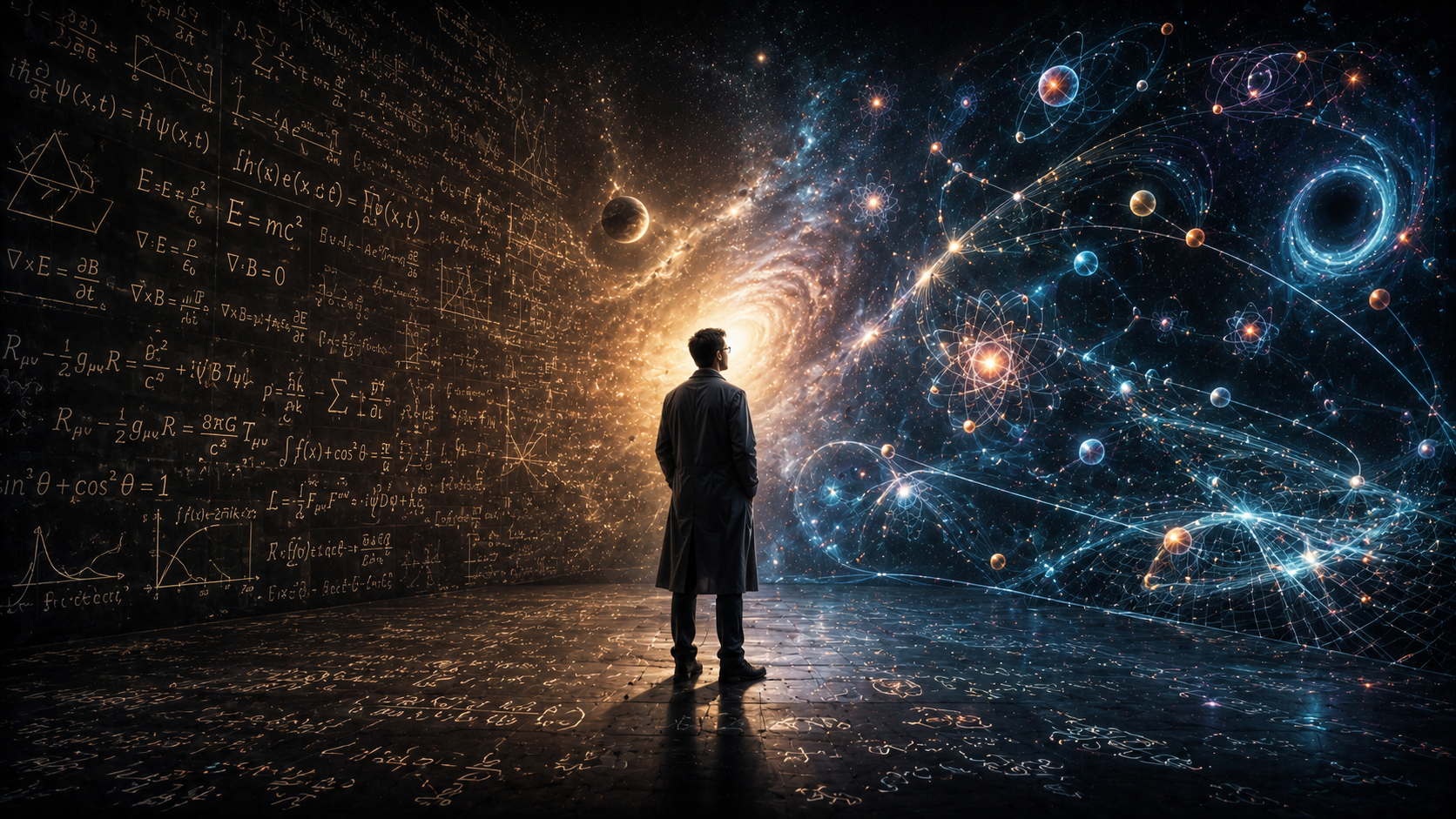
From Newton to Quantum Physics: How Science Continuously Redefines Reality
Science is often treated as humanity’s most reliable path to truth.
It explains the motion of planets, predicts disease outbreaks, builds advanced technologies, and reveals structures invisible to the human eye. Modern civilization itself is deeply built upon scientific knowledge.
Yet science has a fascinating characteristic:
Scientific “truths” sometimes change.
Ideas once considered unquestionable can later be revised, expanded, or even overturned by new discoveries.
For centuries, Newtonian physics seemed to perfectly explain the universe. Then relativity and quantum mechanics transformed humanity’s understanding of space, time, and reality itself.
This raises a profound philosophical question:
Is scientific truth truly absolute—
or is science an endless process of revision and approximation?
Perhaps science is not a collection of eternal certainties, but a continuously evolving way of understanding reality.
1. Scientific Truth Has Changed Throughout History
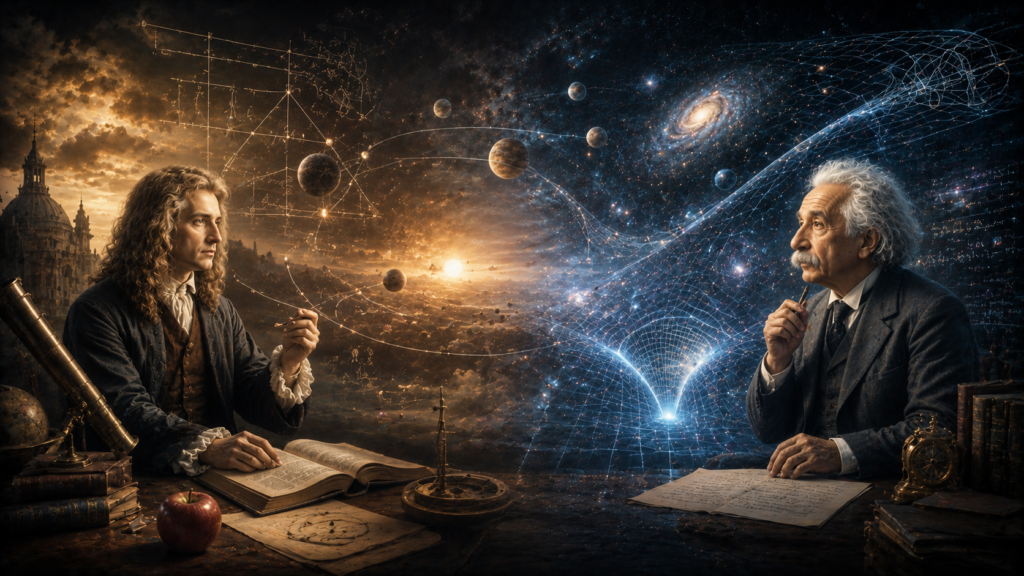
From Newton to Einstein
For centuries, Isaac Newton’s laws of motion were regarded as universal truths.
Newtonian mechanics successfully explained:
- planetary motion
- gravity
- physical force
- and mechanical systems
These principles became the foundation of modern physics and engineering.
However, in the early 20th century, Albert Einstein introduced the theory of relativity, fundamentally transforming scientific understanding.
Einstein demonstrated that:
- time is not absolute
- space can bend
- and measurements depend on the observer’s frame of reference
Phenomena occurring near the speed of light could not be fully explained through Newtonian mechanics alone.
Importantly, Einstein did not completely “destroy” Newton’s theories.
Instead, he showed that Newtonian physics worked accurately only within certain conditions.
This suggests scientific truth may often be conditional rather than absolute.
Quantum Mechanics and Uncertainty
Quantum physics introduced an even deeper challenge to traditional certainty.
At microscopic scales, particles do not always behave predictably.
Werner Heisenberg’s uncertainty principle states that it is impossible to know both the exact position and momentum of a particle simultaneously.
This means scientific knowledge sometimes operates through probabilities rather than certainty.
Reality itself appears less stable and deterministic than classical physics once assumed.
Quantum mechanics therefore challenged the idea that science always discovers perfectly fixed laws governing the universe.
2. Are Scientific Theories Permanent Truths?

Karl Popper and Falsifiability
Philosopher Karl Popper argued that scientific theories should never be treated as permanently proven truths.
Instead, he claimed scientific ideas must remain open to falsification.
According to Popper:
- a scientific theory is valid only if it can potentially be disproven through observation or experiment
For example, the statement:
“All swans are white”
can be scientifically challenged if a single black swan is discovered.
In this view, science does not achieve absolute certainty.
Rather, science produces explanations that survive continuous testing.
Thomas Kuhn and Paradigm Shifts
Philosopher Thomas Kuhn introduced the concept of paradigm shifts.
A paradigm refers to the dominant framework scientists use to interpret reality during a particular historical period.
For example:
- the geocentric model once placed Earth at the center of the universe
- later, the heliocentric model transformed astronomy entirely
Kuhn argued that science does not always progress gradually.
Sometimes entire systems of understanding collapse and are replaced by radically new perspectives.
This means scientific truth may depend partly on historical context and conceptual frameworks.
3. Science as an Evolving Process
Science Seeks Truth—But Never Stops Revising
Science unquestionably remains one of humanity’s most powerful methods for understanding reality.
Scientific inquiry allows humans to:
- test ideas
- verify predictions
- eliminate errors
- and build increasingly accurate models of nature
Without science, modern medicine, engineering, and technology would not exist.
However, science also possesses something unique:
It accepts the possibility of being wrong.
This self-correcting nature may actually be one of science’s greatest strengths.
Temporary Explanations, Expanding Knowledge
Scientific theories are often provisional explanations rather than eternal certainties.
Aristotle’s physics was replaced by Newtonian mechanics. Newton’s framework was later expanded by relativity and quantum physics.
Future discoveries may further transform current scientific understanding.
This does not mean science is unreliable.
Rather, it means science evolves by continuously refining its explanations.
Scientific truth may therefore function less like a final destination—
And more like an ongoing approximation of reality.
4. The Limits of Scientific Knowledge
Can Science Explain Everything?
Modern science explains many aspects of the physical universe.
Yet some philosophical questions remain difficult to answer scientifically:
- consciousness
- meaning
- morality
- beauty
- subjective experience
- and spiritual existence
Science can analyze brain activity associated with love or grief, but it may not fully capture what those experiences feel like internally.
This suggests there may be dimensions of human existence that exceed purely scientific measurement.
Science and Humility
Ironically, the history of science teaches intellectual humility.
Every generation believes it possesses advanced understanding, yet future discoveries repeatedly reveal limitations in previous knowledge.
Scientific progress therefore requires openness, skepticism, and curiosity rather than absolute certainty.
The strength of science may not lie in claiming permanent truth—
But in remaining willing to question itself.
Conclusion: What Does Scientific Truth Really Mean?
Scientific truth is not simply a collection of fixed and eternal facts.
It is a dynamic process through which humanity gradually improves its understanding of reality.
From Newtonian mechanics to relativity and quantum theory, scientific history demonstrates that knowledge evolves through correction, revision, and discovery.
Science may never deliver perfectly absolute truth.
However, it remains humanity’s most powerful system for approaching truth systematically and critically.
Perhaps the real meaning of scientific truth is not certainty itself—
But the willingness to continuously question, test, and refine our understanding of the world.
In that sense, science is not weakened by change.
It becomes stronger because it changes.
Reader Question
Should science be trusted because it gives absolute answers—
Or because it is willing to change?
Related Reading
The broader relationship between scientific knowledge, learning, and the pursuit of truth is explored further in The Paradox of AI Education, which examines how both humans and artificial intelligence acquire, interpret, and refine knowledge. This wider perspective provides an essential framework for understanding why scientific truth advances through continuous learning, revision, and critical inquiry rather than through absolute certainty.
The broader question of truth and interpretation is explored further in Is There a Single Historical Truth—or Many Narratives?, which examines whether knowledge can ever be entirely objective or whether every account of reality is shaped by evidence, perspective, and historical context. This wider discussion provides an essential framework for understanding why scientific knowledge, while evidence-based, continues to evolve through interpretation and revision.
The limits of certainty are explored further in If Memory Can Be Manipulated, What Can We Really Trust?, where the reliability of memory, cognition, and digital information is examined in an age of misinformation and technological influence. Together, these discussions suggest that scientific truth, like historical truth, depends not only on evidence itself but also on the ways human beings interpret, preserve, and communicate knowledge.
References
- Isaac Newton (1687). Philosophiæ Naturalis Principia Mathematica.
Newton’s foundational work established classical mechanics and shaped scientific understanding of physical law for centuries. - Albert Einstein (1920). Relativity: The Special and General Theory.
Einstein explains how relativity transformed traditional assumptions about space, time, and motion beyond Newtonian physics. - Karl Popper (1959). The Logic of Scientific Discovery.
Popper argues that scientific theories must remain falsifiable and open to revision rather than treated as absolute truths. - Thomas Kuhn (1962). The Structure of Scientific Revolutions.
Kuhn introduces the concept of paradigm shifts, explaining how scientific frameworks can fundamentally change across historical periods. - Werner Heisenberg (1958). Physics and Philosophy.
Heisenberg explores the philosophical implications of quantum uncertainty and challenges deterministic views of scientific reality.