Tag: philosophy of mind

  • The Trial of Free Will

    Is Human Freedom an Illusion or a Reality?

    The Weight of the Question

    We live with the persistent feeling that we choose.

    We choose what to eat in the morning, which career to pursue, how to respond in moments of crisis. These decisions feel like ours — deliberate, intentional, free.

    But what if that feeling is deceptive?

    What if every thought, every intention, every choice is simply the unfolding of prior causes — neural activity, genetic predispositions, environmental influences?

    Today, we step onto a stage of inquiry where two long-standing rivals confront one another: determinism and the defense of free will.


    1. The Case for Determinism: Freedom as Illusion
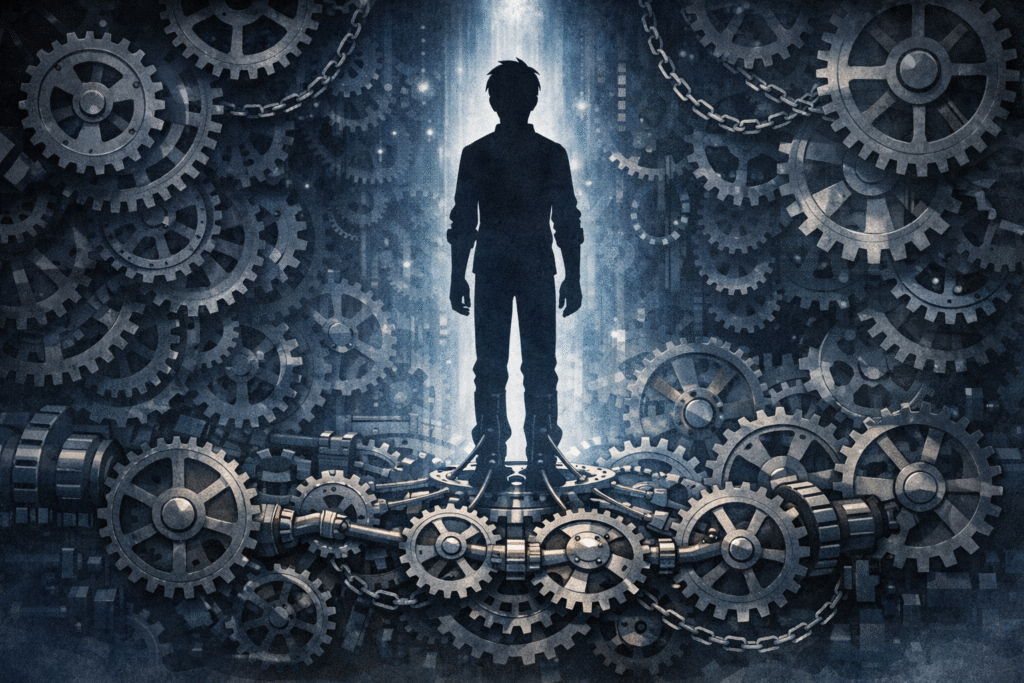
    Human silhouette connected to mechanical gears symbolizing determinism

    Determinism holds that every event is caused by preceding conditions in accordance with natural laws. From this perspective, human thought and action are no exception.

    Spinoza famously argued that free will is merely our ignorance of causes. We feel free because we do not perceive the chain of necessity behind our desires.

    Modern neuroscience adds further tension to the debate. In Benjamin Libet’s experiments, brain activity signaling an action appeared before participants reported consciously deciding to act. If the brain initiates movement before conscious intention arises, then what becomes of free choice?

    From this view, free will may be little more than post-hoc rationalization — a story we tell ourselves after the brain has already acted.


    2. The Defense of Freedom: Responsibility and Moral Agency

    Person standing at a crossroads representing human free will

    Yet the opposing side insists: freedom must be real.

    If every action were predetermined, how could moral responsibility exist? Praise, blame, justice — all would lose their grounding.

    Immanuel Kant argued that freedom is a necessary condition for moral law. Jean-Paul Sartre went further, claiming that human beings are “condemned to be free,” burdened with the responsibility of choice.

    Defenders of free will also caution against over-interpreting neuroscience. Libet’s experiments concern simple motor movements, not complex moral deliberation. The act of resisting temptation, reflecting on consequences, or sacrificing personal gain for ethical principles may not be reducible to automatic neural impulses.


    3. A Third Path: Compatibilism

    Between these poles lies compatibilism — the attempt to reconcile causality and freedom.

    Philosophers such as Daniel Dennett argue that freedom does not require independence from causation. Rather, freedom consists in acting according to one’s own motives and reasoning processes, even if those processes have causal histories.

    In this sense, we may inhabit a determined universe yet still possess a form of agency “worth wanting.”


    4. Why This Debate Matters Today

    This is not merely an abstract philosophical puzzle.

    Law and Justice

    If free will is illusory, should punishment give way entirely to rehabilitation?

    Moral Judgment

    Can we meaningfully blame or praise individuals if they could not have acted otherwise?

    Artificial Intelligence
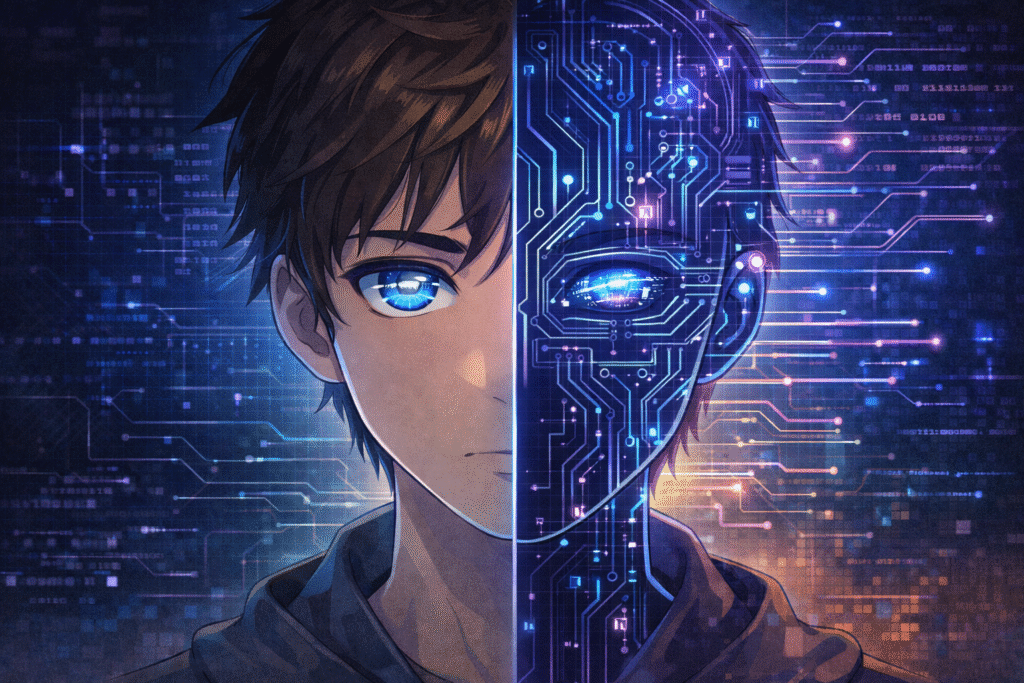
    Half human half AI face symbolizing artificial decision making

    As AI systems become increasingly autonomous, the debate takes on new urgency. If humans themselves operate under deterministic constraints, what distinguishes human agency from machine decision-making.

    Conclusion: An Open Verdict

    The stage remains undecided.

    Determinism offers scientific weight.
    Free will defends moral dignity.
    Compatibilism seeks reconciliation.

    Perhaps the deeper question is not whether we are metaphysically free, but how we ought to live in light of this uncertainty.

    If we are not free, who is responsible?
    If we are free, how do we bear the weight of that freedom?

    The trial continues — not in a courtroom, but within each of us.

    References

    1. Spinoza, Baruch. (1677/1994). Ethics. Translated by Edwin Curley. Princeton: Princeton University Press.
    Spinoza argues that human beings are entirely subject to the causal order of nature. What we call “free will,” he contends, is merely ignorance of the causes that determine our actions. His determinist framework continues to serve as a foundational critique of autonomous agency.

    2. Kant, Immanuel. (1788/1997). Critique of Practical Reason. Translated by Mary Gregor. Cambridge: Cambridge University Press.
    Kant maintains that moral responsibility presupposes freedom. For him, free will is not an empirical observation but a necessary postulate of practical reason. Without freedom, the coherence of moral law and ethical accountability would dissolve.

    3. Sartre, Jean-Paul. (1943/1992). Being and Nothingness. Translated by Hazel E. Barnes. New York: Washington Square Press.
    Sartre famously describes human beings as “condemned to be free.” In his existentialist account, freedom is inseparable from responsibility, and individuals continuously define themselves through their choices. His perspective intensifies the debate by grounding freedom in lived experience rather than abstract metaphysics.

    4. Libet, Benjamin. (2004). Mind Time: The Temporal Factor in Consciousness. Cambridge, MA: Harvard University Press.
    Libet’s neuroscientific experiments suggest that neural activity associated with decision-making can precede conscious awareness. This finding has been widely interpreted as evidence challenging traditional conceptions of free will, reinforcing determinist interpretations from a scientific perspective.

    5. Dennett, Daniel C. (1984/2003). Elbow Room: The Varieties of Free Will Worth Wanting. Cambridge, MA: MIT Press.
    Dennett defends compatibilism, arguing that meaningful forms of freedom can exist within a causally structured universe. Rather than seeking absolute metaphysical independence, he reframes free will as the kind of agency that sustains responsibility, rational deliberation, and social cooperation.


  • If AI Can Imitate Human Intuition, Are We Still Special?

    Intuition as a Human Capacity

    Intuition has long been considered a uniquely human ability.

    Even without complete information or explicit reasoning, we often make important decisions based on a sudden sense of knowing.
    Scientific breakthroughs, artistic inspiration, and life-changing choices have frequently emerged from such intuitive moments.

    Intuition appears to operate beneath conscious thought, guiding us before logic fully catches up.

    But today, artificial intelligence systems—trained on vast amounts of data—are producing remarkably accurate predictions, often in ways that look intuitive.

    If AI can one day perfectly imitate human intuition, what, then, remains uniquely human?

    A person pausing thoughtfully, representing human intuition

    1. The Nature of Intuition: Unconscious Wisdom

    1.1 Fast Thinking and Hidden Knowledge

    Psychologist Daniel Kahneman describes intuition as System 1 thinking: fast, automatic, and largely unconscious.

    This form of thinking allows humans to respond quickly without deliberate calculation.
    It is efficient, adaptive, and deeply rooted in experience.

    1.2 Intuition as Compressed Experience

    Intuition is not a random emotional impulse.
    It is the result of accumulated learning, memory, and pattern recognition operating below awareness.

    In this sense, intuition represents a form of compressed wisdom:
    complex knowledge distilled into immediate judgment.


    2. AI and the Imitation of Intuition

    Abstract visualization of artificial intelligence making predictions

    2.1 Data-Driven Prediction

    Modern AI systems generate instant predictions by processing enormous datasets.

    In medicine, for example, AI can analyze X-ray images and detect diseases faster—and sometimes more accurately—than human experts.
    These outputs resemble intuitive judgments.

    2.2 A Fundamental Difference

    Yet there is a crucial distinction.

    Human intuition integrates perception, emotion, and lived experience within a holistic context.
    AI, by contrast, calculates statistical patterns and outputs probabilities.

    AI may simulate intuition, but it does not experience it.
    Its judgments are produced without awareness, embodiment, or meaning.


    3. Crisis and Opportunity in Human Uniqueness

    3.1 The Threat to Human Specialness

    If AI were to replicate intuition flawlessly, one of humanity’s long-held markers of uniqueness would be challenged.

    Intuition has been central to how we understand creativity, expertise, and insight.
    Its automation raises understandable existential anxiety.

    3.2 Intuition as Collaboration

    Yet this development can also be interpreted differently.

    Rather than replacing human intuition, AI may serve as a complementary tool—handling probabilistic complexity while freeing humans to engage in deeper reflection, creativity, and ethical judgment.

    In this partnership, intuition becomes a bridge rather than a battleground.


    4. Beyond Intuition: What Makes Us Human

    4.1 Meaning, Not Just Judgment

    Even if AI can imitate intuitive decision-making, human intuition is not merely instrumental.

    It is embedded in narrative, emotion, and personal history.
    An artist’s inspiration, a parent’s sudden sense of danger, or a visionary leap into the unknown cannot be reduced to pattern recognition alone.

    4.2 Humans as Meaning-Makers

    AI may calculate intuition.
    Humans, however, assign meaning to it.

    We interpret intuitive insights within ethical frameworks, emotional relationships, and life stories.
    This capacity to care about intuition—to treat it as meaningful rather than functional—marks a fundamental difference.

    A reflective human moment emphasizing meaning and values

    Conclusion: Rethinking Intuition in the Age of AI

    If AI can perfectly imitate human intuition, human uniqueness will no longer rest on intuition alone.

    Instead, it will lie in our ability to interpret, evaluate, and weave intuition into narratives of value and purpose.

    The question, then, shifts:

    If AI can possess intuition, how must humans rethink what intuition truly is?

    Within that question, the distinction between human and machine becomes visible once again.

    Related Reading

    The ethical dimension of artificial cognition is further examined in If AI LIf AI Learns Human Morality, Can It Become an Ethical Agent?earns Human Morality, Can It Become an Ethical Agent?, questioning whether imitation can evolve into responsibility.

    The cultural implications of technological mediation are explored in LiLiving with Virtual Beings: Companionship, Comfort, or Replacement?ving with Virtual Beings: Companionship, Comfort, or Replacement?, where emotional substitution becomes a central theme.


    References

    1. Thinking, Fast and Slow
      Kahneman, D. (2011). Thinking, Fast and Slow. Farrar, Straus and Giroux.
      → Distinguishes intuitive (System 1) and analytical (System 2) thinking, framing intuition as experience-based cognitive efficiency.
    2. Gut Feelings
      Gigerenzer, G. (2007). Gut Feelings: The Intelligence of the Unconscious. Viking.
      → Interprets intuition as an evolved adaptive strategy rather than irrational impulse.
    3. How to Use Intuition Effectively in Decision-Making
      Sadler-Smith, E. (2015). Journal of Management Inquiry, 24(3), 246–255.
      → Examines intuition in organizational decision-making and contrasts it with data-driven systems.
    4. The Tacit Dimension
      Polanyi, M. (1966). The Tacit Dimension. University of Chicago Press.
      → Introduces the idea that humans know more than they can explicitly articulate, grounding intuition philosophically.
    5. What Computers Still Can’t Do
      Dreyfus, H. L. (1992). What Computers Still Can’t Do. MIT Press.
      → A philosophical critique of artificial reason, highlighting limits of machine imitation of human understanding.