Tag: personal reflection

  • The Silent Figure — A Story That Could Not Be Spoken

    The Silent Figure — A Story That Could Not Be Spoken

    A Wooden Sculpture, a Memory of Roots, and a Reflection on Human Dignity

    There is a wooden figure in my collection that I have lived with for more than thirty years.

    It stands about 16.5 inches tall, with a narrow body carved from dark, heavily grained wood.

    Among the many objects I have collected over the years, few have unsettled me as deeply as this one.

    The hands appear bound.

    The ankles seem restrained.

    Across the mouth is what looks like a gag.

    When I first saw it, I stood silently for a long time.

    I did not know the story of the person who carved it. I did not know precisely where it had been made, when it had been created, or what meaning its maker intended.

    And I still do not.

    So I cannot claim that I know exactly what this figure represents.

    But I know what I saw in it.

    I saw a human being prevented from speaking.


    This should be the clearest full-length photograph showing the entire sculpture. Let the reader encounter the object before you explain what it came to mean to you.


    A Memory of Roots

    Looking at the figure brought back a television series that had left a deep impression on me many years earlier: Roots.

    The 1977 American television miniseries, based on Alex Haley’s novel, brought the history of slavery into millions of homes through the story of generations of an African American family.

    One of its most enduring figures was Kunta Kinte.

    What stayed with me was not simply the physical violence inflicted upon him, but the attempt to take away something even more fundamental—his name.
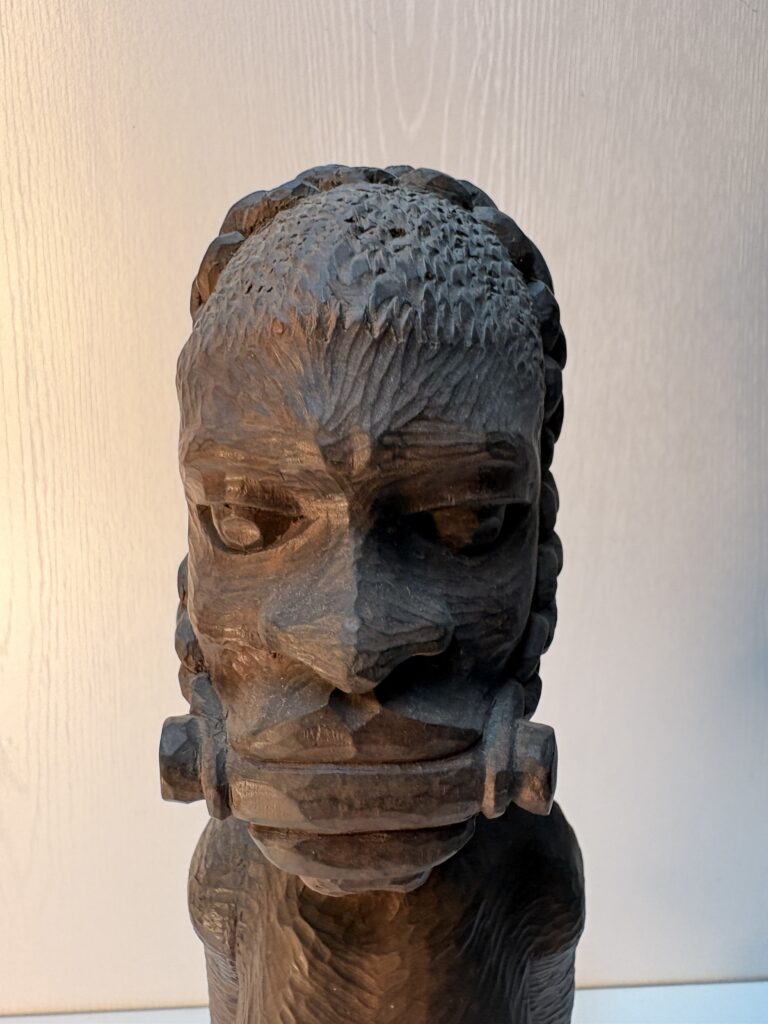
    close-up of the face and covered mouth of an African wooden figure

    To erase a person’s name is to attack more than identity.

    It is an attempt to tell that person:

    Your story no longer belongs to you.

    Yet Kunta’s struggle to hold on to his name became, for many viewers, a powerful image of dignity resisting erasure.

    Years later, standing before this wooden figure, that memory returned.

    The figure could not speak.

    And perhaps because it could not speak, I found myself listening more carefully.


    The Name I Gave It

    Over time, I began privately calling the figure:

    The Unspoken Name.

    It was not the sculpture’s original title. I do not know whether it ever had one.

    It was simply the name that emerged from my own encounter with it.

    The more I looked, the more I noticed the contradiction in its posture.

    The hands appear restrained.

    The feet appear bound.

    The mouth cannot speak.

    And yet the body remains upright.

    side view of an upright wooden figure with hands restrained behind the body

    That uprightness became important to me.

    I began to see it not merely as an image of suffering, but as an image of something suffering had failed to destroy.

    Dignity.

    Of course, that is my interpretation.

    Another viewer might see something different.

    But perhaps that is part of what old objects sometimes do.

    They do not give us complete stories.

    They leave spaces.

    And into those spaces come memory, history, imagination, and questions.


    Use a closer photograph showing the face, covered mouth, bound hands, and upright posture.

    This is the emotional center of the article.


    Why I Collected African Sculpture

    For a period of my life, I collected African wooden figures and sculptures.

    What drew me to them was not simply their visual form.

    I was fascinated by the sense that objects could carry stories across enormous distances.

    But today I also approach such objects with more caution.

    A sculpture removed from its original cultural setting can easily lose its context. Without reliable information about its maker, community, purpose, or history, it is tempting for a collector to create a story that may never have belonged to the object at all.

    That realization has changed the way I look at this figure.

    I no longer want to say:

    “This is what the sculpture means.”

    I would rather say:

    “This is what the sculpture has made me think about.”

    That distinction matters.

    The figure has made me think about slavery.

    About forced silence.

    About people whose names disappeared from written history.

    About the distance between possessing an object and truly understanding the world from which it came.

    And above all, about dignity.


    When Silence Becomes a Voice

    There is something paradoxical about this sculpture.

    Its mouth appears silenced, yet it has prompted me to ask questions for more than thirty years.

    Who made it?

    Whom did the maker imagine?

    Was it intended to represent captivity, punishment, resistance, memory—or something entirely different?

    I cannot answer those questions.

    Perhaps I never will.

    But uncertainty does not make the object meaningless.

    It simply asks me to look with humility.

    History contains countless people whose voices never reached official records.
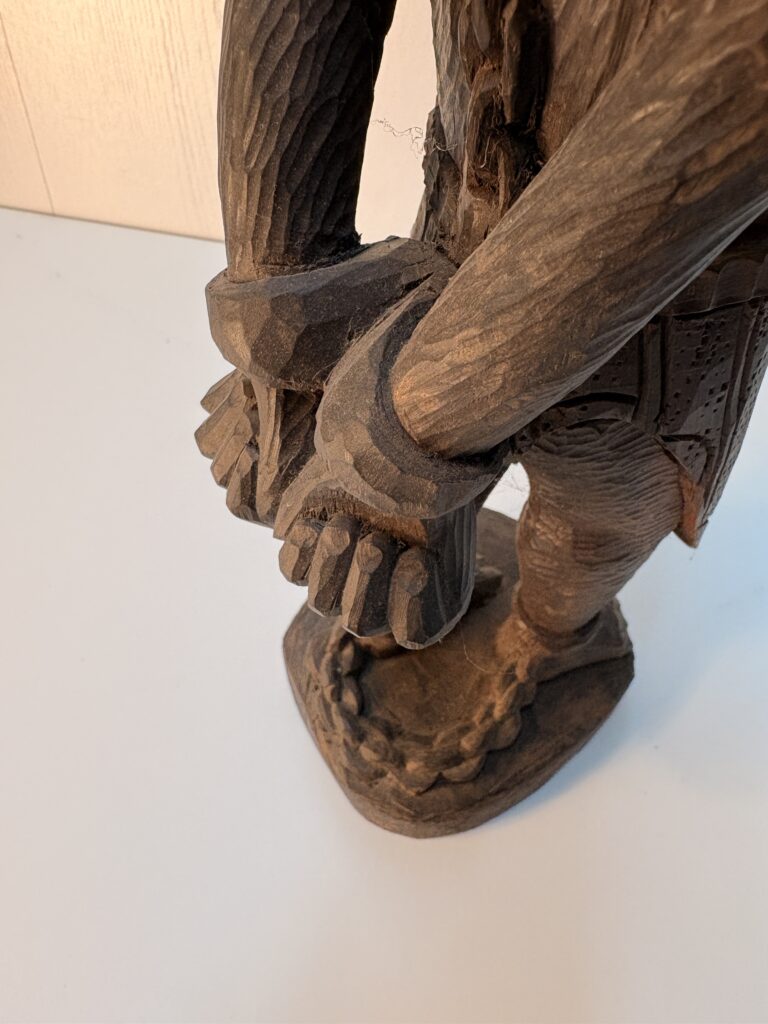
    detail of restrained hands carved into a wooden figure

    We know about kings, presidents, generals, and wealthy families because documents preserved their names.

    Far fewer traces remain of ordinary people who were enslaved, displaced, colonized, silenced, or simply excluded from the written record.

    Their absence is not evidence that they had no stories.

    Sometimes absence itself tells us something about who had the power to record history.


    A detailed photograph of the bound hands or ankles would work especially well here.

    Rather than repeating another full-body shot, let this photograph reveal something the reader may have missed in the first image.


    Thirty Years Later

    The figure has aged beside me.

    Its wooden base has become worn.

    Its surface carries marks that seem more visible now than when I first acquired it.

    And I have changed too.

    Thirty years ago, I looked at it primarily with emotion.

    Today, I look at it with emotion—but also with questions.

    Perhaps that is what happens when we live with an object for a long time.

    At first, we think we are examining it.

    Eventually, we discover that it has been examining us.

    What did I once assume too quickly?

    What histories have I heard only from one side?

    Whose voices have I failed to notice because they were quieter than the voices surrounding them?

    The sculpture cannot answer.

    It remains where it has always been.

    Silent.

    Upright.

    Waiting.


    Conclusion — Remembering Those Who Could Not Speak

    Sometimes I sit near the figure with a cup of tea and look at it for a while.

    I no longer try to give it a history I cannot verify.

    Instead, I allow it to remind me of histories that must not be forgotten.

    People whose words were never written down.

    People whose names were changed or erased.

    People who lived under systems that tried to control not only their bodies, but their identities.

    And people who, in ways history may never fully record, preserved their dignity.

    Perhaps that is why this small wooden figure has remained with me for more than thirty years.

    Not because I know its story.

    But because I do not.

    Its silence leaves a question behind:

    When history cannot tell us someone’s name, can we still learn to recognize their humanity?

    For me, that question has become more powerful with time.

    The figure says nothing.

    And still, I find myself listening.

    Reader Question

    Have you ever encountered an object, image, or work of art that made you think about the voices history has forgotten? What did its silence say to you?

    Related Reading

    Sometimes silence invites us to listen more carefully. In Nipper and the Art of Listening, an old Victor keepsake becomes a quiet reminder of what it means to truly hear another voice.

    In A Thousand-Year Kiss – When a Stone Begins to Tell a Love Story, another object kept for decades reveals how time, memory, and imagination can transform the meaning we discover in the things around us.
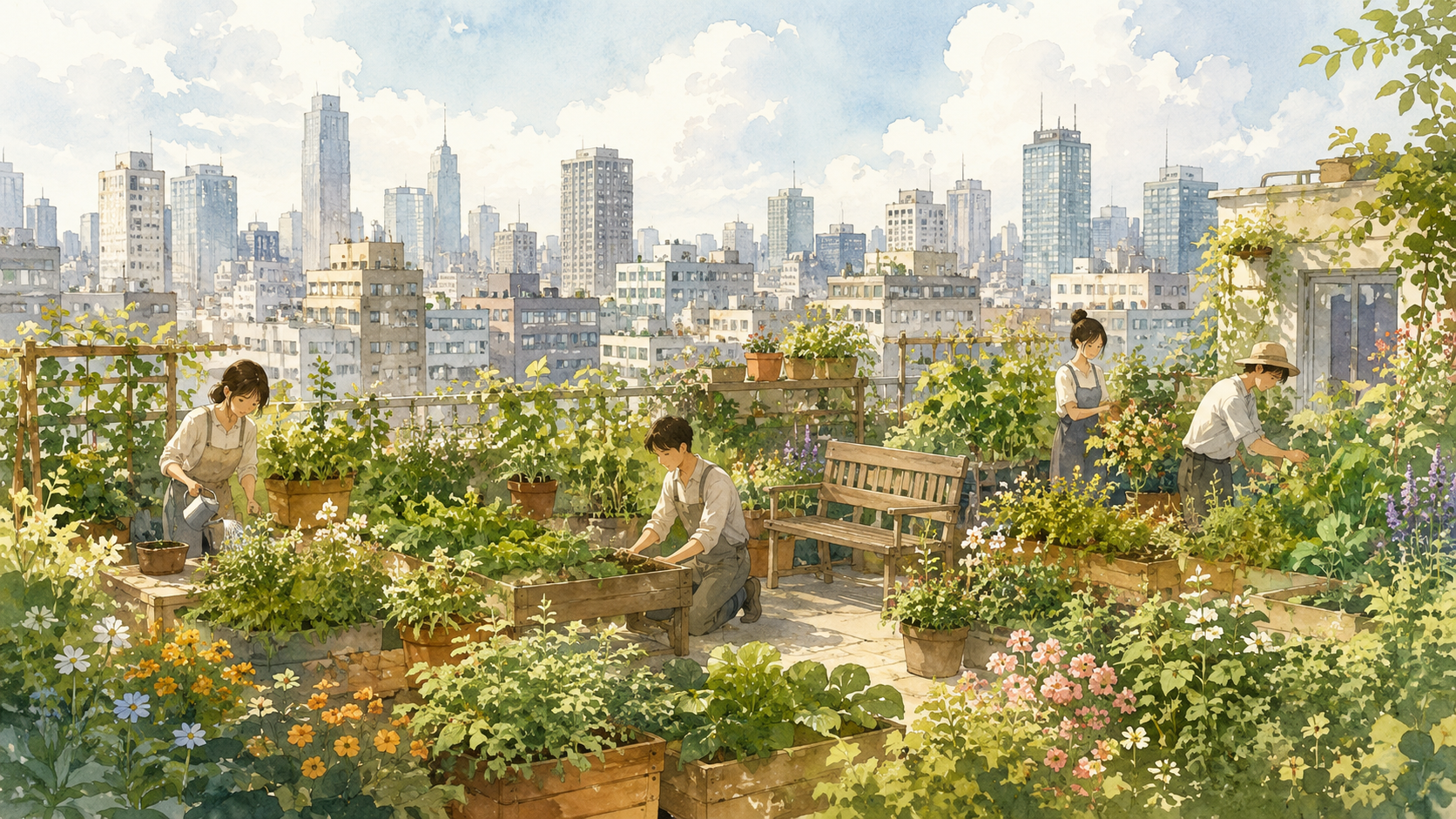

  • A Rooftop Garden in the City

    A Rooftop Garden in the City

    Where Small Acts of Care Grow into Quiet Happiness

    Sometimes the most peaceful place in a city is the one almost nobody notices.

    Hidden among rows of concrete buildings sits a small rooftop garden.

    From the street below, it is nearly invisible.

    But each morning, when sunlight reaches its leaves, the rooftop quietly comes alive.

    Tomatoes climb their supports.

    Herbs release their fragrance into the air.

    Flowers turn gently toward the sun.

    And every Saturday, people arrive.

    Office workers.

    Students.

    Retirees.

    Small business owners.

    People who might never have met anywhere else.

    Yet here, surrounded by soil and growing plants, they become neighbors.


    A Small Escape Above the City

    people caring for plants in a rooftop garden above the city

    When the rooftop garden was first proposed, many people smiled politely.

    “A garden in the middle of the city?”

    It sounded unrealistic.

    But one flowerpot became two.

    Two became twenty.

    Little by little, concrete gave way to green.

    Soon, the rooftop became more than a collection of plants.

    It became a place where people could pause.

    The city below remained noisy.

    Traffic continued.

    Phones kept ringing.

    But a single flight of stairs higher, another rhythm quietly existed.

    Birdsong mixed with laughter.

    The scent of fresh soil replaced the smell of asphalt.

    For a little while, the city seemed to breathe more slowly.


    How Small Seeds Grow into Friendships

    people building friendships while gardening together

    Gardening rarely begins with conversation.

    It begins with simple actions.

    Passing a watering can.

    Holding a pot steady.

    Noticing a new leaf.

    People who once exchanged only polite greetings gradually began sharing stories.

    Someone celebrated a promotion.

    Someone spoke about caring for an aging parent.

    Someone admitted they had simply needed a place to feel less alone.

    Plants have an unusual way of bringing people together.

    No one rushes while tending a garden.

    And when people stop rushing, they begin to notice one another.

    The plants were growing.

    So were the friendships.


    The Garden That Quietly Changed People

    By midsummer, the rooftop had become a small forest above the city.

    The scent of basil drifted through the warm air.

    Bees moved gently between flowers.

    Tomatoes ripened in the sunlight.

    One afternoon, someone quietly said,

    “I thought I was taking care of this garden.”

    Then they smiled.

    “But perhaps this garden has been taking care of me.”

    No one answered immediately.

    There was nothing to add.

    Everyone understood.

    Sometimes healing arrives without announcing itself.

    Sometimes it grows leaf by leaf.


    An Evening Shared Together

    friends sharing tea and vegetables in a rooftop garden at sunset

    As autumn approached, sunflowers slowly lowered their heads while herbs and vegetables reached their final harvest.

    One Saturday evening, everyone stayed a little longer.

    Fresh herbs became tea.

    Vegetables from the garden became a simple meal.

    People who had once been strangers now laughed as though they had known one another for years.

    Looking around the rooftop, someone quietly said,

    “We didn’t just grow a garden.”

    “We grew a place where people could belong.”

    As the sun disappeared behind the skyline, the city continued its restless pace below.

    But above it, surrounded by leaves and evening light, a different kind of happiness remained.


    Conclusion — Growing More Than Plants

    Happiness is rarely as dramatic as we imagine.

    More often, it is found in small acts repeated over time.

    A shared morning.

    Hands covered in soil.

    A conversation that begins while watering a plant.

    A quiet place where no one needs to pretend.

    The rooftop garden continues to grow.

    Not simply because people care for the plants.

    But because, week after week, the garden gently teaches them to care for one another.

    Perhaps that is what every city needs.

    Not more buildings.

    But a few more places where people can quietly grow together.

    Reader Question

    If you could create one small green space anywhere in your city, where would it be—and who would you invite to share it with you?

    Related Reading

    The quiet comfort found in everyday routines is explored further in A White Mug – The Peace Found in Familiar Things, where an ordinary morning ritual becomes a reminder that happiness often grows from simple, familiar moments.

    If you enjoy stories about places that quietly shape our lives, you may also like The Sound of Old Stairs – Where Yesterday’s Memories Meet Today’s Footsteps, a reflection on how familiar spaces preserve memories and gently reconnect us with ourselves.

  • The Sound of Old Stairs

    The Sound of Old Stairs

    Where Yesterday’s Memories Meet Today’s Footsteps

    Before We Begin

    Sometimes, a place remembers us before we remember ourselves.

    The creak of an old wooden stair is never just a sound.

    Hidden within it are footsteps from years ago—those we once took, those we take today, and those we have yet to make.

    Every step carries more than weight.

    Sometimes, it carries time itself.


    A Staircase That Remembered

    person climbing an old wooden staircase

    A few days ago, I visited a historic building that has stood for more than a century.

    As I climbed the old wooden staircase, one step answered with a quiet creak.

    It was an ordinary sound.

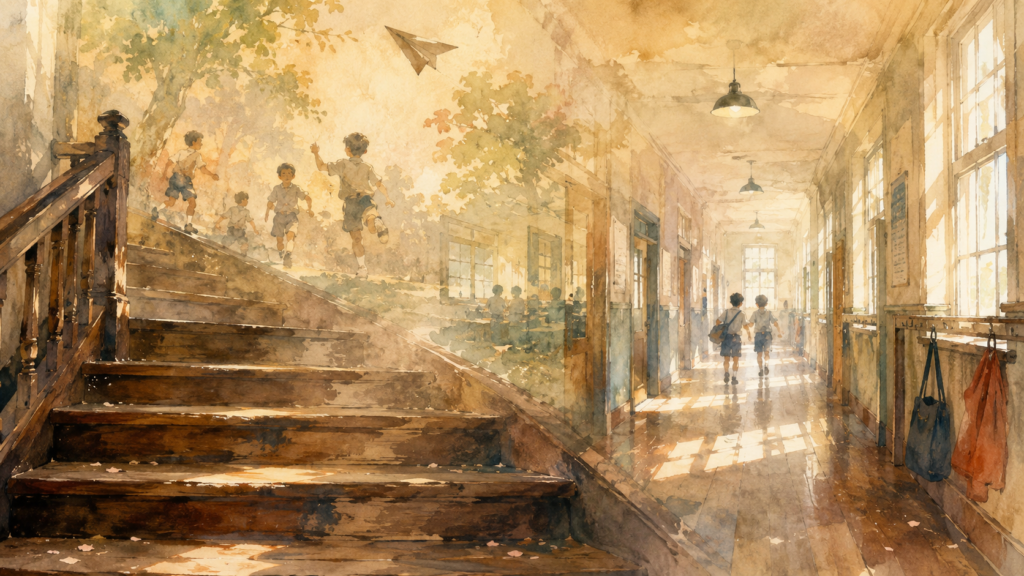
    Yet in an instant, another place appeared.

    The hallway of my childhood school.

    The echo of classmates running past.

    The faint scent of polished wood.

    None of it was physically there.

    Yet all of it returned with astonishing clarity.

    At that moment, the staircase no longer felt like architecture.

    It felt like a place where time had quietly been waiting.


    When Sound Unlocks Memory

    old staircase blending into childhood memories

    Our minds often remember through sound before they remember through images.

    The creak of a stair.

    A wooden door closing.

    Rain tapping against a window.

    These familiar sounds seem to travel directly into memory.

    Neuroscientists have long observed that certain sounds can activate both the hippocampus, where memories are organized, and the amygdala, where emotions are processed.

    That is why a simple sound rarely brings back facts alone.

    It often returns with feelings.

    We do not merely remember.

    For a brief moment, we live there again.

    Perhaps that is why analog sounds continue to comfort us in an increasingly digital world.

    Their imperfections remind us that life itself has texture.


    Where Past and Present Walk Together

    Old buildings have a quiet way of reflecting those who enter them.

    As I continued climbing, another thought appeared.

    The same wooden steps had carried thousands of people before me.

    Students.

    Doctors.

    Workers.

    Visitors.

    Each left only a few seconds of sound behind.

    Yet somehow, those sounds still seemed to remain.

    My own footsteps joined theirs.

    For a brief moment, the past and present walked together.

    Psychologists sometimes describe this experience as a sense of temporal continuity—the feeling that different chapters of our lives belong to the same story.

    When we experience that continuity, we often feel less anxious about the future.

    We remember that we have already walked through many seasons before.


    The Beauty of Moving Slowly

    Modern life encourages speed.

    Elevators replace stairs.

    Automatic doors replace waiting.

    Notifications replace silence.

    Old staircases ask something different.

    They ask us to slow down.

    Each step produces its own sound.

    Each sound lingers just long enough before the next begins.

    That rhythm invites a quiet question.

    Where am I now?

    Not on a map.

    Not in a career.

    But within my own life.

    Sometimes healing begins not with finding an answer, but with finally hearing the question.

    person descending an old staircase in warm afternoon light

    Conclusion — Listening to Time

    When I walked back down the staircase, the sound greeted me once more.

    This time it felt familiar.

    Almost welcoming.

    As though the building itself were quietly wishing me a safe journey.

    Perhaps we all spend our lives climbing invisible staircases.

    Each step connects who we once were, who we are becoming, and who we have not yet met.

    Life may not move in straight lines.

    It moves one step at a time.

    And sometimes, if we listen carefully, time itself answers back with the gentle creak of an old wooden stair.

    Reader Question

    Has a familiar sound ever taken you back to a moment you thought you had forgotten?

    Perhaps it was the creak of an old staircase, the closing of a wooden door, or the sound of rain against a window.

    What ordinary sound brings your memories quietly back to life?

    Related Reading

    The quiet memories hidden within ordinary objects are explored further in A Pebble by the Sea – Seeing the Moon Within a Small Stone, where a simple pebble becomes a reflection of time, patience, and the stories we quietly carry within us.

    A similar reflection on how familiar routines bring calm and meaning to everyday life can be found in A White Mug – The Peace Found in Familiar Things, where a simple morning ritual reveals the comfort of returning to what quietly anchors us.

  • A White Mug — The Peace Found in Familiar Things

    A White Mug — The Peace Found in Familiar Things

    Sometimes the smallest rituals become the strongest anchors in our lives.

    A White Mug — The Peace Found in Familiar Things

    Sometimes the smallest rituals become the strongest anchors in our lives.

    Every morning, a simple white mug waits on the kitchen windowsill.

    It signals the beginning of a new day and offers a quiet moment of calm before the world begins to move.

    The sound of water dripping into freshly brewed coffee, the gentle steam rising from the kettle, and the familiar feeling of wrapping both hands around a warm mug all seem to slow time down for a moment.

    To someone else, it may look like an ordinary routine.

    To me, it is a small but certain source of courage.

    The Quiet Power of Familiarity

    hands holding a white mug during a morning routine

    People often dream of change.

    Yet our minds find some of their deepest comfort in what is familiar.

    A favorite chair, a familiar street, a well-loved object, or a daily ritual can create a sense of stability in an unpredictable world.

    For me, this white mug has become one of those quiet anchors.

    Its shape never changes.

    Its color remains simple and unremarkable.

    Yet that simplicity gives it strength.

    As the aroma of coffee fills the room, I often find myself returning to a simple feeling:

    Everything will be all right.

    Before the uncertainties of the day arrive, this small moment reminds me that not everything needs to change.

    The Peace Created by Repetition

    sunlight illuminating a white mug on a windowsill

    Standing by the window with the mug in my hands, I watch sunlight filter through the glass.

    Dust particles drift slowly through the light, creating a scene I have witnessed countless times before.

    Yesterday.

    Last week.

    Last year.

    And yet it never feels exactly the same.

    Repetition is often mistaken for boredom.

    But sometimes repetition is a form of healing.

    Daily rituals provide a rhythm that helps us navigate uncertainty.

    They remind us that while life may be unpredictable, there are still small moments we can return to.

    Before taking the first sip, I often run my hand along the side of the mug.

    The familiar texture feels almost like a quiet reassurance:

    Today will be manageable.

    The Stories Hidden in Familiar Objects

    This mug was originally a gift from a friend.

    Nothing expensive.

    Nothing particularly rare.

    Just a simple white mug.

    At the time, my friend smiled and said:

    “It may not seem special now, but if you use it every day, it will become special.”

    Years later, I understand what those words meant.

    Many of life’s greatest comforts do not arrive as extraordinary experiences.

    They grow quietly through repetition.

    The mug reminds me that happiness is not always found in discovering something new.

    Sometimes it is found in seeing something familiar with fresh eyes.

    An Evening Cup and a Moment of Gratitude

    white mug with herbal tea beside evening city lights

    At the end of the day, I often reach for the same mug again.

    This time, it holds herbal tea instead of coffee.

    The fragrance slowly fills the room.

    The pace of the day softens.

    Looking out at the city lights beyond the window, I feel the busyness of the day gradually fade.

    And almost without thinking, I find myself saying:

    “I made it through today.”

    Those simple words have become a daily expression of gratitude.

    Conclusion — The Peace of Familiar Things

    Familiar things often appear unchanged.

    Yet within them, something quietly grows.

    A sense of stability.

    A sense of comfort.

    A sense of peace.

    A warm drink in a simple white mug may seem insignificant.

    Yet sometimes it becomes a gentle refuge—a place where we can pause, breathe, and rediscover our rhythm.

    In a world that constantly asks us to move faster and seek something new, perhaps one of the greatest gifts is learning to appreciate what has been quietly waiting beside us all along.

    Reader Question

    What familiar object or daily ritual brings you a sense of peace, even on difficult days?

    Related Reading

    A similar reflection on finding meaning in ordinary objects can be found in A Pebble by the Sea – Seeing the Moon Within a Small Stone, where a simple stone becomes a reminder of patience, time, and the hidden stories we carry within us.

    The importance of moving through life at a steady and intentional pace is further explored in The Rhythm of Wood, The Tempo of My Mind, where a wooden metronome reveals how rhythm and repetition can quietly shape our inner world.

  • Following the Light of a Red Fire Truck

    Following the Light of a Red Fire Truck

    — A Childhood Symbol of Courage That Still Remains —

    Sometimes, a small object can hold a feeling
    we are not meant to forget.

    On one corner of my bookshelf,
    there sits an old red toy fire truck.

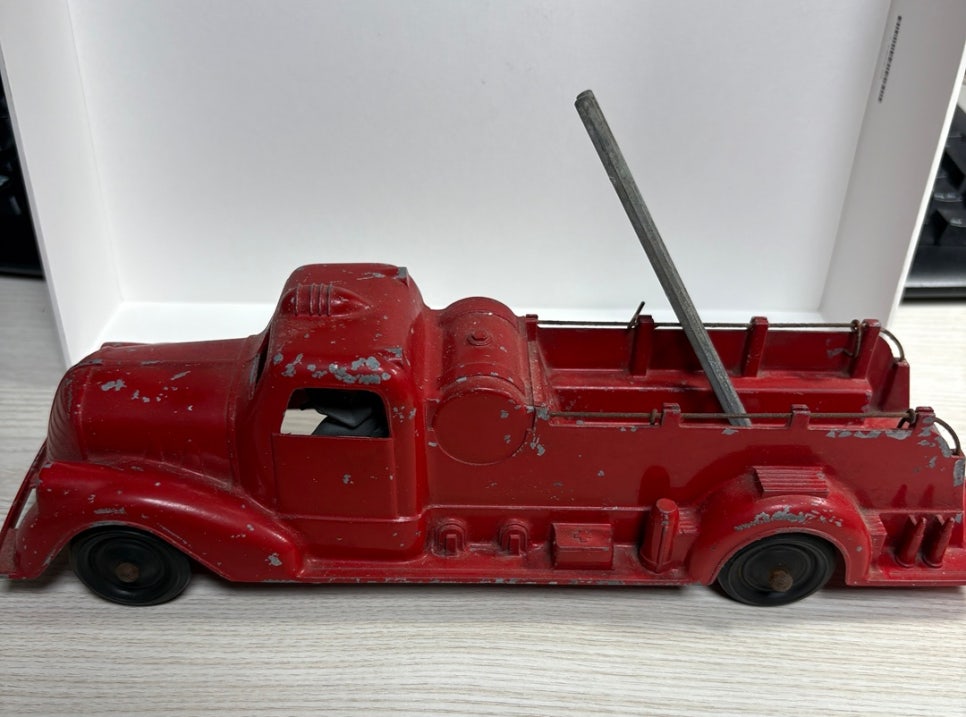
    About 10 inches long and just under 3 inches tall,
    its paint is chipped in places,
    revealing the metal beneath.

    But somehow, those marks do not feel like damage.
    They feel like time.


    This toy was originally made in the United States
    sometime around the 1930s.

    I have kept it for over thirty years.

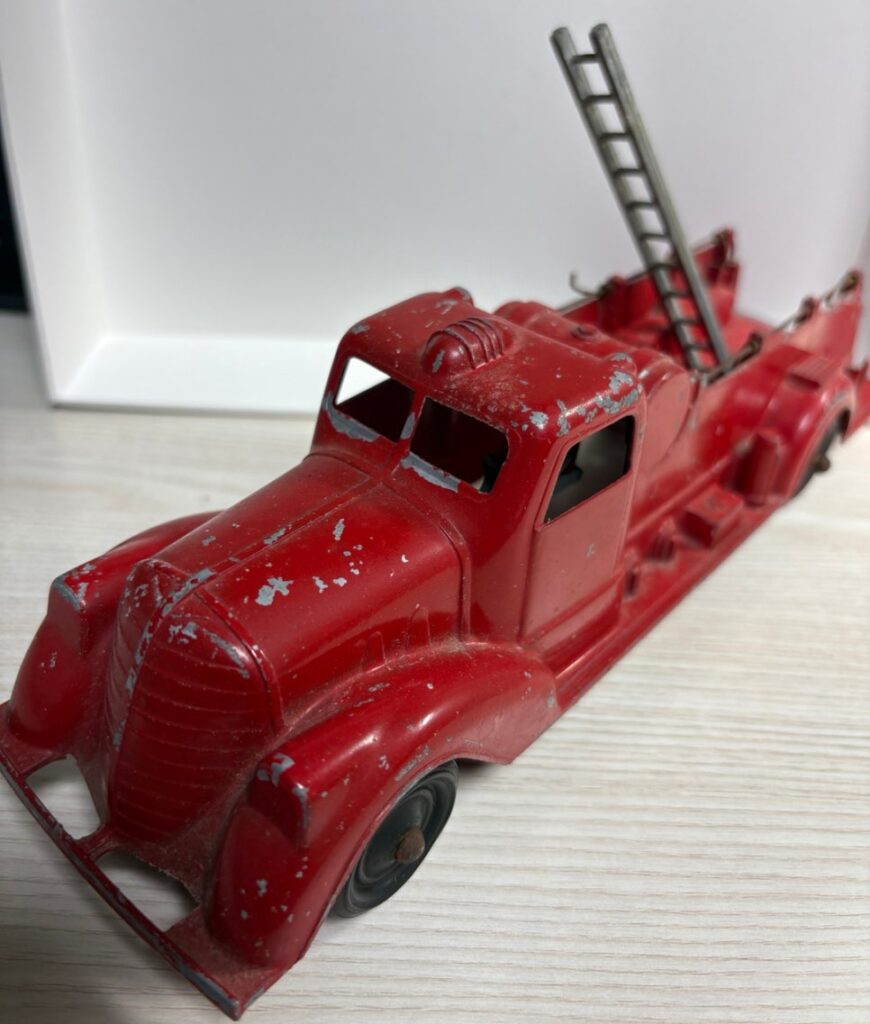
    A small silver ladder rests on its body,
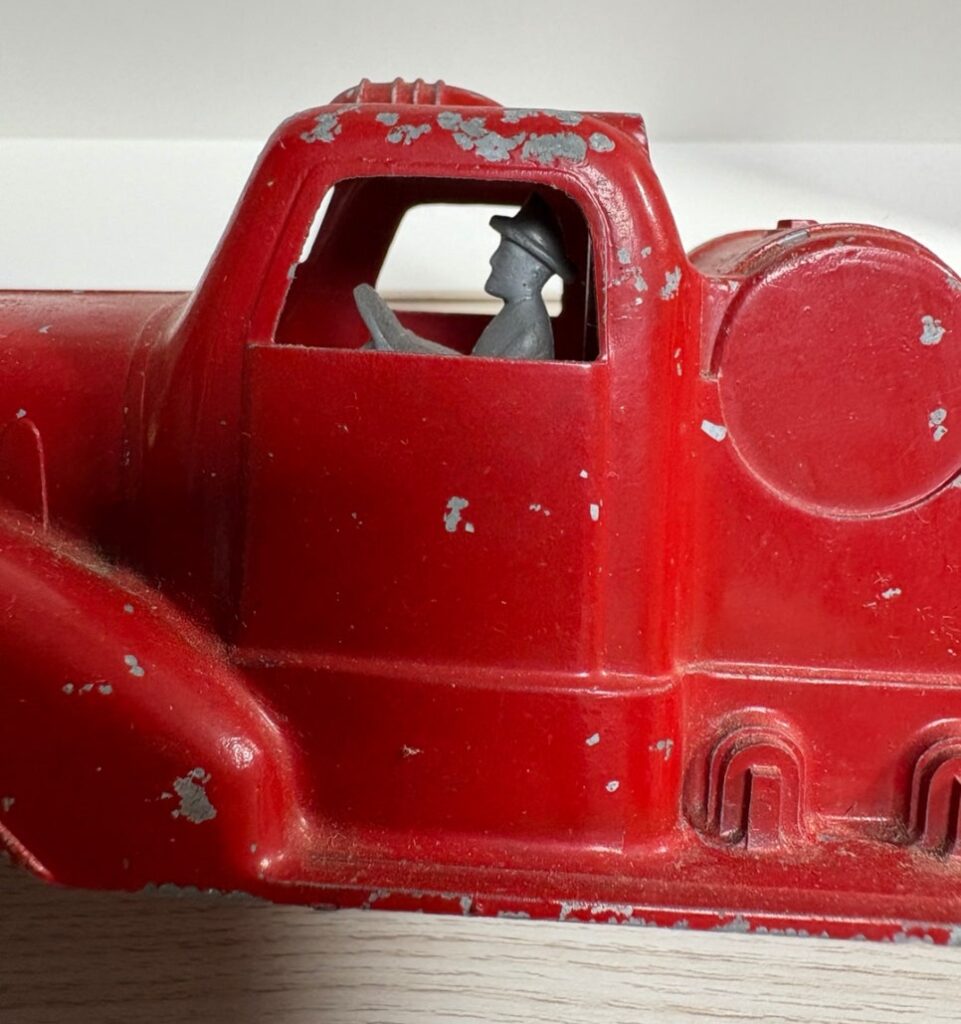
    and inside the driver’s seat,
    a tiny firefighter grips the wheel with steady focus.

    The moment I first saw it,
    something stirred quietly inside me.

    vintage red fire truck toy side view with ladder

    As a child,
    watching a red fire truck race down the street
    was simply thrilling.

    The siren, the speed, the flashing light—

    To me, it felt like
    the bravest people in the world were inside that vehicle.

    They weren’t just driving.
    They were going to help someone.

    And somehow,
    my heart followed that red light.


     close up firefighter figure inside vintage fire truck toy


    Back then,
    I used to imagine that one day
    I might become someone who could run toward others in need.

    Not away—but toward.

    Looking at this toy now,
    that feeling returns.


    I no longer see it as just a relic of the past.

    To me,
    it has quietly remained
    a symbol of responsibility and courage.


    vintage red fire truck toy with metal ladder detail


    Whenever I notice the ladder,
    I think of people climbing into danger
    without hesitation.

    One step higher,
    not for themselves—
    but for someone else.

    That kind of courage is not just professional duty.

    It is something deeper:

    A form of care,
    a quiet expression of human connection.


    Sometimes, I take a moment to clean the dust from the toy.

    And in doing so,
    I also find myself remembering
    the meaning it has carried all along.


    Fire does not always appear as flames.

    There are many invisible fires in life—
    moments of struggle, fear, or quiet desperation.

    And in those moments,
    being someone’s “ladder”
    may be the most important role we can play.


    Even today,
    this small red fire truck remains
    on the corner of my bookshelf.

    Silently reminding me
    of who I once hoped to become—
    and who I should not forget to be.

    A Question for Readers

    What is something from your past that still reminds you of the person you wanted to become?

    Related Reading

    The meaning carried by a simple object is further explored in A Pebble by the Sea – Seeing the Moon Within a Small Stone, where a small stone becomes a quiet reflection of time, patience, and the inner landscapes we hold within.

    A similar reflection on how everyday objects guide our inner direction can be found in TThe Rhythm of Wood, The Tempo of My Mindhe Rhythm of Wood, The Tempo of My Mind, where a wooden metronome reveals how rhythm, balance, and stillness shape the way we move through life.

  • A Yellow Submarine Compass — Finding Direction Within

    A Yellow Submarine Compass — Finding Direction Within

    Sometimes, we keep objects not because they guide our steps,
    but because they remind us where our heart once wanted to go.

    There is a small object I took out of a drawer after many years.

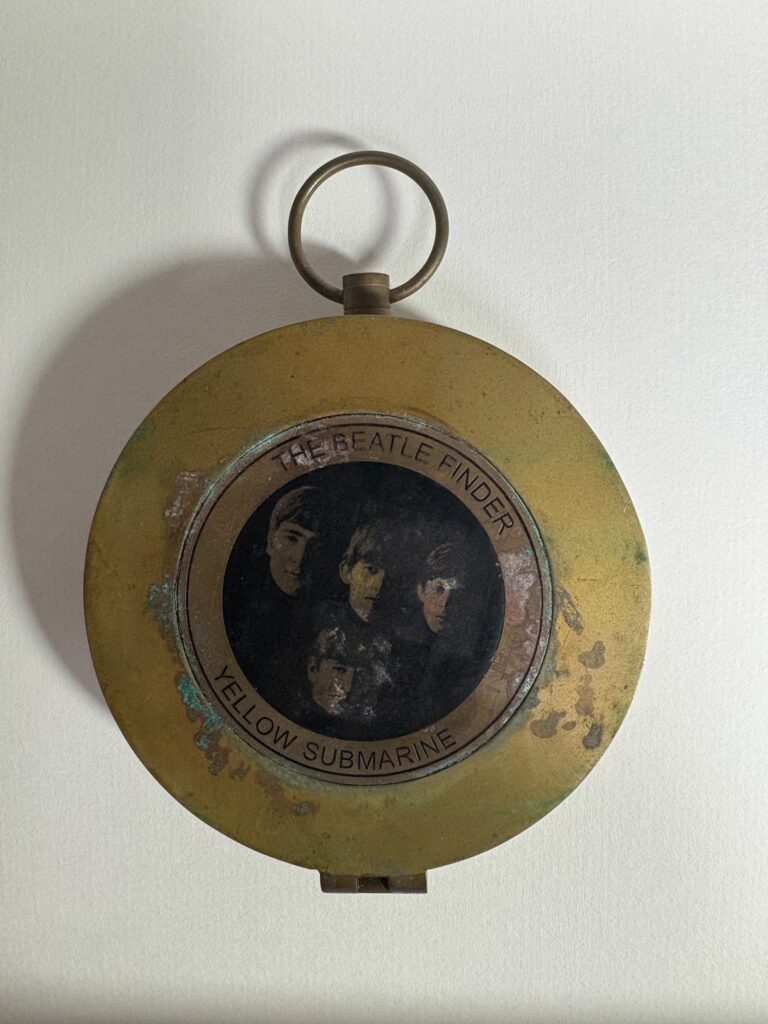
    A round brass case,
    a worn metal loop at the top,
    and at its center—faded faces of a band.

    The Beatle Finder.

    And just beneath it, a small engraving:

    “Yellow Submarine.”


    More than thirty years ago,
    I found this compass somewhere—
    perhaps at a flea market,
    or a small souvenir shop during a trip.

    The memory is blurred,
    but the feeling of holding it for the first time remains.


    At the time,
    I simply loved the music.

    The Beatles—
    their lightness, their sincerity,
    their way of not taking the world too seriously,
    yet somehow being deeply genuine.


     closed vintage brass Beatle Finder compass with Beatles portrait


    “Yellow Submarine” was never just a cheerful song.

    To me, it was
    a quiet metaphor for escape,
    a way to imagine another world
    beneath the surface of everyday life.

    This compass sat at the center of that feeling.


    When I open it,
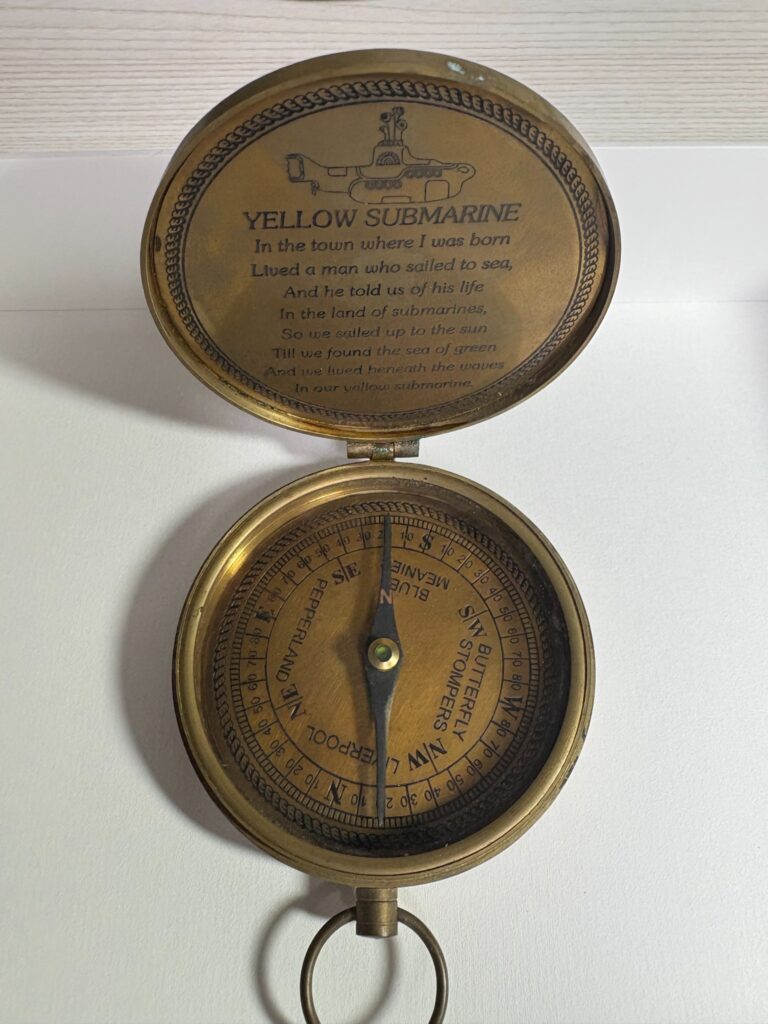
    inside the lid,
    the lyrics are engraved:

    “In the town where I was born
    Lived a man who sailed to sea…”


    engraved Yellow Submarine lyrics inside vintage brass compass lid


    I remember the first time I read those words.

    It felt like a quiet realization:

    Perhaps everyone carries a small submarine within.

    A hidden space
    that no one else can see,
    where we can travel at our own pace.

    A private world made of
    music, imagination, and memory.


    This compass does point north.

    But I have never used it
    to find a physical direction.

    Instead,
    I have used it to find something else.


    vintage compass dial inside Yellow Submarine brass compass pointing direction


    There were moments in life
    when I felt lost—
    unsure of what to do,
    or where to go.

    On those days,
    I would quietly open this compass
    and simply watch the needle.


    And somehow,
    I didn’t feel the need to rush toward a destination.

    Instead, I felt this:

    There are places you don’t have to go.
    There are worlds you can simply stay within.


    Over time,
    the songs moved further down old playlists.

    The idea of sailing away in a yellow submarine
    became less frequent.

    But this small compass
    still rests on the corner of my desk.


    Not as a tool for navigation,
    but as a quiet reminder:

    That I am still capable of imagining,
    still capable of dreaming.


    Sometimes,
    I open it again and whisper to myself:

    “And we lived beneath the waves…
    In our yellow submarine.”

    Reader Question

    Is there something you’ve kept—not for its use,
    but for the meaning it holds in your life?

    Related Reading

    The idea of finding direction beyond physical navigation is reflected in The Rhythm of Wood, The Tempo of My Mind, where a simple metronome becomes a quiet guide to balance and inner timing.

    A similar reflection on meaning within ordinary objects can be found in A Pebble by the Sea – Seeing the Moon Within a Small Stone, where a small stone reveals how time and experience shape who we are.

  • The Transparent Umbrella – Sheltered, Yet Still Connected to the World

    The Transparent Umbrella – Sheltered, Yet Still Connected to the World

    Finding the delicate balance between protection and connection.

    Person holding a transparent umbrella on a rainy street

    Beneath a transparent umbrella, someone learns how to stay protected without turning away from the world.

    Between shelter and connection, the heart slowly becomes stronger.


    Rain fell softly along the morning street.

    Someone walked through the drizzle holding a transparent umbrella.
    Raindrops tapped gently on its surface.

    The umbrella shielded the rain, yet the colors of the city were still visible through it.

    The passing cars.
    The glow of streetlights on wet pavement.
    The quiet rhythm of people moving through the day.

    And a thought appeared:

    “I want protection…
    but I don’t want to be completely separated from the world.”


    The Small Comfort of Shelter

    An umbrella is meant to protect.

    It keeps the rain away,
    gives us a small space of dryness in the middle of a storm.

    But sometimes protection becomes distance.

    When we guard ourselves too carefully,
    we may also block the warmth of connection.

    The transparent umbrella feels different.

    It protects,
    yet it allows the world to remain visible.

    Perhaps the human heart longs for the same thing.


    The Quiet Fear of Connection

    City seen through a transparent umbrella in the rain

    Many people want closeness with others.

    Yet the fear of being hurt
    often leads us to build invisible barriers.

    We protect our feelings.
    We hide what we truly think.

    And little by little,
    those protective layers become walls.

    But connection does not require perfect safety.

    It requires the courage
    to remain open while still caring for ourselves.


    Learning to Tilt the Umbrella

    Walking through the rain,
    the umbrella was tilted slightly.

    A few drops landed softly on a shoulder.

    Surprisingly, the feeling was comforting.

    Perfect protection is not always necessary.

    Sometimes, a gentle touch of the world—
    even a little rain—
    reminds us that we are still alive within it.

    In that moment, the city no longer felt distant.

    It felt shared.


    Conclusion: Staying Open Beneath the Rain

    Person walking in a rainy city holding a transparent umbrella

    Like the transparent umbrella,
    we cannot block every storm in life.

    But we can choose how we face it.

    We can protect ourselves
    while still allowing the world to reach us.

    True maturity may not lie in building stronger walls.

    Instead, it may lie in learning how to remain open—
    even when the rain is falling.


    A Small Note on Psychology

    In psychology, this balance is often described as emotional openness.

    It refers to the ability to express feelings honestly
    while still maintaining emotional stability.

    Being open does not mean being fragile.

    It means allowing the world to be seen clearly—
    while still standing firmly beneath our own shelter.


    Quote

    “Rain is grace; rain is the sky descending to the earth; without rain, there would be no life.”
    — John Updike


    Final Reflection

    Under a transparent umbrella,
    we learn something important:

    Protection does not have to mean isolation.

    Sometimes the strongest heart
    is the one that stays open to the world—
    even in the rain.


    One-line reflection

    Beneath a transparent umbrella, I learned how to face the world without hiding from it.

    Related Reading

    The subtle tension between personal space and social connection is further explored in The Wall of Earphones – Why Do We Choose to Isolate Ourselves?, where everyday technologies designed for comfort and privacy quietly reshape the boundaries between individuals and the surrounding world.

    At a broader societal level, the question of visibility and openness in modern life appears in The Transparency Society: Foundation of Trust or Culture of Surveillance?, where the growing demand for transparency raises deeper debates about whether openness strengthens trust—or gradually erodes personal freedom.

  • Small Self-Esteem: The Quiet Strength That Holds You Together

    Small Self-Esteem: The Quiet Strength That Holds You Together

    Elevator Mirror in the Morning

    Quiet morning reflection in an elevator mirror

    On the way to work this morning, there was a brief pause in front of the elevator mirror.
    A face that looked a little more tired than yesterday.
    A moment of hesitation.
    A smile made slightly on purpose.

    To anyone else, it might have looked like an ordinary morning routine.
    But in that quiet moment, it felt more like a small ritual of holding oneself together.

    Lately, confidence has felt fragile.
    A single mistake at work leads to heavy self-blame.
    A casual remark lingers longer than it should.

    Am I doing this right?
    Am I enough?

    And yet, quietly, an inner voice answers back:

    “It’s okay. You’re still allowed to trust yourself.”


    Today’s Humor

    “Want to know how to boost your self-esteem?”
    “Yes!”
    “First, hide the mirror. Today, let the world reflect you instead.”


    Reflection

    Self-worth is rarely something dramatic.

    It doesn’t begin with major achievements or loud recognition.
    It starts with the small, steady trust we offer ourselves each day.

    Self-worth isn’t about being high or low.
    It’s about having a thread to hold onto when everything else feels unsteady.

    That thread isn’t given by others.
    It grows quietly in everyday moments:

    • Trying one more time
    • Not giving up, even when tired
    • Showing up again on a difficult day

    Instead of thinking, “I’m not enough,”
    it becomes possible to think, “I’ve come this far.”

    And sometimes, that shift is everything.

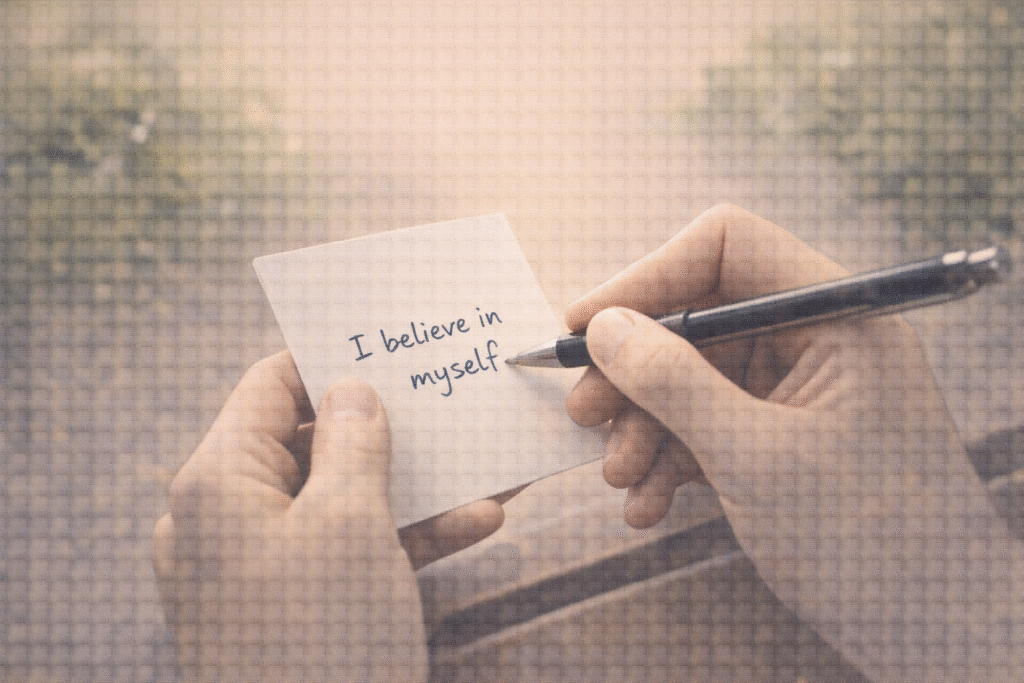
    Writing a small note of self-trust by hand

    Today’s Hobby Suggestion

    Writing a Letter to Yourself

    Take a few minutes today to write a short note to yourself.
    It doesn’t need to be praise.

    “Today was hard.”
    “You did your best.”
    “I see you.”

    That single line may become tomorrow’s support.
    Being gentle with yourself is one of the most reliable ways to strengthen quiet self-worth.


    A Small Action

    During lunch, step outside if you can.
    Sit somewhere with light and air.

    Write one sentence on a small piece of paper:

    “Today, I am doing well enough.”

    Fold it. Keep it in your wallet or pocket.
    It doesn’t have to be loud or visible.

    It’s just a small knot —
    a personal thread to return to when the world starts pulling.


    Today’s Quote

    “Nothing can dim the light that shines from within.”
    Maya Angelou


    Sitting quietly and regaining inner strength at dusk

    Closing

    Self-worth isn’t a sudden realization.
    It’s a quiet practice.

    Instead of proving yourself through others’ eyes,
    being able to say — even softly —

    “I’m okay. I’m doing my best.”

    That alone makes you steadier than you think.


    Today’s Insight

    Psychologist Carl Rogers emphasized that emotional well-being comes from alignment between one’s self-concept and lived experience.

    When who we think we are and who we actually live as grow closer,
    self-worth becomes healthier and more stable.

    Building self-worth, then, is not about becoming someone else —
    but about learning to accept who you already are.


    One-Line Summary

    “Small self-worth is the quiet courage that holds you steady when the world begins to shake.”

    Reader Question

    What is one small habit that helps you trust yourself on difficult days?

    Or have you ever discovered strength in a quiet moment of self-compassion?

    Related Reading

    The tension between internal self-worth and external validation is explored in The Praise-Driven Society: Recognition and Self-Worth in the Digital Age.

    A philosophical reflection on quiet resilience and imperfect contentment appears in Is Perfect Happiness Possible?