Tag: personal growth

  • What Did Socrates Think About Marriage? A Philosophical Perspective

    What Did Socrates Think About Marriage? A Philosophical Perspective

    Is marriage simply about love—or can it be a path to wisdom?

    When we think of marriage today, we often associate it with emotional connection, companionship, and personal fulfillment. But for the ancient Greek philosopher Socrates, marriage meant something deeper. It was not merely a romantic bond—it was a space for self-examination, growth, and philosophical insight.

    Interestingly, Socrates’ own marriage to Xanthippe was far from peaceful. Yet instead of avoiding conflict, he embraced it as part of the human experience. To him, even difficulty had meaning.

    relationship conflict introspective moment

    1. Marriage as a Training Ground for Character

    Socrates believed that the most important task in life was self-knowledge. His famous idea—“Know thyself”—applied not only to abstract thinking, but to everyday relationships.

    Marriage, in this sense, becomes a powerful environment for self-development.

    Xanthippe, often described as strong-willed and temperamental, is frequently mentioned in historical anecdotes. Rather than viewing this as misfortune, Socrates saw it as an opportunity to practice patience and resilience.

    He is famously quoted as saying:

    “Marry. If you get a good wife, you’ll be happy. If you get a bad one, you’ll become a philosopher.”

    Whether humorous or serious, this statement reflects a deeper belief:
    every experience—pleasant or difficult—can teach us something.


    2. Marriage as a Social Responsibility

    In ancient Greece, marriage was not purely a personal choice—it was a civic duty.

    Socrates, like many thinkers of his time, saw family life as essential to the stability of society. Through marriage, individuals contributed to the upbringing of future citizens and the continuation of social order.

    According to Xenophon’s writings, Socrates encouraged young men to marry not just for personal happiness, but to fulfill their role within the community.

    Even today, this perspective still resonates:

    Marriage is not only about two individuals—it also shapes families, communities, and social structures.


    3. Marriage as a Space for Dialogue

    philosophical dialogue reflection scene

    Socrates is best known for his method of questioning—what we now call the Socratic method.

    He believed that truth emerges through dialogue, challenge, and reflection.

    This philosophy extended into his personal life. Even arguments with his wife could be seen as opportunities for deeper understanding.

    Rather than avoiding disagreement, Socrates valued it.

    👉 In this sense, marriage becomes:

    • A place of conversation
    • A space for intellectual exchange
    • A mirror reflecting our own assumptions

    Modern relationships often struggle not because of differences—but because of the inability to discuss them.


    4. Marriage as an Inevitable Reality

    Socrates also approached marriage with realism.

    He did not idealize it as perfect harmony. Instead, he acknowledged its challenges as natural and unavoidable.

    A famous anecdote illustrates this well:

    After a heated argument, Xanthippe allegedly poured water over Socrates. He calmly responded:

    “After thunder comes rain.”

    Rather than reacting emotionally, he accepted conflict with humor and perspective.

    👉 His attitude suggests:
    Marriage is not about avoiding difficulty—but learning how to respond to it.


    Conclusion

    relationship growth and understanding scene

    For Socrates, marriage was far more than a personal relationship. It was:

    • A training ground for character
    • A social responsibility
    • A space for dialogue
    • A reality to be understood, not escaped

    In a world that often seeks comfort and ease, Socrates offers a different view:

    Growth often comes through tension, not harmony.

    So perhaps the question is not:
    “Is marriage supposed to make us happy?”

    But rather:
    “What kind of person does marriage help us become?”

    Reader Question

    Is marriage meant to make us happy—or to make us wiser?

    Do you think conflict in relationships is something to avoid—or something to learn from?

    Related Reading


    If relationships are meant to shape who we become, why do they so often expose our contradictions instead?
    In Why Hypocrisy Persists in Modern Society, we explore how human beings struggle between ideals and reality—revealing that tension within relationships is not failure, but part of moral and personal growth.


    If solitude helps us reflect, can true self-understanding exist without distance from others?
    In The Solitude of the Wise: Withdrawal from the Masses or Intellectual Elitism?, we examine whether stepping away from relationships deepens wisdom—or whether human connection itself is essential for becoming who we are.


    References

    1. Plato, Symposium. Oxford University Press.
    Although not directly about marriage, this work explores love, desire, and human relationships through Socratic dialogue. It provides philosophical insight into how Socrates understood connection beyond simple emotion.

    2. Xenophon, Memorabilia. Harvard University Press.
    This text offers a more personal look at Socrates’ life and character, including his views on family, responsibility, and daily interactions. It helps contextualize his perspective on marriage within real life.

    3. Xenophon, Oeconomicus. Oxford University Press.
    This dialogue examines household management and marital roles, presenting Socrates’ thoughts on marriage as a social and ethical institution.

  • The Rhythm of Wood, The Tempo of My Mind

    The Rhythm of Wood, The Tempo of My Mind

    How a Simple Metronome Taught Me About Time and Life

    1. A Quiet Machine on the Shelf

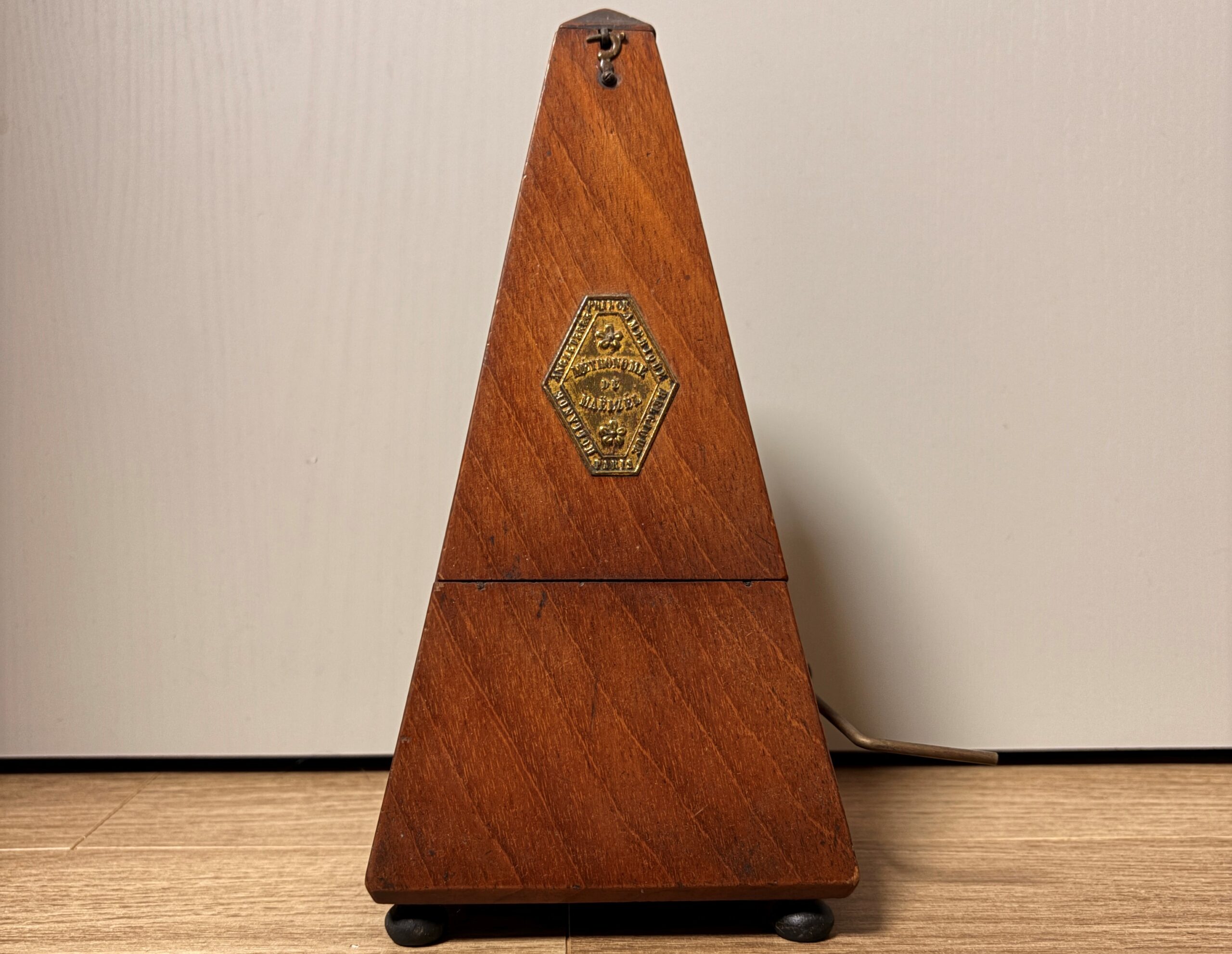
    On the corner of my bookshelf sits a small wooden object—
    about about 4 inches wide and 8.7 inches tall,
    shaped like a simple pyramid.

    It is a handmade mechanical metronome.

    I have kept it by my side for more than twenty years.

    metronome metal latch detail


    2. Learning to Follow Time

    When I first began learning the saxophone,
    I realized something unexpected—

    keeping time was harder than playing notes.

    I could read the sheet music,
    but my body was always slightly ahead or behind the rhythm.

    Whenever that happened,
    I would wind the metronome
    and watch the pendulum swing.

    Tick—tock.
    Tick—tock.

    Inside that small machine,
    there was nothing but balance and rhythm.


    3. Why I Chose Wood Over Precision

    Electronic metronomes are more precise,
    more convenient, and easier to use.

    But I always reached for this wooden one first.

    The sound was different.

    Not just a mechanical beat,
    but something softer—
    a resonance that seemed to linger in the air.

    That quiet repetition
    did not push me.

    It calmed me.


    4. A Small Ritual of Memory

    There was something else I loved about it—
    the delicate metal latch at the top.

    A small click,
    like opening a quiet, hidden box.

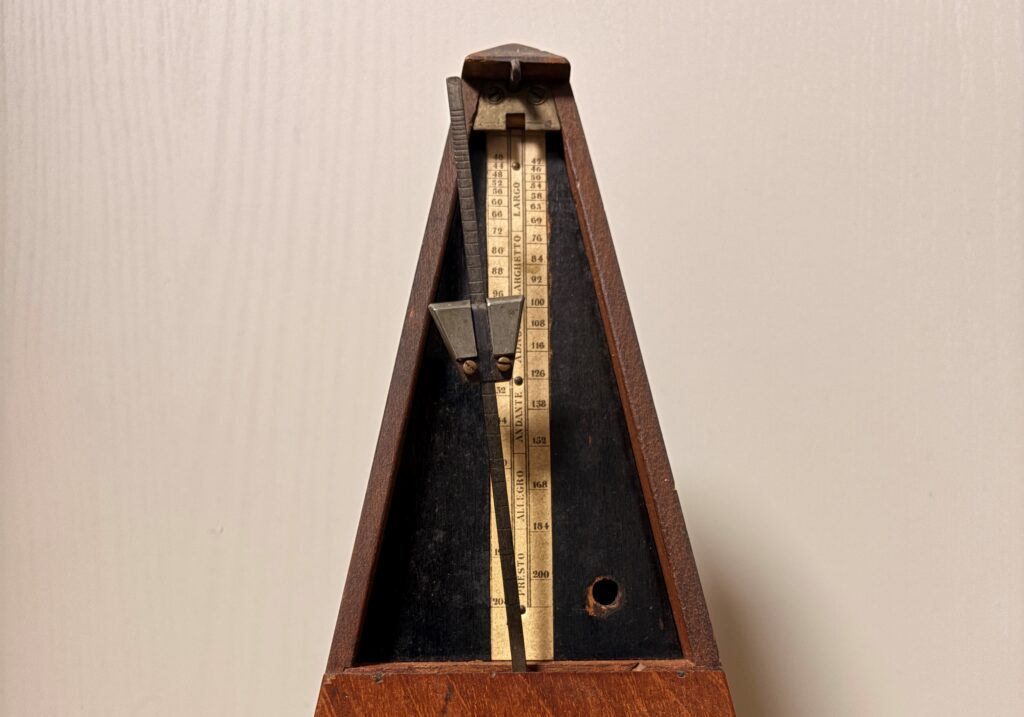
    Inside,
    a vertical scale marked in careful numbers,
    and a pendulum that could be adjusted up and down.

    Its structure was simple.
    Honest.

    Almost like a piece of time itself.


    metronome pendulum tempo scale

    5. The Tempo That Remains

    I no longer practice the saxophone every day.

    But the metronome is still there,
    on my desk.

    Sometimes,
    I wind it once or twice
    and let it move again.

    And in between those steady ticks,
    memories return—

    the tension in my fingers,
    the careful breath before each note,
    the quiet determination of learning something new.

    And I find myself thinking:

    “Rhythm is the time of music,
    and music is the time of life.”


    Conclusion – Finding Our Own Tempo

    What if our lives had a rhythm,
    like a metronome?

    Not too fast.
    Not too slow.

    Just enough to stay in harmony
    with ourselves.

    Like a small pendulum,
    moving back and forth—

    each of us
    keeping time
    in our own way.


    💬 A Question for You

    When was the last time you truly followed your own rhythm,
    instead of trying to match the pace around you?

    Related Reading

    The idea of moving at your own pace is further explored in Am I Falling Behind? — How Comparison Distorts Our Sense of Time, where the pressure of comparison reshapes how we perceive progress and timing in life.

    A similar reflection on quiet inner strength can be found in A Pebble by the Sea – Seeing the Moon Within a Small Stone, where a simple object reveals how patience and time shape who we become.

  • Am I Falling Behind? — How Comparison Distorts Our Sense of Time

    Am I Falling Behind? — How Comparison Distorts Our Sense of Time

    When life feels slow, it may just be a matter of perspective.

    One day, I put my phone down
    and found myself thinking:

    “Why does it feel like I’m the only one falling behind?”

    A friend’s promotion,
    someone else’s wedding photos,
    another person starting something new—

    It seemed like the whole world was moving forward.

    And in the middle of it all,
    I felt as if I was standing still.

    person looking at social media feeling comparison pressure

    Today’s Humor

    I once said to a friend,
    “Everyone seems to be living so fast these days.”

    My friend smiled and replied,
    “No, we’re all just being late in different ways.”

    For a moment, I laughed.

    Because in truth,
    no one is perfectly ahead of life.


    Insight

    There are moments when we feel like we are behind.

    But more often than not,
    that feeling does not come from our own life—
    it comes from comparing it to others.

    When someone succeeds earlier,
    we feel late.

    When someone reaches a milestone first,
    we feel left behind.

    But life is not a race.

    Some people begin quickly,
    while others grow slowly and deeply.

    Some flowers bloom in spring,
    others reveal their fragrance in autumn.

    The feeling of being “late”
    is often nothing more than
    an illusion created by comparison.


    Today’s Hobby

    person walking slowly alone in peaceful nature

    Take a slow walk today.

    Put your phone away for a while
    and simply observe what surrounds you.

    As you walk,
    you may begin to notice something—

    not the pace of others,
    but your own rhythm.


    Concrete Action

    When you catch yourself comparing your life to someone else’s,
    pause for a moment and say:

    “I am moving at my own pace.”

    This simple sentence
    has a quiet way of calming the mind.


    Quote

    “The trouble is, you think you have time.”
    — Jack Kornfield

    We often believe we feel rushed because we lack time.
    But in reality,
    we feel rushed because we measure our time against others.


    multiple clocks moving at different speeds in harmony

    Closing

    That evening, as I walked slowly,
    a thought came to me—

    Maybe I am not late.
    Maybe I am simply moving at a different pace.

    The moment comparison fades,
    time returns to where it belongs.

    And life is no longer a race,
    but a journey.


    Today’s Knowledge

    In psychology, the tendency to evaluate one’s life
    by comparing it to others is known as Social Comparison.

    This concept was introduced by Leon Festinger in 1954.

    Humans often rely on others as reference points
    to judge their own progress, ability, or status.

    When this comparison becomes excessive,
    it can distort how we perceive our own time and life.


    Summary

    You are not behind.

    It is comparison
    that has been distorting your sense of time.

    A Question for You

    Are you truly behind—
    or are you just measuring your life by someone else’s clock?

    Related Reading

    The emotional weight of comparison is further explored in Why Do We Remember Regret Longer Than Failure?, where the lingering impact of self-evaluation reveals how our perception of time is shaped not only by events, but by how we interpret them.

    The broader question of how we measure our lives is examined in Is There a Single Historical Truth, or Many Narratives?, where the idea that “truth” itself can be shaped by perspective parallels how we construct and compare our own timelines.

  • Why Do We Remember Regret Longer Than Failure?

    Why Do We Remember Regret Longer Than Failure?

    The Psychology of Memory, Emotion, and Decision-Making

    We often forget our failures.

    The disappointment of failing an exam fades with time.
    The pain of a lost opportunity slowly weakens.

    Yet regret remains.

    “I should have tried harder.”
    “I shouldn’t have said that.”
    “I should have taken that chance.”

    Why does regret stay with us longer than failure?

    The answer lies not only in emotion, but in how the human mind processes possibility. The difference between regret vs failure psychology lies in how the brain processes imagined possibilities rather than completed events.


    1. Failure Fades, but Regret Persists

    contrast between failure fading and regret lasting

    Failure is an event that has already happened.

    It belongs to the past — fixed, unchangeable, and eventually processed by the brain as a completed experience.

    Regret, however, is different.

    Regret is not about what happened.
    It is about what could have happened.

    This difference makes regret far more persistent.

    Instead of closing a memory, regret keeps it open.


    2. Regret Lives in “What If”

    Think about common experiences of regret:

    • words spoken in anger during an argument
    • a missed opportunity that never returned
    • a decision not taken at a crucial moment

    Regret does not come from reality alone.
    It comes from imagined alternatives.

    The mind constantly asks:

    • What if I had acted differently?
    • What if I had chosen another path?

    These imagined scenarios are replayed again and again.

    This repetition is what makes regret last longer than failure.


    3. The Brain Replays Possibilities

    Psychologist Daniel Gilbert explains regret as the brain’s attempt to “edit the past.”

    This process is known as counterfactual thinking — imagining alternative outcomes to real events.

    The human brain, particularly the prefrontal cortex, actively simulates these “what if” scenarios.

    What is remarkable is this:

    The brain responds to imagined possibilities almost as strongly as it does to real events.

    This means that regret is not just a memory —
    it is a continuously recreated emotional experience.

    Research also suggests that regrets about inaction often last longer than regrets about actions.

    In other words, what we did not do may stay with us longer than what we did.

    person imagining alternative life scenarios

    4. Can Regret Be Useful?

    At first glance, regret seems like a negative emotion.

    But from an evolutionary perspective, regret serves an important function.

    It helps us:

    • learn from past decisions
    • adjust future behavior
    • reflect on moral and social actions

    Regret is a form of cognitive feedback.

    It allows us to simulate better choices without actually reliving the situation.

    In this sense, regret is not just pain.
    It is a tool for growth.


    Conclusion: Learning to Live with Regret

    Regret is not something we need to erase.

    It is something we need to understand.

    Failure ends.
    Regret continues.

    But that continuation also gives us direction.

    Instead of saying,
    “I should have done that,”

    we can learn to say,
    “Next time, I will do it differently.”

    A life without regret may not be possible.
    But a life that knows how to use regret wisely —
    that is a life shaped by reflection and growth.

    Question for Readers

    When you think about your past, do you remember your failures — or your regrets more clearly?

    Are there moments where you find yourself replaying what could have been, rather than what actually happened?

    In a world shaped by constant choices, we might ask a deeper question:

    Is regret something we should avoid, or something we can learn to use as a guide for better decisions?

    Related Reading

    The tension between emotion and judgment is further examined in Why We Excuse Ourselves but Blame Others, where the way we interpret our own actions and others’ mistakes reveals how memory and bias shape our sense of responsibility and regret.

    From a broader perspective on emotional awareness, Why It Feels Like Everyone Is Watching You: The Spotlight Effect explores how our perception of being observed amplifies emotional experiences, suggesting that the intensity of self-consciousness can make certain memories—especially those tied to regret—linger longer than others.


    References

    1. Gilbert, D. T. (2006). Stumbling on Happiness. New York: Knopf. This book explores how humans predict and mispredict their emotional futures, offering key insights into the psychology of regret and counterfactual thinking. Gilbert explains how the mind continuously reconstructs past experiences, which helps explain why regret lingers over time.
    2. Zeelenberg, M., & Pieters, R. (2007). A Theory of Regret Regulation 1.0. Journal of Consumer Psychology, 17(1), 3–18. This paper presents regret as a regulatory emotion that influences decision-making and behavior. It highlights how regret functions as a cognitive mechanism for evaluating choices and guiding future actions.
    3. Camille, N., Coricelli, G., Sallet, J., Pradat-Diehl, P., Duhamel, J. R., & Sirigu, A. (2004). The Involvement of the Orbitofrontal Cortex in the Experience of Regret. Science, 304(5674), 1167–1170. This neuroscientific study identifies the brain regions associated with regret, showing how the orbitofrontal cortex processes alternative outcomes and emotional responses tied to decision-making.
  • Why It Feels Like Everyone Is Watching You: The Spotlight Effect

    Feeling watched in a public space despite no attention

    You get a new haircut, and suddenly it feels strange.
    You sit alone in a café and become aware of every movement.
    You stumble slightly on the subway and feel as if all eyes are on you.

    Have you ever had that feeling — that people around you are paying unusually close attention to you?

    Psychology has a name for this experience.
    It is called the spotlight effect, also known as self-relevance bias.


    1. We See the World From the Center of Ourselves

    1.1 The Natural Focus on the Self

    From birth, we experience the world from a first-person perspective.
    This makes self-awareness a natural part of being human.

    We constantly monitor how we look, how we sound, and how we appear to others. This sensitivity helps us navigate social life — but it also creates distortions.

    1.2 When Self-Awareness Becomes Overestimation

    Because we are so aware of ourselves, we often assume others are just as focused on us. In reality, this is rarely the case.

    The result is an illusion: we feel as if our actions and appearance stand out far more than they actually do.


    2. A Classic Experiment: “No One Noticed My Shirt”

    Overestimating others’ attention due to self-focus

    2.1 The Harvard T-Shirt Study

    In a well-known study conducted at Harvard University in 2000, participants were asked to wear an unattractive, embarrassing T-shirt into a classroom.

    Afterward, they were asked how many people they thought had noticed the shirt.

    On average, participants believed about 50% of others had noticed.
    In reality, only 10–15% actually did.

    2.2 The Gap Between Feeling and Reality

    This experiment clearly shows the gap between perceived attention and actual attention. We dramatically overestimate how much others notice us.

    What feels like a spotlight is often just a dim light.


    3. How the Bias Fuels Anxiety

    3.1 When the Effect Becomes Stronger

    The spotlight effect intensifies in situations such as:

    • Being in unfamiliar environments
    • Making mistakes
    • Feeling insecure about appearance or behavior
    • Being evaluated (presentations, interviews)

    3.2 From Awareness to Anxiety

    In these moments, excessive self-focus can lead to tension and withdrawal. In some cases, it contributes to social anxiety, making public spaces feel threatening rather than neutral.


    4. The Truth: Everyone Else Is Busy Being Themselves

    4.1 Others Are Not Watching — They Are Thinking

    The irony is simple: just as you are focused on yourself, others are absorbed in their own concerns.

    Your small mistake feels significant to you — but to others, it is often unnoticed or quickly forgotten.

    4.2 We Are All Main Characters in Our Own Stories

    Most people are not observers of your life.
    They are protagonists in their own.


    Conclusion

    People focused on their own thoughts, not others

    Feeling watched, judged, or remembered can be deeply uncomfortable.
    But most of the time, this feeling is not reality — it is the mind’s exaggeration of its own importance.

    People notice you far less than you imagine.
    Your mistakes rarely leave lasting impressions.

    So when that familiar anxiety appears, try this reminder:

    The spotlight is mostly in your head.

    And perhaps, that realization itself can be a quiet relief.

    Related Reading

    The psychology of subtle social perception is expanded in Social Attractiveness and the Psychology of Likeability, where unspoken cues shape interpersonal dynamics.

    The deeper philosophical question of withdrawal and presence is discussed in Is Solitude a Freedom of Self-Reflection, or a Risk of Social Disconnection? exploring the tension between connection and distance.


    References

    1.Gilovich, T., Medvec, V. H., & Savitsky, K. (2000). “The Spotlight Effect in Social Judgment: An Egocentric Bias in Estimates of the Salience of One’s Own Actions and Appearance.” Journal of Personality and Social Psychology, 78(2), 211–222.
    This seminal study introduced the concept of the spotlight effect, demonstrating experimentally that people greatly overestimate how much others notice them.

    2.Baumeister, R. F., & Bushman, B. J. (2021). Social Psychology and Human Nature (5th ed.). Boston: Cengage Learning.
    This textbook provides a comprehensive explanation of self-awareness, self-presentation, and cognitive biases, offering a broader framework for understanding self-relevance bias.

    3.Leary, M. R. (2007). The Curse of the Self: Self-Awareness, Egotism, and the Quality of Human Life. Oxford: Oxford University Press.
    Leary explores how excessive self-focus affects well-being, showing how heightened self-awareness can amplify social sensitivity and unnecessary anxiety.

  • The Many Faces of Self-Love: Where Healthy Self-Esteem Ends and Toxic Narcissism Begins

    “Love yourself.”
    “You can’t love others unless you value yourself first.”

    Messages about self-care, self-esteem, and self-love dominate modern psychology and popular culture.
    Yet many people find themselves quietly confused.

    When did loving oneself begin to sound like permission to ignore others?
    Is self-love a healthy emotional foundation—or a carefully disguised form of selfishness?

    Person reflecting calmly on inner emotions and self-worth

    1. Self-Love Is a Universal Human Emotion

    Self-love, often discussed under the term narcissism in psychology, originates from a basic human instinct: the desire to protect and value oneself. In its healthy form, it supports survival, identity formation, and emotional stability.

    Healthy self-love includes:

    • The belief that “I have inherent worth”
    • The recognition that “I deserve respect”
    • The ability to express one’s emotions and needs without shame

    This form of self-love strengthens psychological resilience and serves as the foundation for balanced relationships.

    Problems arise when self-love becomes excessive or distorted—when protecting the self turns into elevating the self at the expense of others.


    2. What Is Toxic Narcissism?

    Toxic narcissism refers to an extreme preoccupation with oneself that leads to the objectification or dismissal of others.

    Such individuals often:

    • Overestimate their own importance
    • React defensively to criticism
    • Constantly seek admiration
    • Show limited empathy toward others

    Outwardly, they may appear confident. Inwardly, however, exaggerated self-importance often masks insecurity and emotional emptiness.

    Common examples include:

    • Dominating conversations by redirecting every topic toward oneself
    • Ignoring a partner’s emotions while emphasizing personal exhaustion or needs
    • Claiming credit while avoiding responsibility in group work

    In this sense, toxic narcissism is not excessive self-love—it is an inability to love at all.

    Person surrounded by social approval symbols showing fragile ego

    3. What Does Healthy Self-Love Look Like?

    The key distinction lies in how self-love operates within relationships.

    Healthy self-love:

    • Respects personal needs and others’ boundaries
    • Accepts responsibility instead of resorting to defensiveness
    • Welcomes praise without collapsing under criticism
    • Recognizes that one’s emotions matter—just as much as another’s

    When loving oneself leads to healthier relationships rather than emotional domination, self-love becomes a source of nourishment rather than harm.


    4. Self-Love and Self-Esteem Are Not the Same

    Though often confused, self-love and self-esteem differ in important ways.

    • Self-esteem is an internal sense of worth that does not depend on comparison.
    • Narcissism relies heavily on external validation and perceived superiority.

    People with stable self-esteem rarely need to exaggerate themselves or diminish others.
    Those with fragile self-worth, by contrast, may appear confident while remaining highly sensitive to rejection or criticism.

    This is why intense narcissistic traits often coexist with deep insecurity.


    5. Living in the Age of Self-Promotion

    Modern society rewards visibility, personal branding, and constant self-display. In such an environment, self-focus becomes not only normalized but encouraged.

    Under these conditions, self-love can easily transform into a survival strategy.

    However, when “self-love” is used to justify rudeness, emotional exploitation, or disregard for others, the result is not empowerment—but isolation.

    A society that celebrates the self while neglecting empathy risks producing individuals who stand alone, disconnected despite constant self-expression.


    Conclusion: Where the Boundary Truly Lies

    Balanced emotional relationship with mutual respect and boundaries

    Self-love is not inherently harmful. In fact, it is essential for psychological well-being.

    But the moment self-love ignores the emotional reality of others, it ceases to be care and becomes a display of power.

    True self-love protects the self without harming others.
    It allows us to stand firmly as individuals while remaining emotionally present within relationships.

    That balance—between self-respect and mutual respect—is where healthy self-love truly resides.


    References

    1. Twenge, J. M., & Campbell, W. K. (2009). The Narcissism Epidemic: Living in the Age of Entitlement. New York: Free Press.
    → Analyzes the cultural rise of narcissistic traits and their impact on relationships, workplaces, and social values, offering a broad sociopsychological perspective.

    2.Kohut, H. (1971). The Analysis of the Self. Chicago: University of Chicago Press.
    → A foundational psychoanalytic work distinguishing healthy narcissism from pathological forms, providing a conceptual framework still influential today.

    3.Vaknin, S. (2001). Malignant Self-Love: Narcissism Revisited. Prague: Narcissus Publications.
    → Examines narcissistic personality patterns through clinical observation, highlighting how distorted self-love affects interpersonal dynamics.