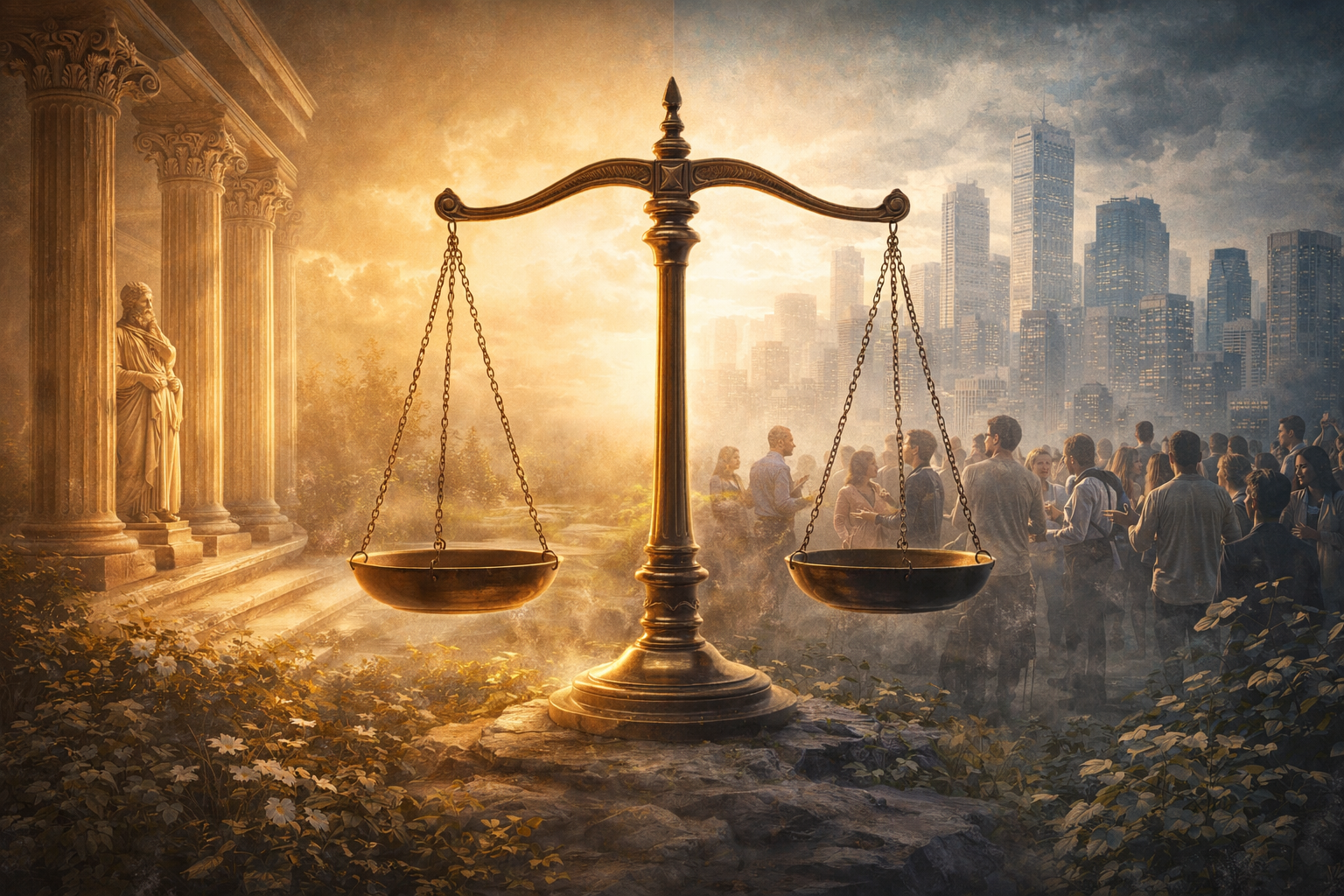
A Philosophical Inquiry into Truth, Power, and Human Agreement
Imagine two people looking at the same situation—
one calls it fair, the other calls it unjust.
A court decision divides public opinion.
A policy feels just to some, but deeply unfair to others.
In moments like these, we are forced to ask:
Is justice something that truly exists—
or something we create together as a society?
This question lies at the heart of philosophy, law, and human coexistence.
Across history, thinkers have struggled with a fundamental tension:
whether justice is an objective truth waiting to be discovered,
or a social agreement shaped by culture, power, and time.
Understanding this distinction is not just theoretical—
it shapes how we judge right and wrong in the real world.
1. Plato: Justice as an Objective Truth

Plato represents one of the strongest defenders of justice as an objective reality.
In The Republic, he defines justice as a harmonious order in which each part of society fulfills its proper role.
For Plato, justice exists in the realm of eternal Forms—unchanging, absolute, and independent of human opinion.
This means justice is not created by agreement.
It is something to be discovered through reason.
Philosophers, therefore, are those capable of perceiving this truth and guiding society accordingly.
This perspective establishes justice as a universal and objective standard—
one that transcends culture, time, and individual preference.
2. Aristotle: Justice Within Social Context
Aristotle offers a more grounded and practical approach.
In Nicomachean Ethics, he distinguishes between:
- Distributive justice (fair allocation based on merit or contribution)
- Corrective justice (restoring balance in cases of wrongdoing)
While Aristotle still believes in rational standards, he recognizes that justice operates within real social contexts.
Justice is not purely abstract—it must be applied within human communities.
This marks a subtle shift:
justice may have universal principles, but its implementation varies depending on circumstances.
3. Social Contract Thinkers: Justice as Agreement
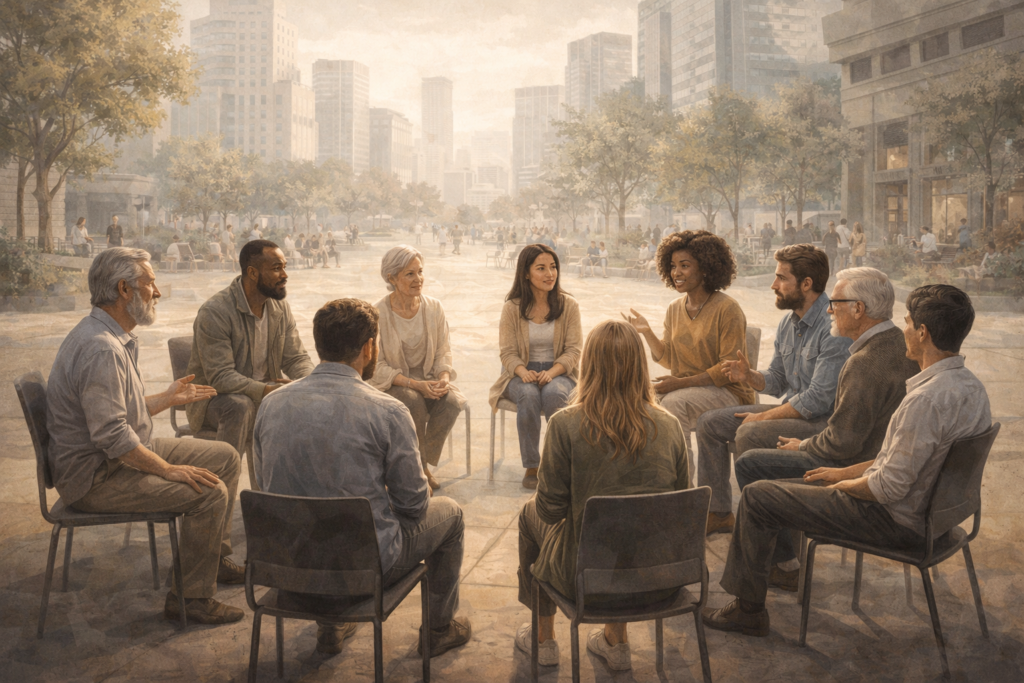
Modern philosophers such as Hobbes, Locke, and Rousseau shift the discussion further.
They argue that justice does not exist in a “natural” state.
Instead, it emerges when individuals form societies and agree on rules.
- Hobbes: Justice arises from escaping chaos through authority
- Locke: Justice protects natural rights through mutual agreement
- Rousseau: Justice reflects the “general will” of the people
Here, justice is not discovered—it is constructed.
It becomes a product of rational consensus, shaped by collective decision-making.
4. Rawls vs. Nozick: Fairness or Freedom?
In the 20th century, the debate takes a new form.
John Rawls
Rawls defines justice as fairness.
Behind a “veil of ignorance,” individuals would choose principles that benefit everyone—especially the least advantaged.
This approach seeks a universal standard, but one grounded in hypothetical agreement.
Robert Nozick
Nozick rejects redistributive justice.
For him, justice lies in process, not outcome.
If resources are acquired and transferred fairly, inequality itself is not unjust.
This sharp contrast highlights a key divide:
Is justice about fairness of results—or legitimacy of procedures?
5. Postmodern Perspectives: Justice as Construction
Postmodern thinkers challenge the idea of objective justice altogether.
- Michel Foucault argues that norms are shaped by power structures
- Jacques Derrida suggests justice is always deferred—never fully realized
From this view, justice is not a fixed truth.
It is a product of discourse, language, and historical context.
What we call “justice” may simply reflect dominant narratives rather than universal morality.

Conclusion: Where Does Justice Truly Exist?
The debate between objective justice and social agreement remains unresolved.
Those who defend objectivity emphasize universal moral principles and human dignity.
Those who emphasize social construction highlight the influence of culture, power, and history.
Perhaps the most meaningful conclusion is not to choose one side—
but to recognize the importance of continually questioning justice itself.
Justice is not merely an abstract ideal.
It is a living practice—shaped by how we think, argue, and act together.
💬 A Question for Readers
Do you believe justice exists as a universal truth—
or is it something we create together as a society?
Related Reading
The question of justice becomes even more complex when we consider how societies remember and interpret truth.
In Is There a Single Historical Truth, or Many Narratives?, the tension between objective reality and collective interpretation reveals how even “truth” itself can be shaped by perspective.
At the same time, the limits of human judgment are revealed in Why We Excuse Ourselves but Blame Others, where cognitive biases such as the actor–observer effect demonstrate how our sense of fairness is often influenced by perspective rather than objective standards.
References
- Rawls, J. (1971). A Theory of Justice. Cambridge, MA: Harvard University Press.
→ This work presents justice as fairness, proposing that rational individuals behind a “veil of ignorance” would agree on equitable principles. It is one of the most influential attempts to reconcile objectivity and social agreement in modern political philosophy. - Sandel, M. (2009). Justice: What’s the Right Thing to Do? New York: Farrar, Straus and Giroux.
→ Sandel introduces competing theories of justice and emphasizes that moral reasoning is deeply embedded in cultural and civic contexts. The book highlights the limits of purely objective definitions of justice. - MacIntyre, A. (1981). After Virtue. Notre Dame: University of Notre Dame Press.
→ This work critiques modern moral fragmentation and argues that justice can only be understood within traditions and communities. It supports a socially constructed view of ethical standards. - Sen, A. (2009). The Idea of Justice. Cambridge, MA: Harvard University Press.
→ Sen challenges ideal theories of justice and focuses on practical improvements in real-world conditions. He frames justice as a comparative and socially negotiated concept. - Fraser, N. (1997). Justice Interruptus. New York: Routledge.
→ Fraser expands justice beyond distribution to include recognition and representation, showing that justice operates across multiple social dimensions and cannot be reduced to a single universal standard.