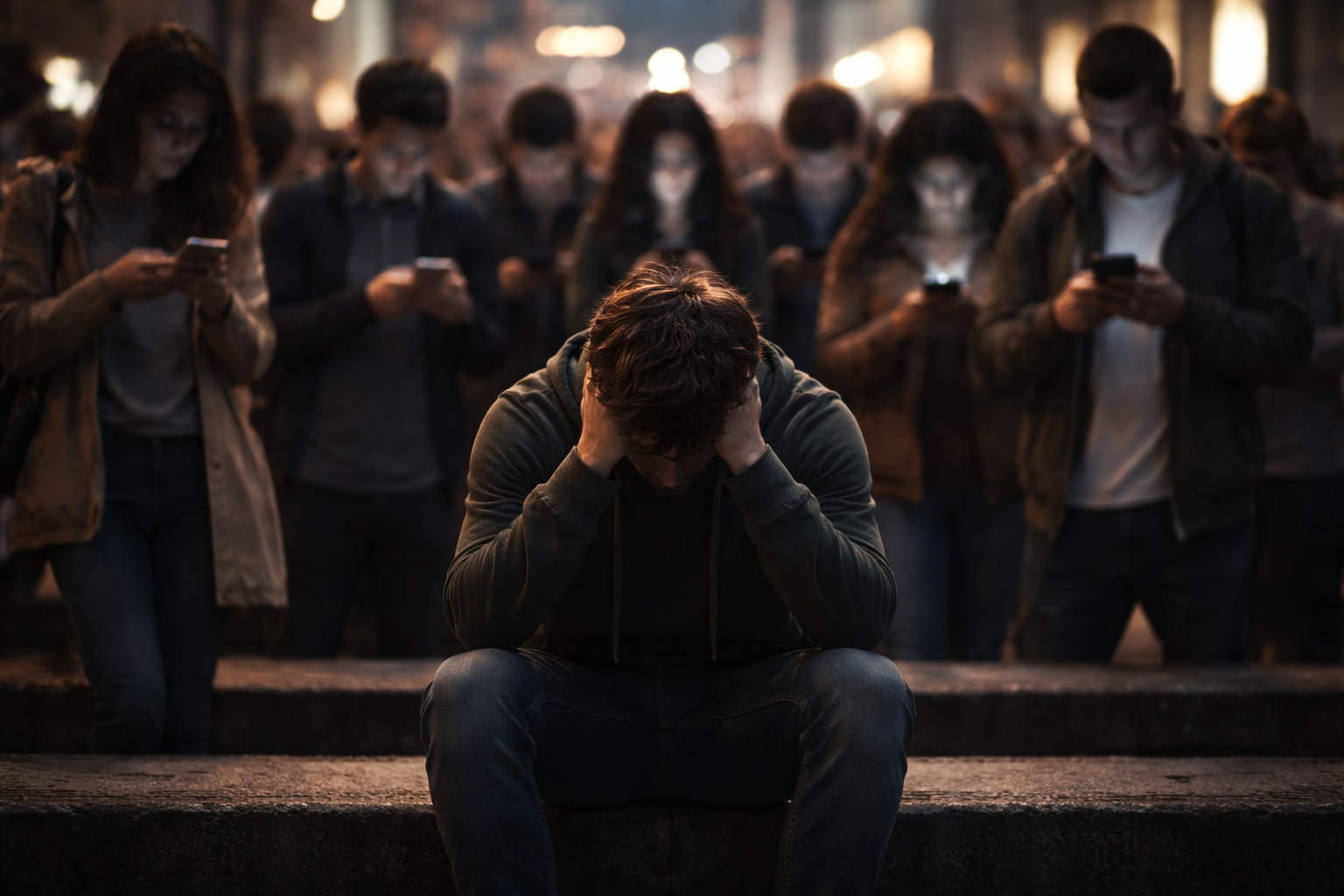
Personal suffering is no longer private.
In today’s world, mental health struggles are increasingly visible—
shared through social media, discussed in public discourse,
and even shaped by economic systems.
Depression, anxiety, and burnout are more widely recognized than ever before.
Yet stigma still exists.
At the same time, the digital age has created new dynamics—
where suffering can generate empathy, but also attention, engagement,
and sometimes profit.
So how should we understand personal suffering in modern society?
1. Mental Health and Social Stigma

Despite growing awareness, stigma has not disappeared.
Misconceptions About Mental Health
Many still believe:
- Depression is simply “feeling sad”
- Anxiety is a matter of weak will
But mental illness involves complex interactions
between brain chemistry, psychology, and environment.
Reducing it to attitude or effort
ignores its reality as a medical and social condition.
The Persistence of Stigma
In many societies, openly discussing mental health
can still lead to discrimination.
- Fear of workplace disadvantage
- Social judgment
- Limited access to support
In countries like Japan and South Korea,
concerns about reputation often prevent people from seeking treatment.
Public Figures and Changing Narratives
When athletes and public figures speak out,
the conversation shifts.
Naomi Osaka and Simone Biles
have openly addressed mental health challenges,
bringing visibility and legitimacy to these struggles.
Public discussion is slowly transforming stigma—
but the process remains incomplete.
2. Social Media: Between Empathy and Exposure

Social media has changed how suffering is shared.
The Rise of Collective Empathy
Platforms like Instagram, TikTok, and X
allow individuals to express vulnerability.
Hashtags such as:
- #MentalHealthAwareness
- #YouAreNotAlone
have created communities of support and connection.
For many, this is the first space
where they feel understood.
The Commodification of Suffering
However, visibility brings new risks.
Suffering can become:
- Content
- Aesthetic
- Engagement-driven material
Emotional expression may be amplified,
curated, or even exaggerated
to attract attention.
Some influencers build personal brands
around vulnerability.
In such cases, suffering shifts
from lived experience
to consumable content.
This raises a difficult question:
Are we witnessing genuine expression—
or performative pain?
3. Capitalism and the Industry of Suffering
In modern economies,
even suffering can become a market.
The Self-Help Industry
Self-improvement culture often frames suffering
as something to “overcome” and “optimize.”
Messages like:
- “Turn pain into success”
- “Become a better version of yourself”
can be empowering—
but also pressuring.
Not all suffering needs to be transformed.
Some of it needs to be understood.
Mental Health Apps and Digital Therapy
Apps such as Calm, Headspace, and BetterHelp
have expanded access to mental health resources.
But concerns remain:
- Lack of clinical validation
- Subscription-based dependency
- Data privacy issues
Research suggests that many digital services
lack strong scientific backing.
Meanwhile, those in greatest need
may still face financial barriers.
When Care Becomes a Commodity
As mental health becomes an industry,
a paradox emerges:
The more suffering is recognized,
the more it can be monetized.
This raises ethical concerns:
Is the goal healing—
or profit?
4. Rethinking How We View Suffering
If suffering is both shared and commercialized,
how should we respond?
Reducing Stigma
Mental health must be treated
as a public issue, not a private weakness.
Policies and cultural change
are both necessary.
Responsible Sharing
Social media can foster connection—
but requires awareness.
Empathy should not become exploitation.
Ethical Systems of Care
Mental health services must balance:
- Accessibility
- Professional integrity
- Ethical responsibility
Care should never be driven solely
by market logic.
Conclusion

We live in a time
where suffering is more visible than ever.
This visibility creates opportunity—
for empathy, understanding, and connection.
But it also creates risk—
of distortion, performance, and commodification.
The challenge is not to hide suffering,
nor to consume it—
but to recognize it
with depth, dignity, and responsibility.
So perhaps the real question is:
When we encounter someone’s pain,
are we truly understanding it—
or simply observing it?
Question for Readers
When you encounter someone’s suffering online, do you feel empathy—or are you simply observing it?
Related Reading
If suffering is no longer private, are we truly sharing pain—or performing it for an audience?
In Am I Falling Behind? — How Comparison Distorts Our Sense of Time, we explore how social media reshapes our perception of self and emotion, revealing how even our most vulnerable moments can be influenced by comparison, visibility, and silent pressure.
What if the emotions we express online are not entirely our own—but shaped by invisible systems around us?
In How Search Boxes Shape What We Think, we examine how algorithms subtly guide attention, behavior, and perception—suggesting that even the way suffering is seen, shared, and amplified may not be as independent as we assume.
Human beings often seek emotional recognition through symbolic gestures and rewards.
This emotional structure is explored in Why Is Candy a Symbol of Reward for Children?, where small rewards become tied to comfort, approval, and belonging.
References
- Hinshaw, S. P. (2007). The Mark of Shame: Stigma of Mental Illness and an Agenda for Change. Oxford University Press.
This book examines how stigma surrounding mental illness develops and persists across societies. It provides a framework for understanding the social barriers that prevent individuals from seeking help. - Turkle, S. (2011). Alone Together: Why We Expect More from Technology and Less from Each Other. Basic Books.
Turkle explores how digital communication reshapes human relationships and emotional expression, highlighting the paradox of increased connection alongside growing isolation. - Davies, J. (2013). Cracked: Why Psychiatry is Doing More Harm Than Good. Icon Books.
This work critically analyzes the commercialization of mental health care, questioning how economic systems influence diagnosis, treatment, and the broader understanding of psychological suffering.