The Lottery as a Symbol of Democratic Opportunity
Every Saturday night, millions of people sit in front of screens, watching numbers being drawn.
The lottery presents itself as a system open to everyone.
For the price of a small ticket, anyone can dream of winning a life-changing sum of money.
Background, education, occupation—none of these matter.
Everyone pays the same price and receives the same chance.
In this sense, the lottery appears to embody democratic opportunity.
In a capitalist society defined by unequal starting points, it offers a rare form of formal equality: equal access to hope.
From the perspective of participation alone, the lottery seems fair.
Both the wealthy and the working class stand in the same line, holding identical tickets.
But does equal access truly mean equal fairness?
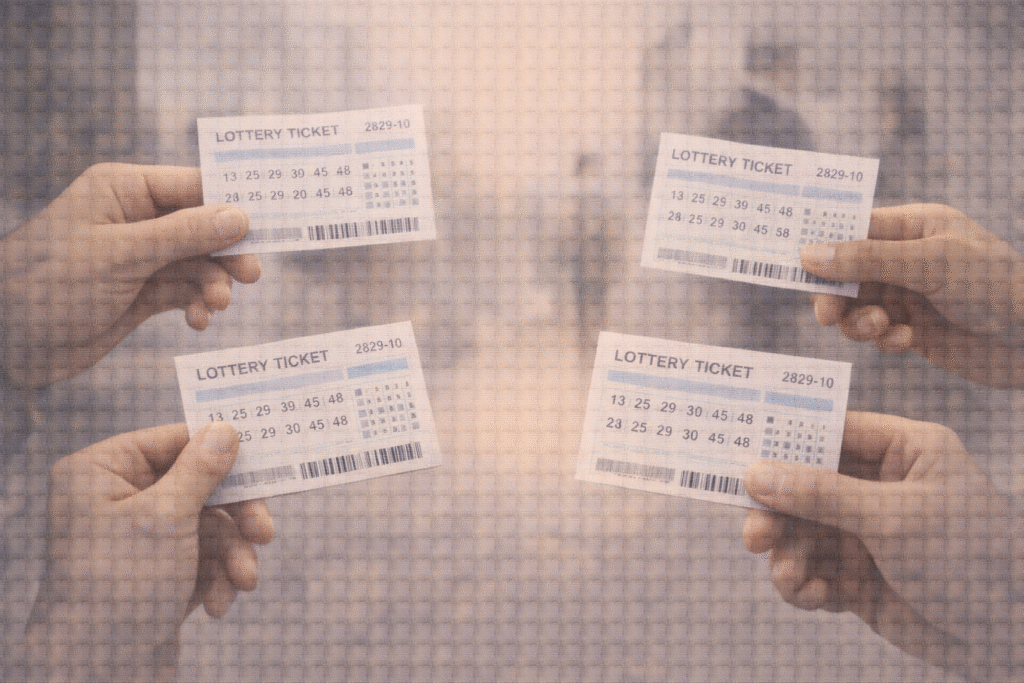
1. The Brutal Inequality of Probability
1.1 Equality of Access Does Not Mean Fair Outcomes
Equal opportunity does not guarantee just outcomes.
In most national lotteries, the probability of winning the jackpot is approximately 1 in 8 million—lower than the likelihood of being struck by lightning.
Formally, everyone has the same chance.
Substantively, almost everyone is guaranteed to lose.
This structure creates a paradox: a system that looks equal on the surface but is mathematically designed for mass failure.
1.2 Probability as Structural Inequality
As more people participate, the odds do not improve.
The expected outcome remains the same: repeated loss for the majority.
This becomes especially problematic when low-income individuals, under economic pressure, invest more money in the hope of a single transformative win.
In such cases, the lottery can reinforce poverty rather than alleviate it.
The door is open to all—but only a microscopic few can pass through.

2. The Psychology of the Lottery: The Economics of Hope
Why do people willingly participate in such an unfavorable game?
2.1 Behavioral Economics and Distorted Risk Perception
Behavioral economics shows that humans tend to overweight small probabilities when the potential reward is large.
The thought “It could be me” exerts a powerful psychological pull, far stronger than rational calculation.
2.2 Emotional Relief and Imagined Futures
The lottery is not merely a financial transaction.
It provides emotional relief—a temporary escape from daily constraints.
Until the numbers are drawn, people are free to imagine a different future.
That anticipation itself offers comfort, even when the outcome is almost certainly loss.
2.3 Social Comparison and Media Narratives
Media stories about lottery winners intensify this effect.
Seeing ordinary people suddenly become wealthy reinforces the illusion that success is just one ticket away.
In this sense, the lottery is not an investment—it is the consumption of hope.
3. Public Good or State-Sanctioned Gambling?
3.1 The Argument for Public Benefit
Governments often justify lotteries by emphasizing their contribution to public funds.
Revenue from lottery sales frequently supports welfare programs, cultural initiatives, sports, and education.
From this perspective, the lottery functions as a voluntary mechanism for financing public goods without raising taxes.
3.2 The Ethical Critique
At the same time, this structure invites serious criticism.
If low-income populations purchase a disproportionate number of tickets, the lottery effectively becomes a regressive system—often described as “a tax on the poor.”
The state, in this view, profits from the economic vulnerability of its citizens while framing the process as harmless entertainment.
What appears as public benefit may, in reality, be the monetization of desperation.
4. Between Opportunity and Inequality
The lottery has two faces.
4.1 Formal Equality
On one hand, it offers universal access.
No other social institution distributes “entry tickets” with such apparent fairness.
4.2 Substantive Inequality
On the other hand, only a vanishingly small minority ever converts opportunity into outcome.
For the vast majority, repeated participation leads to loss, not mobility.
Thus, equality of opportunity quietly transforms into inequality of results.
5. Toward Responsible Institutional Design
If lotteries are to exist without deepening social inequality, reforms are necessary.
- Transparent education: Clear communication that lotteries are entertainment, not investment.
- Fair redistribution: Strong oversight to ensure revenues genuinely benefit vulnerable groups.
- Spending limits: Mechanisms to prevent addiction and excessive financial loss.

Conclusion: Between Hope and Inequality
The lottery condenses a central contradiction of modern society.
It is open to everyone, yet designed for almost universal failure.
It offers hope while converting that hope into revenue.
Ultimately, the question remains:
Is the lottery a genuine expression of equal opportunity, or a system that disguises unequal probability behind the language of fairness?
The answer depends on whether we view the lottery as harmless entertainment—or as a structure that quietly reproduces social inequality.
Related Reading
Structural inequality and unequal access to opportunity are examined more broadly in The New Inequality of the AI Age: The Rise of Digital Refugees.
Perceptions of fairness and choice are further complicated by hidden psychological costs discussed in The Illusion of “Free”: How Zero Price Changes Our Decisions.
References
- Prospect Theory
Kahneman, D., & Tversky, A. (1979). Prospect Theory: An Analysis of Decision under Risk. Econometrica, 47(2), 263–291.
This foundational work explains how people systematically misjudge risk and probability, offering key insight into lottery participation. - Selling Hope
Clotfelter, C. T., & Cook, P. J. (1989). Selling Hope: State Lotteries in America. Harvard University Press.
A comprehensive analysis of state lotteries, framing them as institutionalized “hope markets” with deep social consequences. - Lottery Gambling: A Review
Ariyabuddhiphongs, V. (2011). “Lottery Gambling: A Review.” Journal of Gambling Studies, 27(1), 15–33.
This review synthesizes psychological and behavioral research on why individuals engage in lottery gambling. - Why the Poor Play the Lottery
Beckert, J., & Lutter, M. (2013). “Why the Poor Play the Lottery.” Sociology, 47(6), 1152–1170.
An empirical sociological analysis explaining class-based differences in lottery participation. - Regulating Lotteries
Miers, D. (2019). Regulating Lotteries. Routledge.
A comparative study examining how different countries balance public benefit and gambling-related harm.