Tag: Knowledge and Wisdom

  • Why Is Candy a Symbol of Reward for Children?

    — The Psychology of Sweetness and Behavioral Conditioning

    “Be brave and you’ll get candy.”
    “Finish your homework and here’s a treat.”
    “Don’t cry at the doctor, and you can have one.”

    Across many cultures, candy has become the universal symbol of reward for children.

    But why candy?
    Why not toys, books, or something else?

    Why has a small, sweet object become the emotional shorthand for praise?


    1. Sweetness Is Biologically Rewarding

    Child enjoying sweetness as instant reward

    Humans are wired to prefer sweetness from birth.

    Breast milk itself is sweet, and infants quickly show a strong positive reaction to sugary tastes.

    From an evolutionary perspective, sweetness signals energy-rich carbohydrates — a valuable resource in harsh environments.

    In other words, sweetness equals survival.

    Candy, therefore, triggers immediate pleasure responses in the brain’s reward system.

    For children, whose emotional regulation is still developing, such immediate reinforcement is especially powerful.


    2. From Luxury to Behavioral Tool

    Sugar was once rare and expensive.

    But after industrialization made sugar widely available in the 19th century, candy transformed from a luxury item into a mass-produced consumer good.

    At the same time, modern childhood emerged as a protected and emotionally significant stage of life.

    Candy began to function not merely as food, but as a behavioral incentive.

    “Good behavior = sweet reward.”

    This simple formula reinforced compliance, courage, and discipline.

    Over time, candy became embedded in parenting, schooling, and even medical routines.


    3. Candy as Emotional Recognition

    When adults give candy, they are not only giving sugar.

    They are giving acknowledgment.

    “You did well.”
    “I see your effort.”
    “You were brave.”

    Candy becomes a tangible symbol of recognition.

    For a child, this small object carries emotional meaning far beyond its size.

    It marks a moment of approval and belonging.


    4. Cultural Ritual and Symbolic Memory

    Today, candy is deeply woven into childhood rituals:

    Halloween trick-or-treating
    Birthday parties
    Doctor’s office reward baskets
    Holiday celebrations

    Through repetition, candy has become ritualized.

    It is no longer simply sweet.
    It is symbolic.

    It represents courage, obedience, growth, and celebration.

    These associations become part of early emotional memory.


    Conclusion: A Small Object, A Big Meaning

    Candy is not merely sugar.

    It is a compact emotional language.

    It links biology (reward circuits),
    economics (mass production of sugar),
    and culture (ritualized childhood practices).

    For children, candy often means:

    “You did well.”
    “You are loved.”
    “You belong.”

    Perhaps that is why its sweetness lingers far beyond taste.


    Related Reading

    The subtle emotional layering behind childhood memories and symbolic objects is further explored in The Texture of Time — How the Mind Shapes the Weight of Our Moments, where lived experience gradually transforms simple sensations into lasting meaning.

    In the digital age, the way small pleasures evolve into social comparison is examined in How Social Media Amplifies Feelings of Lack and Comparison, where personal satisfaction can quietly shift into a metric of visibility and validation.

    References

    1. Mintz, S. W. (1985). Sweetness and Power: The Place of Sugar in Modern History. Viking Penguin.
    → Mintz explores how sugar became embedded in systems of power, consumption, and social meaning, showing how sweetness evolved from luxury to everyday reward.

    2. Allison, A. (2006). Millennial Monsters: Japanese Toys and the Global Imagination. University of California Press.
    → Allison examines how children’s consumer culture connects toys, treats, and reward structures, highlighting how material goods mediate emotion and identity.

    3. Zelizer, V. A. (1994). Pricing the Priceless Child. Princeton University Press.
    → Zelizer analyzes the changing cultural value of children in modern society, explaining how material tokens such as gifts and treats became expressions of emotional recognition.
  • Why We Excuse Ourselves but Blame Others

    — Understanding the Actor–Observer Bias

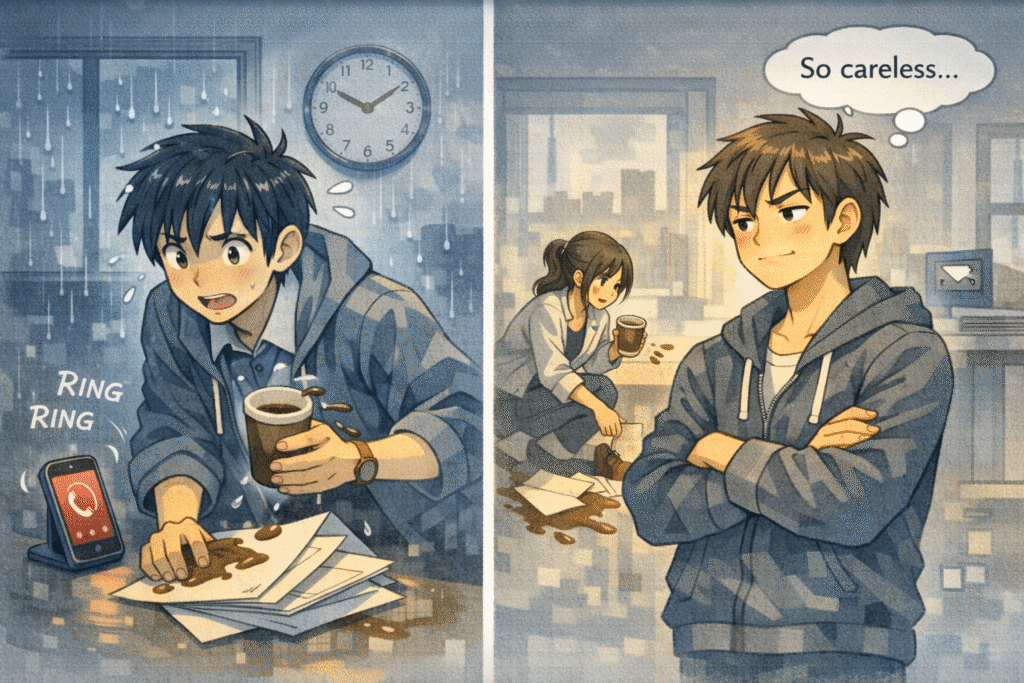
    Different perspectives in judging behavior

    When I make a mistake,
    “I had a good reason.”

    When someone else makes the same mistake,
    “What’s wrong with them?”

    Have you noticed this pattern?

    If someone cuts in traffic, we feel anger.
    But when we cut in because we are late,
    we expect understanding.

    This common psychological tendency is known as the Actor–Observer Bias.


    1. My Behavior Is Situational. Yours Is Personal.

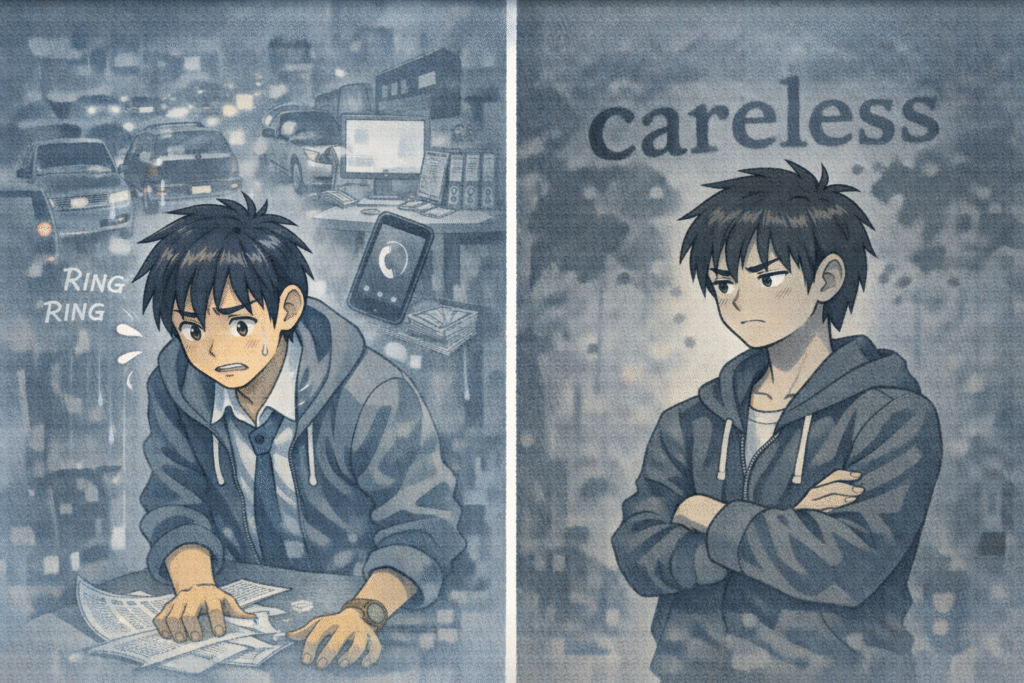
    Situational versus personal attribution bias

    The concept was introduced by Edward Jones and Richard Nisbett in the 1970s.

    The idea is simple:

    When I fail → It was the situation.
    When you fail → It was your personality.

    If I miss a deadline,
    “I was overwhelmed.”

    If you miss a deadline,
    “You’re irresponsible.”

    As actors in our own lives, we see context.
    As observers of others, we see character.


    2. The Power of Perspective

    This bias stems from point of view.

    When I act, I know what I was feeling,
    what constraints I faced,
    what pressure I experienced.

    When I observe you,
    I see only the visible behavior.

    My inner world is vivid to me.
    Yours is invisible.

    That asymmetry creates distorted judgment.


    3. Why It Damages Relationships

    The bias becomes sharper in close relationships.

    If I respond late:
    “I had a stressful day.”

    If you respond late:
    “You don’t care anymore.”

    We interpret our own behavior through circumstance,
    but others’ behavior through intention.

    Over time, this pattern breeds misunderstanding and resentment.


    4. How to Reduce the Bias

    Awareness is the first step.

    Before judging, try asking:

    “What situation might they be in?”
    “Would I act differently under the same pressure?”

    Switching perspective softens attribution.

    Replacing
    “Why are they like that?”
    with
    “What might have happened?”

    can transform conflict into understanding.


    Conclusion

    Changing perspective to reduce blame

    We see ourselves in full color and others in outline.

    The Actor–Observer Bias is not a flaw of bad character.
    It is a built-in feature of human cognition.

    But once we recognize it,
    we gain a choice.

    A choice to pause.
    A choice to interpret more gently.
    A choice to understand before blaming.

    Sometimes, empathy begins with changing the angle of view.

    Related Reading

    The psychological roots of self-perception and social comparison are further explored in The Sociology of Selfies, where identity and recognition are analyzed in digital contexts.
    From a structural perspective, The Age of Overexposure: Why Do We Turn Ourselves into Products? expands this discussion by questioning how social systems amplify performative identity.


    References

    1. Jones, E. E., & Nisbett, R. E. (1972). The Actor and the Observer: Divergent Perceptions of the Causes of Behavior. In Attribution: Perceiving the Causes of Behavior.
    → This foundational work formally introduced the actor–observer bias and demonstrated how individuals attribute their own actions to situational factors while attributing others’ actions to personality traits.

    2. Ross, L. (1977). The Intuitive Psychologist and His Shortcomings. In Advances in Experimental Social Psychology.
    → Ross developed the concept of the fundamental attribution error, closely related to the actor–observer bias, highlighting how people underestimate situational influences when judging others.

    3. Gilbert, D. T. (1998). Ordinary Personology. In The Handbook of Social Psychology.
    → Gilbert explains how everyday people form quick judgments about others and why attribution biases persist even when we attempt to be objective.

  • Why Do Emojis Convey Emotion Better Than Words?

    — The Psychology of Visual Language

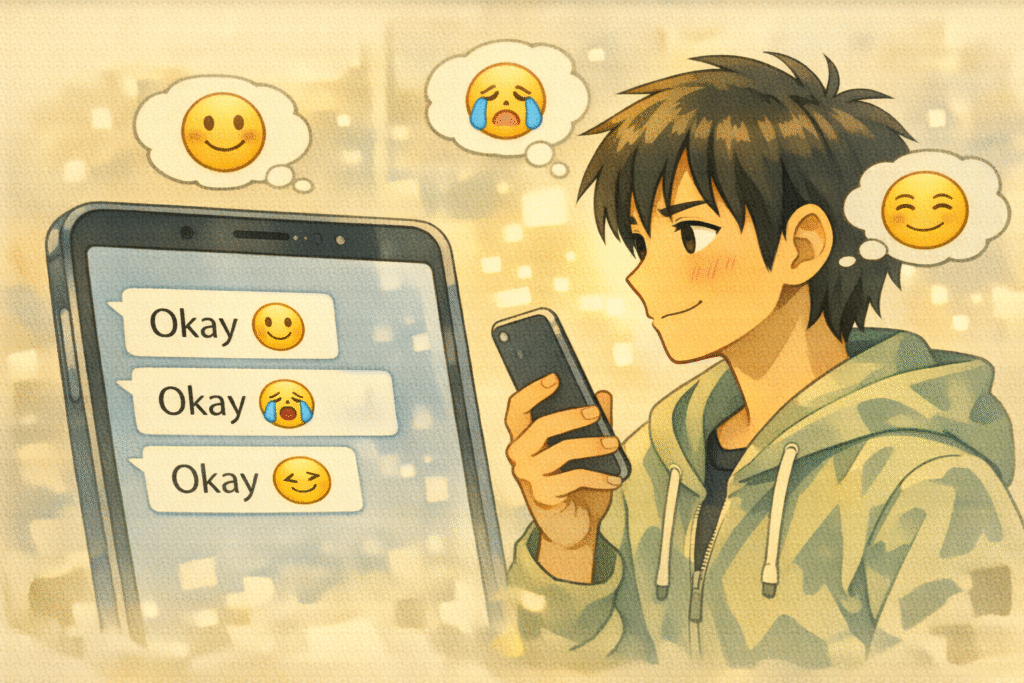
    Same text message showing different emotions with emojis

    “Okay.”

    “Okay 🙂”

    “Okay 😭”

    The word is the same.
    But the feeling changes completely.

    In an age where most conversations happen on screens,
    emojis are no longer decoration.
    They are emotional tools.

    Sometimes, a tiny icon communicates more clearly than a full sentence.

    So why does a small visual symbol carry such powerful emotional weight?


    1. Emojis Replace Lost Facial Expressions

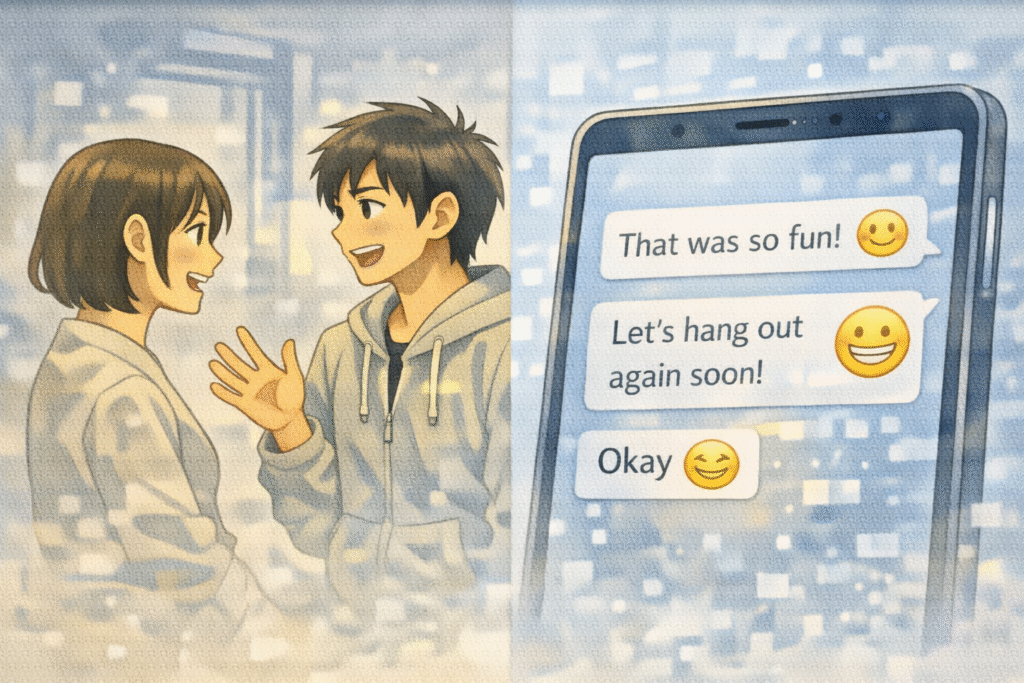
    Emoji replacing facial expression in digital communication

    Human communication is deeply nonverbal.

    In face-to-face conversations,
    tone of voice, facial expression, eye movement, and gestures
    all shape meaning.

    But digital text strips these cues away.

    Emojis step in as substitutes for facial expressions.

    🙂 softens a statement.
    😅 signals nervous humor.
    🙃 suggests irony.

    They restore emotional nuance that plain text cannot easily provide.


    2. Emojis Compress Emotion Efficiently

    Psychology suggests that symbols can compress complex information into simple forms.

    Instead of writing:
    “I support you even if I cannot say much,”
    we might simply send:

    💪✨

    A single emoji can carry encouragement, warmth, and solidarity.

    Emojis allow emotional richness without slowing conversation.

    They are efficient containers of feeling.


    3. Emojis Clarify Intent

    Digital text is highly ambiguous.

    “Nice job.”
    Is it sincere? Sarcastic? Passive-aggressive?

    Add an emoji:

    “Nice job 😍” → Genuine praise
    “Nice job 😏” → Playful teasing
    “Nice job 🤨” → Suspicion

    Emojis reduce misinterpretation by signaling intent.

    They act as emotional safety devices in fragile digital spaces.


    4. Emojis as a Global Emotional Language

    Words differ across cultures.
    Smiles do not.

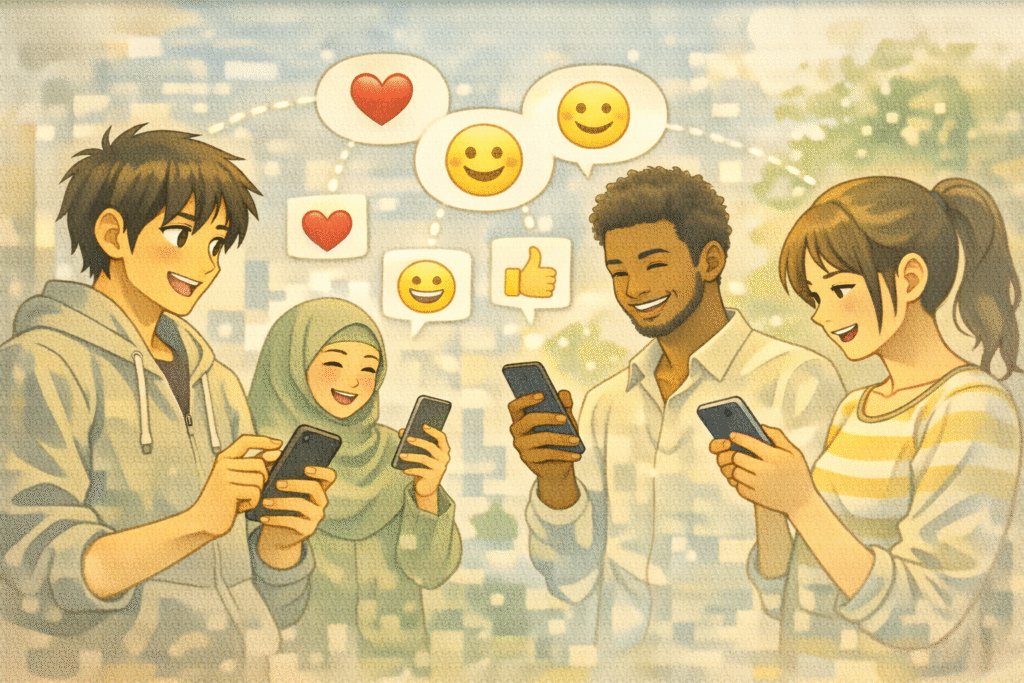
    😊 👍 ❤️

    These symbols transcend linguistic boundaries.

    In cross-cultural communication, emojis often bridge emotional gaps faster than translated sentences.

    They represent a new shared visual vocabulary of empathy.


    Conclusion: A Quiet Evolution of Language

    Emojis connecting people across cultures

    Emojis are not replacing language.
    They are expanding it.

    They compensate for the emotional limitations of text-based communication.

    They make digital interaction warmer, softer, and more human.

    Next time you send a message,
    ask not only what you want to say,
    but how you want it to feel.

    Sometimes, a symbol speaks before the sentence does.

    Related Reading

    The transformation of communication and identity is further explored in The Sociology of Selfies, which investigates how digital expression reshapes social presence.
    On a political and structural level, Automation of Politics: Can Democracy Survive AI Governance? considers how algorithmic systems increasingly mediate human interaction and decision-making.

    References

    1. Evans, V. (2017). The Emoji Code: The Linguistics Behind Smiley Faces and Scaredy Cats. Picador.
    → This book frames emoji as an evolutionary stage of digital language. Evans argues that emoji function as pragmatic emotional markers, restoring tone and nuance lost in text-only communication.

    2. Danesi, M. (2016). The Semiotics of Emoji: The Rise of Visual Language in the Age of the Internet. Bloomsbury Academic.
    → Danesi explores emoji through semiotics, showing how visual symbols increasingly operate as meaningful linguistic units rather than decorative elements in digital discourse.

    3. Crystal, D. (2008). Txtng: The Gr8 Db8. Oxford University Press.
    → Crystal’s work on digital language provides theoretical grounding for understanding how abbreviated forms, emoticons, and emoji reshape emotional and pragmatic communication online.

  • Why It Feels Like Everyone Is Watching You: The Spotlight Effect

    Feeling watched in a public space despite no attention

    You get a new haircut, and suddenly it feels strange.
    You sit alone in a café and become aware of every movement.
    You stumble slightly on the subway and feel as if all eyes are on you.

    Have you ever had that feeling — that people around you are paying unusually close attention to you?

    Psychology has a name for this experience.
    It is called the spotlight effect, also known as self-relevance bias.


    1. We See the World From the Center of Ourselves

    1.1 The Natural Focus on the Self

    From birth, we experience the world from a first-person perspective.
    This makes self-awareness a natural part of being human.

    We constantly monitor how we look, how we sound, and how we appear to others. This sensitivity helps us navigate social life — but it also creates distortions.

    1.2 When Self-Awareness Becomes Overestimation

    Because we are so aware of ourselves, we often assume others are just as focused on us. In reality, this is rarely the case.

    The result is an illusion: we feel as if our actions and appearance stand out far more than they actually do.


    2. A Classic Experiment: “No One Noticed My Shirt”

    Overestimating others’ attention due to self-focus

    2.1 The Harvard T-Shirt Study

    In a well-known study conducted at Harvard University in 2000, participants were asked to wear an unattractive, embarrassing T-shirt into a classroom.

    Afterward, they were asked how many people they thought had noticed the shirt.

    On average, participants believed about 50% of others had noticed.
    In reality, only 10–15% actually did.

    2.2 The Gap Between Feeling and Reality

    This experiment clearly shows the gap between perceived attention and actual attention. We dramatically overestimate how much others notice us.

    What feels like a spotlight is often just a dim light.


    3. How the Bias Fuels Anxiety

    3.1 When the Effect Becomes Stronger

    The spotlight effect intensifies in situations such as:

    • Being in unfamiliar environments
    • Making mistakes
    • Feeling insecure about appearance or behavior
    • Being evaluated (presentations, interviews)

    3.2 From Awareness to Anxiety

    In these moments, excessive self-focus can lead to tension and withdrawal. In some cases, it contributes to social anxiety, making public spaces feel threatening rather than neutral.


    4. The Truth: Everyone Else Is Busy Being Themselves

    4.1 Others Are Not Watching — They Are Thinking

    The irony is simple: just as you are focused on yourself, others are absorbed in their own concerns.

    Your small mistake feels significant to you — but to others, it is often unnoticed or quickly forgotten.

    4.2 We Are All Main Characters in Our Own Stories

    Most people are not observers of your life.
    They are protagonists in their own.


    Conclusion

    People focused on their own thoughts, not others

    Feeling watched, judged, or remembered can be deeply uncomfortable.
    But most of the time, this feeling is not reality — it is the mind’s exaggeration of its own importance.

    People notice you far less than you imagine.
    Your mistakes rarely leave lasting impressions.

    So when that familiar anxiety appears, try this reminder:

    The spotlight is mostly in your head.

    And perhaps, that realization itself can be a quiet relief.

    Related Reading

    The psychology of subtle social perception is expanded in Social Attractiveness and the Psychology of Likeability, where unspoken cues shape interpersonal dynamics.

    The deeper philosophical question of withdrawal and presence is discussed in Is Solitude a Freedom of Self-Reflection, or a Risk of Social Disconnection? exploring the tension between connection and distance.


    References

    1.Gilovich, T., Medvec, V. H., & Savitsky, K. (2000). “The Spotlight Effect in Social Judgment: An Egocentric Bias in Estimates of the Salience of One’s Own Actions and Appearance.” Journal of Personality and Social Psychology, 78(2), 211–222.
    This seminal study introduced the concept of the spotlight effect, demonstrating experimentally that people greatly overestimate how much others notice them.

    2.Baumeister, R. F., & Bushman, B. J. (2021). Social Psychology and Human Nature (5th ed.). Boston: Cengage Learning.
    This textbook provides a comprehensive explanation of self-awareness, self-presentation, and cognitive biases, offering a broader framework for understanding self-relevance bias.

    3.Leary, M. R. (2007). The Curse of the Self: Self-Awareness, Egotism, and the Quality of Human Life. Oxford: Oxford University Press.
    Leary explores how excessive self-focus affects well-being, showing how heightened self-awareness can amplify social sensitivity and unnecessary anxiety.

  • Why Elevator Silence Feels So Uncomfortable: Unspoken Social Rules

    Morning rush hour.
    An elevator packed with strangers.

    No one speaks, yet the space feels strangely tense.
    A sigh, a cough, or the sound of a phone screen lighting up subtly shifts the atmosphere. Someone checks their phone, and others instinctively glance away — or glance too much.

    The elevator is small and quiet, but rarely comfortable.

    Why does such a brief, silent moment feel so awkward?


    Awkward silence among strangers in an elevator

    1. Physical Closeness and Psychological Distance

    1.1 When Personal Space Disappears

    Elevators force strangers into close physical proximity within a confined space. According to psychological research on personal space, people feel most comfortable when a certain distance from others is maintained.

    In elevators, this distance collapses.

    When physical closeness is not accompanied by social interaction, the brain registers tension. We are close to others, yet socially disconnected — a combination that easily produces discomfort.

    1.2 The Brain Never Stops Noticing Others

    Even in silence, our minds continuously monitor those around us. When someone stands too close, we may feel irritation or defensiveness without knowing why.

    Elevators create a paradox: physical intimacy without emotional familiarity. This imbalance places quiet strain on both body and mind.

    Lack of personal space in a crowded elevator

    2. When Silence Becomes a Rule

    2.1 Silence as an Unspoken Norm

    Most people do not speak in elevators.
    Over time, this absence of speech becomes an implicit rule.

    Sociologist Erving Goffman described such patterns as “interaction frames” — shared expectations that guide behavior in specific situations.

    2.2 Breaking the Frame

    In elevators, silence is treated as politeness.
    Someone who speaks loudly on the phone or initiates casual conversation is often perceived as violating the situation’s frame.

    The silence, then, is not neutral.
    It is a collectively maintained form of self-regulation and mutual monitoring.


    3. A Space of Nonverbal Communication

    Nonverbal social rules inside an elevator

    3.1 Communication Without Words

    Interestingly, elevators are full of communication — just not verbal.

    A brief glance
    A slight turn of the body toward the wall
    The careful extension of a hand to press a button
    A small nod to someone holding the door

    3.2 Cooperation Through Gesture

    These gestures help reduce tension and signal cooperation.
    Because words are absent, nonverbal actions become more visible — and more meaningful.

    At the same time, this heightened sensitivity makes the space vulnerable to awkwardness. Small missteps feel amplified.


    4. Why Elevators Feel Especially Intense

    4.1 The Pressure of No Escape

    In cafés or parks, we can leave whenever we want.
    Elevators offer no such freedom.

    Once inside, we must wait until the doors open again.

    4.2 Silence Under Confinement

    This temporary lack of exit heightens awareness.
    Sounds feel louder. Movements feel heavier. Silence feels thicker.

    The discomfort of elevator silence is not just about quiet — it is about being enclosed in a shared social situation with no way out.


    Related Reading

    The psychological mechanisms behind self-perception and social visibility are further explored in TThe Sociology of Selfieshe Sociology of Selfies, where digital identity and performative presence are analyzed.
    From a structural and philosophical perspective, TThe Age of Overexposure: Why Do We Turn Ourselves into Products?he Age of Overexposure: Why Do We Turn Ourselves into Products? expands this discussion by examining how social systems amplify the feeling of constant exposure.

    Conclusion

    The silence in elevators feels uncomfortable because it is not empty.
    It is filled with social rules, psychological tension, and silent coordination.

    Within that small space, we constantly adjust ourselves — our gaze, posture, and presence — in response to others, even without speaking.

    If you feel awkward in an elevator, it is not a personal flaw.
    It is a shared response to a space governed by unspoken norms.

    The discomfort is not yours alone.
    It belongs to all of us, quietly standing together in silence.


    References

    1.Goffman, E. (1959). The Presentation of Self in Everyday Life. New York: Anchor Books.
    Goffman analyzes how individuals manage impressions in social settings. Elevator silence can be understood as a form of “front-stage” behavior, where individuals carefully regulate their actions under the gaze of others.

    2.Hall, E. T. (1966). The Hidden Dimension. New York: Doubleday.
    This classic work introduces the concept of proxemics, explaining how physical distance influences psychological comfort. It is essential for understanding discomfort in confined spaces like elevators.

    3.Argyle, M. (1988). Bodily Communication (2nd ed.). London: Methuen.
    Argyle explores nonverbal communication, offering insight into how gestures, posture, and eye contact function as silent social signals in situations where speech is absent.

  • Why Do We Always Feel Busy? The Social Pressure of Time

    “I have no time.”

    “Today flew by.”

    “I didn’t even get a moment to rest this weekend.”

    Most of us say these things almost automatically.
    Yet, when we look closely, our schedules are not always as full as our exhaustion suggests.

    So a question arises:
    Why do we feel busy even when we are not doing that much?


    1. Time Is a Feeling: Psychological Time vs. Clock Time

    Fragmented time and constant distractions in modern life

    1.1 The Difference Between Measured and Lived Time

    The time we experience is not the same as the time measured by clocks.
    Psychologists distinguish between physical time and perceived time.

    An hour spent watching a favorite movie can pass in an instant, while ten minutes of worrying about unfinished tasks can feel unbearably long.

    1.2 Why Modern Time Feels Fragmented

    Our sense of time is shaped by emotion, attention, and environment.
    Constant notifications, emails, messages, and social media alerts repeatedly interrupt our focus.

    Even without completing many tasks, our attention becomes fragmented.
    As a result, the day feels scattered, unproductive, and exhausting — leaving us with the impression that we were “busy” all along.


    2. Saying “I’m Busy” as Social Self-Defense

    2.1 Busyness as a Social Signal

    When asked, “How are you doing?”, many people instinctively answer, “I’m busy.”

    This response is not just a factual update.
    Psychologists describe it as a form of social self-presentation.

    Busyness as a social identity in everyday life

    2.2 When Busyness Equals Competence

    In competitive societies, busyness is often equated with usefulness and capability.
    To appear busy is to appear productive, valuable, and responsible.

    Conversely, appearing relaxed or unoccupied can feel risky — as if it signals laziness or irrelevance. Over time, we internalize this script and begin to believe we are busy even when we are not.


    3. More “Shoulds” Than Actual Tasks

    3.1 The Pressure to Always Be Doing Something

    We may not have many urgent tasks, but our minds are filled with things we feel we should be doing.

    Scrolling through social media can trigger thoughts like:
    “Everyone else is exercising.”
    “Everyone else is improving themselves.”
    “I should be doing more.”

    3.2 FOMO and Constant Mental Tension

    This pressure is closely linked to FOMO (Fear of Missing Out).
    Even without taking action, we remain mentally alert, comparing ourselves and anticipating future demands.

    The result is a constant state of tension — a feeling of being chased by time without actually moving.


    4. “Time Is Money”: Addiction to Efficiency

    4.1 When Every Moment Must Be Useful

    From an early age, many of us learn that time should never be wasted.
    This belief, rooted in industrial and capitalist values, turns time into a resource that must always generate value.

    Even rest is evaluated:
    “Is this productive rest?”
    “Is this helping me improve?”

    4.2 When Efficiency Becomes Exhausting

    An efficiency-centered view of time makes stillness uncomfortable.
    It keeps us asking, “Am I doing enough?” — a question that never truly ends.

    In this way, busyness becomes less about tasks and more about identity.


    Conclusion: Recovering Slowness

    Quiet moment of slowing down without productivity pressure

    Feeling busy is not simply a scheduling problem.
    It is a psychological state shaped by social expectations, time culture, and self-worth.

    The solution, therefore, is not only to reduce tasks, but to rethink how we relate to time.

    Allowing moments where nothing needs to be done.
    Accepting rest as a meaningful outcome.
    Remembering that moving slowly does not mean falling behind.

    These small shifts can loosen the grip of constant busyness.

    If you feel busy all the time, today, being slow is allowed.

    Related Reading

    The social construction of productivity is analyzed in Sleep: A Fundamental Human Right or a Tool for Productivity?Sleep: A Fundamental Human Right or a Tool for Productivity?, which challenges the moralization of efficiency.

    A structural perspective on modern comparison culture appears in How Social Media Amplifies Feelings of Lack and ComparisonHow Social Media Amplifies Feelings of Lack and Comparison, highlighting how digital environments intensify temporal anxiety.


    References

    1.Rosa, H. (2013). Social Acceleration: A New Theory of Modernity. New York: Columbia University Press.
    Rosa analyzes how modern societies experience constant acceleration, showing that feelings of time pressure are rooted in structural and cultural change rather than individual failure.

    2.Southerton, D. (2009). “Re-ordering Temporal Rhythms: Coordinating Daily Practices in the UK.” Time & Society, 18(1), 91–113.
    This study examines how social scheduling and fragmented daily rhythms contribute to chronic feelings of busyness and time scarcity.

    3.Wajcman, J. (2015). Pressed for Time: The Acceleration of Life in Digital Capitalism. Chicago: University of Chicago Press.
    Wajcman explores how digital technologies reshape attention and time perception, explaining why modern individuals feel increasingly busy despite technological convenience.

  • “Opportunity Favors the Prepared”? The Psychology of Hindsight Bias

    “Opportunity favors the prepared.”

    It is one of the most familiar sayings in modern culture.
    We hear it in interviews with successful people, read it in self-help books, and repeat it as practical wisdom about life and effort.

    At first glance, the phrase sounds undeniably true.
    But psychologists suggest that this belief often rests on a subtle cognitive illusion — one known as hindsight bias.

    Why do we find this idea so convincing?
    And what does it reveal about how we interpret success and failure?

    Success reinterpreting the past through hindsight bias

    1. Explaining Success After the Fact

    1.1 The Human Need for Coherent Stories

    People have a strong tendency to explain outcomes after they occur.
    When someone becomes successful, we search their past for clues that make the result seem inevitable.

    A famous inventor, for example, may be described as having loved machines since childhood. That detail then becomes proof that success was always destined — even though countless others shared similar interests and never achieved recognition.

    1.2 What Is Hindsight Bias?

    This tendency is known as hindsight bias: the inclination to believe, after knowing an outcome, that it was predictable all along.

    Seen through this lens, the idea that “opportunity favors the prepared” may not describe how success actually happens. Instead, it reflects how we reinterpret the past once success is already visible.


    2. When Failure Becomes a Personal Fault

    2.1 Shifting Responsibility to the Individual

    One troubling consequence of this belief is how easily it assigns blame.
    If success is proof of preparation, then failure appears to signal personal deficiency.

    “You missed the opportunity because you were not ready.”

    This explanation feels simple — but it ignores reality.

    Feeling self-blame after missing an opportunity

    2.2 The Weight of Structural Inequality

    Opportunities are not distributed fairly.
    Luck, social capital, economic background, and timing all play powerful roles.

    For those who were prepared yet never given a chance, the phrase can turn inward, becoming a source of self-blame and lowered self-worth. In this way, a comforting slogan can quietly reinforce psychological pressure and social inequality.


    3. Why We Find the Phrase So Comforting

    3.1 The Illusion of Control

    If the saying is flawed, why does it remain so appealing?

    Psychologists argue that it offers an illusion of control.
    In an unpredictable world, the belief that effort guarantees opportunity provides emotional relief.

    “If I prepare enough, I can manage the future.”

    3.2 Motivation, Even When It Is Incomplete

    Although this sense of control may be exaggerated, it can still motivate action.
    The belief that preparation matters encourages persistence, learning, and hope — especially in uncertain environments.

    In this sense, the phrase functions less as an objective truth and more as a psychological coping strategy.


    4. Does Preparation Still Matter?

    4.1 Yes — But Not in the Way We Imagine

    None of this suggests that preparation is meaningless.
    Preparation often determines whether an opportunity is noticed or usable when it appears.

    What it does not guarantee is success.

    4.2 Beyond Individual Responsibility

    Equally important is recognizing that preparation alone cannot compensate for unequal access to opportunity.
    Some people lack safe spaces to study. Others benefit from networks and resources long before effort even begins.

    When preparation is emphasized without acknowledging these conditions, the narrative risks hiding structural injustice behind personal virtue.


    Conclusion

    “Opportunity favors the prepared” is a phrase that sounds wise — and sometimes helps us move forward.

    But beneath it lie selective memory, individualized blame, and a deep human desire for control.

    Preparation matters.
    So do chance, context, and fairness.

    By acknowledging the complexity behind success and failure, we may learn to judge ourselves and others with greater accuracy — and greater compassion.


    Related Reading

    The illusion of control and cognitive framing is explored in Clicktivism in Digital Democracy: Participation or Illusion?, where action may not equal impact.

    A broader examination of perfection and self-expectation appears in Why Do Humans Seek Perfection While Knowing Why Do Humans Seek Perfection While Knowing They Are Incomplete?They Are Incomplete?, connecting hindsight bias with identity formation.

    References

    1. Fischhoff, B. (1975). “Hindsight ≠ Foresight: The Effect of Outcome Knowledge on Judgment Under Uncertainty.” Journal of Experimental Psychology: Human Perception and Performance, 1(3), 288–299.
    This classic study empirically demonstrates hindsight bias, showing how knowledge of outcomes distorts our perception of predictability. It provides the theoretical foundation for understanding how success narratives are reconstructed after the fact.

    2.Ross, L., & Nisbett, R. E. (1991). The Person and the Situation: Perspectives of Social Psychology. New York: McGraw-Hill.
    This work explores how people overemphasize individual traits while underestimating situational factors. It is particularly useful for analyzing how opportunity and preparation are often framed as personal responsibility rather than structural conditions.

    3.Gladwell, M. (2008). Outliers: The Story of Success. New York: Little, Brown and Company.
    Gladwell argues that success emerges from cumulative advantages, timing, and social context as much as individual effort. The book effectively challenges the myth of the purely “prepared individual.”