Tag: identity

  • Is Memory a Container of Truth, or a Story Constantly Rewritten?

    Unforgettable memories, returning in unfamiliar forms

    We often treat memory as a reliable archive of facts.
    A childhood scene, a defining relationship, a historical moment—
    we assume these memories are stored somewhere inside us, intact and unchanged, like photographs preserved over time.

    Yet memory behaves strangely.
    With the passing years, details blur. Emotions shift.
    The same event resurfaces with altered meanings, missing pieces, or unexpected additions.
    When two people recall the same moment, their accounts rarely align perfectly.

    So what, then, is memory?
    Is it a container holding the truth of the past,
    or a story that is rewritten each time it is told?

    Memory represented as a container holding fixed moments from the past

    1. The Nature of Memory: Not Recording, but Reconstruction

    Psychological research has long shown that memory is not a passive recording device.
    It is an active, reconstructive process.

    The work of Elizabeth Loftus demonstrated how easily memories can be altered by suggestion.
    Eyewitnesses exposed to subtly different questions recalled different details of the same event.
    Over time, confidence in false memories often increased rather than diminished.

    Memory, then, does not simply retrieve facts.
    It rebuilds the past using fragments, emotions, expectations, and present-day perspectives.
    What we remember is shaped as much by who we are now as by what happened then.

    Human memory shown as a constantly reconstructed narrative rather than a fixed record

    2. Philosophical Perspectives: Truth or Interpretation?

    Philosophically, memory sits at the intersection of truth and interpretation.

    Rather than preserving objective reality, memory interprets the past from the standpoint of the present.
    Friedrich Nietzsche famously suggested that memory depends on forgetting—that selective remembrance is what allows life to continue.

    From this view, memory is not a failure of accuracy but a condition of meaning.
    The past becomes intelligible only when filtered, organized, and narrated.

    Truth in memory is therefore not absolute correspondence with facts,
    but coherence within a lived narrative shaped by time, identity, and perspective.


    3. Collective Memory and History: Who Decides What Is Remembered?

    If individual memory is fragile, collective memory is even more complex.

    Societies remember through monuments, anniversaries, textbooks, and museums.
    Yet remembrance is never neutral. Some events are emphasized, others erased.

    Wars are remembered differently by victors and the defeated.
    What one group calls liberation, another may record as rebellion.
    These narratives do not simply describe the past—they legitimize present identities and power structures.

    Collective memory, then, is not merely shared recollection.
    It is a political and cultural construction shaped by authority, ideology, and selection.


    4. Neuroscience: Memory as a Dynamic Process in the Brain

    Neuroscience reinforces this view of memory as fluid rather than fixed.

    When a memory is recalled, neural networks are reactivated and modified.
    The act of remembering itself changes the memory.

    Rather than retrieving a static file, the brain reconstructs an experience anew,
    strengthening some connections while weakening others.

    This explains why memories can feel vivid yet unreliable—
    they are living processes, not stored objects.


    5. Memory in the Digital Age: Permanent Records vs. Human Forgetting

    The tension between truth and meaning in human memory

    Digital technology introduces a new tension.

    Photos, videos, messages, and social media archives preserve moments indefinitely.
    Unlike human memory, digital memory does not forget.

    Yet forgetting plays a crucial role in psychological healing and growth.
    Human memory softens pain, reshapes meaning, and allows renewal.

    Digital permanence, by contrast, can trap individuals in past versions of themselves.
    This is why debates around the “right to be forgotten” have emerged—
    not as a rejection of truth, but as a defense of human dignity and temporal change.


    Conclusion: Memory as Both Container and Story

    Memory is neither a flawless container of truth nor mere fiction.
    It is both archive and narrative—holding traces of reality while continuously reshaping them.

    Its value lies not in perfect accuracy, but in meaning-making.
    Memory forms identity, connects individuals to communities, and binds past to present.

    Recognizing the fragility of memory does not weaken truth.
    Instead, it invites humility, reflection, and responsibility in how we remember.

    Memory is not simply how we hold on to the past.
    It is how the past continues to speak—through stories we are always, inevitably, rewriting.


    Related Reading

    Questions about memory and truth overlap with cultural interpretations discussed in A Cultural History of Dream Interpretation.

    Everyday experiences of narrative reconstruction are also reflected in The Sociology of Waiting in Line.

    References

    1. Loftus, E. F. (2005). Planting Misinformation in the Human Mind: A 30-Year Investigation of the Malleability of Memory. Learning & Memory, 12(4), 361–366.
    This landmark study demonstrates how easily human memory can be distorted by external information. Loftus shows that memory is highly malleable, challenging the assumption that recollection reliably reflects objective truth.

    2. Schacter, D. L. (2001). The Seven Sins of Memory: How the Mind Forgets and Remembers. Boston: Houghton Mifflin.
    Schacter categorizes common memory errors and explains why forgetting and distortion are not flaws but functional features of human cognition. The book reframes memory as an adaptive, reconstructive system.

    3. Halbwachs, M. (1992). On Collective Memory. Chicago: University of Chicago Press.
    Halbwachs introduces the concept of collective memory, arguing that individual remembrance is always shaped by social frameworks. This work remains foundational for understanding memory as a social and cultural process.

    4. Neisser, U. (1981). John Dean’s Memory: A Case Study. Cognition, 9(1), 1–22.
    By comparing personal testimony with archival records, Neisser illustrates how confident recollection can diverge from documented facts, highlighting the narrative nature of memory.

    5. Conway, M. A. (2009). Episodic Memories. Neuropsychologia, 47(11), 2305–2313.
    Conway explains how episodic memory is continuously reconstructed in relation to the self and current goals. The study bridges cognitive psychology and neuroscience in explaining memory’s dynamic structure.

  • The Power of Naming: Is Naming an Act of Control?

    “What is your name?”

    This simple question sounds innocent enough.
    We ask it to remember someone, to recognize them, to understand who they are.

    Yet behind this everyday act lies something deeper.

    When we give something a name, are we merely identifying it—
    or are we defining, framing, and quietly exercising power over it?

    We live surrounded by names.
    Names for people, places, objects, social groups, and abstract ideas.
    But naming is never neutral.
    To name something is often to decide how it will be seen, treated, and remembered.

    Objects and people labeled with names shaping identity

    1. Naming Is Never Just a Label

    We often say that we “give” names, as if naming were a harmless convenience.
    Yet the moment something is named, it becomes separated from everything else and fixed within a category.

    A name does not simply point—it interprets.

    Consider a few familiar examples:

    • Calling a plant a “weed” turns a living organism into something unwanted.
    • Labeling a country as “underdeveloped” freezes complex histories into economic deficiency.
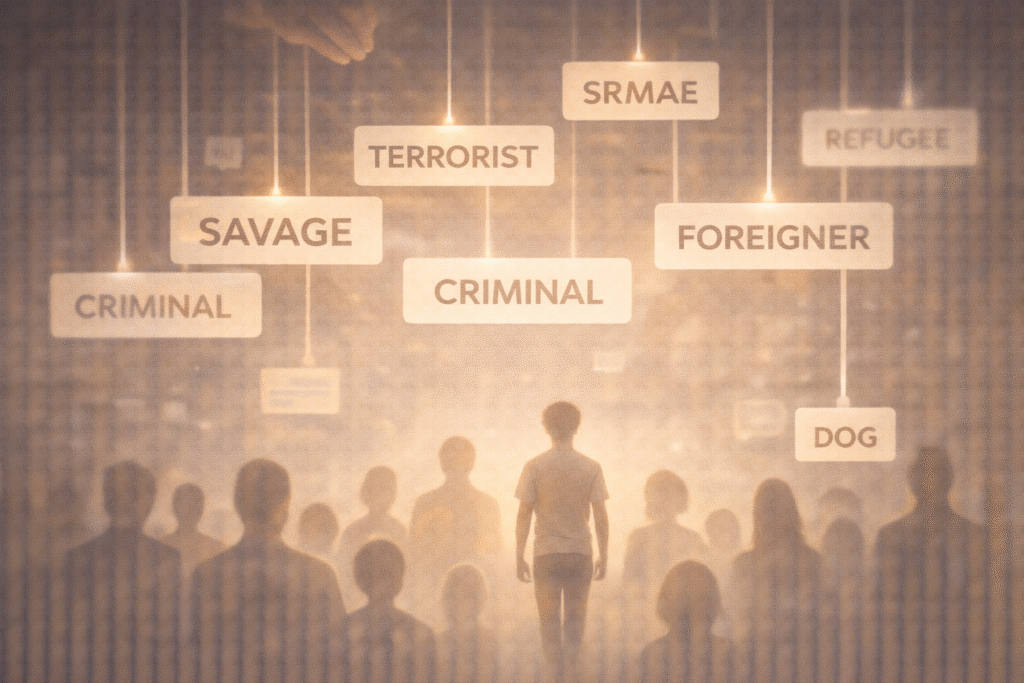
    • Words like “criminal,” “disabled,” or “elderly” often overshadow individual stories with simplified identities.

    In this sense, naming does not just describe reality—it actively shapes how reality is understood.


    2. Who Gets to Name? Power Speaks First

    Power dynamics shown through the act of naming others

    Names rarely emerge from equal positions.
    More often, they flow from the powerful to the powerless.

    Throughout history, naming has been deeply political:

    • Colonial powers renamed lands they occupied, overwriting indigenous names and identities.
    • Administrative systems imposed categories that reorganized populations for governance and control.
    • Minority groups were recorded, classified, and often reduced to labels they did not choose.

    To name is to organize the world—and those who control naming often control meaning itself.


    3. Naming as a Tool of Framing and Persuasion

    In contemporary society, naming has become a battleground of perception.

    • Branding turns ordinary products into lifestyles through carefully chosen names.
    • Political framing contrasts terms like “tax relief” versus “tax burden” to steer public emotion.
    • Social media labels and nicknames can elevate, ridicule, or permanently reduce a person to a single trait.

    A name can condense complex realities into a single emotional shortcut.
    It tells us not only what something is, but how we should feel about it.


    4. Renaming as Resistance and Responsibility

    Yet naming is not only a mechanism of domination.
    It can also be a site of resistance, care, and ethical reflection.

    When people reclaim names—or choose new ones—they reshape relationships:

    • Individuals asserting self-chosen names affirm autonomy and dignity.
    • Public language shifts toward more respectful terms reshape social attitudes.
    • Renaming becomes an act of seeing others differently, not as objects but as subjects.

    To rename is not to change the world itself, but to change how we stand in relation to it.

    Renaming as an act of dignity and respect

    Conclusion: What Do Our Words Reveal?

    An ancient phrase says, “In the beginning was the Word.”
    It reminds us that language does not merely reflect reality—it helps create it.

    Every name carries a perspective.
    Every label contains a judgment, whether intended or not.

    So perhaps the real question is not whether naming involves power—
    but what kind of power we choose to exercise through our words.

    How we name others may quietly reveal how we see them,
    and ultimately, how we choose to live alongside them.


    References

    1.Foucault, M. (1972). The Archaeology of Knowledge. Pantheon Books.
    → Explores how language, classification, and discourse function as systems of power that shape what can be known and said.

    2.Lakoff, G. (1987). Women, Fire, and Dangerous Things. University of Chicago Press.
    → Demonstrates how naming and categorization reflect cognitive structures that influence perception and culture.

    3.Spivak, G. C. (1988). Can the Subaltern Speak? In Marxism and the Interpretation of Culture. University of Illinois Press.
    → Examines how marginalized groups are named and silenced within dominant discourses, revealing naming as a political act.

  • The Sociology of Selfies

    How Self-Representation and the Desire for Recognition Shape Digital Identity

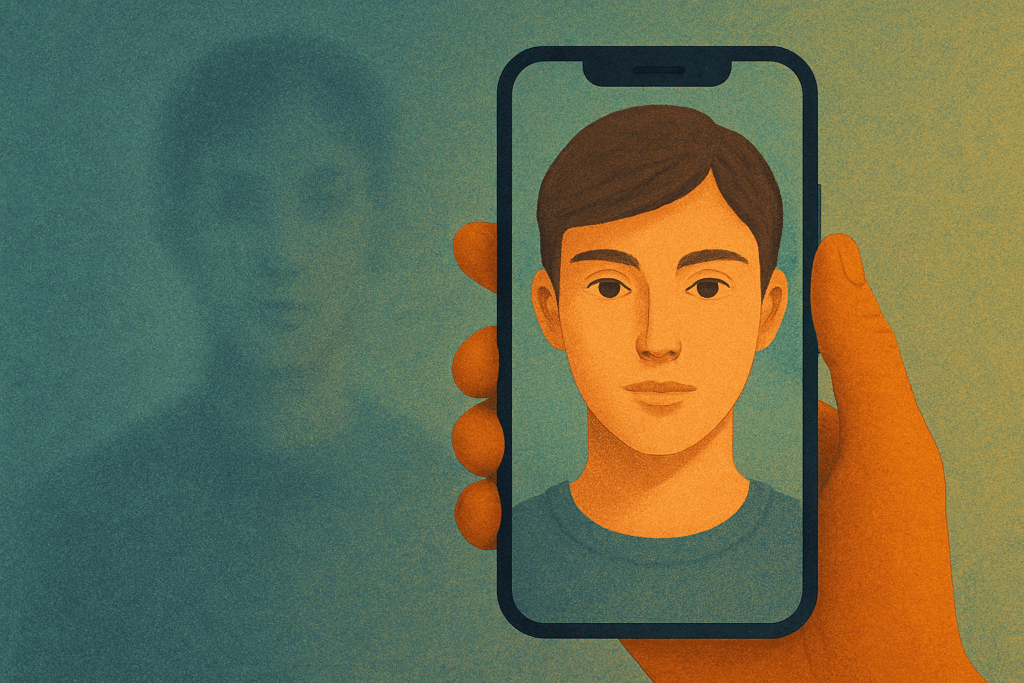
    selfie and digital identity reflection

    Introduction: A Selfie Is Not Just a Photo

    On the subway, in cafés, or while traveling, we instinctively raise our smartphones.
    In the frame, we appear slightly brighter, slightly more confident, slightly more composed.

    A selfie is not merely a record of the self.
    It is a carefully constructed moment shaped by the awareness of being seen.

    Behind this seemingly casual gesture lies a deeper social message—
    a desire for recognition and a question that quietly follows us:
    How do I want to be perceived by others?


    Selfies as a Technology of Self-Presentation

    The evolution of smartphone cameras has turned everyday users into curators of their own personal brands.

    Lighting, filters, angles, and backgrounds are not neutral choices.
    They function as symbols that communicate identity.

    A selfie taken against a scenic landscape performs freedom.
    A selfie at a desk performs discipline and diligence.

    In this sense, selfies are not simple records of reality.
    They are acts of self-presentation, or what sociologists describe as a performance of identity.


    Recognition and the Social Psychology of “Likes”

    When we upload a selfie, we are not simply waiting for numbers to increase.
    We are waiting for acknowledgment.

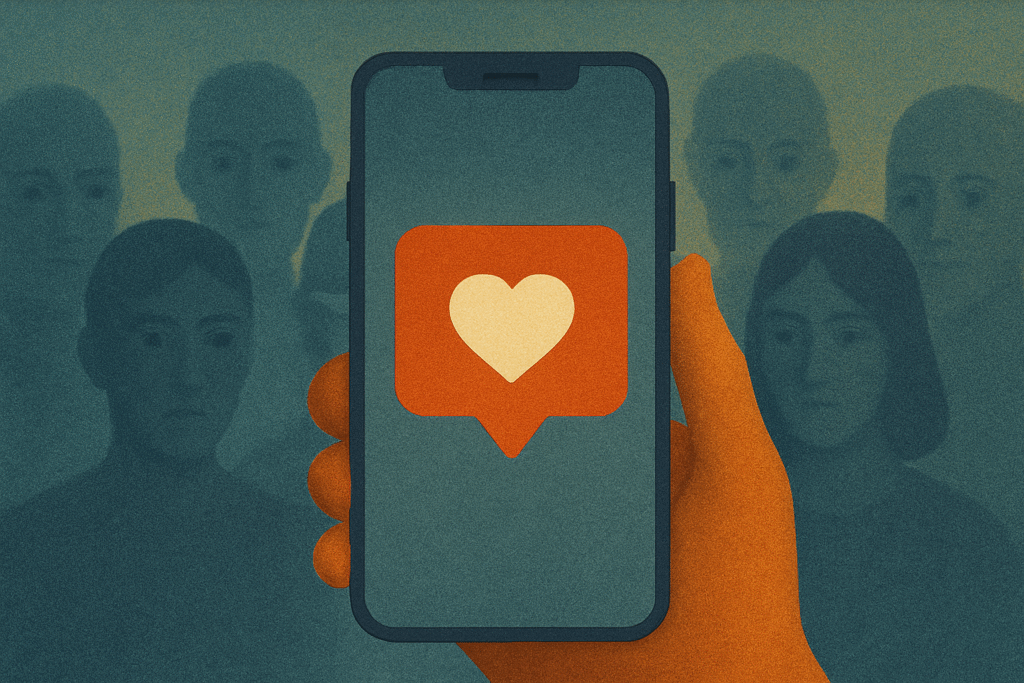
    Each “like” operates as a social signal that says, I see you.

    Sociologist Charles Horton Cooley famously described the looking-glass self
    the idea that individuals form their self-image through the imagined reactions of others.

    In the digital age, selfies place this mirror directly onto the smartphone screen.
    As a result, people often begin to prioritize the visible self over the experienced self.

    Self-expression becomes inseparable from social validation,
    and identity turns into a negotiation between who we are and how we are received.

    social media likes and recognition desire

    The Paradox of Freedom and Anxiety

    Selfies promise freedom.
    We choose how to present ourselves, when to post, and what to reveal.

    Yet this freedom often coexists with anxiety.

    Filters subtly reflect perceived social expectations.
    Endless streams of perfected faces invite comparison and self-doubt.

    For younger generations especially, selfies can become tools of proof—
    evidence that one is worthy, attractive, or socially accepted.

    Thus, selfie culture exists at the boundary between autonomy and control,
    where self-expression is constantly shaped by imagined audiences.


    From the Seen Self to the Lived Self

    Selfies are mirrors of contemporary society.
    They express a human desire to be acknowledged, remembered, and valued.

    But when attention shifts entirely to the seen self,
    there is a risk of losing contact with the lived self.

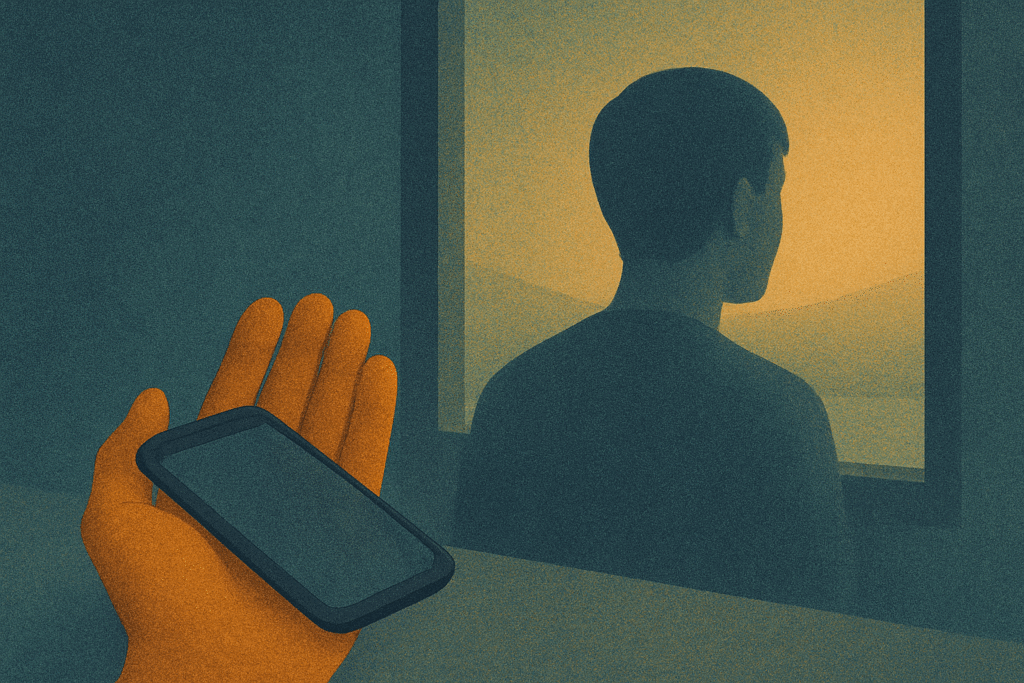
    Occasionally lowering the camera and stepping outside the frame
    allows space to reconnect with experience beyond representation.

    Only then can selfies transform from instruments of performance
    into tools of self-understanding.

    stepping away from social media reflection

    Conclusion

    Selfies are neither shallow nor inherently harmful.
    They are social languages shaped by recognition, identity, and visibility.

    The challenge is not to abandon selfies,
    but to remain aware of the difference between being seen and truly existing.

    In that awareness, digital self-representation can become
    not a performance for approval,
    but a reflection of a life genuinely lived.


    📚 References

    Senft, T. M., & Baym, N. K. (2015).
    What Does the Selfie Say? Investigating a Global Phenomenon.
    International Journal of Communication, 9, 1588–1606.
    This study frames selfies as social and communicative acts rather than trivial images, explaining how identity and recognition are negotiated through digital self-representation.

    Goffman, E. (1959).
    The Presentation of Self in Everyday Life.
    New York: Anchor Books.
    Goffman’s theory of social performance provides a foundational framework for understanding selfies as staged expressions of identity in everyday interactions.

    Marwick, A. E. (2013).
    Status Update: Celebrity, Publicity, and Branding in the Social Media Age.
    New Haven, CT: Yale University Press.
    This work explores how social media encourages self-branding and visibility-seeking behaviors, offering crucial insight into recognition economies that shape selfie culture.