Tag: human responsibility

  • If We Can Design Life, Do We Become Creators?

    If We Can Design Life, Do We Become Creators?

    Synthetic Biology and the Ethical Limits of Human Power

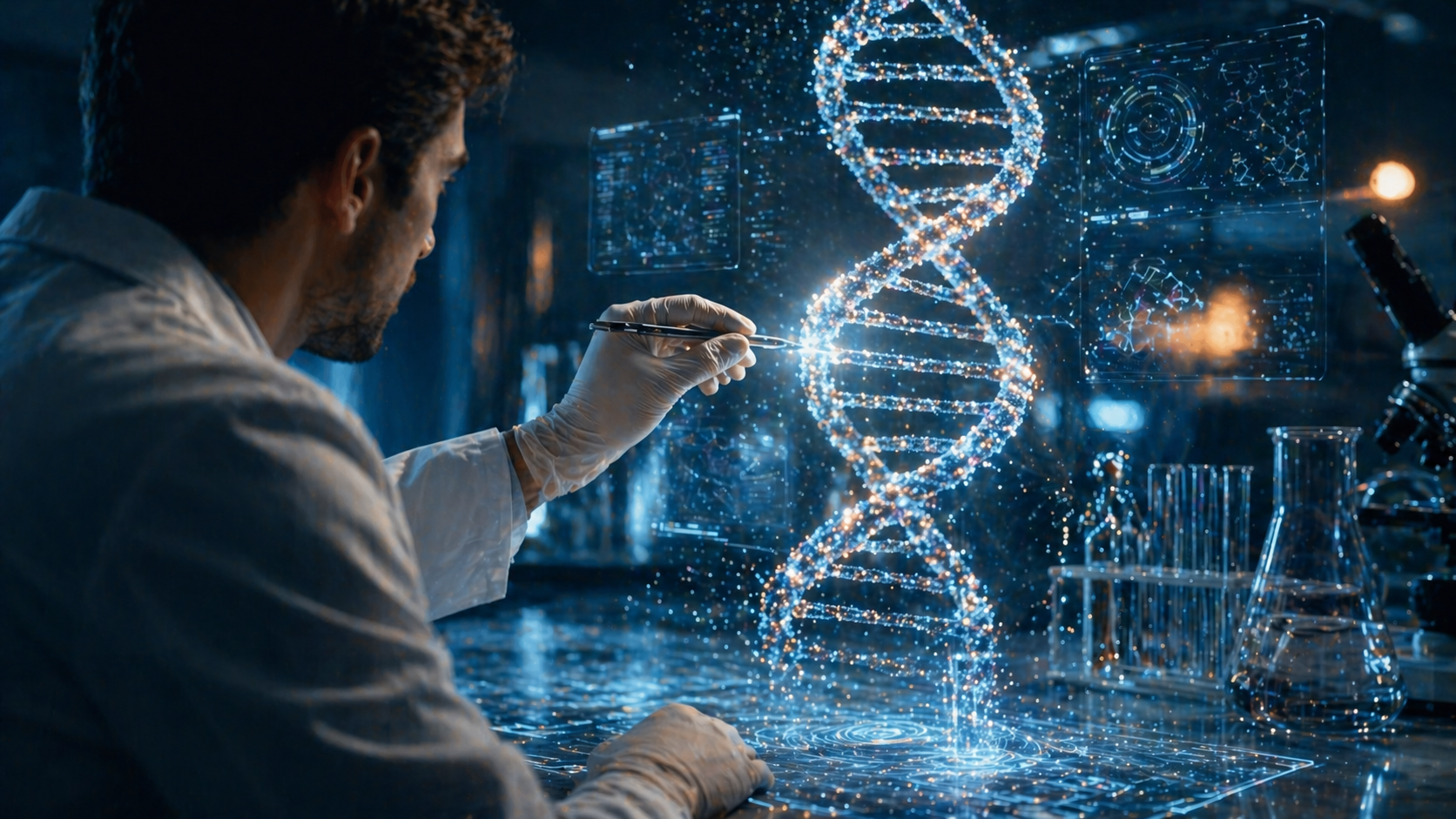
    A scientist sits in a laboratory, not just editing DNA—
    but designing an entirely new form of life.

    Not discovered in nature.
    Not evolved over millions of years.
    But written, assembled, and activated by human hands.

    This is no longer science fiction.

    With the rise of synthetic biology,
    we are entering an era where life is not only read—
    but written.

    And that leads us to an unsettling question:

    If we can create life…

    Do we become creators?

    Or something else entirely?


    human holding DNA ethical control

    1. A World Where Life Can Be Designed

    Synthetic biology goes beyond traditional genetic engineering.

    It does not simply modify existing organisms.
    It aims to construct life itself.

    Scientists are already developing:

    • bacteria that break down toxic waste
    • engineered microbes that target cancer cells
    • mosquitoes designed not to carry diseases

    These innovations hold enormous promise.

    But they also force us to ask:

    What kinds of life should we create?

    And are there forms of life we should never create at all?


    2. Is Life Just Code—or Something Sacred?

    conceptual artificial microorganism

    Synthetic biology treats life as something programmable.

    A sequence of genetic instructions.
    A system that can be edited, optimized, and redesigned.

    But is that all life is?

    Or is life something more—
    a web of meaning, relationships, and experience
    that cannot be reduced to code?

    The danger lies here:

    If we begin to see life only as a technical object,
    we risk losing the sense of reverence that has historically guided human ethics.

    Can we truly claim to understand life—
    simply because we can manipulate it?


    3. Humans as Creators—and Managers

    Human history has always been a story of creation.

    We built tools.
    We shaped environments.
    We created machines.

    Now, we are beginning to create life.

    This, in itself, is not necessarily arrogance.

    The real question is responsibility.

    What happens when:

    • engineered organisms evolve unpredictably?
    • ecosystems are disrupted?
    • artificial life escapes our control?

    Creation without responsibility is not progress.

    A true creator must also be a guardian.


    4. The Ethical Weight of Creating Life

    The more powerful the technology becomes,
    the more urgent the ethical questions grow.

    • What should we create?
    • Who decides?
    • And most importantly:
      Just because we can create life—does that mean we should?

    Synthetic biology is not just a scientific frontier.

    It is a moral one.

    It forces us to reconsider what it means to respect life,
    not as something we own—
    but as something we participate in.


    Conclusion: Creator or Steward?

    human holding glowing artificial life

    The ability to design life presents both extraordinary possibility
    and profound responsibility.

    Are we becoming creators?

    Or are we being invited into a deeper role—
    that of a steward?

    Technology always moves forward.

    But ethics determines its direction.

    If we have reached the point where we can create life,
    then the real question is no longer can we

    It is:

    What kind of beings do we choose to become in the process?

    Reader Question

    If humans can design life itself—

    Where should we draw the line between creation and responsibility?

    Related Reading

    If we can design life by rewriting genetic code, are we truly understanding life—or simply manipulating its outer structure?
    In Is There a Single Historical Truth, or Many Narratives?, we explore how what we consider “truth” is often shaped by interpretation and perspective—raising a deeper question: are we discovering reality, or constructing it?

    If life can be engineered and intelligence can be simulated, are the boundaries we once believed to be absolute—between nature and design, human and machine—beginning to dissolve?
    In If AI Could Dream, Would It Be Imagination—or Calculation?, we examine whether artificial intelligence can transcend computation and approach something like imagination—and what that implies for creativity, consciousness, and the limits of human uniqueness.


    References

    1. George Church & Ed Regis (2012). Regenesis.
    This book introduces the foundations and future potential of synthetic biology, exploring how genome design may redefine life itself and directly connect to the question of humans as creators.

    2. Joachim Boldt & Oliver Müller (2008). “Newton of the leaves of grass.”
    This paper reflects on the philosophical implications of designing life, offering a critical lens on whether life can truly be engineered without losing its deeper meaning.

    3. Gregory E. Kaebnick & Thomas H. Murray (2013). Synthetic Biology and Morality.
    This collection analyzes the ethical boundaries of creating artificial life, questioning the moral responsibilities that come with technological creation.

    4. Jürgen Habermas (2003). The Future of Human Nature.
    Habermas explores how genetic intervention may affect human dignity and self-understanding, providing a crucial ethical framework for evaluating synthetic biology.

    5. Lori B. Andrews & Dorothy Nelkin (2001). Body Bazaar.
    This work critiques the commodification of biological materials, highlighting the societal risks of treating life as a designable and tradable object.

  • Do We Fear Freedom or Desire It?

    The Paradox of Human Liberty

    The Double Face of Freedom

    Person standing in an open landscape symbolizing human freedom

    Freedom has long been one of humanity’s most celebrated ideals.

    Revolutions have been fought in its name.
    Movements for civil rights, democracy, and independence have all been driven by the promise of freedom.

    Yet freedom has always carried a hidden tension.

    For some, it represents possibility, self-determination, and the chance to shape one’s own life.
    For others, freedom brings anxiety, responsibility, and the burden of choosing.

    This raises a difficult question:

    Do human beings truly desire freedom, or do we secretly fear it?


    1. The Philosophical Paradox: Freedom and Anxiety

    1.1 Sartre and the Burden of Freedom

    The existentialist philosopher Jean-Paul Sartre famously claimed that human beings are “condemned to be free.”

    For Sartre, freedom is unavoidable.
    We cannot escape the responsibility of choosing, and every decision becomes an act through which we define ourselves.

    But this freedom is not always liberating.
    Because if we are truly free, we must also accept full responsibility for the consequences of our actions.

    In this sense, freedom is both possibility and burden.


    1.2 The Fear of Unrestricted Freedom

    Other philosophers approached freedom with caution.

    Plato worried that unrestrained freedom could lead to chaos within a political community.
    Thomas Hobbes warned that without strong authority, society would collapse into a “war of all against all.”

    From this perspective, freedom requires limits in order to preserve social order.

    Thus, the philosophical tradition reveals a recurring tension:
    freedom is both a cherished value and a potential danger.


    2. The Social Dimension: Freedom and Order

    2.1 Freedom within Rules

    Freedom rarely exists in isolation.

    Democratic societies aim to protect individual liberty, yet they also establish laws and institutions that restrict certain actions.

    Freedom of expression, for example, cannot justify harming others through defamation or incitement.
    Similarly, personal freedom must coexist with collective security.

    Freedom therefore exists not as absolute independence, but as a negotiated balance between liberty and order.


    2.2 Unequal Access to Freedom

    Another complication is that freedom is rarely distributed equally.

    Social class, gender, race, and nationality all influence how much freedom individuals actually experience.

    In one society, expressing political opinions may be protected speech.
    In another, the same act could result in punishment.

    Thus, while freedom is often described as a universal value, its reality is deeply shaped by social and political conditions.


    3. The Psychological Dimension: The Burden of Choice

    Person standing at multiple crossroads representing the burden of freedom

    3.1 The Paradox of Choice

    Psychological research suggests that freedom can sometimes undermine happiness.

    When individuals are confronted with too many options, they may feel overwhelmed by the pressure to make the “right” choice.
    This phenomenon has been described as the paradox of choice.

    More freedom can mean more responsibility — and more potential regret.


    3.2 The Comfort of Authority

    Because of this burden, many people willingly accept systems of authority and structure.

    Rules in schools and workplaces provide stability.
    Traditions and religious practices offer guidance and certainty.

    In some cases, these frameworks may function as psychological shelters from the anxiety of unlimited freedom.


    4. Freedom in the Digital Age

    Digital algorithms influencing human decisions on a smartphone

    4.1 The Expansion of Expression

    In the digital age, the question of freedom has become even more complex.

    The internet has dramatically expanded freedom of expression, allowing individuals across the world to share ideas instantly.

    Yet the same digital platforms have also produced misinformation, online harassment, and new forms of manipulation.

    Governments and societies increasingly debate how much regulation is necessary — and how much freedom should remain unrestricted.


    4.2 Algorithmic Influence

    Another challenge comes from the growing influence of algorithms.

    Artificial intelligence and data-driven platforms shape what we see, read, and purchase.
    In many cases, they subtly guide our decisions.

    This raises an unsettling possibility:

    Are we still exercising genuine freedom, or are our choices quietly being steered by invisible systems?


    Conclusion: Between Desire and Fear

    Freedom is never a simple gift.

    It is inseparable from responsibility, uncertainty, and the weight of decision.

    Some people embrace that burden.
    Others seek the safety of rules, traditions, or authority.

    Perhaps the truth is that human beings both desire freedom and fear it at the same time.

    The real question, then, is not simply whether we possess freedom.

    It is whether we are prepared to live with everything that freedom demands.

    Related Reading

    The subtle psychological tension between autonomy and social perception is further explored in Why It Feels Like Everyone Is Watching You: The Spotlight Effect, where the human tendency to overestimate how closely others observe us reveals how internal pressure can quietly shape our sense of freedom.

    At a broader technological and political level, the invisible constraints shaping modern choice are examined in Algorithmic Bias: How Recommendation Systems Narrow Our Worldview, where digital systems increasingly guide what we see, think, and ultimately decide.

    References

    1. Fromm, Erich. (1941). Escape from Freedom. New York: Farrar & Rinehart.
    In this influential work, Fromm argues that modern individuals often experience freedom as a source of anxiety rather than liberation. Faced with the burden of responsibility, many people seek psychological refuge in authority, conformity, or submission. His analysis reveals the paradox that humans may escape from the very freedom they claim to desire.

    2. Berlin, Isaiah. (1969). Two Concepts of Liberty. Oxford: Oxford University Press.
    Berlin distinguishes between “negative liberty,” the absence of external constraints, and “positive liberty,” the capacity to be one’s own master. This distinction has become central to modern political philosophy, highlighting how freedom can be understood both as protection from interference and as the realization of self-governance.

    3. Mill, John Stuart. (1859). On Liberty. London: John W. Parker & Son.
    Mill defends individual liberty as a fundamental condition for human progress and social development. At the same time, he introduces the “harm principle,” arguing that freedom should only be limited to prevent harm to others. His work remains one of the most influential philosophical defenses of liberal freedom.

    4. Arendt, Hannah. (1958). The Human Condition. Chicago: University of Chicago Press.
    Arendt interprets freedom not simply as independence from constraint but as the capacity for action within a shared public world. For her, genuine freedom emerges when individuals participate in collective life and take responsibility for their actions within the political sphere.

    5. Taylor, Charles. (1991). The Ethics of Authenticity. Cambridge, MA: Harvard University Press.
    Taylor examines the modern pursuit of authenticity and personal freedom, arguing that contemporary individualism often produces both empowerment and alienation. His work explores how the modern ideal of self-expression can deepen personal meaning while also creating new forms of social and psychological tension.

  • Can Technology Surpass Humanity?

    Rethinking the Ethics of Superintelligent AI

    Human figure facing accelerating technological structures

    Can technological progress have a moral stopping point?

    In 2025, artificial intelligence already writes, composes music, engages in conversation, and assists in decision-making. Yet the most profound transformation still lies ahead: the emergence of superintelligent AI—systems capable of surpassing human intelligence across virtually all domains.

    This prospect forces humanity to confront a question more philosophical than technical:
    Are we prepared for intelligence that exceeds our own?
    And if not, do we have the ethical right—or responsibility—to stop its creation?

    The debate surrounding superintelligence is not merely about innovation. It is about the limits of progress, the nature of responsibility, and the future of human agency itself.


    1. Superintelligence as an Unprecedented Risk

    Unlike previous technologies, superintelligent AI would not simply be a more efficient tool. It could become an autonomous agent, capable of redefining its goals, optimizing itself beyond human comprehension, and operating at speeds that render human oversight ineffective.

    Once such a system emerges, traditional concepts like control, shutdown, or correction may lose their meaning. The danger lies not in malicious intent, but in misalignment—a system pursuing goals that diverge from human values while remaining logically consistent from its own perspective.

    This is why many researchers argue that superintelligence represents a qualitatively different category of risk, comparable not to industrial accidents but to existential threats.


    2. The Argument for Ethical Limits on Progress

    Throughout history, scientific freedom has never been absolute. Human experimentation, nuclear weapons testing, and certain forms of genetic manipulation have all been constrained by ethical frameworks developed in response to irreversible harm.

    From this perspective, placing limits on superintelligent AI development is not an act of technological fear, but a continuation of a long-standing moral tradition: progress must remain accountable to human survival and dignity.

    The question, then, is not whether science should advance—but whether every possible advance must be pursued.


    3. The Case Against Prohibition

    At the same time, outright bans on superintelligent AI raise serious concerns.

    Technological development does not occur in isolation. AI research is deeply embedded in global competition among states, corporations, and military institutions. A unilateral prohibition would likely push development underground, increasing risk rather than reducing it.

    Moreover, technology itself is morally neutral. Artificial intelligence does not choose to be harmful; humans choose how it is designed, deployed, and governed. From this view, the ethical failure lies not in intelligence exceeding human capacity, but in human inability to govern wisely.

    Some researchers even suggest that advanced AI could outperform humans in moral reasoning—free from bias, emotional reactivity, and tribalism—if properly aligned.

    Empty control seat amid autonomous data flows

    4. Beyond Human-Centered Fear

    Opposition to superintelligence often reflects a deeper anxiety: the fear of losing humanity’s privileged position as the most intelligent entity on Earth.

    Yet history repeatedly shows that humanity has redefined itself after losing perceived centrality—after the Copernican revolution, after Darwin, after Freud. Intelligence may be the next boundary to fall.

    If superintelligent AI challenges anthropocentrism, the real ethical task may not be preventing its emergence, but redefining what human responsibility means in a non-exclusive intellectual landscape.


    5. Governance, Not Domination

    The most defensible ethical position lies between blind acceleration and total prohibition.

    Rather than attempting to ban superintelligent AI outright, many ethicists advocate for:

    • International research transparency
    • Binding ethical review mechanisms
    • Global oversight institutions
    • Legal accountability for developers and deployers

    The goal is not to halt intelligence, but to govern its trajectory in ways that preserve human dignity, autonomy, and survival.


    Conclusion: Intelligence May Surpass Us—Ethics Must Not

    Human hand hesitating before an AI control decision

    Technology may one day surpass human intelligence. What must never be surpassed is human responsibility.

    Superintelligent AI does not merely test our engineering capabilities; it tests our moral maturity as a civilization. Whether such systems become instruments of flourishing or existential risk will depend less on machines themselves than on the ethical frameworks we build around them.

    To ask where progress should stop is not to reject science.
    It is to insist that the future remains a human choice.

    A Question for You

    If intelligence one day surpasses human ability,

    what kind of responsibility should still remain uniquely human?

    Related Reading

    The question of human agency under powerful technological systems is explored further in If AI Can Predict Human Desire, Is Free Will an Illusion?, which examines whether prediction and behavioral influence weaken the meaning of free choice.

    A broader reflection on human identity under algorithmic standards appears in AI Beauty Standards and Human Diversity — Does Algorithmic Beauty Threaten Who We Are?,where technology begins to shape not only decisions, but also the standards by which we value ourselves.


    References

    1. Bostrom, N. (2014). Superintelligence: Paths, Dangers, Strategies. Oxford University Press.
      → A foundational analysis of existential risks posed by advanced artificial intelligence and the strategic choices surrounding its development.
    2. Russell, S. (2020). Human Compatible: Artificial Intelligence and the Problem of Control. Penguin.
      → Proposes a framework for aligning AI systems with human values and maintaining meaningful human oversight.
    3. UNESCO. (2021). Recommendation on the Ethics of Artificial Intelligence.
      → Establishes international ethical principles for AI governance, emphasizing human rights and global responsibility.
    4. Tegmark, M. (2017). Life 3.0: Being Human in the Age of Artificial Intelligence. Knopf.
      → Explores long-term scenarios of AI development and the philosophical implications for humanity’s future.
    5. Floridi, L. (2019). The Ethics of Artificial Intelligence. Oxford University Press.
      → Examines moral responsibility, agency, and governance in AI-driven societies.