
Why Biology Alone Cannot Explain One of Our Most Powerful Emotions
Love is one of the most familiar human experiences—and one of the hardest to explain.
People fall in love, form lasting relationships, experience heartbreak, care for children and families, and sometimes make extraordinary sacrifices for those they love. Across cultures and throughout history, love has inspired poetry, music, philosophy, religion, and art.
Yet a surprisingly difficult question remains:
What actually causes us to love another person?
Biology offers one answer. Attraction and attachment involve the brain, hormones, reward systems, and evolutionary processes that help human beings form bonds and reproduce.
Psychology offers another. Our experiences of love are influenced by attachment, emotional security, memory, personality, and the desire to belong.
Society and culture add yet another layer. Ideas about romance, marriage, intimacy, family, and acceptable relationships vary dramatically across societies and historical periods.
So is love fundamentally a biological instinct that culture merely reshapes?
Or is what we call “love” something far more complex—a combination of biology, psychology, culture, and personal experience?
1. Is Love a Biological Instinct?
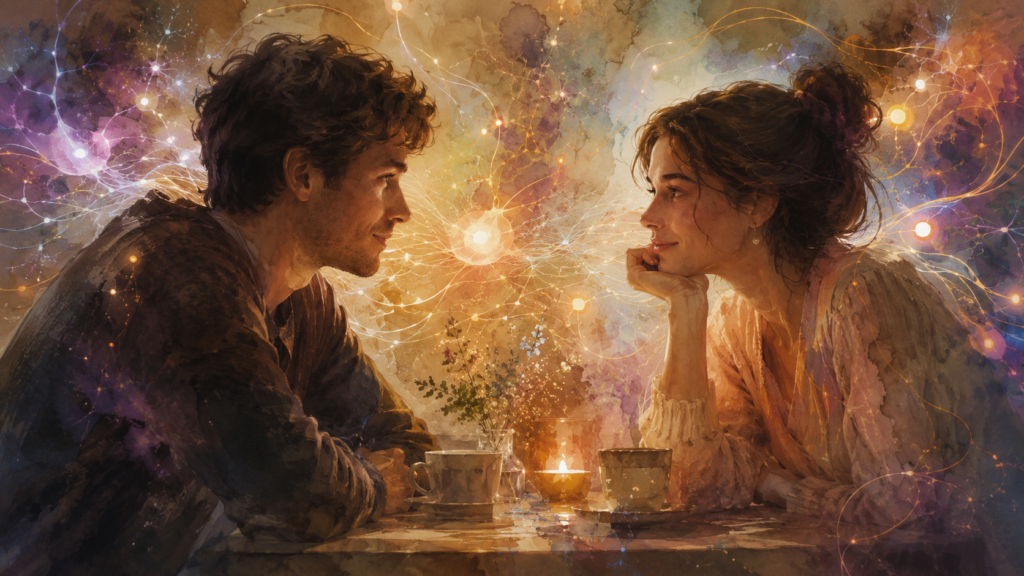
The Brain and the Chemistry of Attraction
There is little doubt that biology plays an important role in love.
Human beings are social creatures whose survival has long depended on cooperation, caregiving, reproduction, and enduring relationships. From an evolutionary perspective, mechanisms that encourage attraction and attachment can help people form bonds that support both partners and offspring.
The brain is deeply involved in these processes.
Romantic attraction has been associated with neural reward systems involving dopamine, a neurotransmitter connected with motivation, reward, and reinforcement. This can help explain the intense attention and excitement people sometimes experience during the early stages of romantic attraction.
Oxytocin is also associated with social bonding and attachment. It is involved in childbirth and breastfeeding but also participates more broadly in social interaction and bonding.
Other neurochemical systems, including serotonin and vasopressin, have also been investigated in relation to attraction, attachment, and social behavior.
But describing these biological mechanisms does not necessarily explain love completely.
Knowing that dopamine participates in reward does not tell us why one particular person becomes emotionally meaningful to us.
Knowing that oxytocin is involved in bonding does not explain why some relationships endure for decades while others disappear.
Biology helps explain the machinery of love.
It may not, by itself, explain its meaning.
2. What Does Psychology Tell Us About Love?

Attachment, Security, and the Need to Belong
Psychology shifts the question from what happens inside the brain to how people experience relationships.
Human beings have a powerful need for connection, belonging, recognition, and emotional security. Love can satisfy these needs, but the way people form close relationships is influenced by their earlier experiences.
Attachment theory provides one influential framework.
Beginning with the work of John Bowlby and later expanded through research by Mary Ainsworth and others, attachment theory examines how early relationships with caregivers can influence patterns of emotional connection.
A person who experiences reliable and responsive caregiving may develop expectations that close relationships can be safe and trustworthy. Someone whose early relationships are inconsistent or emotionally unavailable may approach intimacy differently.
These patterns are not absolute destinies.
People change, relationships differ, and adult experiences can reshape how individuals understand intimacy and trust.
Nevertheless, attachment research illustrates an important point:
We do not enter love as blank biological organisms.
We bring memories, expectations, fears, emotional habits, and previous relationships with us.
Two people can therefore experience the same relationship very differently.
Love is not merely something that happens to the body.
It is also something interpreted by the mind.
3. Is Romantic Love Shaped by Culture?

Why Love Does Not Look the Same Everywhere
If love were purely biological, we might expect it to appear in essentially the same form in every society.
Yet cultures differ greatly in how they understand relationships.
In many contemporary societies, romantic love is considered a central reason for choosing a marriage partner. Individuals are often expected to find someone they personally love and then decide whether to build a life together.
Historically—and still today in some communities—marriage may involve broader considerations.
Family relationships, economic security, religion, social status, community expectations, and obligations between families can influence partner selection.
This does not mean that people in such societies do not experience romantic affection.
Rather, it shows that love and marriage are not always understood as identical things.
Cultures also differ in how affection should be expressed. Public displays of intimacy may be ordinary in one society and discouraged in another. Some cultures emphasize verbal expressions of love; others may place greater importance on responsibility, sacrifice, caregiving, or fulfilling family obligations.
A multicultural perspective therefore complicates any attempt to define a single “natural” form of love.
Human beings may share biological capacities for attraction and attachment, but societies help teach us what love should look like, whom we may love, how it should be expressed, and what commitments should follow from it.
Culture does not necessarily create love from nothing.
But it gives love a language.
4. Why Can’t Biology, Psychology, or Culture Explain Love Alone?
The most convincing explanation may be that these dimensions constantly interact.
Imagine two people meeting for the first time.
Physical attraction may create initial interest. The brain’s reward systems may strengthen the desire to spend more time together.
But attraction alone does not guarantee a lasting relationship.
As the relationship develops, psychological factors become increasingly important. Can the partners trust one another? Do they feel emotionally safe? Can they resolve disagreements? Do they feel understood and respected?
At the same time, social expectations shape the relationship.
What does commitment mean? Is marriage expected? How should responsibilities be divided? What role should families play? How do religion, gender expectations, work, money, and community affect the couple?
Over time, love may change again.
The intense excitement of early attraction can become companionship, trust, familiarity, caregiving, and shared memory.
This does not necessarily mean that love has weakened.
It may mean that it has changed form.
A relationship lasting several decades cannot be understood simply by measuring the intensity of its first months. Long-term love often involves something less dramatic but perhaps equally important:
choosing to remain connected through ordinary life.
5. If Love Has Biological Causes, Is It Still Meaningful?
This is where the scientific question becomes philosophical.
Suppose science eventually explained every biological process involved in attraction and attachment.
Would that make love less meaningful?
Probably not.
Understanding the biology of hunger does not make a shared meal meaningless. Understanding the neural mechanisms of music does not eliminate the beauty of listening to it. Explaining how memory works does not make our memories less important.
The same may be true of love.
A biological explanation tells us how certain experiences become possible. It does not necessarily tell us what those experiences mean within a human life.
Love becomes meaningful through relationships.
It acquires significance through memories, promises, disappointments, forgiveness, intimacy, responsibility, and time.
This also helps explain why reducing love to “brain chemistry” feels incomplete.
The chemistry is real.
But so is the story people build around it.
6. Has Modern Society Changed the Meaning of Love?
Modern life has expanded the possibilities for relationships while creating new complications.
Dating apps allow people to meet potential partners beyond their immediate social circles. Social media makes relationships more visible and sometimes more comparable. Greater individual freedom has enabled many people to choose relationships outside traditional expectations involving class, religion, nationality, gender roles, or family arrangements.
These developments can expand personal autonomy.
But they can also transform love into something that sometimes resembles a marketplace of choices.
When people are constantly presented with alternative partners, does commitment become more difficult?
When relationships are displayed online, do people begin comparing their private lives with idealized versions of other people’s relationships?
And when individual fulfillment becomes a central expectation of romantic relationships, do we ask one partner to provide too much—romance, friendship, emotional security, personal growth, sexual fulfillment, and lifelong companionship all at once?
Technology may change how we meet, communicate, and maintain relationships, but it does not remove the older human needs for attachment, trust, recognition, and belonging.
In that sense, love continues to change while remaining deeply familiar.
Conclusion: So What Is Love?
Love is unlikely to have a single explanation.
It is biological because our brains and bodies make attraction, bonding, and attachment possible.
It is psychological because we experience love through individual histories, emotional needs, attachment patterns, expectations, and memories.
And it is social because cultures teach us how relationships should be formed, expressed, recognized, and maintained.
None of these explanations needs to defeat the others.
They describe different dimensions of the same human experience.
Perhaps the mistake is to ask whether love is either biology or psychology or culture.
A better understanding begins when we recognize that human beings are simultaneously biological organisms, psychological selves, and social beings.
Love emerges where these dimensions meet.
Biology may create the capacity for connection. Psychology shapes how we experience that connection. Culture gives it forms, expectations, and meanings. And through our choices and shared experiences, each relationship develops a history that belongs to the people within it.
That may be why love remains difficult to define even after centuries of philosophy and decades of scientific research.
We can increasingly explain how love happens.
But the deeper question—what love comes to mean in a human life—cannot be answered by chemistry alone.
Reader Question
Science can explain many of the biological and psychological processes involved in love, but relationships also acquire meaning through culture, memory, and personal experience.
If we could fully explain the biology of love, would that change what love means to us—or would its deepest meaning still come from the relationships we choose to build?
Related Reading
If love is one of our most powerful emotions, a broader question follows: why do emotions matter so deeply in shaping our relationships, decisions, and everyday lives?
In Why Emotions Matter, we explore how emotions influence human behavior, relationships, judgment, and the ways we understand ourselves and others.
If culture and social expectations influence how we experience and express love, we must also ask whether our emotions themselves are entirely personal or partly shaped by the societies around us.
In Are Our Emotions Truly Ours—or Socially Constructed?, we examine how biology, personal experience, culture, and social norms interact to shape the emotions we often assume are entirely our own.
References
1. Bowlby, J. (1969). Attachment and Loss: Vol. 1. Attachment. Basic Books.
Bowlby established attachment theory as a framework for understanding the emotional bonds human beings form with important others. His work provides a foundation for understanding how early relationships may influence later patterns of intimacy, trust, and emotional security.
2. Hazan, C., & Shaver, P. (1987). Romantic Love Conceptualized as an Attachment Process. Journal of Personality and Social Psychology, 52(3), 511–524.
This influential study extended attachment theory into adult romantic relationships. It helped establish the idea that patterns of security, anxiety, and avoidance can influence how adults experience intimacy and romantic attachment.
3. Fisher, H. E. (2004). Why We Love: The Nature and Chemistry of Romantic Love. Henry Holt and Company.
Fisher examines romantic love through neuroscience, anthropology, and evolutionary theory. The book is particularly useful for understanding the biological systems associated with attraction, reward, attachment, and pair bonding.
4. Sternberg, R. J. (1986). A Triangular Theory of Love. Psychological Review, 93(2), 119–135.
Sternberg proposes that love can be understood through three interacting components: intimacy, passion, and commitment. The theory helps explain why different relationships can take different forms and why romantic love may change over time.
5. Jankowiak, W. R., & Fischer, E. F. (1992). A Cross-Cultural Perspective on Romantic Love. Ethnology, 31(2), 149–155.
This cross-cultural research examines romantic love across a wide range of societies. It is especially relevant to the article’s argument that the capacity for romantic attachment may be widespread while cultural norms shape how love is understood, expressed, and incorporated into marriage and social life.