Tag: human behavior

  • Why We Excuse Ourselves but Blame Others

    — Understanding the Actor–Observer Bias
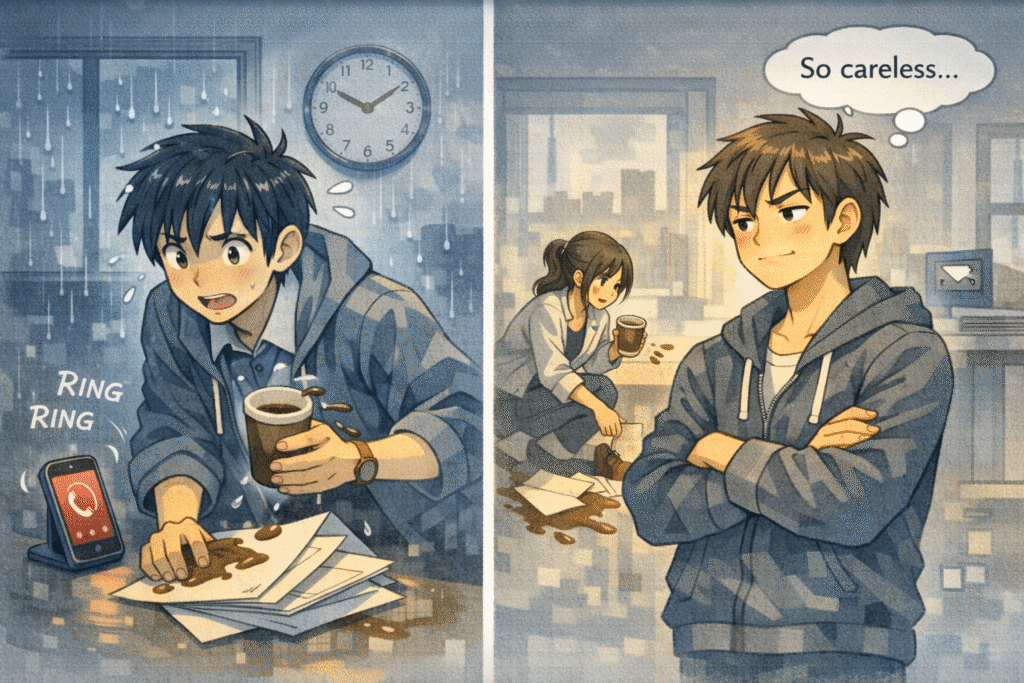
    Different perspectives in judging behavior

    When I make a mistake,
    “I had a good reason.”

    When someone else makes the same mistake,
    “What’s wrong with them?”

    Have you noticed this pattern?

    If someone cuts in traffic, we feel anger.
    But when we cut in because we are late,
    we expect understanding.

    This common psychological tendency is known as the Actor–Observer Bias.


    1. My Behavior Is Situational. Yours Is Personal.
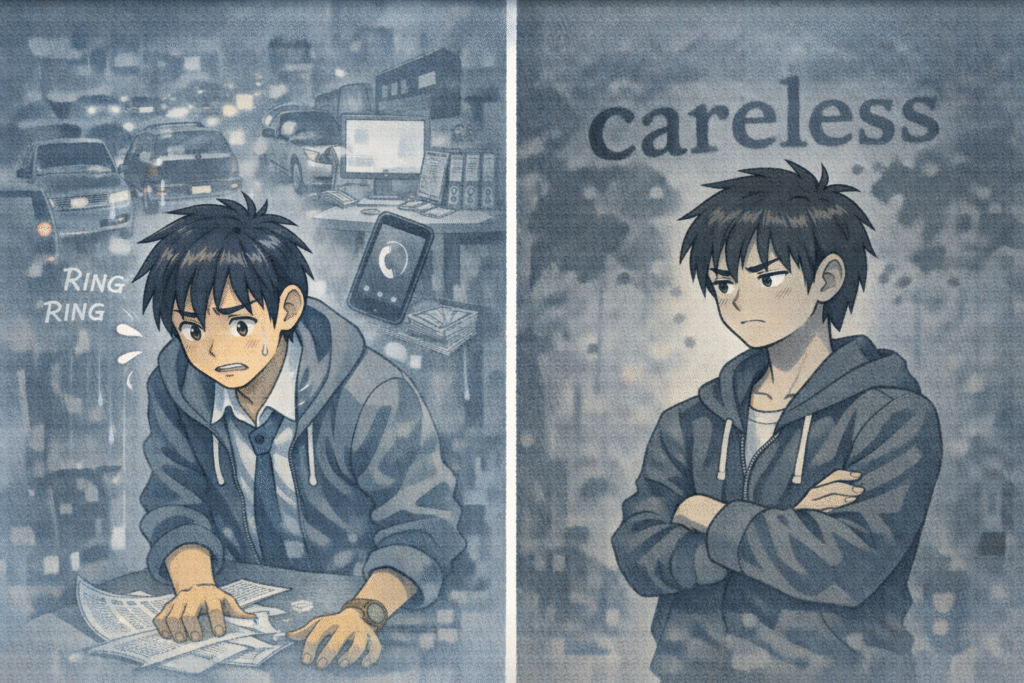
    Situational versus personal attribution bias

    The concept was introduced by Edward Jones and Richard Nisbett in the 1970s.

    The idea is simple:

    When I fail → It was the situation.
    When you fail → It was your personality.

    If I miss a deadline,
    “I was overwhelmed.”

    If you miss a deadline,
    “You’re irresponsible.”

    As actors in our own lives, we see context.
    As observers of others, we see character.


    2. The Power of Perspective

    This bias stems from point of view.

    When I act, I know what I was feeling,
    what constraints I faced,
    what pressure I experienced.

    When I observe you,
    I see only the visible behavior.

    My inner world is vivid to me.
    Yours is invisible.

    That asymmetry creates distorted judgment.


    3. Why It Damages Relationships

    The bias becomes sharper in close relationships.

    If I respond late:
    “I had a stressful day.”

    If you respond late:
    “You don’t care anymore.”

    We interpret our own behavior through circumstance,
    but others’ behavior through intention.

    Over time, this pattern breeds misunderstanding and resentment.


    4. How to Reduce the Bias

    Awareness is the first step.

    Before judging, try asking:

    “What situation might they be in?”
    “Would I act differently under the same pressure?”

    Switching perspective softens attribution.

    Replacing
    “Why are they like that?”
    with
    “What might have happened?”

    can transform conflict into understanding.


    Conclusion
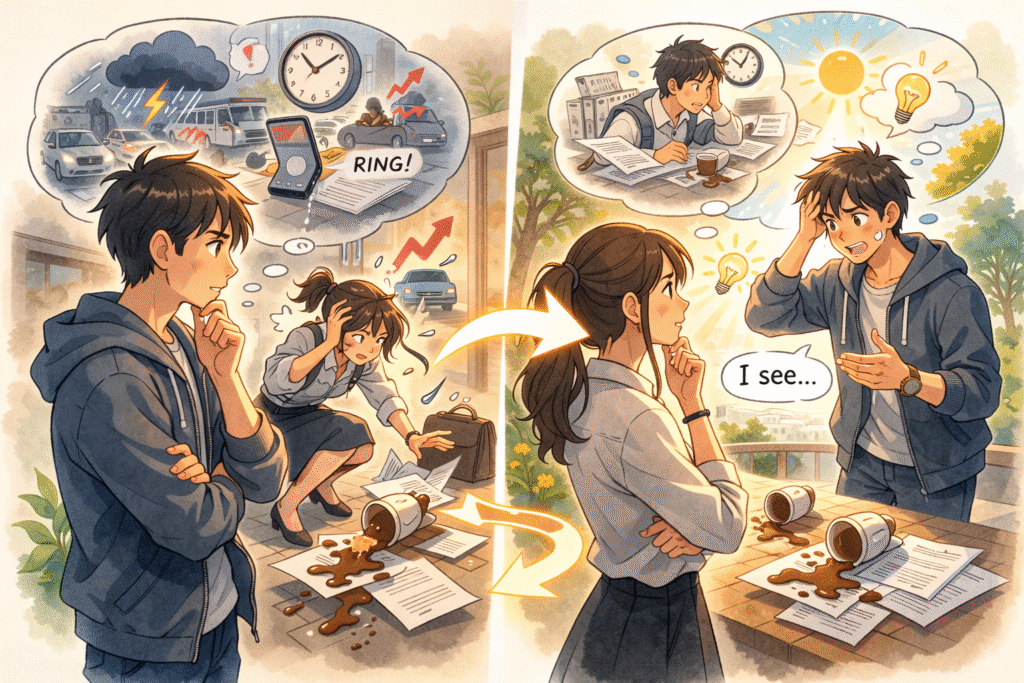
    Changing perspective to reduce blame

    We see ourselves in full color and others in outline.

    The Actor–Observer Bias is not a flaw of bad character.
    It is a built-in feature of human cognition.

    But once we recognize it,
    we gain a choice.

    A choice to pause.
    A choice to interpret more gently.
    A choice to understand before blaming.

    Sometimes, empathy begins with changing the angle of view.

    Related Reading

    The psychological roots of self-perception and social comparison are further explored in The Sociology of Selfies, where identity and recognition are analyzed in digital contexts.
    From a structural perspective, The Age of Overexposure: Why Do We Turn Ourselves into Products? expands this discussion by questioning how social systems amplify performative identity.


    References

    1. Jones, E. E., & Nisbett, R. E. (1972). The Actor and the Observer: Divergent Perceptions of the Causes of Behavior. In Attribution: Perceiving the Causes of Behavior.
    → This foundational work formally introduced the actor–observer bias and demonstrated how individuals attribute their own actions to situational factors while attributing others’ actions to personality traits.

    2. Ross, L. (1977). The Intuitive Psychologist and His Shortcomings. In Advances in Experimental Social Psychology.
    → Ross developed the concept of the fundamental attribution error, closely related to the actor–observer bias, highlighting how people underestimate situational influences when judging others.

    3. Gilbert, D. T. (1998). Ordinary Personology. In The Handbook of Social Psychology.
    → Gilbert explains how everyday people form quick judgments about others and why attribution biases persist even when we attempt to be objective.


  • Why It Feels Like Everyone Is Watching You: The Spotlight Effect

    Feeling watched in a public space despite no attention

    You get a new haircut, and suddenly it feels strange.
    You sit alone in a café and become aware of every movement.
    You stumble slightly on the subway and feel as if all eyes are on you.

    Have you ever had that feeling — that people around you are paying unusually close attention to you?

    Psychology has a name for this experience.
    It is called the spotlight effect, also known as self-relevance bias.


    1. We See the World From the Center of Ourselves

    1.1 The Natural Focus on the Self

    From birth, we experience the world from a first-person perspective.
    This makes self-awareness a natural part of being human.

    We constantly monitor how we look, how we sound, and how we appear to others. This sensitivity helps us navigate social life — but it also creates distortions.

    1.2 When Self-Awareness Becomes Overestimation

    Because we are so aware of ourselves, we often assume others are just as focused on us. In reality, this is rarely the case.

    The result is an illusion: we feel as if our actions and appearance stand out far more than they actually do.


    2. A Classic Experiment: “No One Noticed My Shirt”

    Overestimating others’ attention due to self-focus

    2.1 The Harvard T-Shirt Study

    In a well-known study conducted at Harvard University in 2000, participants were asked to wear an unattractive, embarrassing T-shirt into a classroom.

    Afterward, they were asked how many people they thought had noticed the shirt.

    On average, participants believed about 50% of others had noticed.
    In reality, only 10–15% actually did.

    2.2 The Gap Between Feeling and Reality

    This experiment clearly shows the gap between perceived attention and actual attention. We dramatically overestimate how much others notice us.

    What feels like a spotlight is often just a dim light.


    3. How the Bias Fuels Anxiety

    3.1 When the Effect Becomes Stronger

    The spotlight effect intensifies in situations such as:

    • Being in unfamiliar environments
    • Making mistakes
    • Feeling insecure about appearance or behavior
    • Being evaluated (presentations, interviews)

    3.2 From Awareness to Anxiety

    In these moments, excessive self-focus can lead to tension and withdrawal. In some cases, it contributes to social anxiety, making public spaces feel threatening rather than neutral.


    4. The Truth: Everyone Else Is Busy Being Themselves

    4.1 Others Are Not Watching — They Are Thinking

    The irony is simple: just as you are focused on yourself, others are absorbed in their own concerns.

    Your small mistake feels significant to you — but to others, it is often unnoticed or quickly forgotten.

    4.2 We Are All Main Characters in Our Own Stories

    Most people are not observers of your life.
    They are protagonists in their own.


    Conclusion

    People focused on their own thoughts, not others

    Feeling watched, judged, or remembered can be deeply uncomfortable.
    But most of the time, this feeling is not reality — it is the mind’s exaggeration of its own importance.

    People notice you far less than you imagine.
    Your mistakes rarely leave lasting impressions.

    So when that familiar anxiety appears, try this reminder:

    The spotlight is mostly in your head.

    And perhaps, that realization itself can be a quiet relief.

    Related Reading

    The psychology of subtle social perception is expanded in Social Attractiveness and the Psychology of Likeability, where unspoken cues shape interpersonal dynamics.

    The deeper philosophical question of withdrawal and presence is discussed in Is Solitude a Freedom of Self-Reflection, or a Risk of Social Disconnection? exploring the tension between connection and distance.


    References

    1.Gilovich, T., Medvec, V. H., & Savitsky, K. (2000). “The Spotlight Effect in Social Judgment: An Egocentric Bias in Estimates of the Salience of One’s Own Actions and Appearance.” Journal of Personality and Social Psychology, 78(2), 211–222.
    This seminal study introduced the concept of the spotlight effect, demonstrating experimentally that people greatly overestimate how much others notice them.

    2.Baumeister, R. F., & Bushman, B. J. (2021). Social Psychology and Human Nature (5th ed.). Boston: Cengage Learning.
    This textbook provides a comprehensive explanation of self-awareness, self-presentation, and cognitive biases, offering a broader framework for understanding self-relevance bias.

    3.Leary, M. R. (2007). The Curse of the Self: Self-Awareness, Egotism, and the Quality of Human Life. Oxford: Oxford University Press.
    Leary explores how excessive self-focus affects well-being, showing how heightened self-awareness can amplify social sensitivity and unnecessary anxiety.

  • Why Elevator Silence Feels So Uncomfortable: Unspoken Social Rules

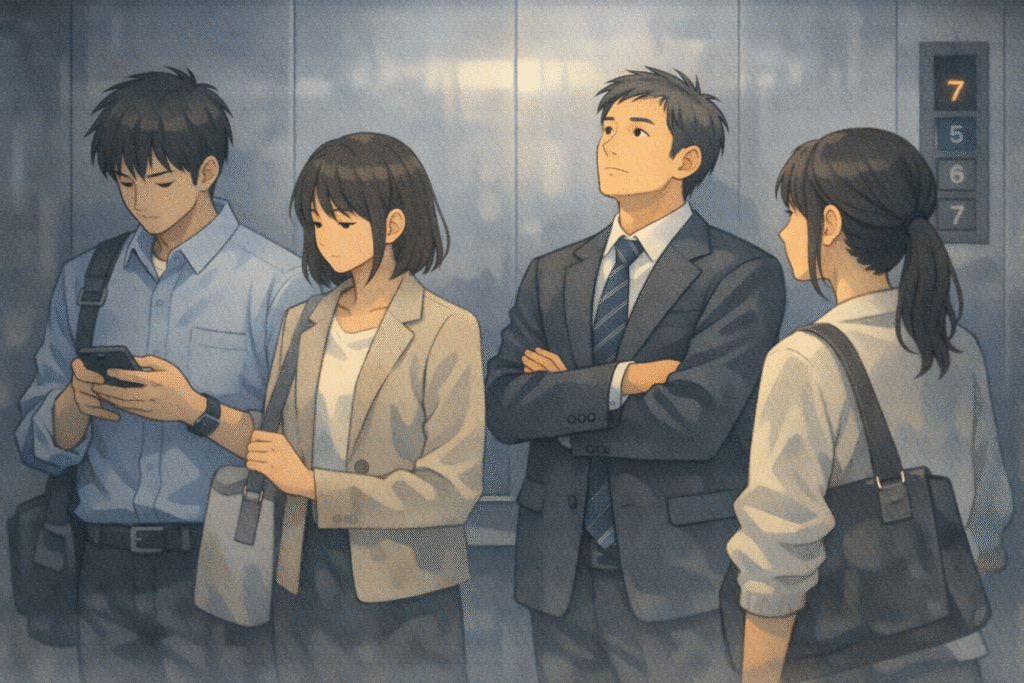
    Morning rush hour.
    An elevator packed with strangers.

    No one speaks, yet the space feels strangely tense.
    A sigh, a cough, or the sound of a phone screen lighting up subtly shifts the atmosphere. Someone checks their phone, and others instinctively glance away — or glance too much.

    The elevator is small and quiet, but rarely comfortable.

    Why does such a brief, silent moment feel so awkward?


    Awkward silence among strangers in an elevator

    1. Physical Closeness and Psychological Distance

    1.1 When Personal Space Disappears

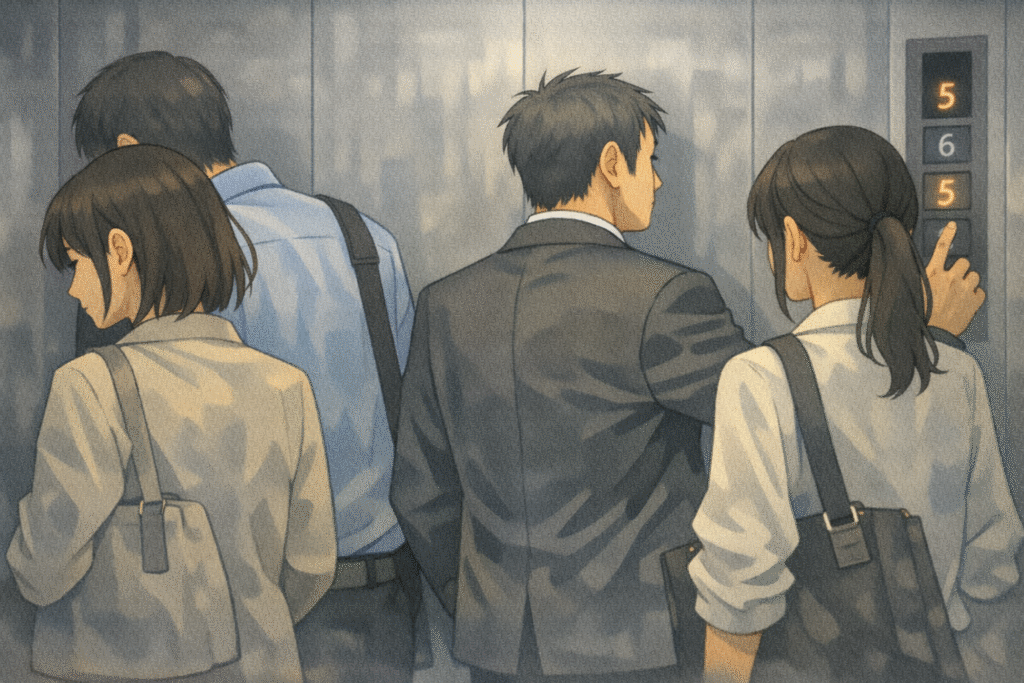
    Elevators force strangers into close physical proximity within a confined space. According to psychological research on personal space, people feel most comfortable when a certain distance from others is maintained.

    In elevators, this distance collapses.

    When physical closeness is not accompanied by social interaction, the brain registers tension. We are close to others, yet socially disconnected — a combination that easily produces discomfort.

    1.2 The Brain Never Stops Noticing Others

    Even in silence, our minds continuously monitor those around us. When someone stands too close, we may feel irritation or defensiveness without knowing why.

    Elevators create a paradox: physical intimacy without emotional familiarity. This imbalance places quiet strain on both body and mind.

    Lack of personal space in a crowded elevator

    2. When Silence Becomes a Rule

    2.1 Silence as an Unspoken Norm

    Most people do not speak in elevators.
    Over time, this absence of speech becomes an implicit rule.

    Sociologist Erving Goffman described such patterns as “interaction frames” — shared expectations that guide behavior in specific situations.

    2.2 Breaking the Frame

    In elevators, silence is treated as politeness.
    Someone who speaks loudly on the phone or initiates casual conversation is often perceived as violating the situation’s frame.

    The silence, then, is not neutral.
    It is a collectively maintained form of self-regulation and mutual monitoring.


    3. A Space of Nonverbal Communication

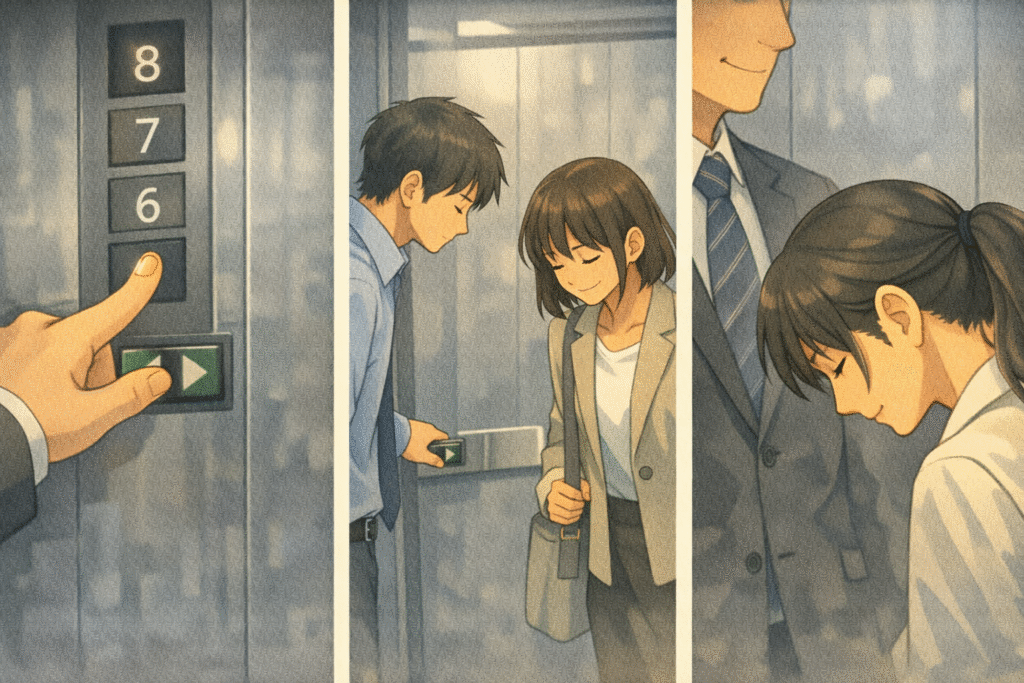
    Nonverbal social rules inside an elevator

    3.1 Communication Without Words

    Interestingly, elevators are full of communication — just not verbal.

    A brief glance
    A slight turn of the body toward the wall
    The careful extension of a hand to press a button
    A small nod to someone holding the door

    3.2 Cooperation Through Gesture

    These gestures help reduce tension and signal cooperation.
    Because words are absent, nonverbal actions become more visible — and more meaningful.

    At the same time, this heightened sensitivity makes the space vulnerable to awkwardness. Small missteps feel amplified.


    4. Why Elevators Feel Especially Intense

    4.1 The Pressure of No Escape

    In cafés or parks, we can leave whenever we want.
    Elevators offer no such freedom.

    Once inside, we must wait until the doors open again.

    4.2 Silence Under Confinement

    This temporary lack of exit heightens awareness.
    Sounds feel louder. Movements feel heavier. Silence feels thicker.

    The discomfort of elevator silence is not just about quiet — it is about being enclosed in a shared social situation with no way out.


    Related Reading

    The psychological mechanisms behind self-perception and social visibility are further explored in TThe Sociology of Selfieshe Sociology of Selfies, where digital identity and performative presence are analyzed.
    From a structural and philosophical perspective, TThe Age of Overexposure: Why Do We Turn Ourselves into Products?he Age of Overexposure: Why Do We Turn Ourselves into Products? expands this discussion by examining how social systems amplify the feeling of constant exposure.

    Conclusion

    The silence in elevators feels uncomfortable because it is not empty.
    It is filled with social rules, psychological tension, and silent coordination.

    Within that small space, we constantly adjust ourselves — our gaze, posture, and presence — in response to others, even without speaking.

    If you feel awkward in an elevator, it is not a personal flaw.
    It is a shared response to a space governed by unspoken norms.

    The discomfort is not yours alone.
    It belongs to all of us, quietly standing together in silence.


    References

    1.Goffman, E. (1959). The Presentation of Self in Everyday Life. New York: Anchor Books.
    Goffman analyzes how individuals manage impressions in social settings. Elevator silence can be understood as a form of “front-stage” behavior, where individuals carefully regulate their actions under the gaze of others.

    2.Hall, E. T. (1966). The Hidden Dimension. New York: Doubleday.
    This classic work introduces the concept of proxemics, explaining how physical distance influences psychological comfort. It is essential for understanding discomfort in confined spaces like elevators.

    3.Argyle, M. (1988). Bodily Communication (2nd ed.). London: Methuen.
    Argyle explores nonverbal communication, offering insight into how gestures, posture, and eye contact function as silent social signals in situations where speech is absent.

  • “Opportunity Favors the Prepared”? The Psychology of Hindsight Bias

    “Opportunity favors the prepared.”

    It is one of the most familiar sayings in modern culture.
    We hear it in interviews with successful people, read it in self-help books, and repeat it as practical wisdom about life and effort.

    At first glance, the phrase sounds undeniably true.
    But psychologists suggest that this belief often rests on a subtle cognitive illusion — one known as hindsight bias.

    Why do we find this idea so convincing?
    And what does it reveal about how we interpret success and failure?

    Success reinterpreting the past through hindsight bias

    1. Explaining Success After the Fact

    1.1 The Human Need for Coherent Stories

    People have a strong tendency to explain outcomes after they occur.
    When someone becomes successful, we search their past for clues that make the result seem inevitable.

    A famous inventor, for example, may be described as having loved machines since childhood. That detail then becomes proof that success was always destined — even though countless others shared similar interests and never achieved recognition.

    1.2 What Is Hindsight Bias?

    This tendency is known as hindsight bias: the inclination to believe, after knowing an outcome, that it was predictable all along.

    Seen through this lens, the idea that “opportunity favors the prepared” may not describe how success actually happens. Instead, it reflects how we reinterpret the past once success is already visible.


    2. When Failure Becomes a Personal Fault

    2.1 Shifting Responsibility to the Individual

    One troubling consequence of this belief is how easily it assigns blame.
    If success is proof of preparation, then failure appears to signal personal deficiency.

    “You missed the opportunity because you were not ready.”

    This explanation feels simple — but it ignores reality.

    Feeling self-blame after missing an opportunity

    2.2 The Weight of Structural Inequality

    Opportunities are not distributed fairly.
    Luck, social capital, economic background, and timing all play powerful roles.

    For those who were prepared yet never given a chance, the phrase can turn inward, becoming a source of self-blame and lowered self-worth. In this way, a comforting slogan can quietly reinforce psychological pressure and social inequality.


    3. Why We Find the Phrase So Comforting

    3.1 The Illusion of Control

    If the saying is flawed, why does it remain so appealing?

    Psychologists argue that it offers an illusion of control.
    In an unpredictable world, the belief that effort guarantees opportunity provides emotional relief.

    “If I prepare enough, I can manage the future.”

    3.2 Motivation, Even When It Is Incomplete

    Although this sense of control may be exaggerated, it can still motivate action.
    The belief that preparation matters encourages persistence, learning, and hope — especially in uncertain environments.

    In this sense, the phrase functions less as an objective truth and more as a psychological coping strategy.


    4. Does Preparation Still Matter?

    4.1 Yes — But Not in the Way We Imagine

    None of this suggests that preparation is meaningless.
    Preparation often determines whether an opportunity is noticed or usable when it appears.

    What it does not guarantee is success.

    4.2 Beyond Individual Responsibility

    Equally important is recognizing that preparation alone cannot compensate for unequal access to opportunity.
    Some people lack safe spaces to study. Others benefit from networks and resources long before effort even begins.

    When preparation is emphasized without acknowledging these conditions, the narrative risks hiding structural injustice behind personal virtue.


    Conclusion

    “Opportunity favors the prepared” is a phrase that sounds wise — and sometimes helps us move forward.

    But beneath it lie selective memory, individualized blame, and a deep human desire for control.

    Preparation matters.
    So do chance, context, and fairness.

    By acknowledging the complexity behind success and failure, we may learn to judge ourselves and others with greater accuracy — and greater compassion.


    Related Reading

    The illusion of control and cognitive framing is explored in Clicktivism in Digital Democracy: Participation or Illusion?, where action may not equal impact.

    A broader examination of perfection and self-expectation appears in Why Do Humans Seek Perfection While Knowing Why Do Humans Seek Perfection While Knowing They Are Incomplete?They Are Incomplete?, connecting hindsight bias with identity formation.

    References

    1. Fischhoff, B. (1975). “Hindsight ≠ Foresight: The Effect of Outcome Knowledge on Judgment Under Uncertainty.” Journal of Experimental Psychology: Human Perception and Performance, 1(3), 288–299.
    This classic study empirically demonstrates hindsight bias, showing how knowledge of outcomes distorts our perception of predictability. It provides the theoretical foundation for understanding how success narratives are reconstructed after the fact.

    2.Ross, L., & Nisbett, R. E. (1991). The Person and the Situation: Perspectives of Social Psychology. New York: McGraw-Hill.
    This work explores how people overemphasize individual traits while underestimating situational factors. It is particularly useful for analyzing how opportunity and preparation are often framed as personal responsibility rather than structural conditions.

    3.Gladwell, M. (2008). Outliers: The Story of Success. New York: Little, Brown and Company.
    Gladwell argues that success emerges from cumulative advantages, timing, and social context as much as individual effort. The book effectively challenges the myth of the purely “prepared individual.”

  • The Sociology of Waiting in Line

    Why Do People Willingly Queue?

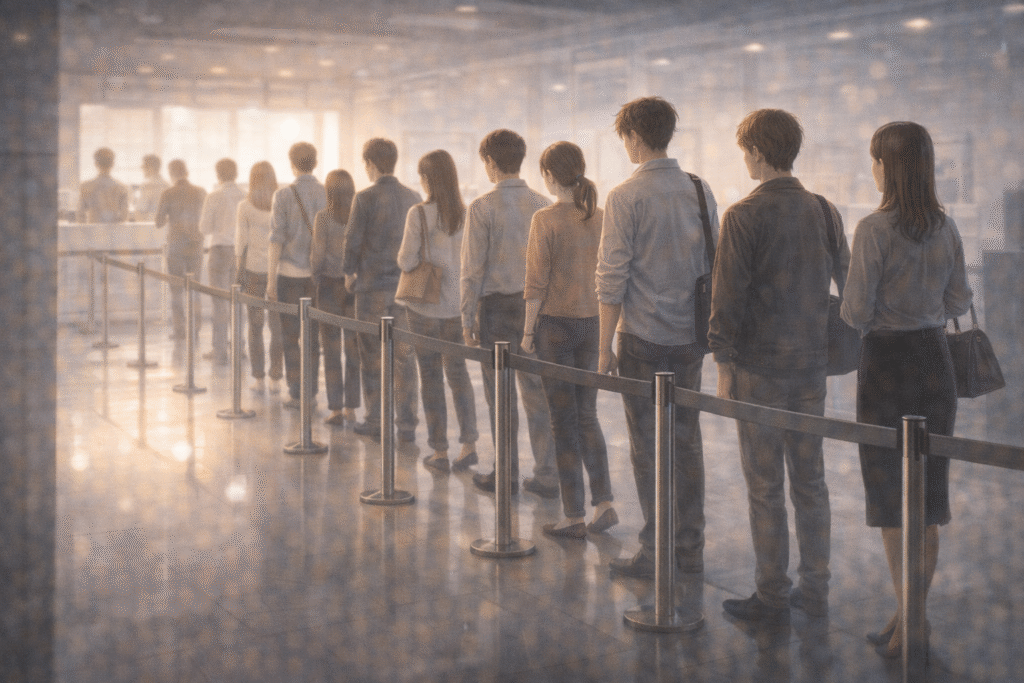
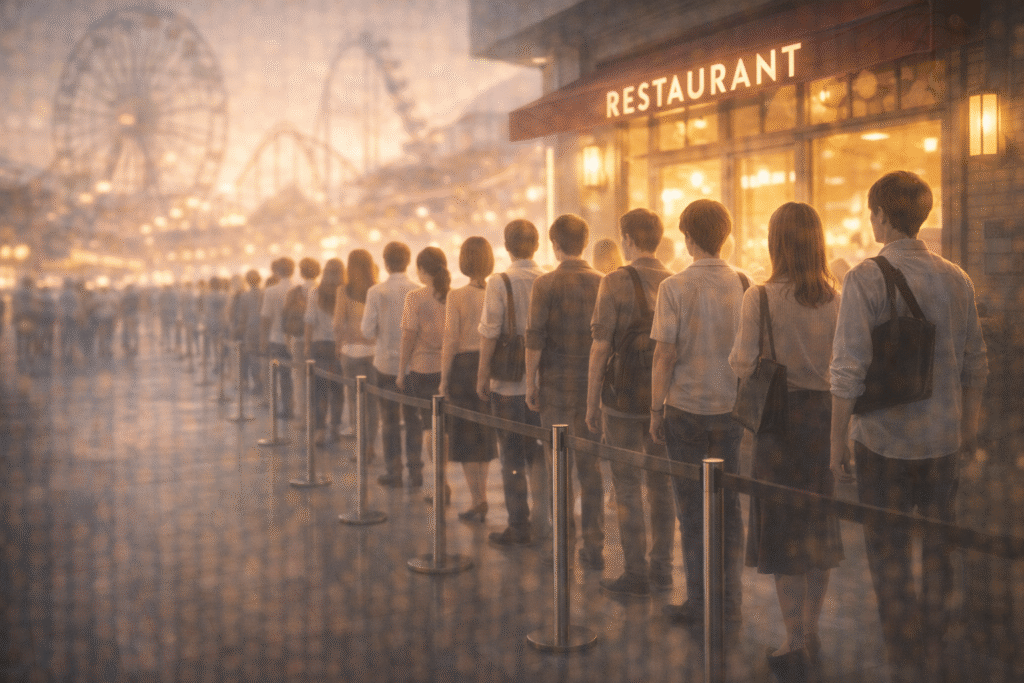
    People standing in line representing fairness and social order

    1. Why Do We Line Up So Willingly?

    We stand in lines almost every day—
    at amusement parks, popular restaurants, hospital counters, and even online shopping platforms where “waiting numbers” appear on our screens.

    At first glance, lining up looks like nothing more than inconvenient waiting.
    Yet people rarely question it. On the contrary, they often accept it willingly.
    Why do we voluntarily endure waiting instead of seeking alternatives?

    The answer lies not in patience alone, but in the social meaning embedded in queues.


    1.1. Lines as a Guarantee of Fairness

    The most fundamental function of a line is fairness.
    The rule is simple: first come, first served.

    Sociologists describe this as the first-come, first-served norm, a powerful yet easily shared social agreement.
    It reassures individuals that their turn will be respected.

    If someone cuts the line at a hospital reception desk, frustration spreads immediately.
    The anger is not about time alone—it is about the violation of fairness.
    Without lines, trust erodes quickly and social conflict intensifies.


    2. Waiting Turns Time into Meaning

    Interestingly, waiting in line does more than organize order—it reshapes experience.

    At amusement parks, waiting two hours for a roller coaster often heightens anticipation.
    People feel that the experience must be more rewarding because they invested time.

    The same applies to long restaurant lines.
    A crowded queue becomes a social signal: this place must be worth it.
    Even ordinary food can feel more valuable when framed by a visible line.

    Long queue outside a popular place signaling value and demand

    3. Lines Create Social Bonds

    Standing in line often produces a subtle sense of solidarity.
    People waiting for the same goal share space, time, and expectation.

    Fans lining up for concert tickets may begin as competitors,
    but often end up feeling like comrades.
    Small conversations, shared complaints, and mutual understanding emerge.

    Lining up is not only about waiting—it is also about belonging.


    4. Lines as Tools of Power and Control

    Despite their appearance of fairness, lines can also function as instruments of power.

    Who controls the line matters.
    VIP lanes, priority access, and exclusive queues immediately reveal inequality.

    Luxury brands deliberately create long lines to increase perceived value.
    Standing in line itself becomes a status symbol—
    a sign of inclusion in a desirable group.

    In these cases, waiting is no longer neutral; it is carefully designed.


    5. Digital Lines in the Online Age

    Lines have not disappeared in digital society—they have simply changed form.

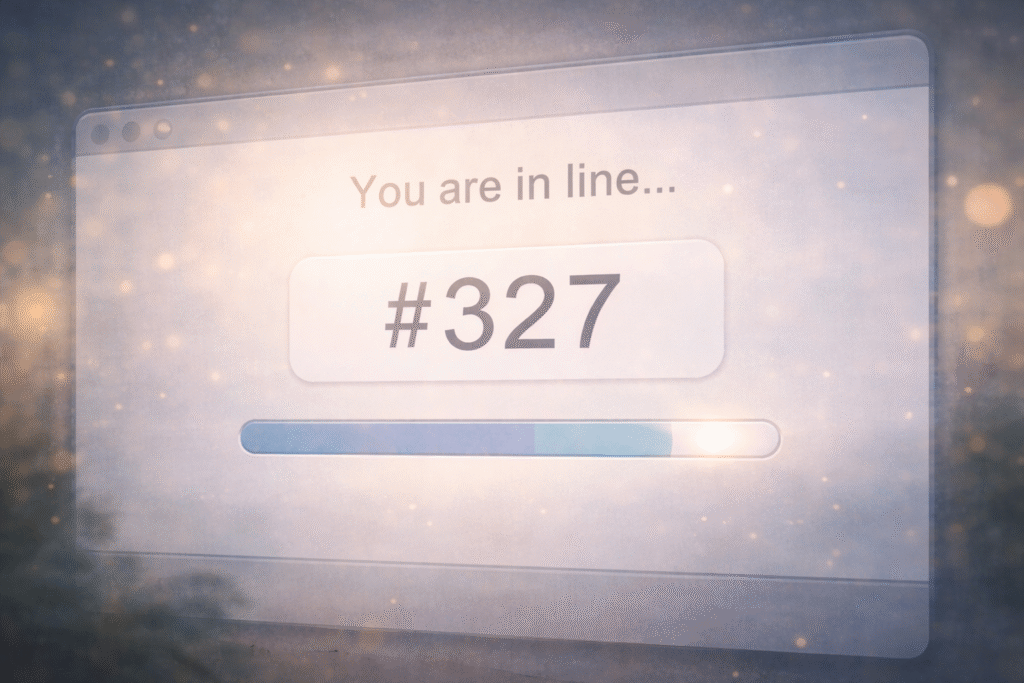
    Online ticket platforms display messages like “You are number 10,524 in line.”
    Video games restrict access with server queues.
    Physical waiting has become virtual waiting.

    Because digital queues are invisible, trust becomes fragile.
    Platforms compensate by showing estimated wait times and live updates,
    attempting to preserve the sense of fairness that physical lines once provided.


    Digital waiting queue on a screen representing online waiting

    Related Reading

    The politics of everyday space and design are examined in The Politics of Empty Space, where minimalism and structure subtly guide collective behavior.

    At a broader social level, the tension between individual freedom and shared order resurfaces in The Minimal State: An Ideal of Liberty or a Neglect of the Common Good?, questioning how fairness is negotiated within structured systems.

    Conclusion

    Waiting in line is far more than idle time.

    It is a social mechanism where fairness, expectation, belonging, and power intersect.
    Within the lines we casually join each day,
    the hidden order of society quietly reveals itself.


    References

    1. Mann, L. (1969). Queue Culture: The Waiting Line as a Social System.
      American Journal of Sociology, 75(3), 340–354.
      → A foundational study analyzing queues as structured social systems that sustain order and fairness.
    2. Schweingruber, D., & Berns, N. (2005). Shaping the Social Experience of Waiting.
      Symbolic Interaction, 28(3), 347–367.
      → Examines how theme parks transform waiting into a designed experience of anticipation.
    3. Maister, D. H. (1985). The Psychology of Waiting Lines.
      Harvard Business School Service Notes.
      → Explores how perceived fairness and engagement shape satisfaction during waiting.