
Tag: historiography

  • Is There a Single Historical Truth, or Many Narratives?

    Is There a Single Historical Truth, or Many Narratives?

    Power, Interpretation, and the Subjectivity of History

    “History is written by the victors.”

    This familiar phrase suggests that history is not simply a record of facts, but a narrative shaped by power, perspective, and interpretation.

    We learn history through textbooks, national stories, and cultural memory. Yet the same event often carries entirely different meanings depending on who tells it—and when.

    So what, then, is historical truth?
    Does it exist as an objective reality, or is all history inevitably shaped by subjective interpretation?


    1. Historical Truth — Does It Exist?

    fragmented historical records and documents

    At its core, historical truth refers to events that actually occurred in the past.

    For example, the statement “On July 28, 1914, Austria-Hungary declared war on Serbia” is a verifiable fact grounded in time, place, and action. History undeniably contains such factual elements—dates, figures, locations, and events.

    However, even these facts are never fully preserved.

    Historical records are created by individuals with perspectives, limitations, and intentions. Not all events are recorded, and not all records survive intact. Documents may be lost, damaged, or incomplete, and their interpretation is often uncertain.

    Thus, while historical truth may exist, it reaches us only in fragmented and partial forms.


    2. The Subjectivity of Historical Narratives — Selection and Interpretation

    historians interpreting the same event differently

    Historians do not simply report facts—they select, organize, and interpret them.

    Out of countless possible sources, certain events are emphasized while others are omitted. These choices are shaped by the historian’s values, political context, and the needs of their time.

    Consider the French Revolution.
    To some, it represents a heroic struggle for liberty and equality.
    To others, it appears as a period of violence and social chaos.

    Both interpretations draw on real events, yet they differ in emphasis, framing, and meaning.

    Moreover, historical writing often relies on narrative techniques—metaphor, causality, and storytelling. While these help convey meaning, they also embed interpretation within the narrative itself.

    History, therefore, is not only about what happened, but also about how we understand what happened.


    3. Collective Memory and Identity

    The subjectivity of history extends beyond academia—it shapes collective memory and identity.

    What a society chooses to remember—or forget—reveals its values. National heroes, founding events, and historical achievements become part of a shared identity.

    However, these memories are not universal.

    An event remembered as “liberation” in one country may be remembered as “occupation” in another. Such differences can lead to conflicts not only between nations, but also between generations within the same society.

    History, in this sense, is not just about the past—it actively constructs the present.


    4. The Self-Reflection of Historiography — Toward Plural Narratives

    Since the late 20th century, historians have increasingly questioned the idea of a single, objective historical narrative.

    Instead, there has been a shift toward recognizing multiple perspectives—histories, rather than one definitive history.

    This approach seeks to include voices previously excluded from dominant narratives. For example, studies of colonial history now incorporate not only official records of colonizing powers, but also oral histories, diaries, and testimonies of colonized peoples.

    Such plural narratives do not eliminate truth, but they broaden our understanding of it.

    They remind us that historical knowledge is constructed through dialogue, not dictated by a single authority.


    5. History in the Digital Age — Opportunity and Risk

    Today, access to historical information has expanded dramatically.

    Digital archives, online databases, and artificial intelligence allow us to explore vast amounts of data and uncover patterns previously invisible.

    Yet this abundance also brings new risks.

    Misinformation, manipulated records, and selective reinterpretations can spread rapidly. History can be reshaped to serve political or ideological agendas in ways that are more subtle—and more pervasive—than ever before.

    In such a context, the ability to critically evaluate sources becomes essential.

    Understanding the subjectivity of historical narratives is no longer just an academic concern—it is a civic responsibility.

    For example, debates over historical events—such as colonial history, war responsibility, or national identity—continue to shape political discourse and social conflict in many countries today.


    Conclusion: Judgment Deferred

    multiple perspectives shaping history

    Historical truth may exist, but it is never encountered in a pure, untouched form.

    It is always mediated through selection, interpretation, and narrative.

    Absolute objectivity may be unattainable. Yet the pursuit of balance—through diverse perspectives, critical inquiry, and careful analysis—remains essential.

    As readers, we must resist the temptation to accept a single narrative as final truth.

    History is not a closed book.
    It is an ongoing conversation between the past and the present.

    And perhaps the most important question is not what history is, but how we choose to understand it.

    This raises a deeper question: if history is shaped by perspective, can we ever speak of a single truth?


    A Question for Readers

    When you read history, do you seek objective facts—
    or do you recognize that every narrative reflects a particular perspective?

    Related Reading

    The question of who has the authority to define truth is further examined in Why Do Taboo Words Exist? — Language, Power, and Social Control, where the regulation of language reveals how power structures shape what can be said, remembered, and ultimately accepted as truth.

    From a broader perspective on human perception and interpretation, “Opportunity Favors the Prepared”? The Psychology of Hindsight Bias explores how individuals reconstruct past events through present understanding, suggesting that what we call “history” may often be shaped as much by interpretation as by fact.

    References

    1. E. H. Carr (1961). What is History?
      This classic work examines the relationship between historical facts and the historian’s interpretation. Carr argues that facts do not speak for themselves, emphasizing that selection and arrangement inevitably introduce subjectivity into historical writing.
    2. R. G. Collingwood (1946). The Idea of History
      Collingwood presents history not as a simple record of events but as a reconstruction of past thought. He highlights that understanding history requires re-enacting human consciousness, shifting focus from data to interpretation.
    3. Hayden White (1973). Metahistory: The Historical Imagination in Nineteenth-Century Europe
      White demonstrates how historical narratives are shaped by literary structures such as plot and metaphor. His analysis challenges the objectivity of historical truth by revealing the narrative frameworks behind historical writing.
    4. Marc Bloch (1949). The Historian’s Craft
      Bloch offers a systematic approach to historical methodology and source criticism. He emphasizes that historians’ perspectives inevitably influence how evidence is interpreted and understood.
    5. Peter Novick (1988). That Noble Dream: The “Objectivity Question” and the American Historical Profession
      Novick explores the debate over objectivity in historiography, showing how historical writing is shaped by political and cultural contexts. He argues that neutrality in history is often constructed rather than absolute.
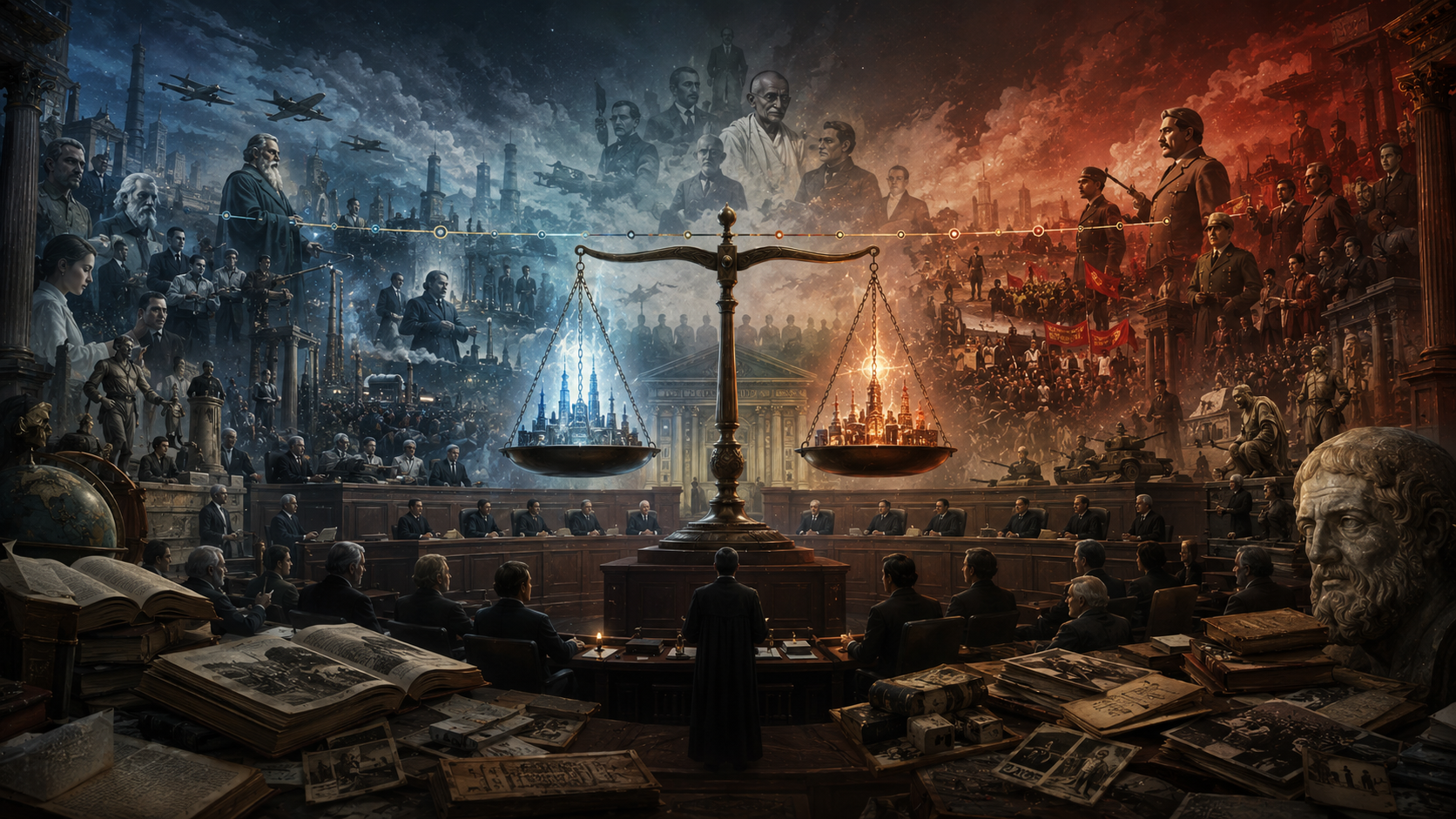
  • Is History a Record of Progress or a Narrative of Power?

    Enlightenment Optimism and Postmodern Critique on Trial

    Two Ways of Seeing History

    An empty stage illuminated as a metaphor for historical interpretation

    Human beings have always recorded and interpreted the past in order to understand who they are.

    History is not simply a collection of events that have already happened.
    It is a foundation upon which societies build their present identities and imagine their futures.

    Yet there are fundamentally different ways of understanding what history is.

    One view treats history as a record of human progress—an ongoing movement toward reason, freedom, and moral improvement.
    Another sees history as a narrative shaped by power—constructed, selected, and told by those who dominate political and cultural authority.

    These two perspectives have long confronted one another on the grand stage of historical interpretation.
    Today, they meet again in a renewed trial of ideas.


    1. The Plaintiff: History as a Record of Progress

    The Enlightenment Tradition

    A symbolic path representing gradual human progress through history

    1.1 Reason, Freedom, and Historical Direction

    Enlightenment thinkers understood history as a rational process through which humanity gradually advances.

    In Idea for a Universal History with a Cosmopolitan Purpose, Idea for a Universal History with a Cosmopolitan Purpose by Immanuel Kant presents history as the unfolding of human reason within nature.
    Even war, conflict, and disorder are interpreted as unintended mechanisms through which humanity moves toward a more lawful and moral global order.

    History, from this perspective, is not random.
    It has a direction, even if that direction is only visible in retrospect.

    1.2 Hegel and the Philosophy of Historical Progress

    This claim becomes more explicit in Lectures on the Philosophy of World History by G. W. F. Hegel.
    For Hegel, history is the process by which reason realizes itself in the world.

    Freedom is not given all at once.
    It expands gradually as human consciousness develops—from despotism, to limited liberty, to the recognition that all humans are free.

    In this view, history is not merely descriptive.
    It is the story of humanity coming to understand itself.

    1.3 The Enduring Appeal of Progress

    This narrative remains persuasive today.

    The abolition of slavery, the expansion of women’s rights, the institutionalization of democracy, and the global spread of human rights norms are often cited as evidence that history does move in a better direction.

    From this angle, history offers hope.
    It reassures us that injustice is not permanent and that moral learning is possible.


    2. The Defense: History as a Narrative of Power

    Postmodern Critiques

    2.1 Power, Knowledge, and Historical Construction

    Postmodern thinkers challenge the very idea that history has an inherent direction.

    In The Archaeology of Knowledge and Discipline and Punish, Michel Foucault argues that history is inseparable from power.
    What counts as historical truth is shaped by institutions, discourses, and systems of knowledge that serve particular interests.

    From this perspective, historical facts are never neutral.
    They are selected, organized, and interpreted in ways that legitimize existing power structures.

    2.2 History as Narrative, Not Mirror

    A similar argument appears in Metahistory by Hayden White.
    White treats historical writing as a form of narrative construction, governed by literary tropes and rhetorical choices.

    History, he argues, does not simply reflect reality.
    It tells stories—and those stories could always have been told differently.

    Thus, the story of “progress” may itself be a narrative strategy rather than an objective description.

    2.3 Exclusion, Silence, and Authority

    From this standpoint, the writing of history becomes a political act.

    Colonial histories written from the perspective of imperial powers, the marginalization of subaltern voices, and the selective memory preserved in textbooks all reveal how power shapes historical meaning.

    History, the defense insists, is not a neutral archive—but a contested terrain.


    3. Evidence and Counterarguments

    Supporters of the progress narrative point to concrete transformations:
    expanded political rights, improved living standards, and international legal frameworks.

    Critics respond that these achievements often coexist with new forms of domination.
    Colonialism was justified as “civilization,” and human rights discourse has sometimes been used to legitimize geopolitical intervention.

    The very concept of progress, they argue, may reflect the worldview of those who benefit most from the existing order.


    4. Contemporary Implications: Textbooks and the Politics of Memory

    This debate is not abstract.

    It shapes how history is taught in schools, how nations commemorate past events, and how societies decide what to remember—and what to forget.

    Disputes over history textbooks, debates about monuments, and conflicts over collective memory reveal that history is always written in the present.

    At the same time, few would deny that humanity has achieved genuine moral breakthroughs.
    The challenge lies in acknowledging progress without ignoring power.

    A shadow over a history book symbolizing power shaping narratives

    Conclusion: An Open Verdict

    Is history a record of progress, or a narrative of power?

    The advocates of progress emphasize humanity’s capacity for reason, learning, and moral growth.
    The critics remind us that history is always told from somewhere, by someone, for some purpose.

    The trial does not end with a final judgment.

    Instead, it leaves us with a question that must remain open:

    Is the history we learn a trace of human advancement—or a reflection of power’s imprint?

    That question, ultimately, is still under deliberation—within each reader’s own interpretive court.

    Related Reading

    The politics of language and interpretation is further developed in The Power of Naming: Is Naming an Act of Control?, where classification becomes an instrument of authority.

    A contemporary reflection on collective perception can be found in Algorithmic Bias: How Recommendation Systems Narrow Our Worldview, which examines how narratives are filtered in the digital age.


    References

    1. Idea for a Universal History with a Cosmopolitan Purpose
      Kant, I. (1784/1991). Idea for a Universal History with a Cosmopolitan Purpose. Cambridge: Cambridge University Press.
      → Kant presents history as the gradual unfolding of human reason toward a cosmopolitan moral order, forming a cornerstone of Enlightenment historical thought.
    2. Lectures on the Philosophy of World History
      Hegel, G. W. F. (1837/1975). Lectures on the Philosophy of World History. Cambridge: Cambridge University Press.
      → Hegel systematizes the idea of historical progress as the realization of freedom through world history.
    3. The Archaeology of Knowledge
      Foucault, M. (1969/2002). The Archaeology of Knowledge. London: Routledge.
      → Foucault demonstrates how historical knowledge is shaped by discourse and power rather than objective truth alone.
    4. Metahistory
      White, H. (1973). Metahistory. Baltimore: Johns Hopkins University Press.
      → White argues that historical writing is fundamentally narrative and rhetorical, challenging claims of neutral historiography.
    5. What Is History?
      Carr, E. H. (1961). What Is History?. London: Macmillan.
      → Carr occupies a middle ground, emphasizing both factual evidence and the historian’s interpretive role.