How do earphones shape the way we interact with the world around us?
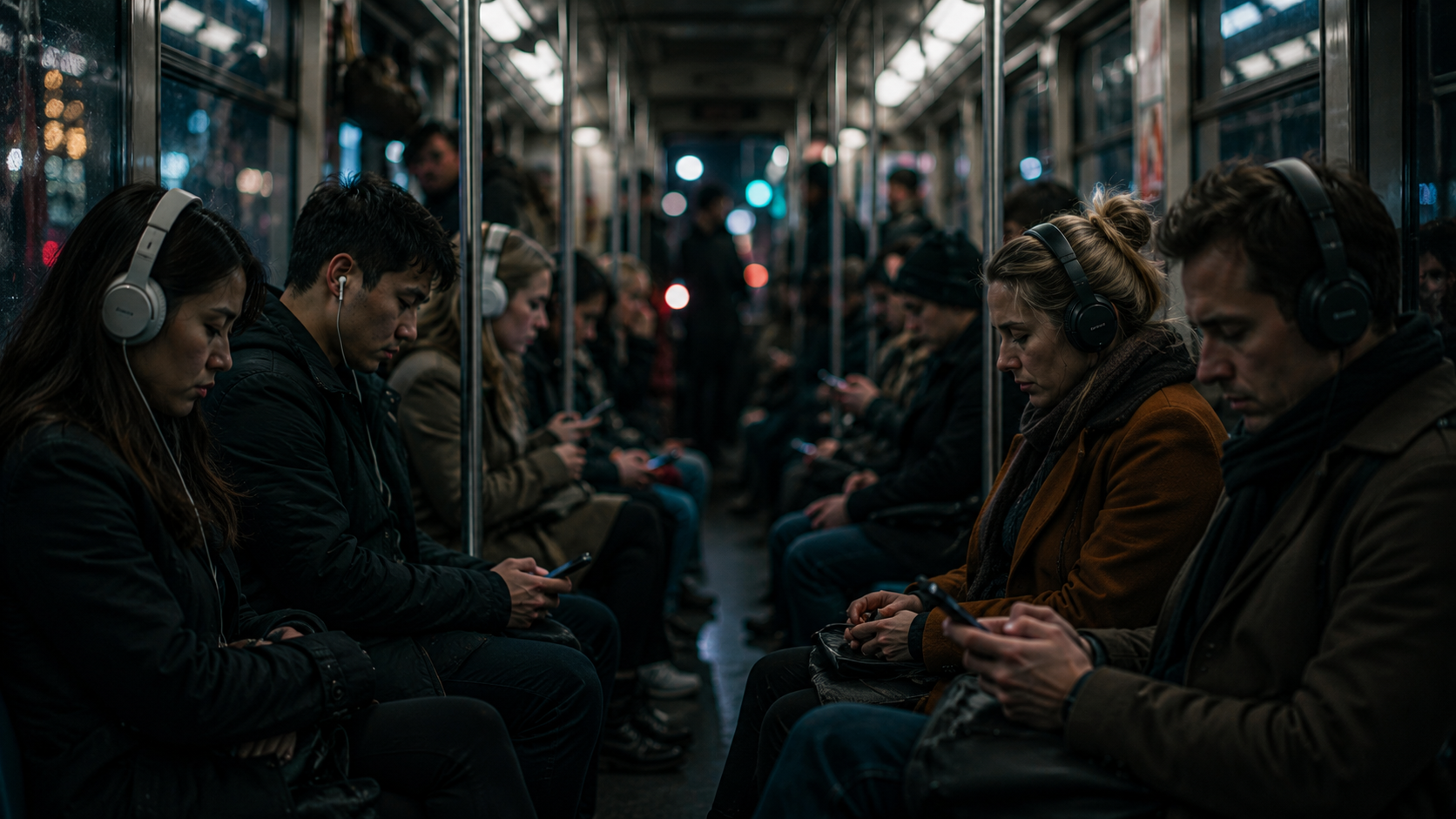
It was an unusually loud evening on the subway.
Someone nearby was talking on the phone. Advertisements repeated above the doors, and the metallic rhythm of the train seemed louder than usual.
Without thinking, I reached into my bag and put on my earphones.
A familiar piece of music began to play.
Nothing outside had actually changed. The train was still noisy. People were still talking. The carriage was just as crowded as before.
Yet within seconds, the surrounding world seemed to move a little farther away.
I felt calmer.
Then I looked around.
A student across from me was watching something through wireless earbuds. A man near the door wore noise-canceling headphones. Several other passengers were absorbed in their own private sounds.
We were all traveling together, yet each of us seemed to occupy a slightly different world.
That was when a simple thought occurred to me:
Perhaps earphones do more than bring sound closer. They also keep the world at a distance.
That invisible distance is what we might call the wall of earphones.
1. Earphones as a Small ‘Safety Net’
A private space in a public place
Earphones are more than devices for listening to music.
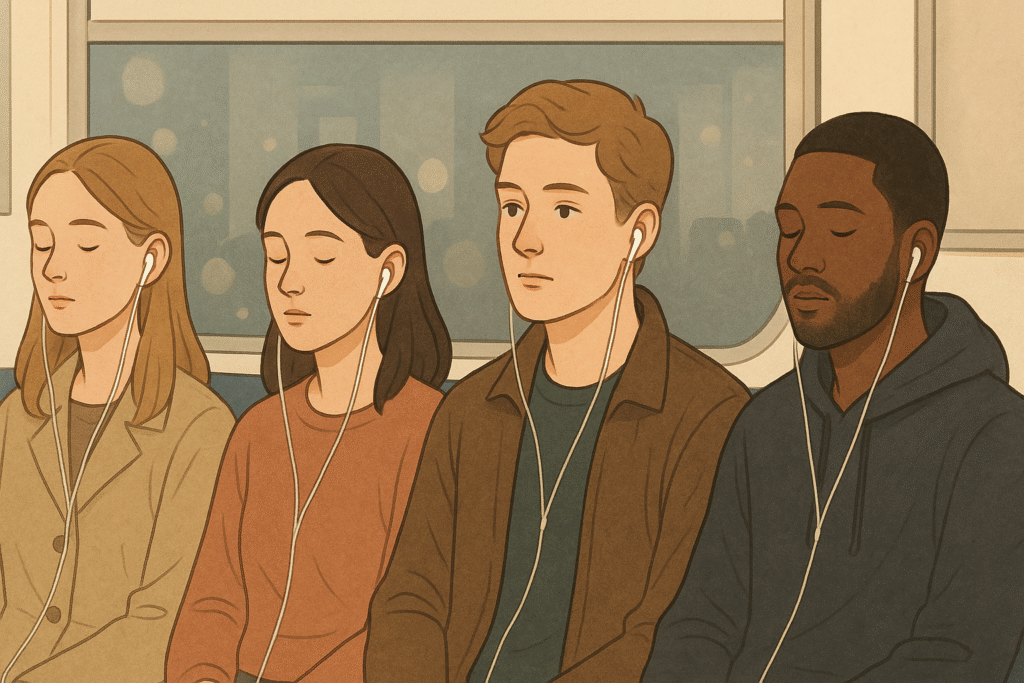
In a crowded subway, on a busy street, or in a noisy café, they allow us to create a small private space without physically leaving the public one.
The surrounding sounds remain, but we decide which sounds deserve our attention.
This sense of control can be surprisingly comforting.
Research on personal listening has long examined this phenomenon. Michael Bull, for example, describes how portable audio allows people to reorganize their experience of urban space, creating personalized sound environments while moving through the city.
In this sense, earphones can function almost like a small psychological safety net.
They do not remove us from the crowd.
They simply make the crowd feel a little farther away.
An invisible boundary
Earphones also communicate something without requiring us to say a word.
In public spaces, they can quietly signal:
“I want to be alone right now.”
Someone wearing earphones is less likely to be approached for casual conversation. Even when no music is playing, the device itself can create a subtle social boundary.
This is one reason earphones feel protective.
They allow us to regulate not only sound, but also our availability to other people.
2. Personal Isolation or Emotional Self-Defense?
Why shutting out the world can feel good
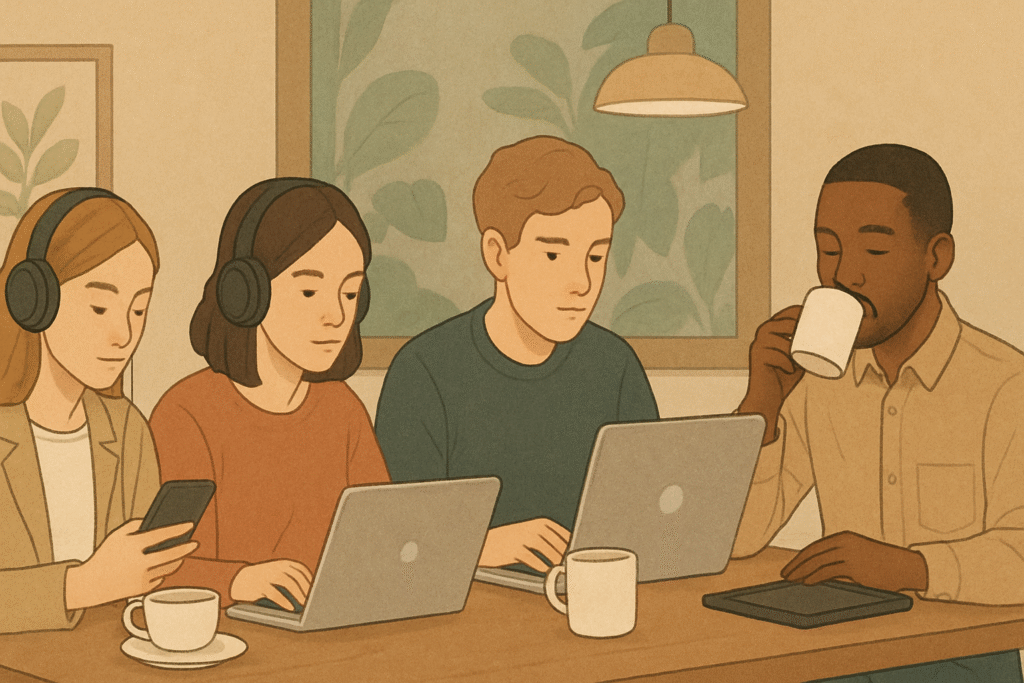
Modern urban life surrounds us with constant stimulation.
Traffic, announcements, conversations, advertisements, screens, notifications, and countless other sounds compete for our attention.
Sometimes we simply become tired of receiving.
At such moments, putting on earphones can feel like closing a door.
A favorite song may help us regain our rhythm. A podcast can redirect our attention. Noise cancellation can provide a few precious minutes of quiet.
We are not necessarily rejecting society.
Sometimes we are simply protecting our attention and giving our emotions a little room to settle.
In that sense, earphones can become a form of emotional self-defense.
But every boundary has another side
Yet the same boundary that protects us can also separate us.
When our ears are occupied and our attention turns inward, eye contact becomes less frequent. Small conversations disappear before they begin. The people around us gradually become part of the background.
Think about the tiny encounters that happen in public places.
Someone asks for directions. A stranger notices that another person has dropped something. Two people exchange a smile after an unexpected delay. Someone hears a child laugh or an elderly passenger ask for help.
None of these moments is dramatic.
But together they remind us that public life is something we share.
Beyond the wall of earphones, there may always be someone’s voice we no longer hear.
3. The Earphone Generation: Identity, Personal Space, and Social Fatigue
Our own soundtrack to everyday life
Personal listening has also become part of how we express ourselves.
The music we choose on the way to work, the podcast we listen to while walking, or the playlist we create for a particular mood can all become extensions of our identity.
Shuhei Hosokawa described the cultural transformation produced by the portable music player decades ago as the “Walkman effect.” Long before wireless earbuds and streaming services, personal audio was already changing the relationship between individuals and public space.
Today that transformation has gone much further.
We can carry almost unlimited music, voices, stories, and information wherever we go.
A city street is no longer accompanied only by the sounds of the city.
Each person can give it a private soundtrack.
Together, but in separate worlds
There is something liberating about this.
We can make a tiring commute more pleasant. We can create moments of calm in a crowded environment. We can choose what enters our attention.
But there is also a paradox.
The more precisely we customize our personal environment, the easier it becomes to withdraw from the environment we actually share.
A subway carriage may contain dozens of people traveling together while each person inhabits a separate auditory world.
Sherry Turkle has written extensively about a related contradiction in digital life: technology allows us to remain constantly connected while also making it easier to retreat from direct human interaction.
Earphones offer a particularly visible version of this tension.
They connect us to voices, music, and ideas from anywhere in the world while sometimes disconnecting us from the person sitting beside us.

4. When Does a Shelter Become a Wall?
The problem, then, is not the earphones themselves.
There are good reasons to use them.
They help us concentrate, rest, regulate stimulation, enjoy music, and create moments of solitude. For people navigating crowded and noisy environments, these benefits can be especially valuable.
The more interesting question is whether we still choose when to put them on and when to take them off.
A tool becomes different when it turns into an automatic habit.
Do we put on earphones because we genuinely want to listen to something?
Or do we sometimes put them on simply because being unavailable to the world has become comfortable?
There is an important difference.
Solitude can restore us.
But constant withdrawal may gradually reduce the small, unpredictable encounters through which we experience ourselves as part of a community.
Perhaps what matters is not removing the wall entirely, but remembering that we built it—and that we can lower it whenever we choose.
Conclusion — Opening the Heart Without Closing the Sound
Understanding earphone isolation is not about rejecting technology.
Earphones give us something valuable: a small measure of control over attention, noise, and personal space in environments that can sometimes feel overwhelming.
I still use mine on the subway.
There are days when I want music between myself and the noise, and days when a familiar melody makes a long journey easier.
But occasionally, I take them off before reaching my destination.
The city immediately becomes louder.
I hear footsteps, fragments of conversation, the train doors opening, someone laughing, a child asking a question.
Most of these sounds are ordinary.
Yet they remind me that I am not simply moving through a city.
I am moving among other people.
Perhaps that is the balance worth keeping.
We all need a private world from time to time. But we also need moments when we remain available to the shared world around us.
Closing out sound does not have to mean closing the heart.
May our earphones remain a shelter when we need one—but never become a wall we forget how to open.
A Question for Readers
When you put on earphones in a public place, are you mainly choosing what you want to hear—or choosing what you no longer want to notice?
Related Reading
The quiet experience of being alone is explored more deeply in Familiar Solitude — The Quiet Comfort of Being Alone, where solitude is portrayed not as loneliness, but as a gentle space for reflection, healing, and reconnecting with oneself. Together, these ideas invite us to reconsider whether moments of silence are something to escape—or something to embrace.
Modern technology allows people to remain constantly connected while emotionally withdrawing into private spaces. Solitude in the Digital Age explores whether contemporary isolation represents meaningful self-reflection or a deeper loss of human connection.
References
1. Bull, Michael. (2000). Sounding Out the City: Personal Stereos and the Management of Everyday Life. Berg Publishers.
A foundational work examining how portable audio devices allow individuals to create private auditory spaces and manage their experience of everyday urban life.
2. Hosokawa, Shuhei. (1984). “The Walkman Effect.” Popular Music, 4, 165–180.
An influential early study of how personal listening technologies transform the relationship between individuals, sound, and public space.
3. Turkle, Sherry. (2011). Alone Together: Why We Expect More from Technology and Less from Each Other. Basic Books.
Explores how digital technologies can simultaneously increase connectivity and encourage withdrawal from direct human interaction.