How to Balance Present Happiness and Future Security
Human beings live with an unusual awareness of time. We remember the past, experience the present, and imagine a future that has not yet arrived.
Much of modern life is organized around a familiar promise: work hard today so that tomorrow will be better.
Students spend years studying for future careers. Young professionals work long hours to build financial security. Families postpone travel or leisure to save for a home. Workers contribute to retirement accounts in the hope of enjoying greater freedom decades later.
This future-oriented mindset encourages discipline, planning, and long-term achievement. Without it, many of the things we value—education, savings, scientific progress, stable careers, and retirement security—would be difficult to achieve.
But there is another question we rarely ask:
How much of the present should we sacrifice for a future that is never completely guaranteed?
At the other extreme is the philosophy of living for today: enjoy experiences while they are available, spend time with people you love, and do not postpone happiness indefinitely.
Both perspectives contain wisdom. Both also carry risks.
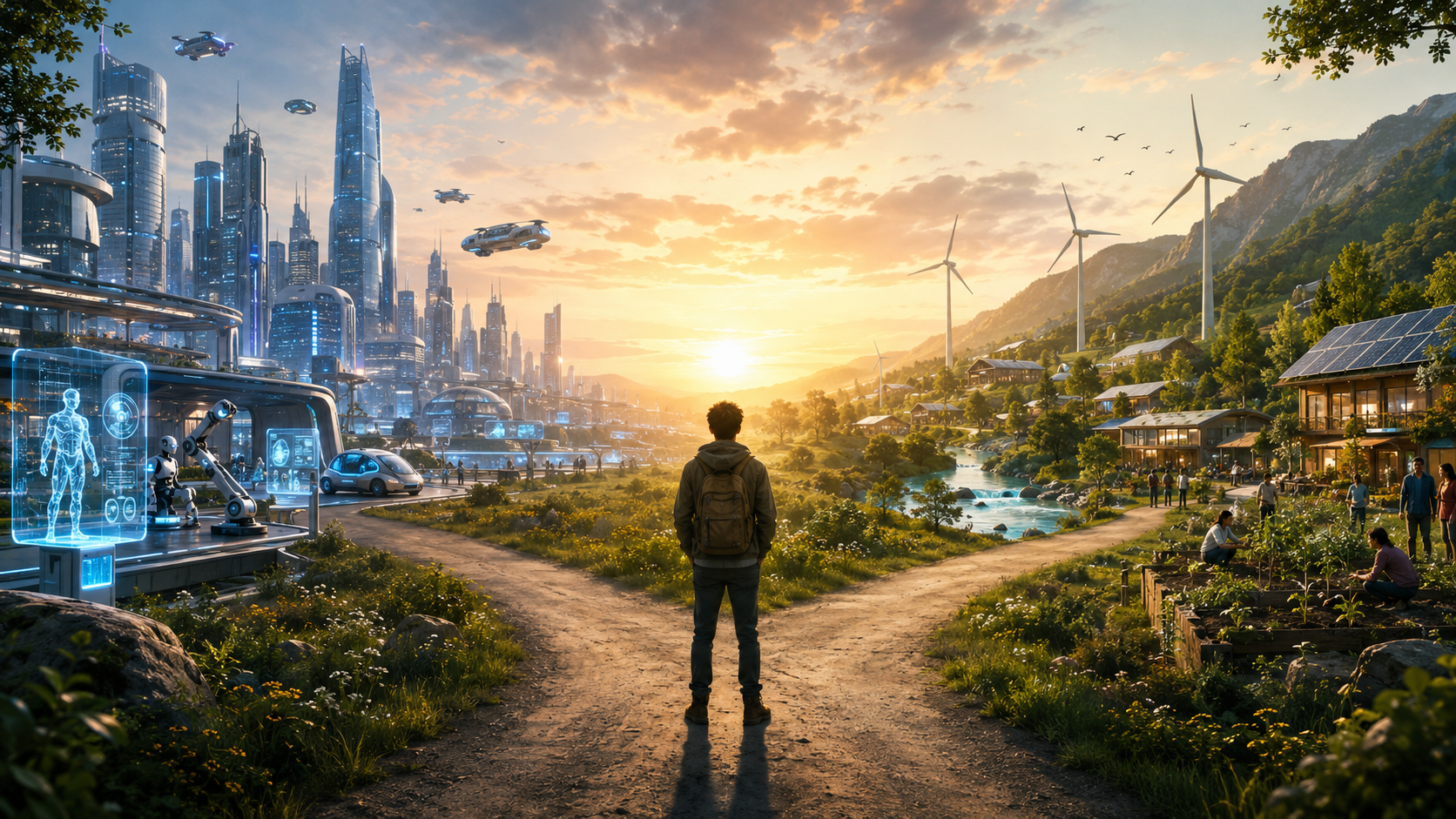
Perhaps the real challenge is not choosing between today and tomorrow, but learning how to prepare for the future without disappearing from our own present.
1. Why We Live for the Future

The Logic of Delayed Gratification
Future-oriented thinking means accepting short-term costs in exchange for long-term benefits.
Education is an obvious example. A university student may spend years studying, preparing for examinations, and developing professional skills rather than maximizing leisure in the present. The expectation is that these sacrifices will eventually create better opportunities, meaningful work, or financial stability.
The same principle applies to saving money, investing, maintaining health, raising children, and building a career.
Human societies themselves depend on this ability to think beyond immediate rewards. Roads, universities, scientific research, pension systems, and environmental policies all require people to invest resources today for benefits that may emerge years or even decades later.
Future thinking also provides direction. Difficult work can become easier to endure when it contributes to a goal that matters.
In this sense, preparing for tomorrow is not simply an economic strategy. It is one of the ways human beings create purpose.
2. When the Future Consumes the Present
The Endless Postponement of Happiness
The problem begins when preparation for the future becomes permanent.
A student tells herself she will relax after graduation.
After graduation, she decides happiness can wait until she finds a stable job. Then until she receives a promotion. Then until she buys a home. Then until the mortgage becomes manageable. Eventually, happiness is postponed until retirement.
The destination keeps moving.
Life can gradually become a sequence of preparation stages in which satisfaction always exists somewhere ahead.
Modern achievement culture can intensify this tendency. Success is frequently measured through qualifications, income, promotions, property, investments, and social status.
These goals are not inherently harmful. The difficulty is believing that one final achievement will eventually produce lasting satisfaction.
Human beings adapt surprisingly quickly to improved circumstances. A promotion that once seemed life-changing can soon become ordinary. A higher income creates new expectations. One achievement is followed by another target.
The danger is not ambition itself.
It is becoming so skilled at preparing for life that we forget to experience it.
3. The Case for Living in the Present

Life Happens Only Now
Present-oriented thinking begins with a simple observation: although we can imagine the future and remember the past, we experience life only in the present.
This perspective encourages us to pay attention to experiences that are easily overlooked—conversation, food, music, nature, friendship, family, rest, or simply an afternoon without constant productivity.
Consider someone who chooses to spend part of her savings on a family journey rather than maximizing every possible investment for retirement.
From a purely financial perspective, the decision may appear inefficient.
But time has its own value.
Children grow older. Parents age. Health changes. Friendships evolve. Some experiences cannot simply be postponed for twenty years and recreated later.
Yet living only for today creates another danger.
Psychologists and behavioral economists have long observed that people tend to value immediate rewards more strongly than distant ones. This tendency, often called present bias, can encourage overspending, inadequate saving, or neglect of long-term health.
The future cannot simply be ignored because, sooner or later, it becomes the present.
The question is therefore not whether we should enjoy today, but how we can do so without creating unnecessary hardship for tomorrow.
4. Money, Work, and Retirement: The Time Dilemma
How Much Is Enough for Tomorrow?
Money makes the conflict between present and future particularly visible.
Saving provides security. Emergency funds protect us from unexpected events. Investments can create future independence, while retirement planning can reduce anxiety later in life.
But maximizing savings at all costs can also diminish the quality of life.
A person who continually refuses meaningful experiences in order to accumulate more wealth may eventually possess substantial financial resources but fewer memories of how those years were lived.
The same dilemma appears in work.
There are periods when intensive effort may be worthwhile—completing a degree, building a business, developing expertise, or overcoming financial hardship. But problems arise when temporary sacrifice becomes a permanent lifestyle.
Retirement presents the dilemma in its clearest form.
People may spend thirty or forty years preparing financially for the day when they can finally enjoy freedom. Yet health, energy, relationships, and personal circumstances at seventy may be very different from those at forty or fifty.
Preparing for old age is sensible.
Assuming that life can simply be postponed until old age is far more questionable.
Perhaps a better question is not:
“How much must I sacrifice now so that I can enjoy life later?”
but:
“How can I build a secure future while still creating a life worth remembering along the way?”
5. Living with an Uncertain Future
Planning Without Controlling Everything
Future planning contains an unavoidable difficulty: the future is uncertain.
Economic crises occur. Careers change. Illness appears. Relationships evolve. New technologies transform industries. Political and environmental conditions shift in unexpected ways.
Today, this uncertainty may feel especially visible.
Artificial intelligence is changing the nature of work. Climate change may alter where and how people live. Housing affordability has delayed traditional milestones for many younger adults. Entire professions may look different within a generation.
None of this means that planning is useless.
It means that good planning should create flexibility rather than assume complete control.
Education, savings, health, and adaptable skills can provide options without requiring us to predict exactly what the future will look like.
This distinction is important.
Future-oriented thinking becomes unhealthy when it demands that life follow a predetermined script. It becomes valuable when it increases our ability to respond to whatever eventually happens.
In an uncertain world, resilience may be more valuable than perfect planning.
6. Finding a Balance Between Today and Tomorrow

Our Future Self Is Still Us
One useful way to think about this dilemma is to imagine a relationship between our present and future selves.
The person who will need retirement savings decades from now is not a stranger. That future person is still us.
Present-you can give future-you valuable gifts: savings, education, health, skills, relationships, and opportunities.
But the relationship should work in both directions.
Future-you should not demand that present-you sacrifice every journey, friendship, hobby, celebration, or meaningful experience.
Neither self should exploit the other.
How Do You Balance Living in the Present and Planning for the Future?
The answer is unlikely to be a perfect fifty-fifty balance. Different stages of life require different priorities. A student may temporarily prioritize education, while someone facing financial insecurity may need to save more aggressively for a period. Later, the balance may shift toward relationships, travel, leisure, or rest.
What matters is whether future planning expands our choices or continually postpones the experiences that give life meaning.
A useful question is:
Am I investing in my future—or merely postponing my life?
Saving for financial security, developing meaningful skills, or protecting one’s health can expand future possibilities. But endlessly delaying relationships, rest, travel, or meaningful experiences for goals that keep moving further away may be something different.
There is no universal formula. The right balance depends on our circumstances, responsibilities, and values. The goal is not to divide life equally between today and tomorrow, but to ensure that neither is permanently neglected.
Conclusion
Future-oriented thinking and present-moment living do not have to be enemies.
Human beings need both.
Without concern for the future, we risk financial insecurity, missed opportunities, and avoidable regret. Without attention to the present, we may eventually reach our goals only to discover that much of life passed while we were preparing for it.
The goal, therefore, is not to sacrifice the present for the future—or to abandon the future for the pleasures of today.
It is to build a relationship between them.
We save because tomorrow matters.
We rest, travel, love, talk, listen, and experience because today matters too.
Perhaps a good life is one in which today’s choices make tomorrow better without making today empty.
The future deserves our preparation.
But when it finally arrives, it will arrive as another present moment.
Reader Question
How much of today’s happiness should we reasonably sacrifice for future security and achievement?
And when we continually postpone meaningful experiences for a better tomorrow, how can we tell whether we are investing in our future—or simply postponing our lives?
Related Reading
If we spend much of our lives preparing for future happiness, how might our understanding of happiness itself change as technology, society, and the environment transform the future we are preparing for?
In The Future of Happiness: How Will We Define Happiness in the Age of AI and Climate Change?, we explore how artificial intelligence, environmental change, and evolving social values may reshape what people consider a good and meaningful life.
If our choices between present enjoyment and future preparation depend partly on what we believe will happen tomorrow, how certain can we ever be about the future we are planning for?
In The Nature of Truth: Between Objectivity and Relativity, we examine how evidence, interpretation, perspective, and uncertainty shape what we accept as true in an increasingly complex world.
References
1. Zimbardo, P. G., & Boyd, J. N. (2008). The Time Paradox: The New Psychology of Time That Will Change Your Life. Free Press.
Zimbardo and Boyd examine how people develop different orientations toward the past, present, and future. They argue that psychological well-being depends less on choosing one perspective than on developing a flexible balance among different ways of experiencing time.
2. Kahneman, D. (2011). Thinking, Fast and Slow. Farrar, Straus and Giroux.
Kahneman explores how human judgment is influenced by intuitive thinking, immediate rewards, and cognitive biases. His work provides an important foundation for understanding why people often struggle to balance present satisfaction with long-term interests.
3. Carstensen, L. L. (2006). “The Influence of a Sense of Time on Human Development.” Science, 312(5782), 1913–1915.
Carstensen explains how our perception of remaining time influences priorities and emotional goals. As people perceive time as more limited, emotionally meaningful relationships and experiences often become more important than distant achievements.
4. Kasser, T. (2002). The High Price of Materialism. MIT Press.
Kasser examines the relationship between material aspirations, achievement, and psychological well-being. The book raises an important question for future-oriented societies: whether continually pursuing wealth, status, and external success necessarily leads to a more satisfying life.
5. Burkeman, O. (2021). Four Thousand Weeks: Time Management for Mortals. Farrar, Straus and Giroux.
Burkeman challenges the modern tendency to treat time as something that must constantly be optimized. By emphasizing the finite nature of human life, he encourages readers to reconsider productivity, long-term planning, relationships, and the value of experiences in the present.