Cultural fusion is everywhere today.
From food and music to fashion and architecture, cultures mix and blend in ways that would have been unimaginable just decades ago.
But when cultures merge, are they truly meeting as equals?
In the twenty-first century, cultural boundaries appear more fluid than ever before. Foods travel across continents, music circulates instantly through digital platforms, and fashion trends move from one culture to another at unprecedented speed.
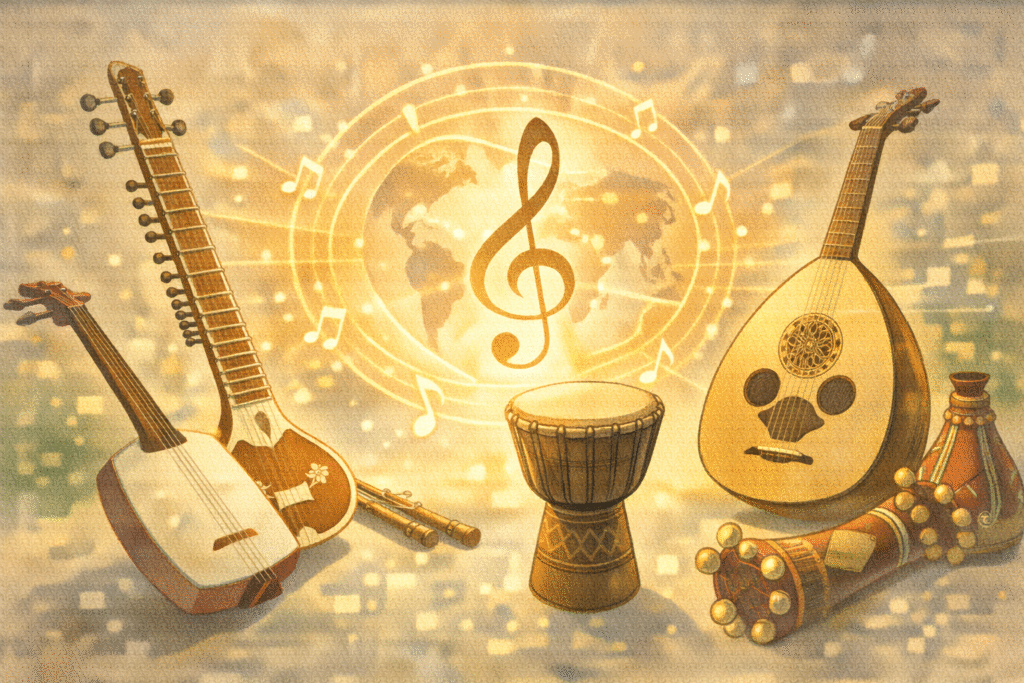
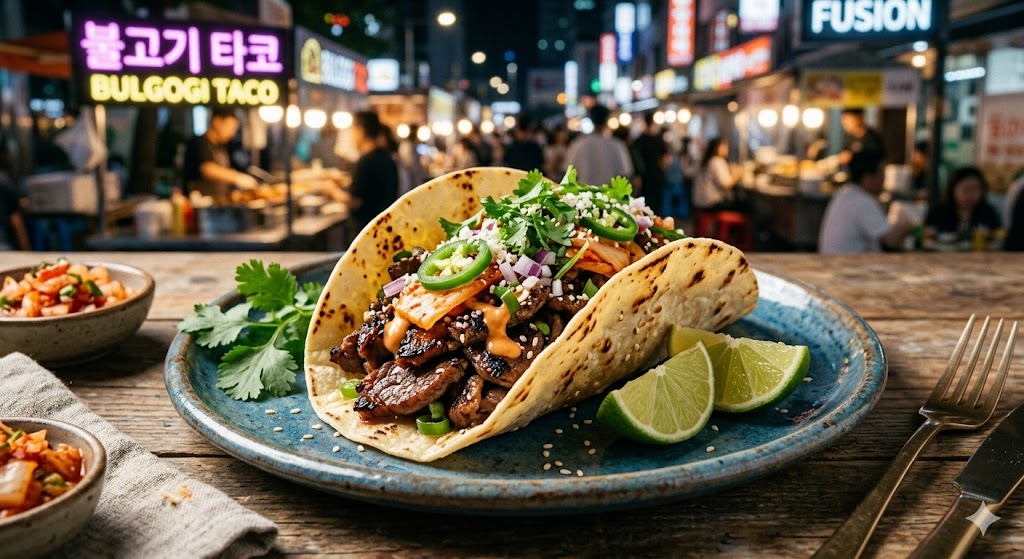
This environment has produced what is often called fusion culture. Different cultural elements—culinary traditions, musical styles, aesthetic forms—combine to create something new. Korean bulgogi appears in tacos, traditional instruments blend with electronic beats, and historical clothing styles are reimagined in contemporary design.
To many observers, fusion represents creativity and cultural dialogue. It demonstrates how cultures learn from one another and generate new artistic possibilities.
Yet not everyone celebrates this phenomenon.
Critics argue that fusion often emerges within unequal power relations shaped by globalization. When dominant cultures absorb elements from weaker ones, the result may not be genuine exchange but a form of cultural imperialism, in which local traditions are simplified, commodified, or erased.
This raises a central question for the global age:
Is cultural fusion a creative form of exchange, or is it a new expression of cultural domination?
1. Fusion as Creative Cultural Exchange
Supporters of cultural fusion emphasize its potential to generate creativity and expand cultural understanding.
Cultural traditions have never been completely isolated. Throughout history, societies have exchanged ideas, technologies, and artistic forms through migration, trade, and communication.
Fusion culture can therefore be understood as a continuation of this long historical process.
One important benefit of fusion is creative innovation. When different traditions interact, they often produce new artistic forms that would not have existed otherwise. For example, musicians who combine traditional instruments with contemporary electronic sounds create new aesthetic experiences that attract global audiences.
Fusion can also contribute to expanding cultural identities. In an increasingly interconnected world, individuals often belong to multiple cultural contexts simultaneously. Fusion culture reflects this reality by allowing people to express hybrid identities rather than rigid cultural boundaries.
Finally, fusion may function as a medium of global communication. Food, music, and fashion often serve as accessible entry points through which people encounter unfamiliar cultures. Fusion forms can therefore act as bridges between societies, encouraging curiosity and dialogue.
From this perspective, fusion is not simply a mixture of elements but a creative space where cultures interact and evolve.
2. The Shadow of Cultural Imperialism

Despite these positive interpretations, critics argue that fusion culture cannot be separated from the power dynamics of globalization.
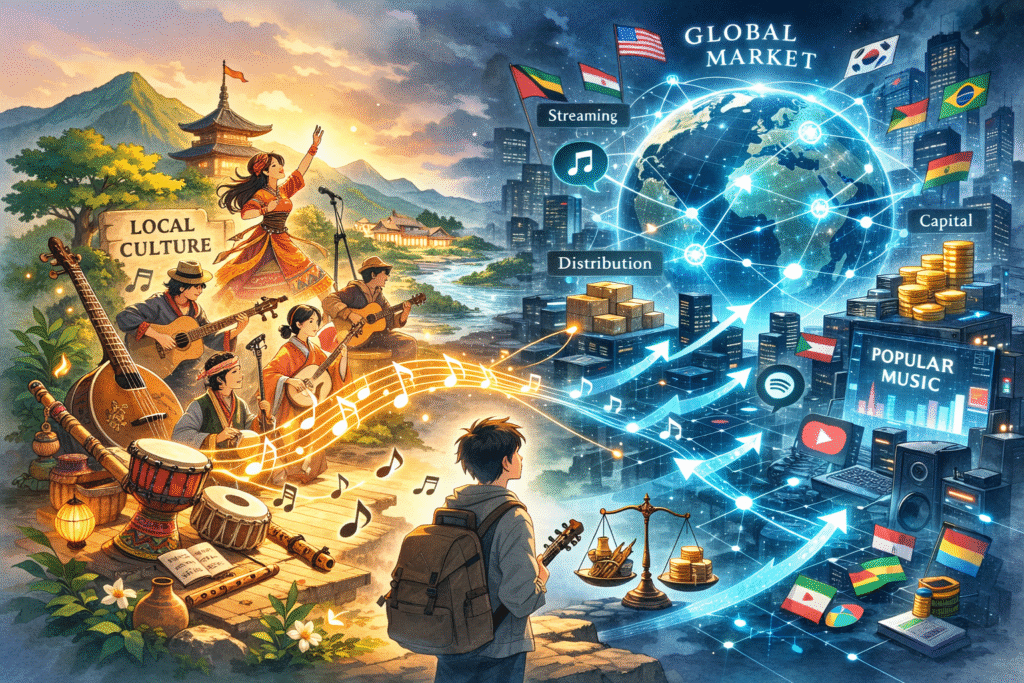
Global cultural exchange rarely occurs on equal terms. Economic power, media influence, and global markets often favor certain cultures over others.
In such contexts, fusion may become a process in which dominant cultures selectively appropriate elements from marginalized traditions.
This phenomenon can take several forms.
First, cultural appropriation may occur when elements of a minority culture are adopted without understanding their historical or symbolic meanings. Cultural symbols may be transformed into aesthetic objects detached from their original context.
Second, fusion often involves commercialization. Cultural elements become products designed for global markets. Traditional cuisines, for instance, may be modified to suit international tastes, sometimes losing their historical significance in the process.
Third, there is the risk of cultural homogenization. When global markets favor certain cultural styles, local traditions may gradually adapt to dominant global aesthetics in order to remain commercially viable.
In these cases, fusion does not necessarily represent equal cultural dialogue. Instead, it may reflect deeper inequalities within global cultural systems.
3. Real-World Examples of Cultural Fusion
The debate surrounding fusion culture becomes clearer when examining concrete examples.
In cuisine, the globalization of food has produced numerous fusion dishes. Korean-Mexican tacos, sushi burritos, and bulgogi pizza illustrate how culinary traditions can blend across cultures. These creations often introduce new audiences to unfamiliar ingredients and cooking techniques.
However, critics note that such dishes sometimes simplify complex culinary traditions into easily marketable forms.
Music provides another example. Contemporary popular music frequently combines elements from multiple traditions. The global success of genres such as K-pop reflects a mixture of Western pop structures with Korean language and cultural aesthetics.
Supporters see this as evidence of cultural innovation and global creativity. Critics argue that global music markets often privilege Western production styles, influencing how local musical traditions evolve.
Fashion offers similar examples. Traditional garments are frequently redesigned in modern styles and marketed internationally. While these reinterpretations can renew interest in historical clothing, they may also transform cultural symbols into commercial commodities.
These cases illustrate that fusion culture is neither purely creative nor purely exploitative. Instead, it often contains both possibilities simultaneously.
4. Theoretical Perspectives: Hybridity and Cultural Power
Cultural theorists have proposed different frameworks for understanding these dynamics.
Homi K. Bhabha introduced the concept of cultural hybridity, emphasizing how interactions between cultures create a “third space” where new identities and meanings emerge. In this perspective, cultural fusion is not simply imitation or domination but a productive site of negotiation and creativity.
Hybridity challenges the idea that cultures are fixed or pure. Instead, it highlights how cultural identities are continuously reshaped through interaction.
In contrast, the theory of cultural imperialism, developed by scholars such as Herbert Schiller, emphasizes the role of global power structures in shaping cultural exchange. According to this view, media systems and global markets often spread dominant cultural forms across the world, influencing local traditions and creating patterns of cultural dependency.
These two theoretical perspectives offer contrasting interpretations of fusion culture.
One emphasizes creativity and hybridity.
The other highlights power, inequality, and domination.
Understanding fusion culture requires acknowledging both dimensions.
5. Toward a More Balanced Cultural Exchange
Recognizing the dual nature of fusion culture invites a more nuanced approach.
Fusion does not automatically lead to either cultural enrichment or cultural domination. Its outcomes depend largely on how cultural interactions are structured.
Several principles may help encourage more balanced forms of cultural exchange.
First, cultural interaction should involve mutual participation rather than one-sided appropriation. Genuine dialogue requires that multiple cultural voices contribute to the process.
Second, it is important to respect cultural context. Cultural elements should not be treated merely as aesthetic resources but as expressions of historical traditions and social meanings.
Third, fusion should emphasize creative authenticity rather than purely commercial motives. When cultural exchange is driven solely by market logic, the risk of cultural simplification increases.
By recognizing these principles, societies may foster fusion practices that encourage creativity while respecting cultural diversity.
Conclusion

Fusion culture is one of the defining cultural phenomena of globalization.
It reflects the increasing interconnectedness of societies and the creative possibilities that emerge when traditions meet and interact.
At the same time, fusion culture cannot be separated from the economic and political structures that shape global cultural exchange.
Whether fusion becomes a space of genuine dialogue or a vehicle for cultural domination depends largely on how cultural interactions are organized and interpreted.
Ultimately, the question is not simply whether fusion is good or bad.
The more important question is this:
Does fusion represent a conversation between cultures, or does it conceal unequal power behind the language of creativity?
The answer may determine whether fusion becomes a force for cultural diversity or a pathway toward cultural uniformity.
A Question for Readers
When you encounter a fusion culture — in food, music, or fashion — do you see it as creative dialogue or cultural domination?
Can fusion ever be completely equal, or will power differences always shape it?
Related Reading
The psychological foundations of how people interpret others and their actions are explored further in Why We Excuse Ourselves but Blame Others: Understanding the Actor–Observer Bias, where differences in perspective shape how individuals assign responsibility, judge intentions, and interpret behavior across social contexts.
At a broader political and ethical level, similar questions about power, influence, and participation in global systems appear in Clicktivism in Digital Democracy: Participation or Illusion?, where debates about digital activism raise deeper concerns about whether global cultural and technological exchanges create genuine participation—or reproduce new forms of dominance and influence.
What appears as cultural exchange may sometimes reflect deeper structures of influence and dependency (see Buena Vista Social Club: Cultural Diversity or a New Form of Dependency?).
References
1. Bhabha, H. K. (1994). The Location of Culture. London: Routledge.
This influential work introduces the concept of cultural hybridity and the “third space,” emphasizing how interactions between cultures produce new meanings and identities. Bhabha’s theory provides a foundation for interpreting fusion culture as a creative process of negotiation rather than simple cultural imitation.
2. Schiller, H. I. (1976). Communication and Cultural Domination. New York: International Arts and Sciences Press.
Schiller’s classic study develops the theory of cultural imperialism, arguing that powerful nations spread their cultural products globally through media and economic systems. His analysis highlights how cultural exchange can reproduce global inequalities and influence local traditions.
3. Tomlinson, J. (1999). Globalization and Culture. Chicago: University of Chicago Press.
Tomlinson examines the complex relationship between globalization and cultural identity. The book explores how global cultural flows produce both hybrid cultural forms and new forms of cultural dependency.
4. Iwabuchi, K. (2002). Recentering Globalization: Popular Culture and Japanese Transnationalism. Durham: Duke University Press.
Iwabuchi analyzes how Japanese popular culture circulates globally, illustrating the interplay between cultural exchange, national identity, and global cultural markets.
5. Marcus, G. E., & Myers, F. R. (1995). The Traffic in Culture: Refiguring Art and Anthropology. Berkeley: University of California Press.
This edited volume explores how cultural artifacts move through global markets and institutions. The essays examine how traditions are reinterpreted, commodified, and transformed in transnational cultural exchanges.