Tag: existential philosophy

  • The Trial of Free Will

    Is Human Freedom an Illusion or a Reality?

    The Weight of the Question

    We live with the persistent feeling that we choose.

    We choose what to eat in the morning, which career to pursue, how to respond in moments of crisis. These decisions feel like ours — deliberate, intentional, free.

    But what if that feeling is deceptive?

    What if every thought, every intention, every choice is simply the unfolding of prior causes — neural activity, genetic predispositions, environmental influences?

    Today, we step onto a stage of inquiry where two long-standing rivals confront one another: determinism and the defense of free will.


    1. The Case for Determinism: Freedom as Illusion
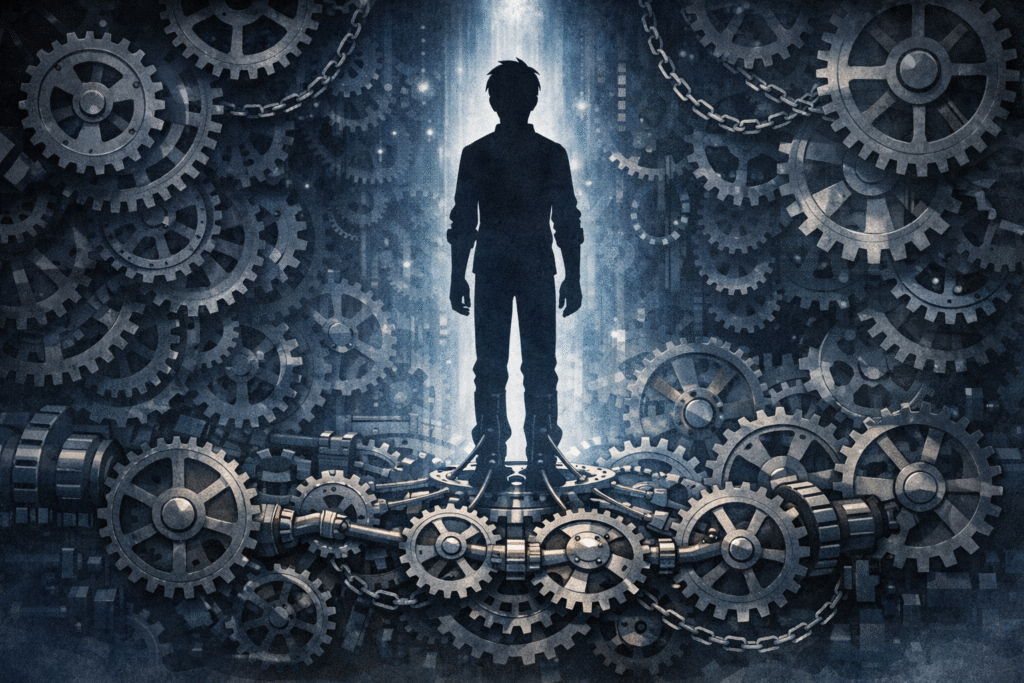
    Human silhouette connected to mechanical gears symbolizing determinism

    Determinism holds that every event is caused by preceding conditions in accordance with natural laws. From this perspective, human thought and action are no exception.

    Spinoza famously argued that free will is merely our ignorance of causes. We feel free because we do not perceive the chain of necessity behind our desires.

    Modern neuroscience adds further tension to the debate. In Benjamin Libet’s experiments, brain activity signaling an action appeared before participants reported consciously deciding to act. If the brain initiates movement before conscious intention arises, then what becomes of free choice?

    From this view, free will may be little more than post-hoc rationalization — a story we tell ourselves after the brain has already acted.


    2. The Defense of Freedom: Responsibility and Moral Agency

    Person standing at a crossroads representing human free will

    Yet the opposing side insists: freedom must be real.

    If every action were predetermined, how could moral responsibility exist? Praise, blame, justice — all would lose their grounding.

    Immanuel Kant argued that freedom is a necessary condition for moral law. Jean-Paul Sartre went further, claiming that human beings are “condemned to be free,” burdened with the responsibility of choice.

    Defenders of free will also caution against over-interpreting neuroscience. Libet’s experiments concern simple motor movements, not complex moral deliberation. The act of resisting temptation, reflecting on consequences, or sacrificing personal gain for ethical principles may not be reducible to automatic neural impulses.


    3. A Third Path: Compatibilism

    Between these poles lies compatibilism — the attempt to reconcile causality and freedom.

    Philosophers such as Daniel Dennett argue that freedom does not require independence from causation. Rather, freedom consists in acting according to one’s own motives and reasoning processes, even if those processes have causal histories.

    In this sense, we may inhabit a determined universe yet still possess a form of agency “worth wanting.”


    4. Why This Debate Matters Today

    This is not merely an abstract philosophical puzzle.

    Law and Justice

    If free will is illusory, should punishment give way entirely to rehabilitation?

    Moral Judgment

    Can we meaningfully blame or praise individuals if they could not have acted otherwise?

    Artificial Intelligence

    Half human half AI face symbolizing artificial decision making

    As AI systems become increasingly autonomous, the debate takes on new urgency. If humans themselves operate under deterministic constraints, what distinguishes human agency from machine decision-making.

    Conclusion: An Open Verdict

    The stage remains undecided.

    Determinism offers scientific weight.
    Free will defends moral dignity.
    Compatibilism seeks reconciliation.

    Perhaps the deeper question is not whether we are metaphysically free, but how we ought to live in light of this uncertainty.

    If we are not free, who is responsible?
    If we are free, how do we bear the weight of that freedom?

    The trial continues — not in a courtroom, but within each of us.

    References

    1. Spinoza, Baruch. (1677/1994). Ethics. Translated by Edwin Curley. Princeton: Princeton University Press.
    Spinoza argues that human beings are entirely subject to the causal order of nature. What we call “free will,” he contends, is merely ignorance of the causes that determine our actions. His determinist framework continues to serve as a foundational critique of autonomous agency.

    2. Kant, Immanuel. (1788/1997). Critique of Practical Reason. Translated by Mary Gregor. Cambridge: Cambridge University Press.
    Kant maintains that moral responsibility presupposes freedom. For him, free will is not an empirical observation but a necessary postulate of practical reason. Without freedom, the coherence of moral law and ethical accountability would dissolve.

    3. Sartre, Jean-Paul. (1943/1992). Being and Nothingness. Translated by Hazel E. Barnes. New York: Washington Square Press.
    Sartre famously describes human beings as “condemned to be free.” In his existentialist account, freedom is inseparable from responsibility, and individuals continuously define themselves through their choices. His perspective intensifies the debate by grounding freedom in lived experience rather than abstract metaphysics.

    4. Libet, Benjamin. (2004). Mind Time: The Temporal Factor in Consciousness. Cambridge, MA: Harvard University Press.
    Libet’s neuroscientific experiments suggest that neural activity associated with decision-making can precede conscious awareness. This finding has been widely interpreted as evidence challenging traditional conceptions of free will, reinforcing determinist interpretations from a scientific perspective.

    5. Dennett, Daniel C. (1984/2003). Elbow Room: The Varieties of Free Will Worth Wanting. Cambridge, MA: MIT Press.
    Dennett defends compatibilism, arguing that meaningful forms of freedom can exist within a causally structured universe. Rather than seeking absolute metaphysical independence, he reframes free will as the kind of agency that sustains responsibility, rational deliberation, and social cooperation.


  • Why Do Humans Seek Perfection While Knowing They Are Incomplete?

    The Endless Tension Between Imperfection and the Desire for Wholeness

    Standing in front of a mirror at the start of the day, we often notice small misalignments—
    a crooked button, unruly hair, a detail slightly out of place.
    They seem trivial, yet they quietly invite a deeper question:
    Why can’t I ever be completely right?

    Human life is filled with such imperfections.
    What is striking, however, is that these flaws rarely end in resignation.
    Instead, we continue to imagine better versions of ourselves and strive toward a more complete life.
    Perhaps the moment we recognize imperfection is precisely the moment our pursuit of perfection begins.


    1. Philosophical Perspectives — Imperfection as an Ontological Trigger

    Human figure confronting imperfection through self-awareness

    1.1 Lack as the Origin of Aspiration

    In Symposium, Plato explains human desire through the concept of lack.
    We seek beauty, goodness, and truth not because we possess them, but because we do not.
    Imperfection, in this sense, is not a weakness—it is the very condition that gives rise to longing and growth.

    Aristotle similarly described humans as rational animals, whose reason enables them to recognize deficiency and move toward excellence (arete).
    To be human, then, is not to be complete, but to strive.

    1.2 Modern Reflections on Human Fragility

    Blaise Pascal famously called humans “thinking reeds.”
    We are fragile and finite, yet capable of contemplating infinity.
    This paradox—weakness combined with reflection—makes imperfection not merely a flaw, but the source of human dignity.


    2. Religious Perspectives — Perfection as an Unreachable Ideal

    2.1 Theological Limits of Human Completion

    In Christian theology, humans are marked by original sin and cannot achieve perfection without divine grace.
    Yet the moral task is not to become perfect, but to move toward holiness.
    The value lies in direction, not arrival.

    2.2 Spiritual Practice and Acceptance of Limits

    Buddhist traditions likewise emphasize human entanglement in ignorance and attachment.
    Enlightenment is not achieved by becoming flawless, but by recognizing impermanence and letting go of rigid ideals.
    Here, perfection functions as orientation rather than destination.


    3. Psychological Perspectives — Perfectionism and Self-Awareness

    3.1 The Double Edge of Perfectionism

    Psychology describes the tension between imperfection and aspiration through perfectionism.
    At its best, perfectionism motivates growth and discipline.
    At its worst, it produces anxiety, self-criticism, and chronic dissatisfaction.

    3.2 Social Recognition and the Fear of Exposure

    Modern research shows that perfectionism is deeply connected to social evaluation.
    We are aware of our flaws, yet we fear revealing them to others.
    The desire to appear flawless often reflects not self-confidence, but vulnerability.

    Human striving toward perfection despite visible limitations

    4. Evolutionary Perspectives — Imperfection as a Survival Strategy

    4.1 Biological Limits and Human Innovation

    From an evolutionary standpoint, human imperfection has always demanded compensation.
    Lacking physical strength or speed, humans developed tools, language, and cooperation.
    Our awareness of limitation fueled creativity and adaptation.

    4.2 Progress Through Dissatisfaction

    The pursuit of “better” weapons, safer shelters, and more accurate knowledge emerged from recognizing what was insufficient.
    Perfection, here, is not an illusion—it is a guiding pressure that shaped survival itself.


    5. Cultural Perspectives — The Aesthetics of Imperfection

    5.1 Celebrating the Incomplete

    Some cultures embrace imperfection as beauty.
    Japanese wabi-sabi aesthetics find meaning in irregularity and transience, while Renaissance art idealized proportion and harmony.
    Each reflects a different response to the same human tension.

    5.2 Contemporary Myths of Perfection

    In the age of social media, flawless images circulate endlessly.
    At the same time, movements emphasizing self-acceptance and authenticity are gaining ground.
    Modern culture oscillates between hiding imperfection and reclaiming it.


    Conclusion — Moving Toward Perfection Without Denying Imperfection

    Embracing imperfection as a foundation for human growth

    Humans are imperfect beings who know they are imperfect—and still strive for perfection.
    This pursuit may never reach its endpoint.
    Yet growth does not depend on arrival, but on movement.

    To acknowledge imperfection without abandoning aspiration may be the most human stance of all.
    Perfection, then, is not a final state, but a horizon—
    one that gives direction, meaning, and momentum to an incomplete life.

    References

    1. Aristotle. (1999). Nicomachean Ethics. Translated by T. Irwin. Indianapolis: Hackett Publishing.
      → This foundational work explores human flourishing (eudaimonia) as a process grounded in recognizing limitations and cultivating virtue through practice. Aristotle’s account highlights how imperfection motivates ethical striving rather than signaling failure.
    2. Frankl, V. E. (2006). Man’s Search for Meaning. Boston: Beacon Press.
      → Frankl argues that human beings seek meaning precisely within conditions of suffering, finitude, and incompleteness. The book offers a psychological and existential account of how imperfection becomes the ground for purpose rather than despair.
    3. Plato. (2002). Symposium. Translated by Alexander Nehamas and Paul Woodruff. Indianapolis: Hackett Publishing.
      → In this dialogue, Plato presents desire (eros) as arising from lack, positioning imperfection as the source of humanity’s pursuit of beauty, truth, and goodness. The text provides a classical philosophical foundation for understanding aspiration as rooted in incompleteness.
    4. Pascal, B. (1995). Pensées. Translated by A. J. Krailsheimer. London: Penguin Classics.
      → Pascal famously describes humans as fragile yet reflective beings, emphasizing the paradox of weakness combined with the capacity for infinite thought. His reflections illuminate how imperfection and greatness coexist at the core of human identity.
    5. Hewitt, P. L., & Flett, G. L. (1991). “Perfectionism in the Self and Social Contexts: Conceptualization, Assessment, and Association with Psychopathology.” Journal of Personality and Social Psychology, 60(3), 456–470.
      → This influential psychological study distinguishes different forms of perfectionism and examines their emotional and social consequences. It provides empirical insight into how awareness of imperfection can lead either to growth or psychological distress.