Tag: everyday wisdom

  • The Transparent Umbrella – Sheltered, Yet Still Connected to the World

    Finding the delicate balance between protection and connection.

    Person holding a transparent umbrella on a rainy street

    Beneath a transparent umbrella, someone learns how to stay protected without turning away from the world.

    Between shelter and connection, the heart slowly becomes stronger.


    Rain fell softly along the morning street.

    Someone walked through the drizzle holding a transparent umbrella.
    Raindrops tapped gently on its surface.

    The umbrella shielded the rain, yet the colors of the city were still visible through it.

    The passing cars.
    The glow of streetlights on wet pavement.
    The quiet rhythm of people moving through the day.

    And a thought appeared:

    “I want protection…
    but I don’t want to be completely separated from the world.”


    1. The Small Comfort of Shelter

    An umbrella is meant to protect.

    It keeps the rain away,
    gives us a small space of dryness in the middle of a storm.

    But sometimes protection becomes distance.

    When we guard ourselves too carefully,
    we may also block the warmth of connection.

    The transparent umbrella feels different.

    It protects,
    yet it allows the world to remain visible.

    Perhaps the human heart longs for the same thing.


    2. The Quiet Fear of Connection

    City seen through a transparent umbrella in the rain

    Many people want closeness with others.

    Yet the fear of being hurt
    often leads us to build invisible barriers.

    We protect our feelings.
    We hide what we truly think.

    And little by little,
    those protective layers become walls.

    But connection does not require perfect safety.

    It requires the courage
    to remain open while still caring for ourselves.


    3. Learning to Tilt the Umbrella

    Walking through the rain,
    the umbrella was tilted slightly.

    A few drops landed softly on a shoulder.

    Surprisingly, the feeling was comforting.

    Perfect protection is not always necessary.

    Sometimes, a gentle touch of the world—
    even a little rain—
    reminds us that we are still alive within it.

    In that moment, the city no longer felt distant.

    It felt shared.


    Conclusion: Staying Open Beneath the Rain

    Person walking in a rainy city holding a transparent umbrella

    Like the transparent umbrella,
    we cannot block every storm in life.

    But we can choose how we face it.

    We can protect ourselves
    while still allowing the world to reach us.

    True maturity may not lie in building stronger walls.

    Instead, it may lie in learning how to remain open—
    even when the rain is falling.


    A Small Note on Psychology

    In psychology, this balance is often described as emotional openness.

    It refers to the ability to express feelings honestly
    while still maintaining emotional stability.

    Being open does not mean being fragile.

    It means allowing the world to be seen clearly—
    while still standing firmly beneath our own shelter.


    Quote

    “Rain is grace; rain is the sky descending to the earth; without rain, there would be no life.”
    — John Updike


    Final Reflection

    Under a transparent umbrella,
    we learn something important:

    Protection does not have to mean isolation.

    Sometimes the strongest heart
    is the one that stays open to the world—
    even in the rain.


    One-line reflection

    Beneath a transparent umbrella, I learned how to face the world without hiding from it.

    Related Reading

    The subtle tension between personal space and social connection is further explored in The Wall of Earphones – Why Do We Choose to Isolate Ourselves?, where everyday technologies designed for comfort and privacy quietly reshape the boundaries between individuals and the surrounding world.

    At a broader societal level, the question of visibility and openness in modern life appears in The Transparency Society: Foundation of Trust or Culture of Surveillance?, where the growing demand for transparency raises deeper debates about whether openness strengthens trust—or gradually erodes personal freedom.


  • The Many Faces of Self-Love: Where Healthy Self-Esteem Ends and Toxic Narcissism Begins

    “Love yourself.”
    “You can’t love others unless you value yourself first.”

    Messages about self-care, self-esteem, and self-love dominate modern psychology and popular culture.
    Yet many people find themselves quietly confused.

    When did loving oneself begin to sound like permission to ignore others?
    Is self-love a healthy emotional foundation—or a carefully disguised form of selfishness?

    Person reflecting calmly on inner emotions and self-worth

    1. Self-Love Is a Universal Human Emotion

    Self-love, often discussed under the term narcissism in psychology, originates from a basic human instinct: the desire to protect and value oneself. In its healthy form, it supports survival, identity formation, and emotional stability.

    Healthy self-love includes:

    • The belief that “I have inherent worth”
    • The recognition that “I deserve respect”
    • The ability to express one’s emotions and needs without shame

    This form of self-love strengthens psychological resilience and serves as the foundation for balanced relationships.

    Problems arise when self-love becomes excessive or distorted—when protecting the self turns into elevating the self at the expense of others.


    2. What Is Toxic Narcissism?

    Toxic narcissism refers to an extreme preoccupation with oneself that leads to the objectification or dismissal of others.

    Such individuals often:

    • Overestimate their own importance
    • React defensively to criticism
    • Constantly seek admiration
    • Show limited empathy toward others

    Outwardly, they may appear confident. Inwardly, however, exaggerated self-importance often masks insecurity and emotional emptiness.

    Common examples include:

    • Dominating conversations by redirecting every topic toward oneself
    • Ignoring a partner’s emotions while emphasizing personal exhaustion or needs
    • Claiming credit while avoiding responsibility in group work

    In this sense, toxic narcissism is not excessive self-love—it is an inability to love at all.

    Person surrounded by social approval symbols showing fragile ego

    3. What Does Healthy Self-Love Look Like?

    The key distinction lies in how self-love operates within relationships.

    Healthy self-love:

    • Respects personal needs and others’ boundaries
    • Accepts responsibility instead of resorting to defensiveness
    • Welcomes praise without collapsing under criticism
    • Recognizes that one’s emotions matter—just as much as another’s

    When loving oneself leads to healthier relationships rather than emotional domination, self-love becomes a source of nourishment rather than harm.


    4. Self-Love and Self-Esteem Are Not the Same

    Though often confused, self-love and self-esteem differ in important ways.

    • Self-esteem is an internal sense of worth that does not depend on comparison.
    • Narcissism relies heavily on external validation and perceived superiority.

    People with stable self-esteem rarely need to exaggerate themselves or diminish others.
    Those with fragile self-worth, by contrast, may appear confident while remaining highly sensitive to rejection or criticism.

    This is why intense narcissistic traits often coexist with deep insecurity.


    5. Living in the Age of Self-Promotion

    Modern society rewards visibility, personal branding, and constant self-display. In such an environment, self-focus becomes not only normalized but encouraged.

    Under these conditions, self-love can easily transform into a survival strategy.

    However, when “self-love” is used to justify rudeness, emotional exploitation, or disregard for others, the result is not empowerment—but isolation.

    A society that celebrates the self while neglecting empathy risks producing individuals who stand alone, disconnected despite constant self-expression.


    Conclusion: Where the Boundary Truly Lies

    Balanced emotional relationship with mutual respect and boundaries

    Self-love is not inherently harmful. In fact, it is essential for psychological well-being.

    But the moment self-love ignores the emotional reality of others, it ceases to be care and becomes a display of power.

    True self-love protects the self without harming others.
    It allows us to stand firmly as individuals while remaining emotionally present within relationships.

    That balance—between self-respect and mutual respect—is where healthy self-love truly resides.


    References

    1. Twenge, J. M., & Campbell, W. K. (2009). The Narcissism Epidemic: Living in the Age of Entitlement. New York: Free Press.
    → Analyzes the cultural rise of narcissistic traits and their impact on relationships, workplaces, and social values, offering a broad sociopsychological perspective.

    2.Kohut, H. (1971). The Analysis of the Self. Chicago: University of Chicago Press.
    → A foundational psychoanalytic work distinguishing healthy narcissism from pathological forms, providing a conceptual framework still influential today.

    3.Vaknin, S. (2001). Malignant Self-Love: Narcissism Revisited. Prague: Narcissus Publications.
    → Examines narcissistic personality patterns through clinical observation, highlighting how distorted self-love affects interpersonal dynamics.

  • A Cultural History of Dream Interpretation: Symbols and Meanings Across Cultures

    The World We Enter Each Night

    Every night, we step into the strange and familiar world of dreams.
    Some nights, nothing remains in our memory. On others, a single dream lingers, quietly shaping our thoughts throughout the day.

    What is fascinating is that the same dream can be interpreted very differently across cultures.
    In one society, it may signal good fortune; in another, it may be read as a warning or an omen.

    How, then, have human societies interpreted dreams?
    And what do these cultural differences reveal about the ways we understand ourselves and the world?


    1. When Dreams Were Messages from the Divine

    Ancient cultures interpreting dreams as messages from gods

    In many ancient societies, dreams were not considered mere psychological events. They were believed to be messages sent by gods, ancestors, or natural forces.

    In ancient Mesopotamia, dream interpretation was so significant that professional dream interpreters existed. In Egypt, the dreams of pharaohs were sometimes treated as divine revelations capable of shaping the fate of the entire kingdom.

    The Epic of Gilgamesh repeatedly portrays characters who dream and then act upon the interpretations of those dreams. In this worldview, dreams served as a bridge between the human and the divine—a channel through which invisible forces communicated with mortals.


    2. Eastern Perspectives: Harmony and Cycles

    In many East Asian traditions, dreams were interpreted through a more holistic and cyclical understanding of life.

    In Korea, China, and Japan, taemong—dreams surrounding conception and pregnancy—have long been considered meaningful signs. Such dreams are believed to hint at a child’s character, destiny, or fortune.

    Traditional interpretations often link animals and natural symbols to future outcomes: dragons or tigers may signal the birth of a strong son, while flowers or fruits may suggest a daughter. Within Confucian cultural contexts, dreams were also understood as reflections of the flow of qi (vital energy), revealing the dreamer’s emotional and moral state.

    Rather than isolating dreams as irrational phenomena, Eastern traditions often integrated them into broader systems of harmony between nature, society, and the self.

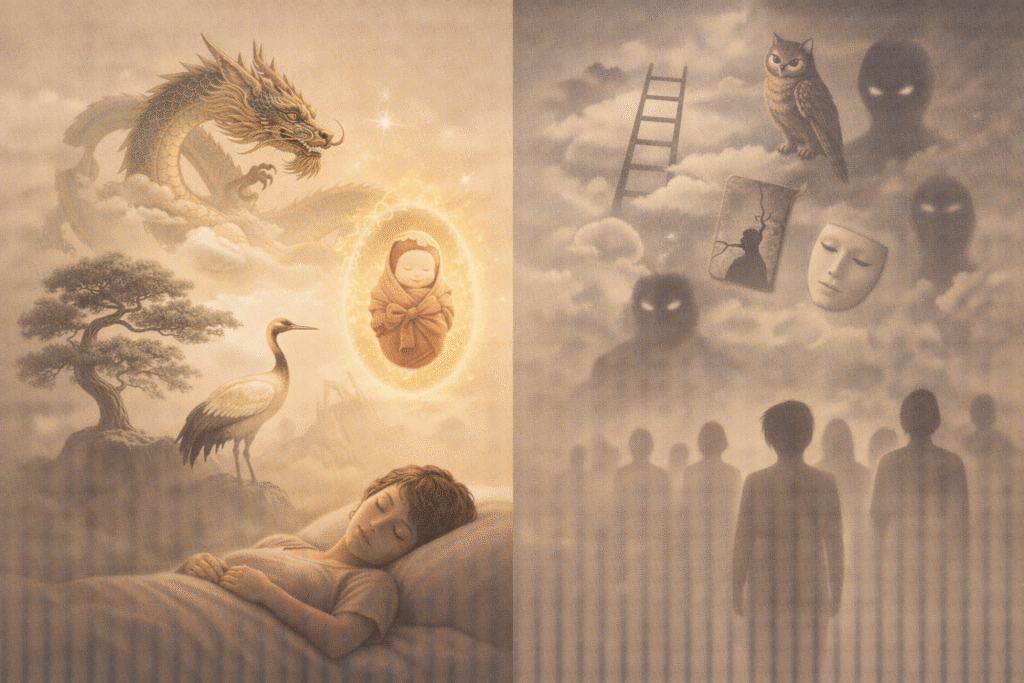
    Different cultural symbols used to interpret dreams

    3. Western Thought: Dreams as the Language of the Unconscious

    In the late nineteenth century, Western dream interpretation underwent a dramatic transformation.

    Sigmund Freud’s The Interpretation of Dreams reframed dreams as expressions of the unconscious mind. According to Freud, dreams symbolized repressed desires and unresolved psychological conflicts. Falling dreams, for example, could represent anxiety or a loss of control, while other symbols pointed to hidden fears or forbidden wishes.

    Carl Jung later expanded this view, arguing that dreams were not merely personal but connected to the collective unconscious. For Jung, dream symbols guided individuals toward psychological integration and self-realization.

    In modern Western thought, dreams thus became tools for understanding the inner architecture of the mind rather than messages from external divine forces.


    4. Dreams Today: Between Science and Culture

    In contemporary society, dreams are also studied through neuroscience. Research shows that dreams most commonly occur during REM (rapid eye movement) sleep and play a role in memory consolidation and emotional regulation.

    Yet culture continues to shape how dreams are understood.

    In parts of Latin America, dreams are still believed to involve communication with ancestral spirits. In some African communities, dreams guide communal rituals and collective decision-making. Even in modern Korea, traditional interpretations—such as the belief that dreaming of pigs signals financial luck—remain deeply embedded in everyday life.

    Despite scientific explanations, cultural meaning has not disappeared. Instead, it coexists with biological accounts of dreaming.

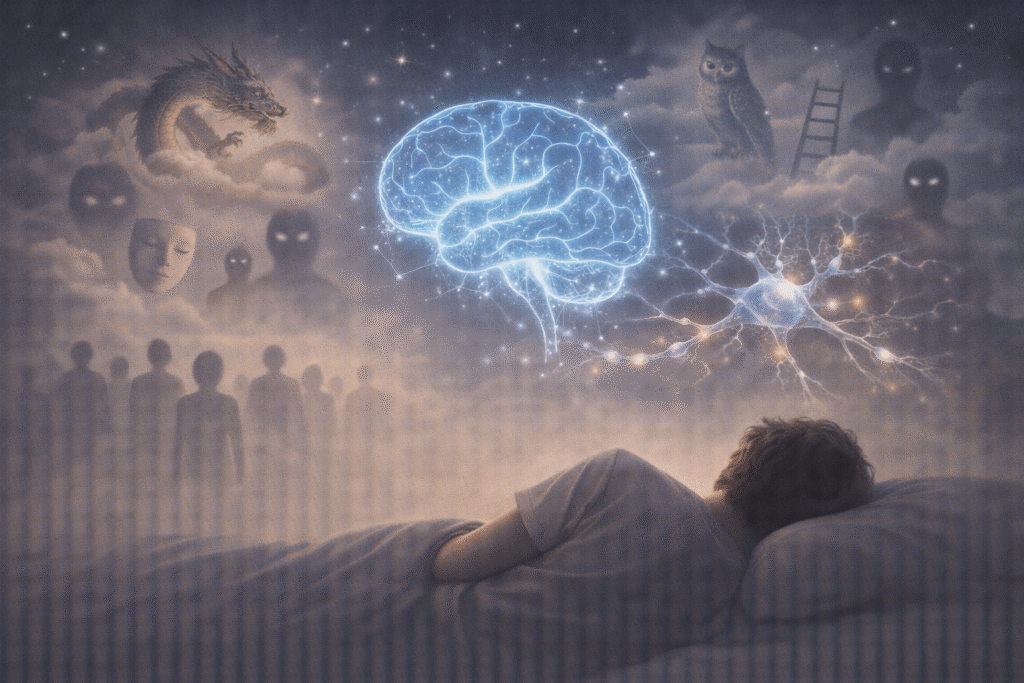
    Modern understanding of dreams between culture and neuroscience

    5. Conclusion: Dreams as Cultural Mirrors

    Dreams lie beyond our conscious control, yet they reflect the cultural frameworks through which we interpret experience.

    The same dream can be fortunate or ominous, meaningful or meaningless, depending on cultural context. These differences are not trivial variations in folklore but windows into how societies understand reality, fate, and the self.

    Dreams continue to ask us enduring questions:
    Why did I dream this?
    And how should I understand what it means?

    In answering them, we are not merely interpreting dreams—we are interpreting ourselves.


    References

    Related Reading

    The human longing for meaning beyond immediate reality continues in Dreams, Utopia, and the Impossible.

    These symbolic interpretations also echo cultural hierarchies questioned in Civilization and the “Savage Mind”: Relative Difference or Absolute Hierarchy?

    1. Freud, S. (1899). The Interpretation of Dreams.
      → A foundational text in psychoanalysis that established dreams as expressions of the unconscious, shaping modern Western approaches to dream interpretation.
    2. Bulkeley, K. (2008). Dreaming in the World’s Religions: A Comparative History.
      → A comprehensive cultural history examining how dreams function within major religious and cultural traditions worldwide.
    3. Oppenheim, A. L. (1956). The Interpretation of Dreams in the Ancient Near East.
      → A classic scholarly work on dream interpretation in Mesopotamian civilization, including early dream manuals and religious symbolism.