Tag: everyday technology

  • Digital Aging: When Technology Moves Faster Than We Do

    “Where do I click?”
    “Can you show me again? Everything changed after the update.”
    “Is this a DM or a message?”

    Most of us have said—or heard—something like this at least once.

    Technology keeps accelerating, yet many of us experience a quiet, unsettling feeling:
    even without standing still, we somehow fall behind.

    That moment is often described as digital aging.

    A person hesitating in front of a complex digital interface, symbolizing digital aging

    1. What Is Digital Aging?

    Digital aging refers to the growing difficulty people experience as technology evolves faster than their ability—or willingness—to adapt.

    This is not simply about chronological age.
    It includes:

    • Feeling disoriented when interfaces change overnight
    • Knowing a feature exists but lacking the energy to relearn it
    • Feeling exhausted by constant updates rather than curious about them
    • Interpreting difficulty as personal failure instead of design overload

    Digital aging is less about incapacity and more about cognitive fatigue caused by relentless change.

    Importantly, this phenomenon affects all age groups.
    Many people in their twenties already describe themselves as “falling behind” certain platforms.


    2. Why Does Technology Evolve Without Waiting for Us?

    Technology claims to aim for convenience and efficiency.
    In practice, however, innovation often prioritizes novelty over familiarity.

    Common patterns include:

    • Menus relocating after updates
    • Essential settings buried deeper in interfaces
    • Gestures replacing buttons
    • Voice commands replacing visual cues

    Most digital systems are designed with speed-oriented, highly adaptable users in mind.
    As a result, those who value stability or need more time are unintentionally excluded.

    The message becomes subtle but clear:
    This system was not designed for you.
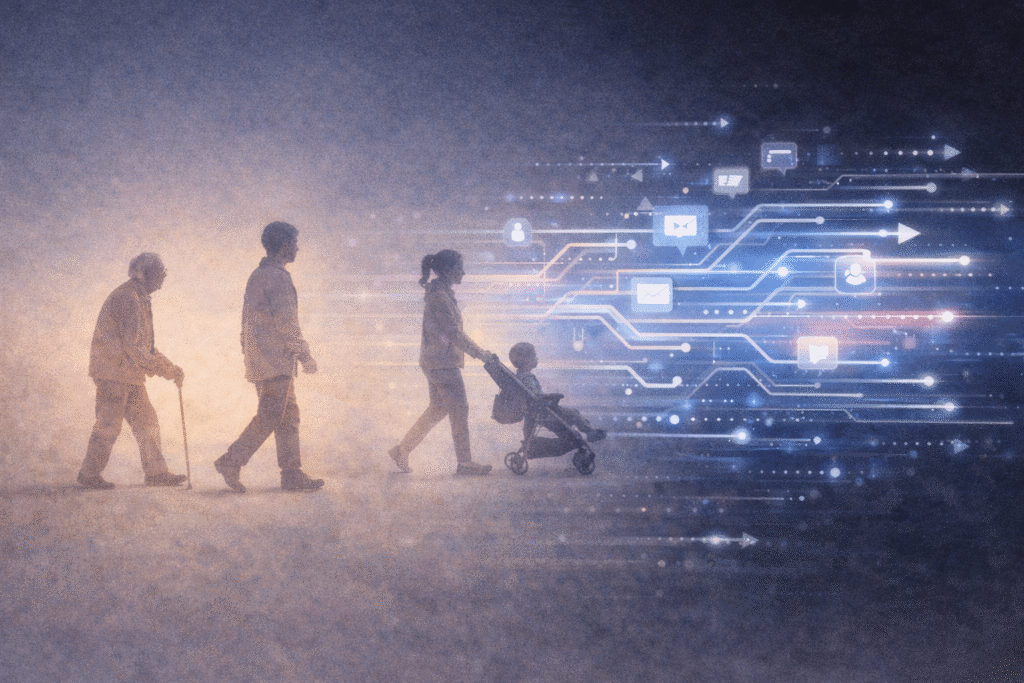
    Technology advancing faster than people, showing the growing digital gap

    3. How Technology Creates New Generational Divides

    Today, generational gaps are shaped less by age and more by technological fluency.

    • Some grew up before the internet
    • Some adapted during its expansion
    • Others have never known a world without smartphones

    Even within the same age group, digital confidence can vary dramatically depending on professional exposure, learning opportunities, and cultural context.

    Technology no longer just reflects generational difference—it produces it.


    4. From Discomfort to Digital Exclusion

    Digital aging becomes socially significant when it leads to exclusion.

    Examples include:

    • Older adults unable to use self-service kiosks
    • People missing invitations because communication moved to unfamiliar platforms
    • Students falling behind due to unfamiliar digital tools
    • Workers struggling with AI-driven systems introduced without support

    Over time, repeated difficulty can erode confidence and create avoidance.

    The psychological barrier often becomes stronger than the technical one.
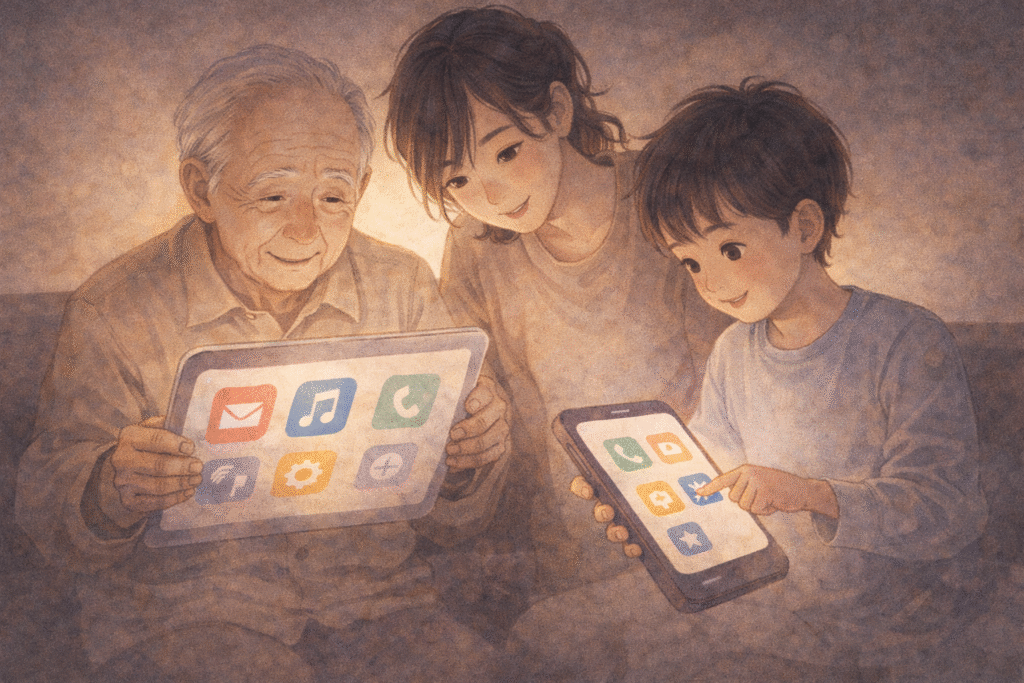
    Inclusive digital design allowing people of all ages to use technology comfortably

    5. Can Technology Slow Down for Humans?

    There is growing recognition of the need for digital inclusion.

    Encouraging developments include:

    • Simplified device modes
    • Accessibility-focused design standards
    • Larger text and clearer interfaces
    • Digital literacy programs for all ages

    True inclusion, however, requires more than features.
    It requires design that respects human pacing, not just technological capability.

    Progress should not mean leaving people behind.


    Related Reading

    The sense of temporal mismatch between humans and systems is explored philosophically in If AI Can Predict Human Desire, Is Free Will an Illusion?.

    Practical effects of accelerated systems on daily judgment are also examined in Algorithmic Bias: How Recommendation Systems Narrow Our Worldview.

    Conclusion: Falling Behind Is a Shared Experience

    Digital aging is not a personal weakness.
    It is a structural consequence of rapid innovation without sufficient care.

    Everyone experiences moments of falling behind.

    The question is not whether technology advances—but whether it advances with people, not past them.

    You do not need to master every new tool.
    What matters is preserving curiosity without shame and designing systems that value humans as much as efficiency.

    Digital society becomes more humane when it moves at a pace people can actually live with.

    Related Reading

    The exhaustion that follows moral expectation connects to broader reflections on social pressure discussed in The Praise-Driven Society: Recognition and Self-Worth in the Digital Age.

    Similar emotional dynamics in daily life are also explored in How Social Media Amplifies Feelings of Lack and Comparison.

    References

    1. Selwyn, N. (2004). Adult Learning in the Digital Age: Information Technology and the Learning Society. London: Routledge.
    This book examines how adults engage with rapidly evolving digital technologies and highlights structural inequalities in access, skills, and confidence. Selwyn emphasizes that difficulties with technology are not individual failures but socially produced gaps shaped by design, education, and policy. It provides a foundational framework for understanding digital aging beyond chronological age.

    2. Prensky, M. (2001). Digital Natives, Digital Immigrants. On the Horizon, 9(5).
    Prensky introduces the influential distinction between “digital natives” and “digital immigrants,” arguing that generational exposure to technology shapes thinking patterns and learning styles. While widely cited, this work is best read as a starting point for debates on digital generational gaps rather than a definitive explanation.

    3. Bennett, S., Maton, K., & Kervin, L. (2008). The ‘Digital Natives’ Debate: A Critical Review of the Evidence. British Journal of Educational Technology, 39(5), 775–786.
    This critical review challenges the oversimplified native–immigrant divide, showing that digital competence varies widely within age groups. The authors argue that social, educational, and cultural factors matter more than age alone, offering an important corrective perspective for discussions of digital aging and inclusion.

  • The Social History of Vending Machines

    How Unattended Transactions Reshaped Everyday Life

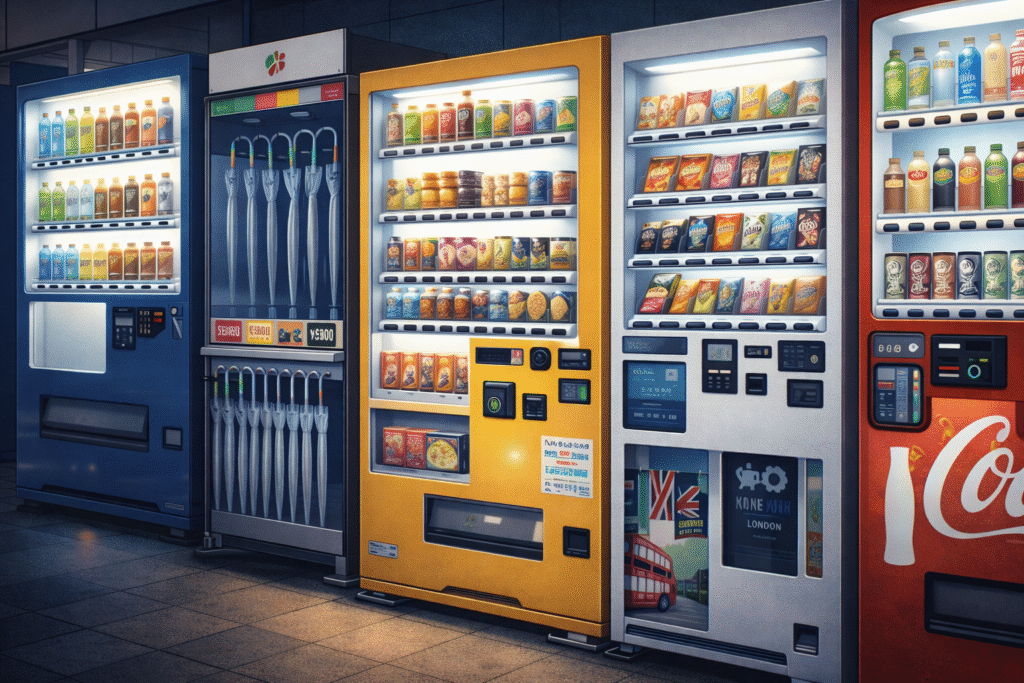
    Urban vending machine glowing in everyday city life

    1. The Origins of Vending Machines: Convenience Enters Everyday Life

    When walking down the street feeling thirsty, waiting at a subway station, or searching for a late-night alternative to a convenience store, we often encounter a familiar machine: the vending machine. With a single press of a button, drinks or snacks appear instantly. Today, vending machines feel like a natural and almost invisible part of everyday life.

    Yet vending machines are more than simple devices. They are inventions that have quietly transformed how people consume, interact, and organize daily routines. Their history reveals not only technological progress, but also shifting expectations about convenience, time, and human presence in economic exchange.

    1.1 Ancient beginnings of automated exchange

    The idea of automated selling is far older than modern society. Records from ancient Alexandria describe a device that dispensed holy water when a coin was inserted. Even in antiquity, people imagined systems in which exchange could occur without direct human mediation.

    1.2 The rise of the modern vending machine

    Modern vending machines began spreading in the late nineteenth century in Britain and the United States. Early machines sold stamps, postcards, and chewing gum. The possibility of purchasing goods without encountering a seller was initially perceived as novel—and sometimes unsettling. Over time, however, vending machines gained public trust and became symbols of a new kind of convenience: reliable, predictable, and independent of human availability.

    From that moment on, consumption no longer required dialogue, negotiation, or shared time. A button, a coin, and a machine were enough.

    2. The 20th Century: Industrialization Meets Consumer Culture

    2.1 Urban life and efficiency

    As industrialization accelerated and cities expanded, vending machines became increasingly important. After World War II, they spread rapidly in countries such as the United States and Japan, where busy urban life demanded faster and more efficient consumption.

    2.2 The American experience

    In the United States, beverage and cigarette vending machines became iconic. Coca-Cola machines in particular symbolized a new promise of modern consumption: the same taste, available anywhere, at any time.

    2.3 Japan and vending machine density

    In Japan, vending machines proliferated dramatically from the 1960s onward. Compact, reliable, and operating 24 hours a day, they suited dense urban environments. Over time, Japan became the country with the highest vending-machine density in the world.


    3. How Unattended Transactions Changed Daily Life

    Vending machines did more than sell products—they reshaped everyday habits.

    3.1 The rise of 24-hour consumption

    Vending machines introduced the experience of “buying anything at any time.” This expanded the temporal boundaries of consumption and paved the way for 24-hour convenience stores.

    3.2 Normalizing contactless exchange

    By enabling transactions without face-to-face interaction, vending machines became an early form of contactless consumption. Today’s self-service kiosks, unmanned stores, and automated checkout systems all trace their roots back to this experience.

    3.3 Expanding consumption spaces

    Vending machines challenged the assumption that consumption required designated spaces. They appeared in subways, schools, hospitals, streets, and offices, allowing consumption to permeate nearly every corner of daily life.

    Japanese vending machines reflecting urban consumer culture

    4. Vending Machines as Cultural Symbols

    Vending machines also function as cultural codes that reflect societal values.

    4.1 Japan: everyday creativity

    In Japan, vending machines sell far more than drinks and snacks—umbrellas, flowers, and even hot meals are available. This reflects how deeply vending machines are integrated into everyday life.

    4.2 The United States: speed and immediacy

    American vending machines align with a culture that values speed and instant gratification. Pressing a button to satisfy a need mirrors the broader logic of fast consumption.

    4.3 Korea: memory and social space

    In South Korea, vending machines—especially coffee machines in the 1980s and 1990s—were part of street and campus culture. They often functioned as informal spaces for conversation and brief rest.


    5. Notable and Contemporary Examples

    • High-tech vending machines in Tokyo: AI-powered machines now recommend drinks based on season and user preferences.
    • Pizza vending machines in New York: Some machines prepare fresh pizza on demand, from dough to toppings.
    • Korean coffee vending culture: Low-cost coffee machines became symbols of everyday leisure and social interaction.
    • Vending machines during the COVID-19 pandemic: Machines selling masks and hand sanitizer demonstrated the value of unattended transactions during crises.
    Solitary vending machine glowing at night in empty street

    6. Conclusion

    Vending machines are not merely mechanical tools. They are agents that have reshaped consumption patterns and everyday life. The experience of purchasing without human interaction expanded consumption across time, space, and social boundaries.

    Today’s unmanned stores, online shopping platforms, and automated kiosks all follow paths first opened by vending machines. They stand simultaneously as nostalgic artifacts and as foundations of future consumption culture—quietly reminding us that even the simplest machines can leave lasting social footprints.


    📚 References

    Fishman, C. (2007). The Wal-Mart Effect: How the World’s Most Powerful Company Really Works—and How It’s Transforming the American Economy. Penguin.
    → While not focused solely on vending machines, this work explains how large-scale, automated distribution systems reshape modern consumption culture, offering valuable context for understanding unattended transactions.

    Miller, D. (1998). A Theory of Shopping. Cornell University Press.
    → A sociocultural analysis of shopping behavior that provides a theoretical framework for understanding how automated consumption devices influence everyday life and identity.

    Bestor, T. C. (2004). Tsukiji: The Fish Market at the Center of the World. University of California Press.
    → An ethnographic study of Japanese market culture that helps contextualize Japan’s unique vending-machine landscape and its broader consumer environment.