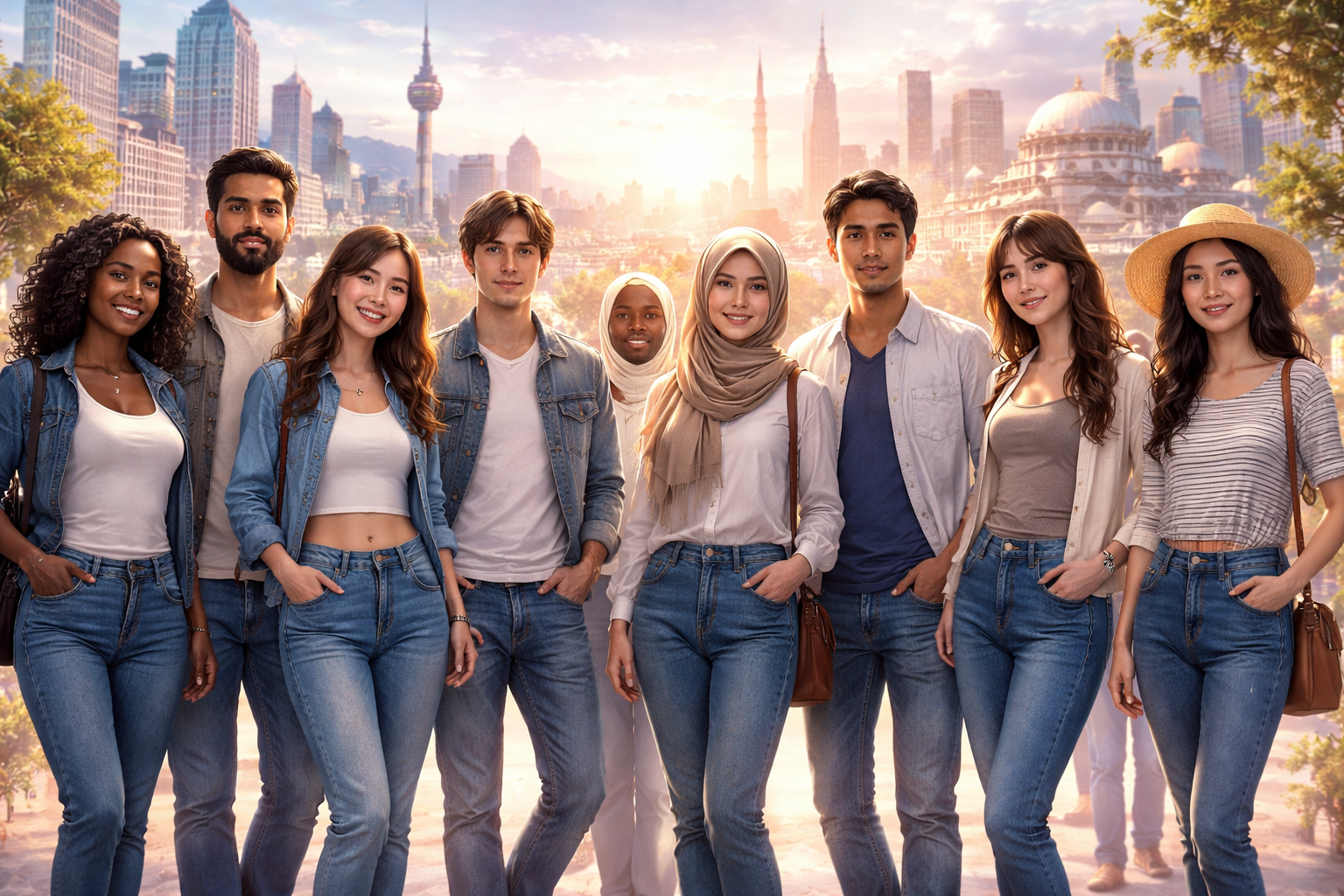
An American Icon, Cultural Paradox, and Global Hybridization
Have you ever wondered why people all over the world wear blue jeans?
From the streets of Seoul to markets in Indonesia, from Dubai to New York—
jeans appear everywhere, across cultures, religions, and political systems.
What is even more fascinating is this:
Even in countries with strong anti-American sentiment,
blue jeans have never truly been rejected.
This raises an intriguing question—
are jeans merely clothing, or something much more powerful?
1. Blue Jeans as a Symbol of American Culture

Blue jeans did not begin as fashion.
In the late 19th century, they were designed as durable workwear
for American laborers—practical, rugged, and affordable.
However, everything changed in the 1950s.
Hollywood icons like James Dean and Marlon Brando transformed jeans
into symbols of rebellion, youth, and freedom.
From that moment on, jeans were no longer just clothing.
They became a cultural message.
Through jeans, the United States exported not only a product,
but an entire worldview:
freedom, equality, practicality, and even resistance.
Much like Coca-Cola, McDonald’s, or rock music,
jeans became part of global cultural influence—
often discussed within the framework of cultural imperialism.
2. Local Adaptation: Jeans as Cultural Hybridization
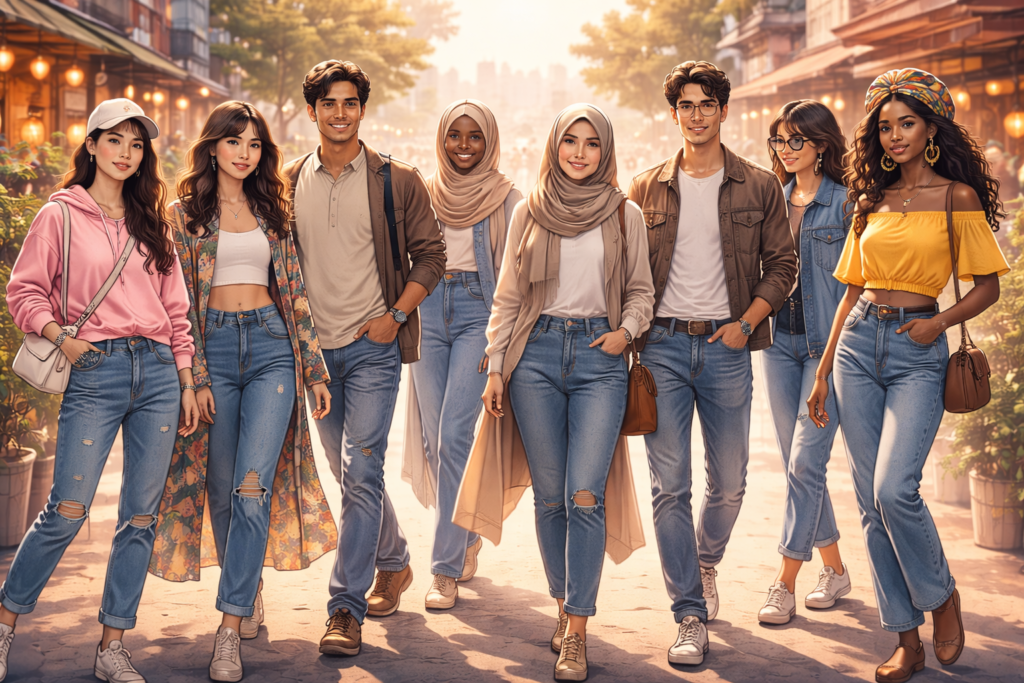
Yet, jeans were never simply copied worldwide.
Each region reinterpreted them in its own way.
2.1. Asia
In Japan, jeans entered through admiration for American style
during the 1960s and 1970s.
Over time, however, Japan developed its own identity—
high-end vintage denim culture, now globally respected.
In South Korea, jeans became associated with student movements
and democratic resistance during the 1980s.
Today, they exist across both luxury fashion and streetwear.
2.2. Middle East
In countries such as Iran and Saudi Arabia,
jeans are widely worn despite political criticism of the United States.
Among younger generations, jeans sometimes function as subtle expressions
of identity and resistance.
Even within religious constraints, people creatively combine jeans
with traditional garments like long shirts or hijabs.
This demonstrates something important:
Jeans are not simply “imported culture”—
they are continuously reinterpreted and transformed.
3. The Paradox: Anti-American Sentiment vs. Jeans Consumption
One of the most striking aspects of jeans is this contradiction.
Even in societies critical of American foreign policy,
jeans remain deeply embedded in everyday life.
3.1. Universal Appeal Beyond Politics
Jeans have transcended their origin.
They represent universal values:
comfort, practicality, individuality, and freedom.
3.2. Jeans as a Symbol of Resistance
For example, in Iran, some women activists wear jeans
as a symbolic expression of autonomy and resistance.
In this context, jeans become something paradoxical:
a product of cultural power,
yet also a tool of personal liberation.
4. Cultural Imperialism or Cultural Fusion?
This leads to an ongoing debate.
4.1. Cultural Imperialism Perspective
From this view, jeans represent the global spread of American capitalism
and consumer culture.
They are seen as displacing traditional clothing
and standardizing global identity.
4.2. Cultural Hybridization Perspective
On the other hand, many scholars argue that jeans are a perfect example
of cultural fusion.
They are not simply imposed—
they are adapted, reinterpreted, and localized.
In this sense, jeans are not just a symbol of domination,
but of interaction.
They function simultaneously as:
a global product,
a local expression,
and a cultural translator.

Conclusion
Blue jeans are no longer “American clothing.”
Today, people tear them, redesign them, customize them,
and embed their own identities into them.
They are one of the few global objects that are constantly rewritten
by those who wear them.
Jeans conquered the world—
but in doing so, they also surrendered to it.
That is the true power of culture.
Question for Readers
Have blue jeans become a universal cultural language, or do they still carry the influence of their American origins?
Related Reading
The global spread of blue jeans reflects more than just fashion—it reveals how everyday objects carry deeper cultural meanings. This dynamic between global influence and local reinterpretation is further explored in What Can Nature Teach Us About Ethics?, where universal values are not imposed, but discovered through interaction between humans and their environments.
At the same time, the symbolic power of ordinary elements in shaping identity connects closely with 0 and 1 in the Age of Artificial Intelligence: The Symbolic Philosophy of the Digital World, which examines how even the simplest forms—like binary code—can evolve into powerful cultural and philosophical systems shaping our modern lives.
References
- Miller, D. (2010). Blue Jeans: The Art of the Ordinary. University of California Press.
This work explores how jeans became a globally shared object while being locally reinterpreted. It demonstrates that jeans are not merely symbols of American culture, but dynamic cultural artifacts shaped by everyday practices and meanings across societies. - Crane, D. (2002). Culture and Globalization: Theoretical Models and Emerging Trends. Routledge.
Crane analyzes how global cultural products interact with local identities, highlighting tensions between cultural imperialism and localization. Jeans are presented as a key example of how global goods are reshaped within diverse cultural contexts. - Nederveen Pieterse, J. (2009). Globalization and Culture: Global Mélange. Rowman & Littlefield.
This book argues that globalization produces cultural hybridity rather than simple Westernization. Jeans are used as a representative case of hybrid cultural formation, showing how different societies reinterpret global symbols in unique ways.