Tag: environmental ethics

  • Would Earth Be Better Without Humans?

    Would Earth Be Better Without Humans?

    Rethinking Anthropocentrism and Our Place in the Living World

    Imagine a world where humans have disappeared.

    Cities grow silent. Forests reclaim abandoned streets.
    Oceans begin to heal, and endangered species return.

    Surprisingly, this vision does not always feel like a dystopia.

    It leads us to an unsettling question:

    Would the Earth be better without us?

    1. Nature Does Not Depend on Humans

    empty city street without humans

    1.1. Evidence from Temporary Absence

    During the COVID-19 pandemic, reduced human activity led to
    clearer skies, cleaner air, and the return of wildlife to urban areas.

    Nature began to recover—
    not because of human intervention, but because of its absence.


    1.2. The Resilience of Ecosystems

    This suggests that ecosystems possess
    an inherent capacity for regeneration.

    Life on Earth evolved long before humans existed—
    and it can continue without us.


    2. The Shadow of Anthropocentrism

    2.1. Humans at the Center

    For centuries, human civilization has placed itself
    at the center of existence.

    Philosophical traditions—from Descartes onward—
    reinforced the idea that humans are distinct from, and superior to, nature.


    2.2. The Cost of Dominance

    This worldview has justified exploitation:
    deforestation, industrialization, and biodiversity loss.

    The belief that we are “owners” of the Earth
    may be one of the greatest threats to its survival.

    wildlife thriving in restored nature

    3. Would a Human-Free Earth Be Ideal?

    3.1. A World Without Witnesses

    A human-free Earth might be greener, cleaner, and more balanced.

    But it would also be a world without observers—
    no one to perceive beauty, meaning, or value.


    3.2. Humans as Destroyers—and Stewards

    Humans are not only agents of destruction.
    We are also capable of responsibility, care, and restoration.

    Environmental movements, conservation efforts, and sustainability innovations
    all originate from human awareness.


    4. From Dominance to Coexistence

    4.1. A Better Question

    Perhaps the real question is not:

    “Would Earth be better without humans?”

    But rather:

    “How can humans exist in a way that allows Earth to thrive?”


    4.2. Redefining Our Role

    Through technology, ethics, education, and culture,
    we can move from domination to coexistence.

    Not as rulers of nature—
    but as participants within it.


    Conclusion: Who Does the Earth Belong To?

    humans and nature living in harmony

    A human-free Earth might be quieter and more balanced.

    But it would also be a world without meaning—
    at least in human terms.

    The future of Earth does not depend on our disappearance,
    but on our transformation.

    From exploiters to caretakers,
    from owners to co-inhabitants.

    The question is not whether we should vanish—
    but whether we can learn to belong.


    Reader Question

    Do you believe the Earth needs fewer humans—
    or better humans?


    Related Reading

    The relationship between humans and the natural world becomes even more complex when we consider how our daily choices shape the environment.
    In Is Minimalism a Lifestyle or a Privilege?, the idea of consumption reveals how reducing what we take from the world may be one of the first steps toward a more sustainable coexistence.

    At the same time, the question of progress itself invites deeper reflection.
    In Are Cities Symbols of Progress—or Spaces of Inequality?, the tension between development and its consequences highlights how human-centered growth can both improve and destabilize the environments we depend on.


    References

    1. ReferencesKolbert, E. (2014). The Sixth Extinction: An Unnatural History. New York: Henry Holt.
    → Kolbert documents how human activity is driving mass extinction, offering powerful evidence that ecological imbalance is closely tied to anthropogenic impact.

    2. Weisman, A. (2007). The World Without Us. New York: Thomas Dunne Books.
    → This book imagines a planet without humans, illustrating how natural systems would reclaim human-made environments and restore ecological balance over time.

    3. Crist, E. (2018). Abundant Earth: Toward an Ecological Civilization. Chicago: University of Chicago Press.
    → Crist critiques anthropocentrism and proposes a shift toward ecological coexistence, emphasizing the need

  • What Can Nature Teach Us About Ethics?

    What Can Nature Teach Us About Ethics?

    When people discuss morality or ethics, they often look to religion, philosophy, law, or social agreements.

    But there is another question worth asking:

    Could nature itself offer ethical guidance for human life?

    If human beings are part of nature, then perhaps the patterns we observe in the natural world—balance, cycles, restraint, and coexistence—can provide subtle hints about how we should live.

    Nature may not speak in words, but it often teaches through patterns.


    1. Where Do Human Moral Standards Come From?

    Ethical standards have traditionally been derived from philosophical reasoning, religious teachings, or social rules.

    However, long before formal moral systems existed, humans lived within ecosystems that already followed certain patterns of order.

    The natural world operates through cycles—birth and decay, growth and renewal, balance and limitation.

    Observing these patterns raises an intriguing possibility: perhaps ethical reflection can also emerge from the structure of nature itself.


    2. Ethical Clues Hidden in Everyday Nature

    forest ecosystem showing balance and coexistence Insert Position

    Nature quietly demonstrates several principles that resemble ethical ideas.

    The sun rises in the morning and sets at night.
    Trees grow leaves in spring and release them in autumn without resistance.
    Animals hunt for survival, not for endless accumulation.

    From these patterns we may notice ideas such as restraint, balance, and coexistence.

    Imagine a wolf in a forest that begins hunting far beyond what it needs for survival.
    If it were to eliminate large numbers of deer without restraint, the ecosystem would collapse.

    Nature functions through equilibrium.
    When one part of the system exceeds its limits, the entire system becomes unstable.

    In this sense, nature silently warns against excess.


    3. How Natural Ethics Differ from Human Ethics

    Nature does not issue moral commands.

    It does not tell us directly what we “should” do.

    Instead, it reveals consequences.

    When humans exploit natural resources without limits—through deforestation, pollution, or excessive consumption—the results appear in the form of climate change and ecological disruption.

    It can almost feel as if nature is saying:

    “You have taken more than the system can sustain.”

    The American philosopher and naturalist Henry David Thoreau believed that nature could teach humans how to live more wisely.

    Through his time living near Walden Pond, Thoreau argued that simplicity and closeness to nature could help humans rediscover moral clarity beyond material excess.


    4. Natural Harmony as an Ethical Model

    One of the most powerful lessons in nature is coexistence.

    Bees collect nectar while pollinating flowers.
    Forests grow through networks of cooperation among plants, fungi, and animals.

    Each organism survives while contributing to the stability of the whole system.

    In modern society, many ethical discussions revolve around balancing individual benefit with collective well-being.

    Nature has been demonstrating such balance for millions of years.

    Movements such as Zero Waste reflect attempts to imitate nature’s cycles.
    Instead of producing endless waste, these philosophies encourage human systems to function more like ecosystems—where outputs from one process become inputs for another.


    5. Are Humans Part of Nature—or Opposed to It?

    person walking in city disconnected from nature

    Interestingly, humans possess the ability to understand nature deeply and even imitate its systems.

    Yet modern societies often organize life in ways that move against natural rhythms.

    Nature moves slowly, but modern life emphasizes speed.
    Nature is interconnected, while modern culture often prioritizes individualism.

    These differences sometimes lead to consequences such as environmental crises, social isolation, and psychological burnout.

    Some environmental philosophers therefore argue that ethics must move beyond purely human-centered thinking.

    Instead of seeing humans as rulers of nature, they propose redefining humanity as participants within an ecological community.

    From that perspective, ethical living may mean learning to live as a part of nature rather than above it.

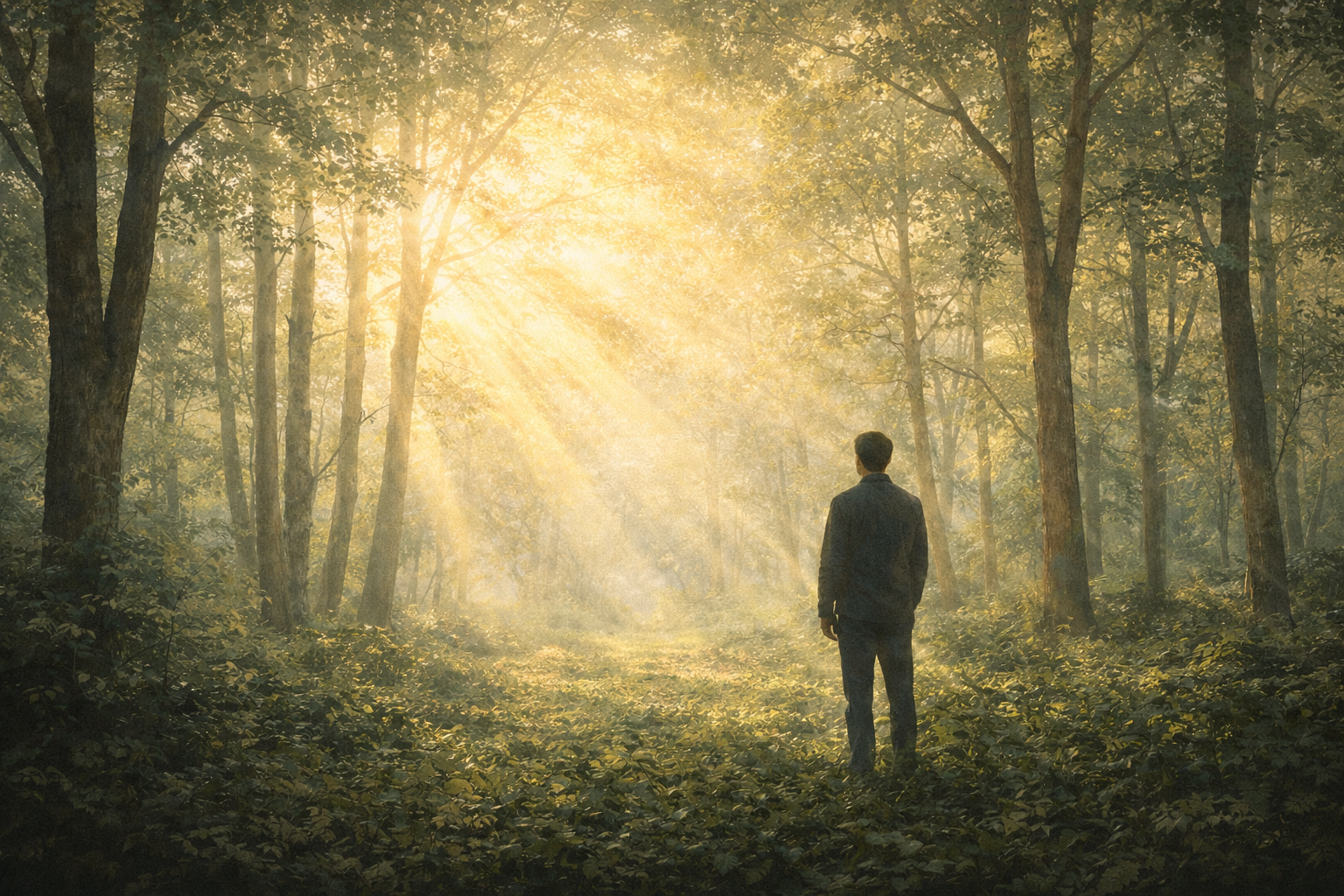
    person reflecting quietly beside a lake in nature Insert Position

    Conclusion

    Nature rarely speaks in words.

    Yet over long stretches of time, it communicates through patterns and consequences.

    It quietly suggests moderation, balance, and coexistence.

    If humans are willing to listen, nature can become a profound ethical teacher.

    Perhaps the most important lesson is simple:

    We are not masters of nature.
    We are part of it.

    Related Reading

    The search for ethical guidance in everyday life is explored further in Why Lighting a Candle Feels Like a Ritual — The Cultural Meaning of Candlelight, where simple human practices reveal how symbolic acts and natural elements help people reflect on values such as humility, reflection, and moral awareness. Just as candlelight invites quiet contemplation, nature itself often serves as a silent teacher of balance, restraint, and interconnectedness.

    At a broader philosophical level, questions about how human systems interact with larger forces are examined in Fusion Culture: Creative Exchange or Cultural Imperialism?, where debates about cultural exchange reveal tensions between cooperation and dominance in global society. Similar to ecosystems in nature, human cultures constantly interact, adapt, and influence one another—raising deeper questions about responsibility, power, and ethical coexistence.

    Question for Readers

    Do you think nature can teach humans ethical lessons?

    For example, can ideas like balance, restraint, and coexistence in nature guide how we live and make decisions?

    Or do you believe that ethics should come only from human culture, philosophy, and social agreements?

    Share your thoughts in the comments.


    References

    1. Thoreau, H. D. (1854). Walden; or, Life in the Woods. Boston: Ticknor and Fields.
    → In this classic work, Thoreau reflects on simple living in natural surroundings near Walden Pond. He argues that modern society’s obsession with wealth and speed distracts people from deeper moral reflection. By reconnecting with nature, individuals can rediscover simplicity, self-awareness, and ethical clarity.

    2. Leopold, A. (1949). A Sand County Almanac. Oxford University Press.
    → Leopold introduces the influential concept of the “land ethic,” which expands ethical consideration to include soils, waters, plants, and animals. He argues that humans should see themselves as members of an ecological community rather than conquerors of it, forming one of the foundations of modern environmental ethics.

    3. Carson, R. (1962). Silent Spring. Boston: Houghton Mifflin.
    → Carson’s groundbreaking book exposed the ecological damage caused by pesticides such as DDT. By revealing the interconnectedness of ecosystems, the work sparked the modern environmental movement and emphasized the ethical responsibility humans have toward the natural world.

  • Can Humans Be the Moral Standard?

    Rethinking Anthropocentrism in a Changing World

    1. Can Humans Alone Be the Measure of All Things?

    Human-centered worldview with nature and technology marginalized

    For centuries, human dignity, reason, and rights have stood at the center of philosophy, science, politics, and art.
    The modern world, in many ways, was built on the assumption that humans occupy a unique and privileged position in the moral universe.

    Yet today, that assumption feels increasingly fragile.

    Artificial intelligence imitates emotional expression.
    Animals demonstrate pain, memory, and cooperation.
    Ecosystems collapse under human-centered development.
    Even the possibility of extraterrestrial life forces us to question long-held hierarchies.

    At the heart of these shifts lies a single question:
    Is anthropocentrism—a human-centered worldview—still ethically defensible?


    2. The Critical View: Anthropocentrism as an Exclusive and Risky Framework

    2.1 Ecological Consequences

    The planet is not a human possession.
    Yet history shows that humans have treated land, oceans, and non-human life primarily as resources for extraction.

    Mass extinctions, deforestation, polluted seas, and climate crisis are not accidental outcomes.
    They are the logical consequences of placing human interests above all else.

    From this perspective, anthropocentrism appears less like moral leadership and more like systemic neglect of interdependence.

    2.2 Reason as a Dangerous Monopoly

    Human exceptionalism has often rested on language and rationality.
    But today, AI systems calculate, predict, and even create.
    Non-human animals—such as dolphins, crows, and primates—use tools, learn socially, and exhibit emotional bonds.

    If rationality alone defines moral worth, the boundary of “the human” becomes unstable.
    Anthropocentrism risks turning non-human beings into mere instruments rather than moral participants.

    2.3 The Fragility of “Human Dignity”

    Even within humanity, dignity has never been evenly distributed.
    The poor, the sick, the elderly, children, and people with disabilities have repeatedly been treated as morally secondary.

    This internal hierarchy raises an uncomfortable question:
    If anthropocentrism struggles to secure equal dignity among humans, can it credibly claim moral authority over all other beings?

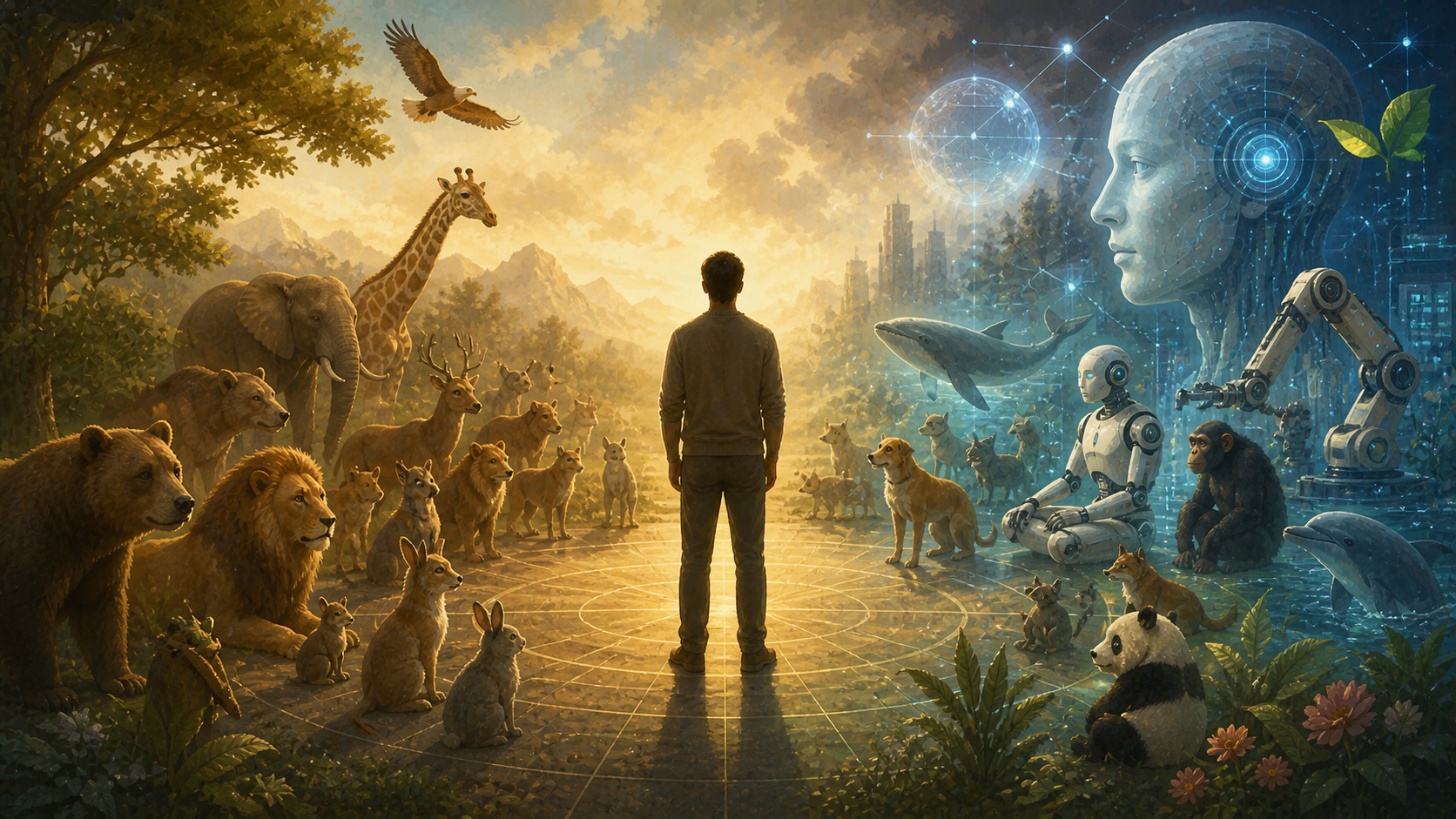
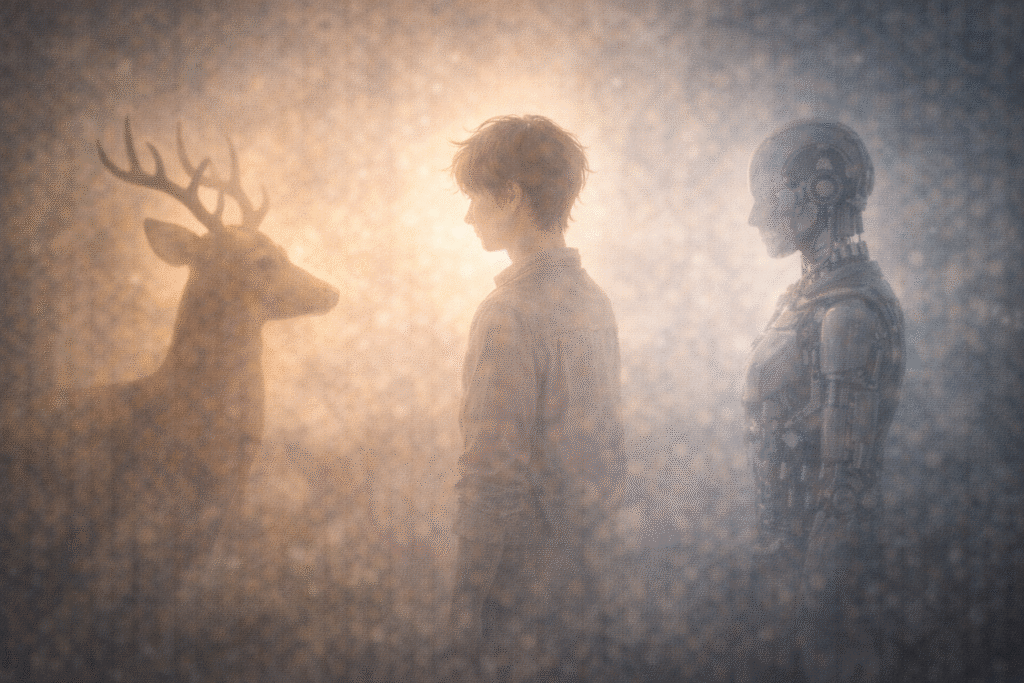
    Questioning anthropocentrism through human, animal, and AI coexistence

    3. The Defense: Anthropocentrism as the Foundation of Moral Responsibility

    3.1 Humans as Moral Agents

    Only humans, so far, have developed moral languages, legal systems, and ethical institutions.
    We are the ones who debate responsibility, regulate technology, and attempt to reduce suffering.

    Without a human-centered framework, it becomes unclear who is accountable for ethical decision-making.

    Anthropocentrism, in this view, is not about superiority—but about responsibility.

    3.2 Responsibility, Not Domination

    A human-centered ethic does not necessarily imply exclusion.
    On the contrary, environmental protection, animal welfare, and AI regulation have all emerged within anthropocentric moral reasoning.

    Humans protect others not because we are above them, but because we recognize our capacity to cause harm—and our obligation to prevent it.

    3.3 An Expanding Moral Horizon

    History shows that the category of “the human” has never been fixed.
    Once limited to a narrow group, it gradually expanded to include women, children, people with disabilities, and non-Western populations.

    Today, that expansion continues—toward animals, ecosystems, and potentially artificial intelligences.

    Anthropocentrism, then, may not be a closed doctrine, but an evolving moral platform.


    4. Voices from the Ethical Frontier

    An Ecological Philosopher

    “We have long classified the world using human language and values.
    Yet countless silent others remain. Ethics begins when we learn how to listen.”

    An AI Ethics Researcher

    “The key issue is not whether non-humans ‘feel’ like us,
    but whether we are prepared to take responsibility for the systems we create.”


    Conclusion: From Human-Centeredness to Responsibility-Centered Ethics

    Human responsibility within interconnected ethical relationships

    Anthropocentrism has shaped human civilization for millennia.
    It enabled rights, laws, and moral reflection.

    But it has also justified exclusion, exploitation, and ecological collapse.

    The challenge today is not to abandon anthropocentrism entirely,
    but to redefine it—from a doctrine of human superiority into a language of responsibility.

    When we question whether humans should remain the moral standard,
    we are already stepping beyond ourselves.

    And perhaps, in that very act of self-questioning,
    we come closest to what it truly means to be human.

    References

    1. Singer, P. (2009). The Expanding Circle: Ethics, Evolution, and Moral Progress. Princeton, NJ: Princeton University Press.

    This book traces how moral concern has gradually expanded beyond kin and tribe to include all humanity and, potentially, non-human beings. It provides a key framework for understanding ethical progress beyond strict anthropocentrism.


    2. Singer, P. (1975). Animal Liberation. New York: HarperCollins.

    A foundational work in animal ethics, this book challenges human-centered morality by arguing that the capacity to suffer—not species membership—should guide ethical consideration. It remains central to debates on anthropocentrism and moral inclusion.


    3. Haraway, D. (2003). The Companion Species Manifesto: Dogs, People, and Significant Otherness. Chicago, IL: University of Chicago Press.

    Haraway rethinks human identity through interspecies relationships, arguing that ethics emerges from co-existence rather than human superiority. The work offers a relational alternative to traditional human-centered worldviews.


    4. Malabou, C. (2016). Before Tomorrow: Epigenesis and Rationality. Cambridge: Polity Press.

    This philosophical work critiques the dominance of rationality as the defining human trait and explores how biological and cognitive plasticity reshape ethical responsibility. It supports a reconsideration of human exceptionalism in contemporary thought.


    5. Braidotti, R. (2013). The Posthuman. Cambridge: Polity Press.

    Braidotti presents a systematic critique of anthropocentrism and proposes posthuman ethics grounded in responsibility, interdependence, and ecological awareness. The book is essential for understanding ethical frameworks beyond human-centered paradigms.