Tag: emotional resilience

  • The Transparent Umbrella – Sheltered, Yet Still Connected to the World

    Finding the delicate balance between protection and connection.

    Person holding a transparent umbrella on a rainy street

    Beneath a transparent umbrella, someone learns how to stay protected without turning away from the world.

    Between shelter and connection, the heart slowly becomes stronger.


    Rain fell softly along the morning street.

    Someone walked through the drizzle holding a transparent umbrella.
    Raindrops tapped gently on its surface.

    The umbrella shielded the rain, yet the colors of the city were still visible through it.

    The passing cars.
    The glow of streetlights on wet pavement.
    The quiet rhythm of people moving through the day.

    And a thought appeared:

    “I want protection…
    but I don’t want to be completely separated from the world.”


    1. The Small Comfort of Shelter

    An umbrella is meant to protect.

    It keeps the rain away,
    gives us a small space of dryness in the middle of a storm.

    But sometimes protection becomes distance.

    When we guard ourselves too carefully,
    we may also block the warmth of connection.

    The transparent umbrella feels different.

    It protects,
    yet it allows the world to remain visible.

    Perhaps the human heart longs for the same thing.


    2. The Quiet Fear of Connection

    City seen through a transparent umbrella in the rain

    Many people want closeness with others.

    Yet the fear of being hurt
    often leads us to build invisible barriers.

    We protect our feelings.
    We hide what we truly think.

    And little by little,
    those protective layers become walls.

    But connection does not require perfect safety.

    It requires the courage
    to remain open while still caring for ourselves.


    3. Learning to Tilt the Umbrella

    Walking through the rain,
    the umbrella was tilted slightly.

    A few drops landed softly on a shoulder.

    Surprisingly, the feeling was comforting.

    Perfect protection is not always necessary.

    Sometimes, a gentle touch of the world—
    even a little rain—
    reminds us that we are still alive within it.

    In that moment, the city no longer felt distant.

    It felt shared.


    Conclusion: Staying Open Beneath the Rain

    Person walking in a rainy city holding a transparent umbrella

    Like the transparent umbrella,
    we cannot block every storm in life.

    But we can choose how we face it.

    We can protect ourselves
    while still allowing the world to reach us.

    True maturity may not lie in building stronger walls.

    Instead, it may lie in learning how to remain open—
    even when the rain is falling.


    A Small Note on Psychology

    In psychology, this balance is often described as emotional openness.

    It refers to the ability to express feelings honestly
    while still maintaining emotional stability.

    Being open does not mean being fragile.

    It means allowing the world to be seen clearly—
    while still standing firmly beneath our own shelter.


    Quote

    “Rain is grace; rain is the sky descending to the earth; without rain, there would be no life.”
    — John Updike


    Final Reflection

    Under a transparent umbrella,
    we learn something important:

    Protection does not have to mean isolation.

    Sometimes the strongest heart
    is the one that stays open to the world—
    even in the rain.


    One-line reflection

    Beneath a transparent umbrella, I learned how to face the world without hiding from it.

    Related Reading

    The subtle tension between personal space and social connection is further explored in The Wall of Earphones – Why Do We Choose to Isolate Ourselves?, where everyday technologies designed for comfort and privacy quietly reshape the boundaries between individuals and the surrounding world.

    At a broader societal level, the question of visibility and openness in modern life appears in The Transparency Society: Foundation of Trust or Culture of Surveillance?, where the growing demand for transparency raises deeper debates about whether openness strengthens trust—or gradually erodes personal freedom.


  • Small Self-Esteem: The Quiet Strength That Holds You Together

    1. Elevator Mirror in the Morning

    Quiet morning reflection in an elevator mirror

    On the way to work this morning, there was a brief pause in front of the elevator mirror.
    A face that looked a little more tired than yesterday.
    A moment of hesitation.
    A smile made slightly on purpose.

    To anyone else, it might have looked like an ordinary morning routine.
    But in that quiet moment, it felt more like a small ritual of holding oneself together.

    Lately, confidence has felt fragile.
    A single mistake at work leads to heavy self-blame.
    A casual remark lingers longer than it should.

    Am I doing this right?
    Am I enough?

    And yet, quietly, an inner voice answers back:

    “It’s okay. You’re still allowed to trust yourself.”


    2. Today’s Humor

    “Want to know how to boost your self-esteem?”
    “Yes!”
    “First, hide the mirror. Today, let the world reflect you instead.” 😄


    3. Reflection

    Self-worth is rarely something dramatic.

    It doesn’t begin with major achievements or loud recognition.
    It starts with the small, steady trust we offer ourselves each day.

    Self-worth isn’t about being high or low.
    It’s about having a thread to hold onto when everything else feels unsteady.

    That thread isn’t given by others.
    It grows quietly in everyday moments:

    • Trying one more time
    • Not giving up, even when tired
    • Showing up again on a difficult day

    Instead of thinking, “I’m not enough,”
    it becomes possible to think, “I’ve come this far.”

    And sometimes, that shift is everything.

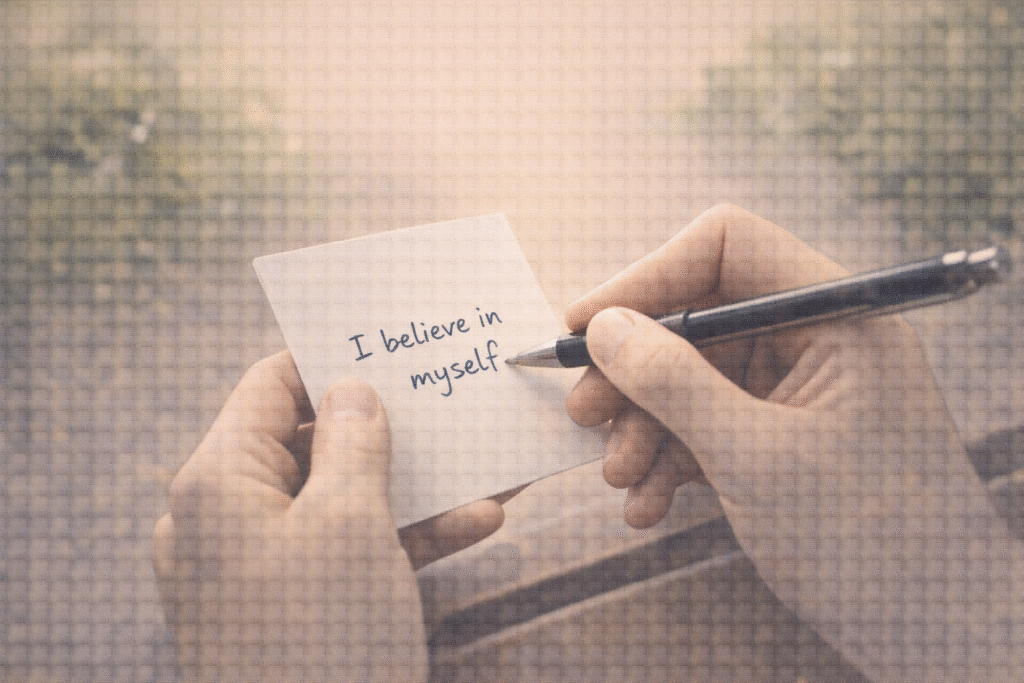
    Writing a small note of self-trust by hand

    4. Today’s Hobby Suggestion

    Writing a Letter to Yourself ✉️

    Take a few minutes today to write a short note to yourself.
    It doesn’t need to be praise.

    “Today was hard.”
    “You did your best.”
    “I see you.”

    That single line may become tomorrow’s support.
    Being gentle with yourself is one of the most reliable ways to strengthen quiet self-worth.


    5. A Small Action

    During lunch, step outside if you can.
    Sit somewhere with light and air.

    Write one sentence on a small piece of paper:

    “Today, I am doing well enough.”

    Fold it. Keep it in your wallet or pocket.
    It doesn’t have to be loud or visible.

    It’s just a small knot —
    a personal thread to return to when the world starts pulling.


    6. Today’s Quote

    “Nothing can dim the light that shines from within.”
    Maya Angelou


    Sitting quietly and regaining inner strength at dusk

    7. Closing

    Self-worth isn’t a sudden realization.
    It’s a quiet practice.

    Instead of proving yourself through others’ eyes,
    being able to say — even softly —

    “I’m okay. I’m doing my best.”

    That alone makes you steadier than you think.


    8. Today’s Insight

    Psychologist Carl Rogers emphasized that emotional well-being comes from alignment between one’s self-concept and lived experience.

    When who we think we are and who we actually live as grow closer,
    self-worth becomes healthier and more stable.

    Building self-worth, then, is not about becoming someone else —
    but about learning to accept who you already are.


    9. One-Line Summary

    “Small self-worth is the quiet courage that holds you steady when the world begins to shake.”

    Related Reading

    The tension between internal self-worth and external validation is explored in The Praise-Driven Society: Recognition and Self-Worth in the Digital Age.

    A philosophical reflection on quiet resilience and imperfect contentment appears in Is Perfect Happiness Possible?