Tag: emotional reflection

  • The Old Clock Tower in the Park – Where Time Seems to Pause

    Meeting the same people beneath the hands of time
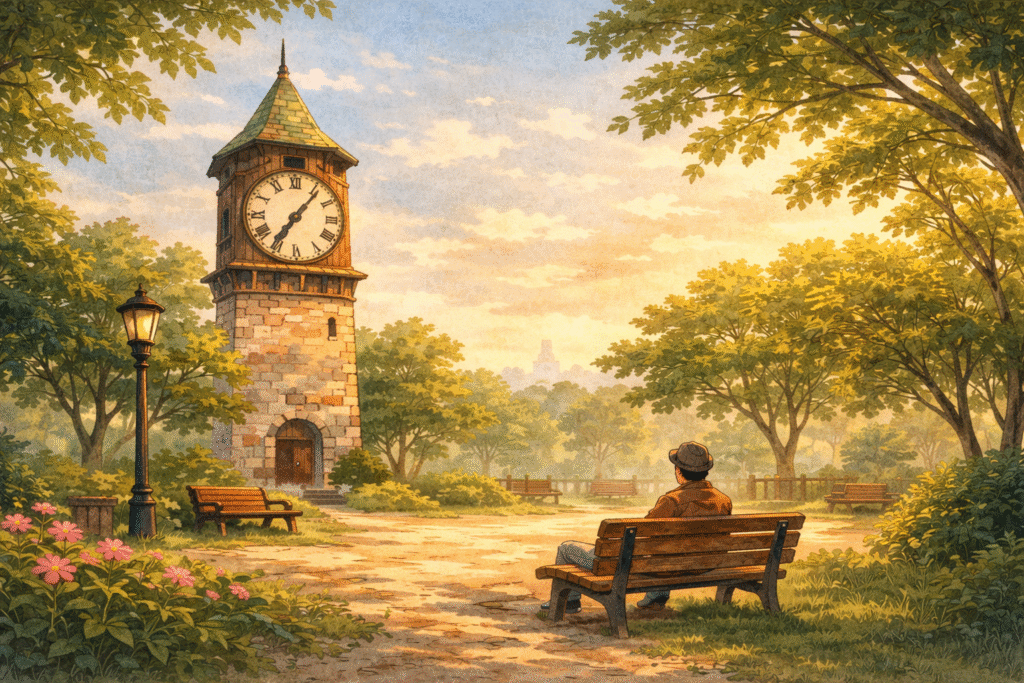
    Old clock tower in a park during quiet morning light

    In the center of the city,
    there is an old park.

    Each season paints the leaves differently.
    Sunlight leaves traces on the benches.
    Footsteps carve quiet paths along the stone walkway.

    At the heart of it stands an old clock tower.

    Once the center of the neighborhood,
    the clock now moves slightly slower—
    sometimes almost as if it has forgotten to hurry.

    Yet people still pass beneath it,
    carrying their days forward.

    For some, it is a meeting place.
    For others, a waiting place.
    And for a few, a stage where memories never quite fade.


    1. An Elderly Man’s Morning

    At eight o’clock each morning,
    an elderly man walks slowly toward the tower.

    In his hand, he holds an old wristwatch.

    He looks up and murmurs softly,
    “This clock still remembers my younger days.”

    He once waited here for his grandson.
    He stood beneath this clock the day the boy left for military service.

    Time has moved on.
    His footsteps have not.

    For him, this is not just a park.
    It is a timetable of memories.


    2. A Young Girl’s Afternoon

    Around noon,
    a young girl sits beneath the clock tower.

    She opens a book while waiting for a friend,
    but her eyes drift toward the clock.

    “I wish it would move a little slower today.”

    For her, this is not just a meeting place.

    It is a small stage
    where anticipation quietly grows.

    As the second hand moves,
    her own day gently unfolds.


    3. A Worker Taking a Short Break

    Toward evening,
    a worker sits on the bench and exhales.

    The drink in his hand has grown warm,
    but there is a quiet peace on his face.

    He looks up at the tower and smiles.

    “You don’t hear bells like this anymore.”

    All day long,
    he runs on schedules and deadlines.

    But here, beneath the tower,
    he pauses.

    The chime of the clock sounds like a quiet message:

    “You made it through today.”
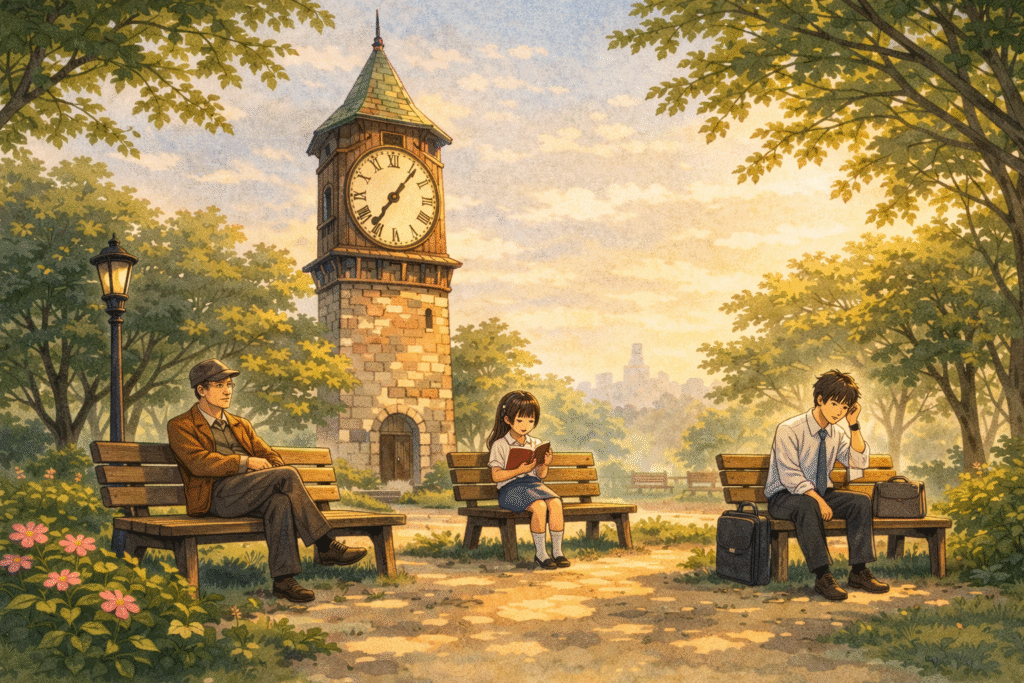
    Different people sitting quietly beneath a park clock tower

    4. Where Days Overlap

    As sunset approaches,
    the park fills with different lives.

    A commuter on the way home.
    A parent pushing a stroller.
    A couple walking hand in hand.

    They do not know one another.

    Yet at the same hour,
    in the same place,
    their days briefly intersect.

    Beneath the clock tower,
    time overlaps.

    And in that overlap,
    a quiet sense of connection forms.


    Conclusion: Where Time Continues to Remember
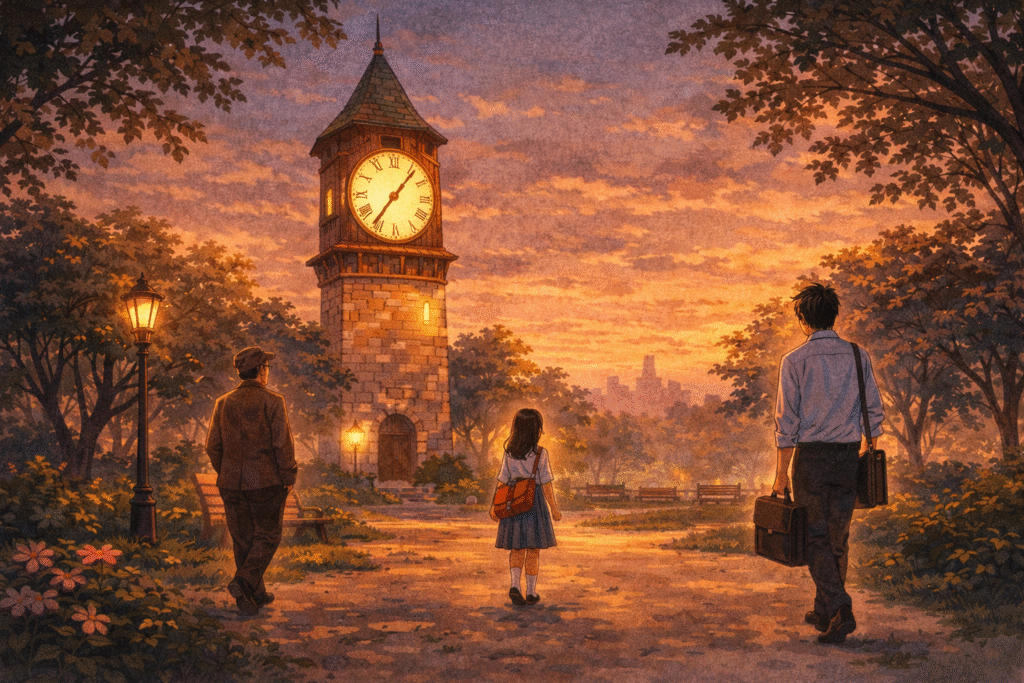
    Park clock tower glowing at dusk as people walk away

    At night,
    the clock tower lights up.

    The hands still move slowly,
    but beneath that light
    thousands of days have passed.

    For someone, it was a beginning.
    For another, a farewell.
    For someone else, a place to gather strength.

    Time moves forward.

    But the stories of those who stood there
    linger in the air.

    And if one day we pass beneath it again,
    the clock tower might quietly say:

    “Your time was here, too.”

    Related Reading

    The quiet weight of time and memory is also reflected in The Texture of Time: How the Mind Shapes the Weight of Our Moments, where psychological time and lived experience are explored in depth.
    At a broader social level, the question of how technology reshapes our perception of time is examined in The Standardization of Experience, which considers how modern systems structure everyday life.

  • The Inner House

    A Day of Clearing the Rooms of the Mind

    Soft light entering a quiet room, symbolizing the inner house of the mind

    1. Opening – Cleaning More Than a Space

    One afternoon, I decided it was time for a long-overdue deep cleaning.

    Unfinished books were stacked on the desk.
    Clothes from different seasons were tangled together in the closet.
    As I sorted through these small messes, a quiet thought surfaced:

    Perhaps my mind looks much the same.

    I opened the window to let fresh air in.
    Soft sunlight filled the room, and something inside felt lighter.
    That was when I realized that cleaning is not only about space—
    it is also about letting air move through the mind.


    2. A Small Moment of Humor

    “Even the mind needs cleaning,” someone once joked.
    “Then what is the dust?”
    “Perhaps,” came the answer, “unattended emotions.”


    3. Insight – The Rooms We Carry Inside

    Inside each of us are many rooms.

    A room of joy.
    A room of sorrow.
    A room of regret we hesitate to enter.

    We often live with these doors closed.
    Yet emotions left untouched do not disappear.
    They quietly accumulate, making the inner air heavy.

    To organize the mind is not to erase feelings,
    but to become honest with oneself.

    When an old wound is gently brought into the light,
    it transforms—from a burden into understanding.

    The essence of inner organization is not discarding emotions,
    but finding the courage to look at them again.


    Hands gently organizing notes on a desk, reflecting emotional clarity

    4. Today’s Practice – Creating an Emotional Storage Map

    Take a sheet of paper and name the rooms of your inner house.

    For example:
    The Room of Joy
    The Room of Regret
    The Room of Gratitude

    Write down, in a single line, what each room contains.
    Then choose one room to tend to today.

    When emotions are given structure,
    what once felt overwhelming begins to take shape.


    5. A Small Act of Courage

    Later that afternoon, with a warm cup of tea nearby,
    I opened a page labeled The Room of Regret.

    Slowly, I wrote what I had long postponed:
    “Why wasn’t I kinder then?”

    Tears welled up—not from regret, but from understanding.
    When the page was complete, the weight inside had eased.

    “This room,” I thought, “can finally breathe.”


    6. Quote of the Day

    “The unexamined life is not worth living.”
    Socrates

    A calm figure by the window in warm light, symbolizing inner peace

    7. Closing Reflection – Letting Light In

    Organizing the inner house is not about removing emotions.
    It is about returning them to their rightful place.

    As scattered thoughts are gently arranged,
    new feelings find space to enter.

    Everyone carries at least one room that remains unorganized.
    Today, consider opening its door—
    and letting in a line of sunlight and a breath of air.


    8. A Thought from Psychology

    Psychologist D. W. Winnicott emphasized that reconnecting with the True Self
    begins by recognizing one’s inner emotional space.

    This process is not about meeting external expectations,
    but about noticing what is genuinely felt within.

    To clean the rooms of the mind
    is to begin finding one’s way back to the self.


    9. One-Sentence Takeaway

    “Caring for the inner house is the quietest way of loving who you are today.”