Tag: emotional healing

  • The Sound of Old Stairs

    The Sound of Old Stairs

    Where Yesterday’s Memories Meet Today’s Footsteps

    Before We Begin

    Sometimes, a place remembers us before we remember ourselves.

    The creak of an old wooden stair is never just a sound.

    Hidden within it are footsteps from years ago—those we once took, those we take today, and those we have yet to make.

    Every step carries more than weight.

    Sometimes, it carries time itself.


    A Staircase That Remembered

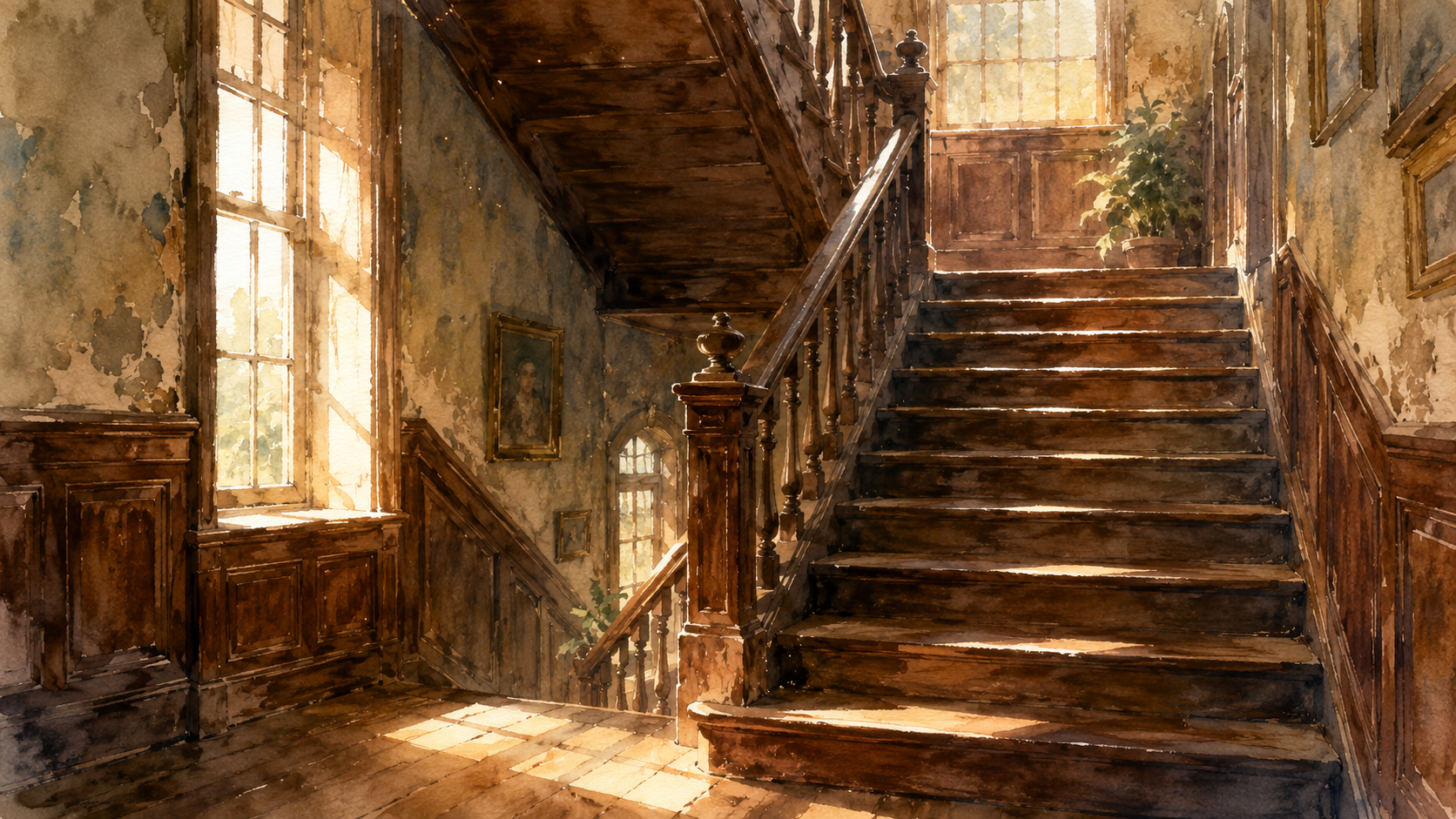
    person climbing an old wooden staircase

    A few days ago, I visited a historic building that has stood for more than a century.

    As I climbed the old wooden staircase, one step answered with a quiet creak.

    It was an ordinary sound.

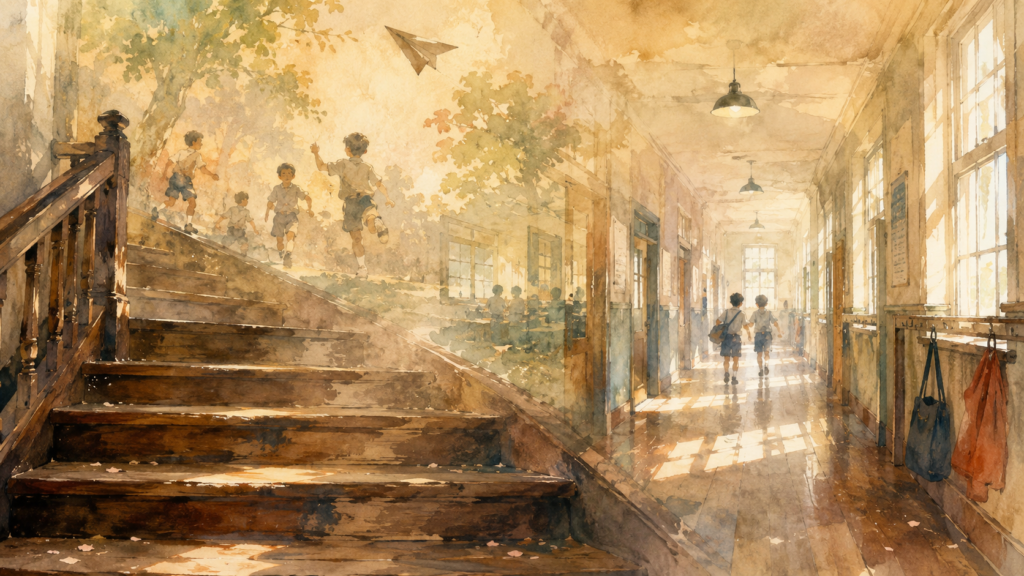
    Yet in an instant, another place appeared.

    The hallway of my childhood school.

    The echo of classmates running past.

    The faint scent of polished wood.

    None of it was physically there.

    Yet all of it returned with astonishing clarity.

    At that moment, the staircase no longer felt like architecture.

    It felt like a place where time had quietly been waiting.


    When Sound Unlocks Memory

    old staircase blending into childhood memories

    Our minds often remember through sound before they remember through images.

    The creak of a stair.

    A wooden door closing.

    Rain tapping against a window.

    These familiar sounds seem to travel directly into memory.

    Neuroscientists have long observed that certain sounds can activate both the hippocampus, where memories are organized, and the amygdala, where emotions are processed.

    That is why a simple sound rarely brings back facts alone.

    It often returns with feelings.

    We do not merely remember.

    For a brief moment, we live there again.

    Perhaps that is why analog sounds continue to comfort us in an increasingly digital world.

    Their imperfections remind us that life itself has texture.


    Where Past and Present Walk Together

    Old buildings have a quiet way of reflecting those who enter them.

    As I continued climbing, another thought appeared.

    The same wooden steps had carried thousands of people before me.

    Students.

    Doctors.

    Workers.

    Visitors.

    Each left only a few seconds of sound behind.

    Yet somehow, those sounds still seemed to remain.

    My own footsteps joined theirs.

    For a brief moment, the past and present walked together.

    Psychologists sometimes describe this experience as a sense of temporal continuity—the feeling that different chapters of our lives belong to the same story.

    When we experience that continuity, we often feel less anxious about the future.

    We remember that we have already walked through many seasons before.


    The Beauty of Moving Slowly

    Modern life encourages speed.

    Elevators replace stairs.

    Automatic doors replace waiting.

    Notifications replace silence.

    Old staircases ask something different.

    They ask us to slow down.

    Each step produces its own sound.

    Each sound lingers just long enough before the next begins.

    That rhythm invites a quiet question.

    Where am I now?

    Not on a map.

    Not in a career.

    But within my own life.

    Sometimes healing begins not with finding an answer, but with finally hearing the question.

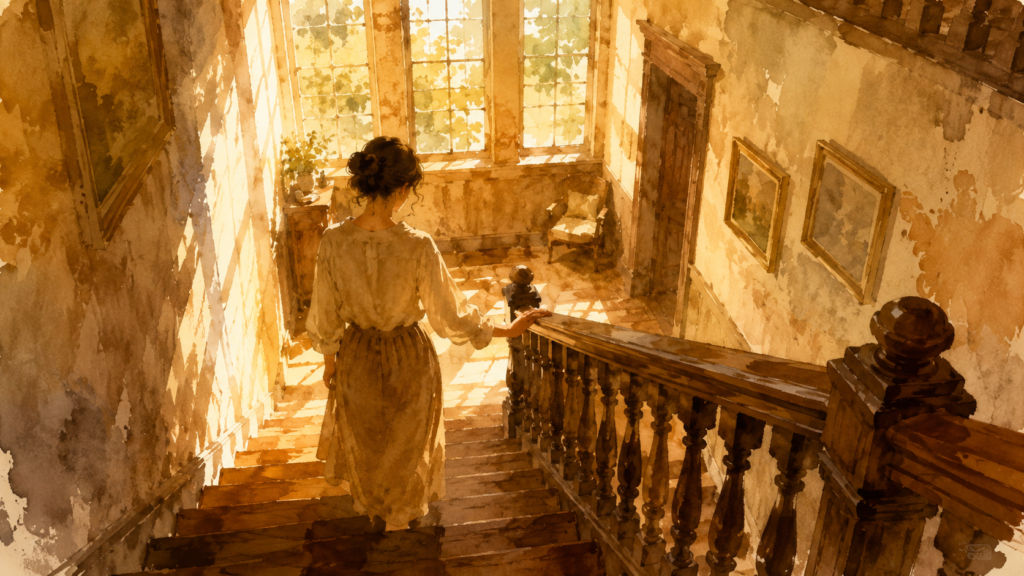
    person descending an old staircase in warm afternoon light

    Conclusion — Listening to Time

    When I walked back down the staircase, the sound greeted me once more.

    This time it felt familiar.

    Almost welcoming.

    As though the building itself were quietly wishing me a safe journey.

    Perhaps we all spend our lives climbing invisible staircases.

    Each step connects who we once were, who we are becoming, and who we have not yet met.

    Life may not move in straight lines.

    It moves one step at a time.

    And sometimes, if we listen carefully, time itself answers back with the gentle creak of an old wooden stair.

    Reader Question

    Has a familiar sound ever taken you back to a moment you thought you had forgotten?

    Perhaps it was the creak of an old staircase, the closing of a wooden door, or the sound of rain against a window.

    What ordinary sound brings your memories quietly back to life?

    Related Reading

    The quiet memories hidden within ordinary objects are explored further in A Pebble by the Sea – Seeing the Moon Within a Small Stone, where a simple pebble becomes a reflection of time, patience, and the stories we quietly carry within us.

    A similar reflection on how familiar routines bring calm and meaning to everyday life can be found in A White Mug – The Peace Found in Familiar Things, where a simple morning ritual reveals the comfort of returning to what quietly anchors us.

  • A Small Hair Salon at the End of the Alley

    A Small Hair Salon at the End of the Alley

    The Quiet Touch That Changes More Than Hair

    At the end of a narrow alley,
    on the first floor of an old brick building,
    there is a small hair salon.

    The sign is modest, with faded gold lettering on the glass door.
    Warm light slips through the curtains,
    and when the door opens,
    the familiar hum of a hairdryer fills the air.

    The hairdresser has worked here for over thirty years.

    She often says:

    “Cutting hair is never just about appearance.
    It’s about helping someone begin their day again.”


    Where Stories Flow Between Strands of Hair

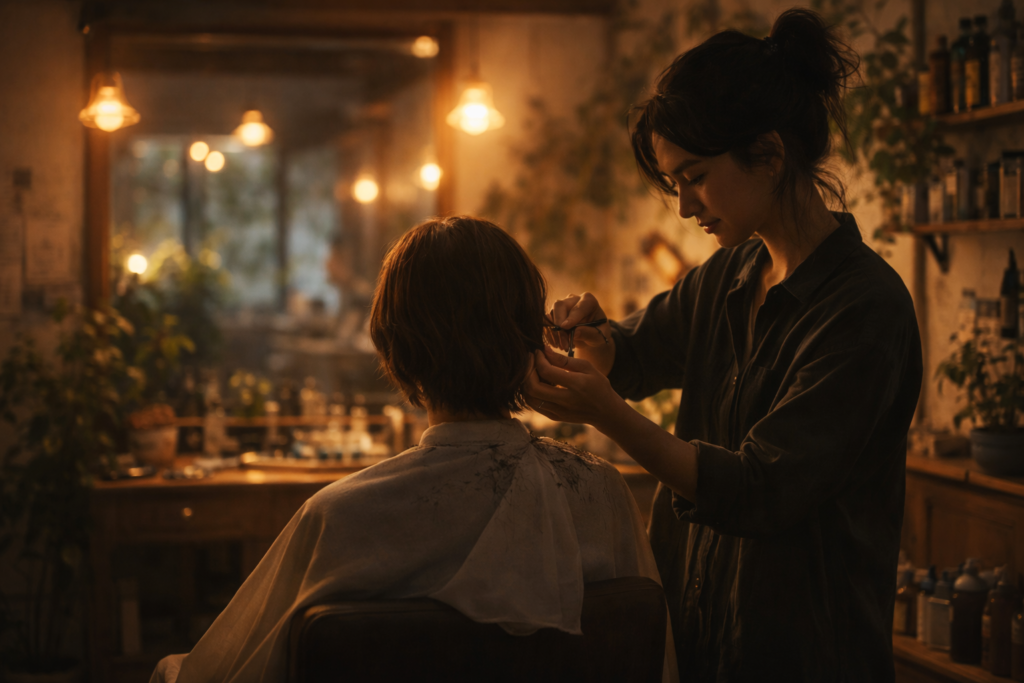
    hairdresser cutting hair softly

    Inside the salon, stories are always present.

    As their hair is trimmed, people begin to speak.

    “My child has been going through a difficult time lately.”
    “My husband just started working again.”
    “Today… I just wanted to feel different.”

    The hairdresser listens quietly,
    moving her scissors with calm precision.

    Strands of hair fall gently to the floor.

    But perhaps they are not just hair—
    perhaps they are fragments of fatigue, worry,
    and the invisible weight carried through the day.

    When the warm air of the dryer lifts them away,
    something in the room feels lighter.

    Here, change happens softly.


    The Art of Care, The Temperature of the Heart

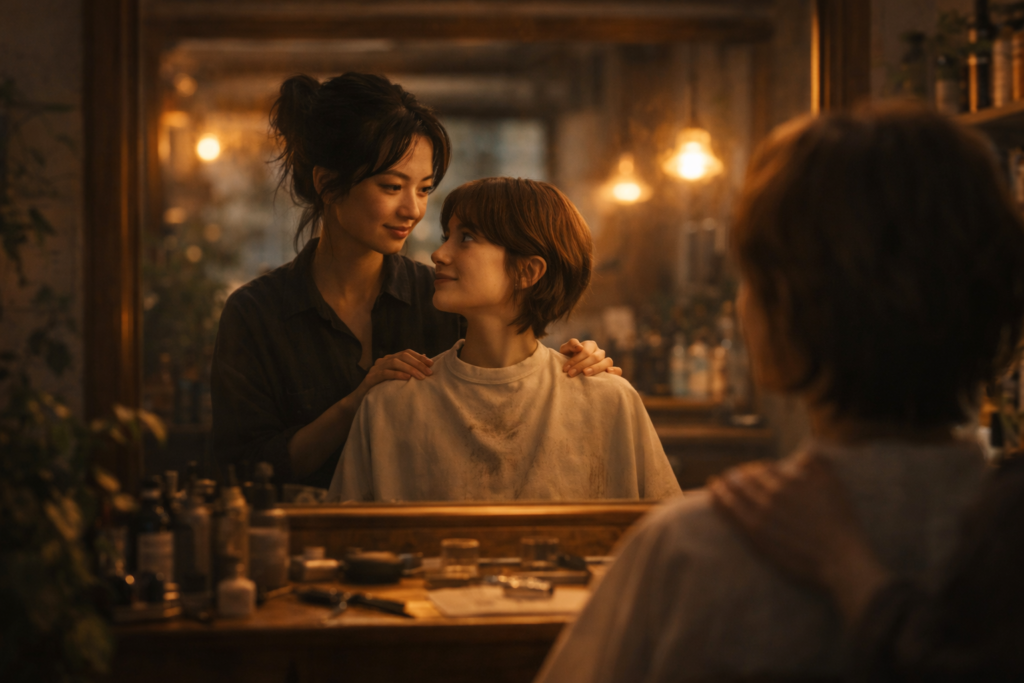
    hair salon mirror emotional connection

    A day in this salon is not simply a service.

    The hairdresser does not shape only hair—
    she shapes expressions, moods, and moments.

    “Hair never lies,” she says.
    “You can feel someone’s state of mind through your hands.”

    With the scissors in her hand,
    she knows how to handle another person’s life
    with quiet care.

    Regular customers call this place
    “a refuge for the heart.”

    Here, differences fade.

    Doctor or delivery worker,
    parent or student—
    once the cape is placed around the shoulders,
    everyone becomes simply human.


    The Moment of Change

    At first, customers sit quietly,
    their heads slightly lowered.

    Tired faces.
    Heavy expressions.

    But as the hair is shaped,
    and the final touches are made,
    something begins to shift.

    The hairdresser gently asks:

    “Does this feel better?”

    And often, the answer comes with a smile:

    “Yes… I feel like I can start again.”

    Within that brief exchange,
    something deeper than appearance has changed.

    A few centimeters of hair—
    and yet, a subtle renewal of the self.


    The Light Behind a Closed Door

    As night falls and the alley grows quiet,
    the last customer leaves.

    The door closes.

    The hairdresser sweeps the floor,
    gathering the day into small, silent motions.

    There is tiredness,
    but also a sense of order.

    Standing before the mirror,
    she looks at herself and whispers:

    “You did well today.”

    It is both a compliment
    and a quiet promise.

    A day spent shaping others
    becomes a moment of shaping oneself.

    The light from the salon
    spills softly into the alley.

    And beneath that light,
    someone walks home—
    carrying a small, unseen change.

    small salon light night alley

    Conclusion — What It Means to Transform

    A small hair salon is not just a place for cutting hair.

    It is a place where relationships continue,
    where quiet healing occurs,
    where people imagine a new version of themselves.

    And sometimes,
    that imagination becomes real.

    As the hairdresser once said:

    “As hair grows, so does the human heart.”

    Our lives, too,
    are shaped—slowly, gently—
    through the hands we encounter along the way.

    A Question for Readers

    When was the last time a small, simple change made you feel like starting again?

    Sometimes, it’s not a big decision—but a quiet moment, a gentle touch, or a small shift in your routine that brings renewal.
    What was that moment for you?

    Related Reading

    The quiet transformation that unfolds in a small hair salon resonates with a deeper reflection found in The Rhythm of Wood, The Tempo of My Mind, where the steady rhythm of a metronome becomes a metaphor for finding balance and pace within one’s inner life.

    A similar perspective on personal renewal can be found in Am I Falling Behind? — How Comparison Distorts Our Sense of Time, where the illusion of “being late” reveals how comparison reshapes our sense of progress—and how reclaiming our own timing can restore a sense of calm.


    References

    Gilligan, C. (1982). In a Different Voice: Psychological Theory and Women’s Development. Cambridge, MA: Harvard University Press.
    → This work explores ethics through the lens of care and relationships, offering insight into how emotional connection and attentive listening shape human growth, much like the quiet interactions within the salon.

    Noddings, N. (2003). Caring: A Relational Approach to Ethics and Moral Education. Berkeley: University of California Press.
    → Noddings emphasizes the importance of relational care as a foundation for ethical life, helping us understand everyday spaces—like a hair salon—as meaningful sites of human connection.

    Bourdieu, P. (1984). Distinction: A Social Critique of the Judgement of Taste. Cambridge, MA: Harvard University Press.
    → Bourdieu interprets everyday practices such as grooming and appearance as forms of social expression, revealing how even small acts of self-care reflect deeper structures of identity and belonging.