Introduction — Slipping Into a Small, Private World
This essay explores earphone isolation in modern life.
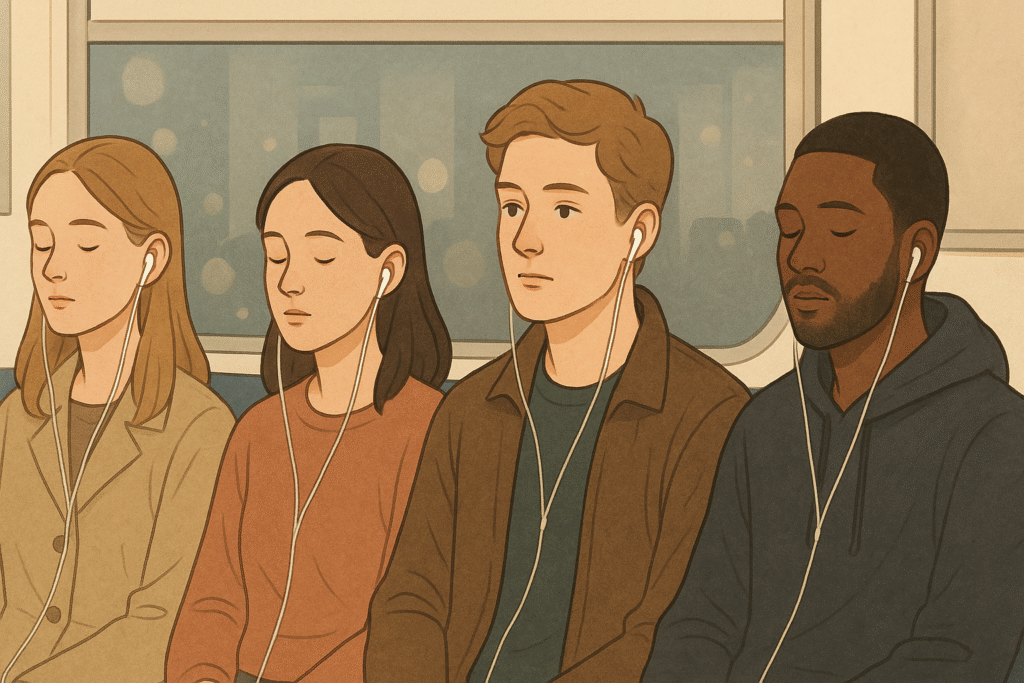
It was an unusually loud evening on the subway.
Someone’s phone call, the repetitive ads, the metallic wheel noise…
The day’s accumulated sounds filled my mind all at once.
Without thinking, I reached into my bag, pulled out my earphones, and placed them in my ears.
As soon as music began to flow, the world instantly grew distant.
In that brief moment, a thin but unmistakable wall seemed to form between myself and the world.
And then a thought emerged:
“Escaping into sound — that is the wall of earphones.”
Is this peaceful isolation a moment of self-care?
Or is it a quiet form of disconnection?
1. Earphones as a Small ‘Safety Net’
Earphones are not just devices.
They are psychological shields, subtle boundaries around our inner world.
Sociologist Erving Goffman described daily life as a “stage of self-presentation.”
In this sense, earphones function as a tool that regulates distance between performer and audience.
In public spaces, earphones send a silent message:
“I want to be alone right now.”
Even without sound, simply wearing earphones becomes
a nonverbal signal of refusal — a gentle but firm boundary.
2. Personal Isolation or Emotional Self-Defense?
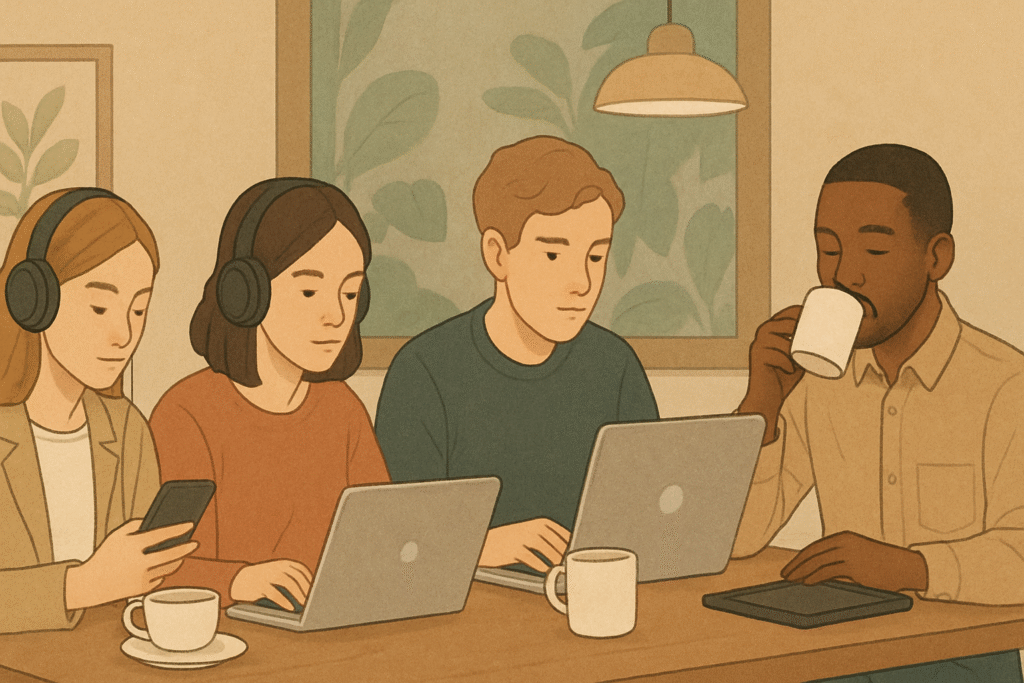
Modern life bombards us with noise and constant stimulation.
Earphones help us regain our rhythm, process emotions,
and briefly shut out the gaze of others.
They are, in many ways, an emotional shield that maintains our personal world.
Yet this small device also deepens social distance.
We avoid eye contact, conversations fade before they begin,
and public spaces drift into silent parallel worlds.
Beyond the wall of earphones,
there is always someone’s voice we no longer hear.
3. The Identity of the Earphone Generation — ‘My Rhythm’ and ‘Social Fatigue’
For Gen Z and Millennials, earphones are cultural markers of identity.
White earbuds, Bluetooth headsets, noise-canceling devices —
these are no longer audio tools but symbols of personal taste.
Curated playlists express “today’s version of me,”
yet the more softly the music plays,
the thicker the wall of earphones becomes.
Sociologist Ulrich Beck called our era a “risk society of individualization.”
Everything is connected, yet people are more isolated than ever.
When we put on earphones,
we protect ourselves from overwhelming noise
while also becoming part of the broader pattern of social withdrawal.

4. Conclusion — Opening the Heart Without Closing the Sound
Understanding earphone isolation helps us see the balance between solitude and connection.
Earphones are essential tools and emotional armor.
They give us comfort, but they can also gently close the door to everyday connection.
Sometimes we need to take them off —
to hear the conversations, the footsteps, the subtle rhythms of the city.
Noise can feel overwhelming,
but within it lives the reminder that we still belong to a larger, living world.
Closing sound does not have to mean closing the heart.
May our earphones become windows, not walls.
📚 References
1. Bull, Michael. (2000). Sounding Out the City: Personal Stereos and the Management of Everyday Life.
Berg Publishers.
→ A foundational work on how portable audio devices allow individuals to create private auditory spaces within noisy urban environments.
2. Hosokawa, Shuhei. (1984). “The Walkman Effect.” Popular Music, 4, 165–180.
→ An early study on personal listening in public spaces and how it creates new social boundaries.
3. Turkle, Sherry. (2011). Alone Together: Why We Expect More from Technology and Less from Each Other.
Basic Books.
→ Explores how digital devices reshape emotional connection and human relationships, including the rise of “connected solitude.”