
How Smartphones, Social Media, AI, and Changing Values Are Reshaping Relationships Between Generations
Every generation grows up with different technologies.
For one generation, television may once have represented a revolutionary new medium. For another, personal computers transformed work and education. Younger generations have grown up with smartphones, social media, streaming services, and increasingly artificial intelligence as ordinary parts of everyday life.
Technology itself is not new.
What may be different today is the speed of change.
Digital tools can transform communication, education, work, shopping, banking, entertainment, and even relationships within only a few years. People who adapt quickly may experience these changes as greater freedom and convenience. Others may feel that familiar ways of living are disappearing faster than they can adjust.
This creates more than a technological divide.
It can create differences in values, communication, trust, privacy, learning, and even perceptions of what constitutes a normal life.
But is technology really dividing generations?
Or can the same technologies that create misunderstanding also become tools for bringing generations closer together?
1. What Is the Digital Generation Gap?
Age Matters—but It Is Not the Whole Story
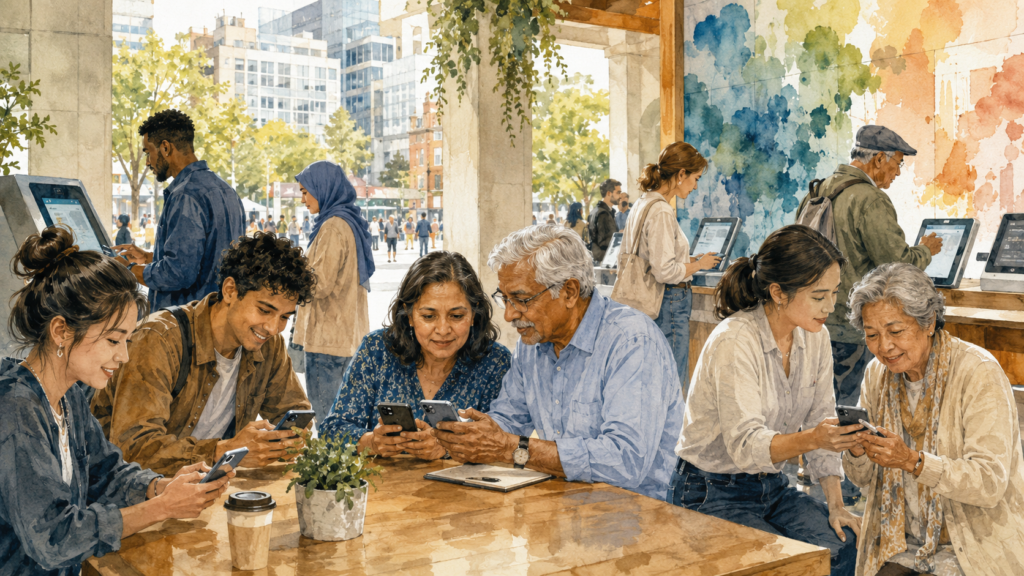
The digital generation gap refers broadly to differences between generations in their access to, familiarity with, and attitudes toward digital technology.
Younger people who have used digital devices from an early age may move naturally between messaging apps, social media, online video, cloud services, digital payments, and AI tools.
Older adults may have learned many of these technologies later in life.
But it would be misleading to divide society neatly into “digital young people” and “non-digital older people.”
Many older adults are highly proficient with technology, while some younger people lack advanced digital skills. Income, education, occupation, disability, infrastructure, and previous exposure to technology can be as important as age.
The deeper divide is therefore not simply about who owns a smartphone.
It concerns who can confidently use digital systems to participate in society.
As banking, government services, healthcare appointments, transportation, shopping, and communication move online, limited digital skills can become a form of social disadvantage.
What begins as a technological gap can therefore become an opportunity gap.
2. Does Technology Create Different Values Between Generations?
Privacy, Convenience, and Different Ideas About Normal Life
Generational differences become more complicated when technology begins to influence values.
Consider privacy.
Some people are comfortable sharing photographs, locations, personal opinions, and everyday experiences online. Others regard the same behavior as unnecessarily exposing private life.
Neither attitude can be explained entirely by age.
But generations that encountered social media at different stages of life may develop different assumptions about what should remain private and what can appropriately become public.
Similar differences appear around convenience.
A younger person may wonder why anyone would visit a bank when a transaction can be completed on a phone.
An older person may wonder why an important financial decision should be entrusted to an interface with no human being present.
One sees efficiency.
The other may see the disappearance of human contact and an additional security risk.
The disagreement is therefore not always about whether someone understands the technology.
Sometimes it reflects different ideas about trust, safety, relationships, and the kind of society people want to live in.
3. Is Social Media Changing Family Relationships?
Connected to Everyone—and Sometimes Distant from the Person Beside Us
Few situations illustrate the generation gap more clearly than a family gathering where several people are looking at their phones.
An older family member may interpret this as disengagement:
Why are you talking to people online when your family is sitting beside you?
A younger person may experience the same behavior differently.
The smartphone may be maintaining friendships, coordinating work, participating in a group conversation, sharing photographs, or responding to people who are also important parts of their social world.
Digital communication has changed what it means to be “together.”
Physical presence no longer guarantees attention, while physical distance no longer necessarily means social separation.
This creates a genuine tension.
Online networks can maintain relationships across cities and countries, allowing grandparents to see grandchildren, migrants to remain connected with families, and friends to sustain relationships over long distances.
At the same time, constant digital connection can compete with face-to-face attention.
The important question may therefore not be whether online relationships are real.
They clearly can be.
The question is whether we are learning to manage different forms of connection without allowing one to continually displace the other.
4. Is Digital Learning Creating a New Educational Divide?

Education provides another revealing example.
Digital technology has dramatically expanded access to information. Students can watch lectures, search academic resources, collaborate online, learn languages, conduct simulations, and increasingly use AI to explain difficult concepts or assist with writing and research.
This can make learning more flexible and individualized.
But access to information is not the same as education.
Students still need to evaluate sources, distinguish evidence from misinformation, develop sustained attention, formulate their own questions, and understand rather than merely retrieve answers.
This becomes especially important in the age of generative AI.
Older educators may sometimes distrust AI because they see the danger of dependency, plagiarism, superficial learning, or declining independent thought.
Younger learners may see the same technology as an ordinary intellectual tool.
Both concerns deserve attention.
From an educational perspective, the goal should not be to decide which generation understands learning better. Education has always involved both preserving valuable knowledge and adapting to new ways of acquiring it.
Intergenerational learning can therefore work in both directions.
Younger people may help older generations understand new technologies.
Older generations can contribute experience, historical perspective, judgment, and forms of knowledge that cannot simply be downloaded.
A digitally mature society should not ask only:
How can older people catch up with younger people?
It should also ask:
What can generations teach one another?
5. Will AI Make the Generation Gap Even Wider?
Artificial intelligence may become the next major test.
Generative AI is increasingly influencing writing, information search, education, translation, programming, creative work, and professional decision-making.
People who learn to use these systems effectively may gain significant advantages.
Those who do not may find themselves increasingly dependent on others in workplaces and institutions redesigned around AI-assisted processes.
This resembles earlier digital divides—but potentially at greater speed.
At the same time, familiarity does not automatically equal wisdom.
A person who can use an AI system quickly may not necessarily understand its limitations, biases, privacy implications, or tendency to produce confident but inaccurate information.
Older adults may lack familiarity with some AI tools while possessing professional or life experience that helps them recognize when an answer does not make sense.
The emerging divide may therefore not simply be between AI users and non-users.
It may be between people who can use AI critically and those who cannot.
That is a challenge for every generation.
6. Should Society Adapt to Technology—or Should Technology Adapt to People?
This may be the most important question behind the digital generation gap.
When a government service becomes online-only, efficiency may improve for millions of users.
But what happens to people who cannot navigate the system?
When restaurants replace menus with QR codes, banks close physical branches, and customer service becomes automated, technological convenience for the majority can create difficulty for a minority.
Should everyone simply be expected to adapt?
There is a strong argument that digital literacy has become an essential modern skill. Societies cannot preserve every older system simply because technological change is uncomfortable.
But technological progress should not automatically mean eliminating alternatives before people can make the transition.
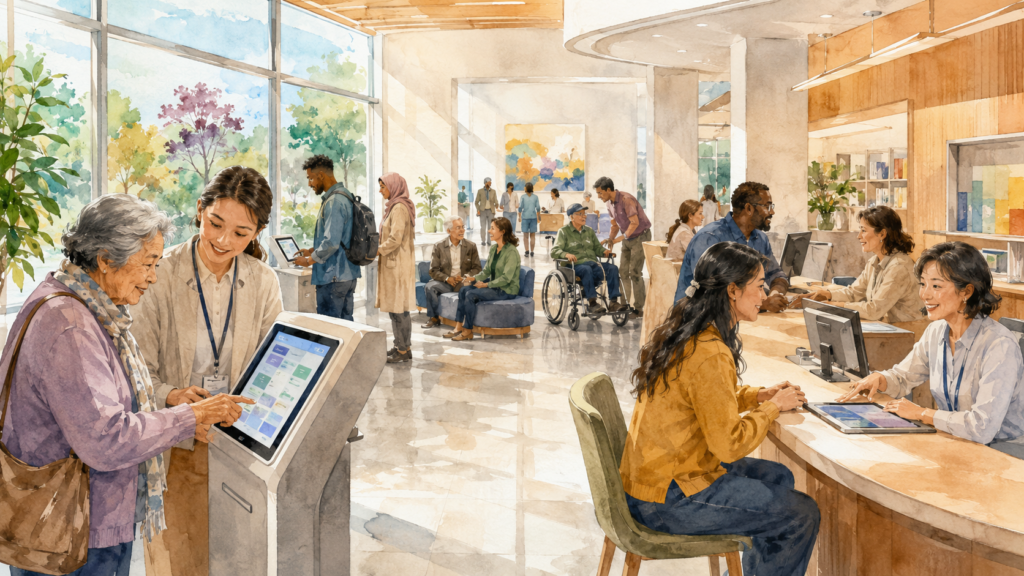
A genuinely inclusive digital society needs accessible design, digital education, human assistance, and reasonable alternatives for people who cannot easily use new systems.
The goal should not be to stop innovation.
It should be to ensure that innovation does not become exclusion.
Conclusion: The Generation Gap Is Not Just About Technology
The digital generation gap is often described as a conflict between young people who embrace technology and older people who resist it.
Reality is far more complicated.
The disagreement is partly about skills, but it is also about values.
It concerns privacy and openness, speed and patience, convenience and human contact, innovation and continuity.
And increasingly, it concerns who can participate fully in a society whose institutions are becoming digital by default.
The solution is therefore not simply to teach older generations how to use smartphones or AI.
Nor is it to tell younger generations that older ways of communicating and learning were inherently better.
A healthier approach is intergenerational exchange.
Younger generations can share digital knowledge without assuming that technological fluency makes them wiser in every respect. Older generations can question technological change without assuming that unfamiliarity makes new forms of communication or learning inferior.
Technology will continue to change.
Every generation will eventually encounter innovations developed by people younger than themselves.
So perhaps the digital generation gap contains a lesson larger than technology itself:
Can generations learn from one another without requiring either the past or the future to win?
Reader Question
Digital technology can make life faster, easier, and more connected, but people of different generations do not always experience those changes in the same way.
When technological progress leaves some generations struggling to participate, who should adapt—the individual to the technology, or the technology to the needs of different generations?
Related Reading
If technological change moves faster than some people can adapt, does growing older inevitably increase the risk of being left behind in an increasingly digital society?
In Digital Aging: When Technology Moves Faster Than We Do, we explore how rapid technological change affects older adults and ask how societies can embrace innovation without excluding people who need more time or support to adapt.
But the digital divide is not only about age. As artificial intelligence becomes embedded in education, work, and everyday services, could differences in digital access and skills create an entirely new form of social inequality?
In The New Inequality of the AI Age: The Rise of Digital Refugees, we examine how unequal access to AI and digital capabilities may create new forms of exclusion—and what digital inclusion should mean in the age of artificial intelligence.
References
1. OECD. (2025). Trends Shaping Education 2025. OECD Publishing.
This report examines major technological, demographic, social, and economic changes affecting education and society. It is particularly relevant to understanding how digital transformation and artificial intelligence are changing learning across generations and why digital competence has become increasingly important.
2. International Telecommunication Union. (2024). Measuring Digital Development: Facts and Figures 2024. ITU.
The ITU provides global data on internet connectivity and digital access across different populations and regions. The report demonstrates that the digital divide is shaped not only by age but also by factors such as income, geography, infrastructure, and socioeconomic conditions.
3. United Nations Department of Economic and Social Affairs. (2023). World Social Report 2023: Leaving No One Behind in an Ageing World. United Nations.
This report examines the social consequences of global population ageing and the challenges older adults face in rapidly changing societies. It provides useful context for understanding why digital inclusion is becoming increasingly important as essential services and social participation move online.
4. UNESCO. (2023). Global Education Monitoring Report 2023: Technology in Education—A Tool on Whose Terms? UNESCO.
UNESCO examines both the opportunities and risks associated with the growing use of technology in education. The report supports the article’s argument that access to digital tools alone does not guarantee better learning and that technology should serve educational needs rather than determine them.
5. World Health Organization. (2021). Global Report on Ageism. World Health Organization.
This report examines age-based stereotypes and discrimination across societies. It is relevant to the digital generation gap because assumptions that all older adults are technologically incapable—or that younger people are automatically digitally competent—can reinforce misleading generational stereotypes.