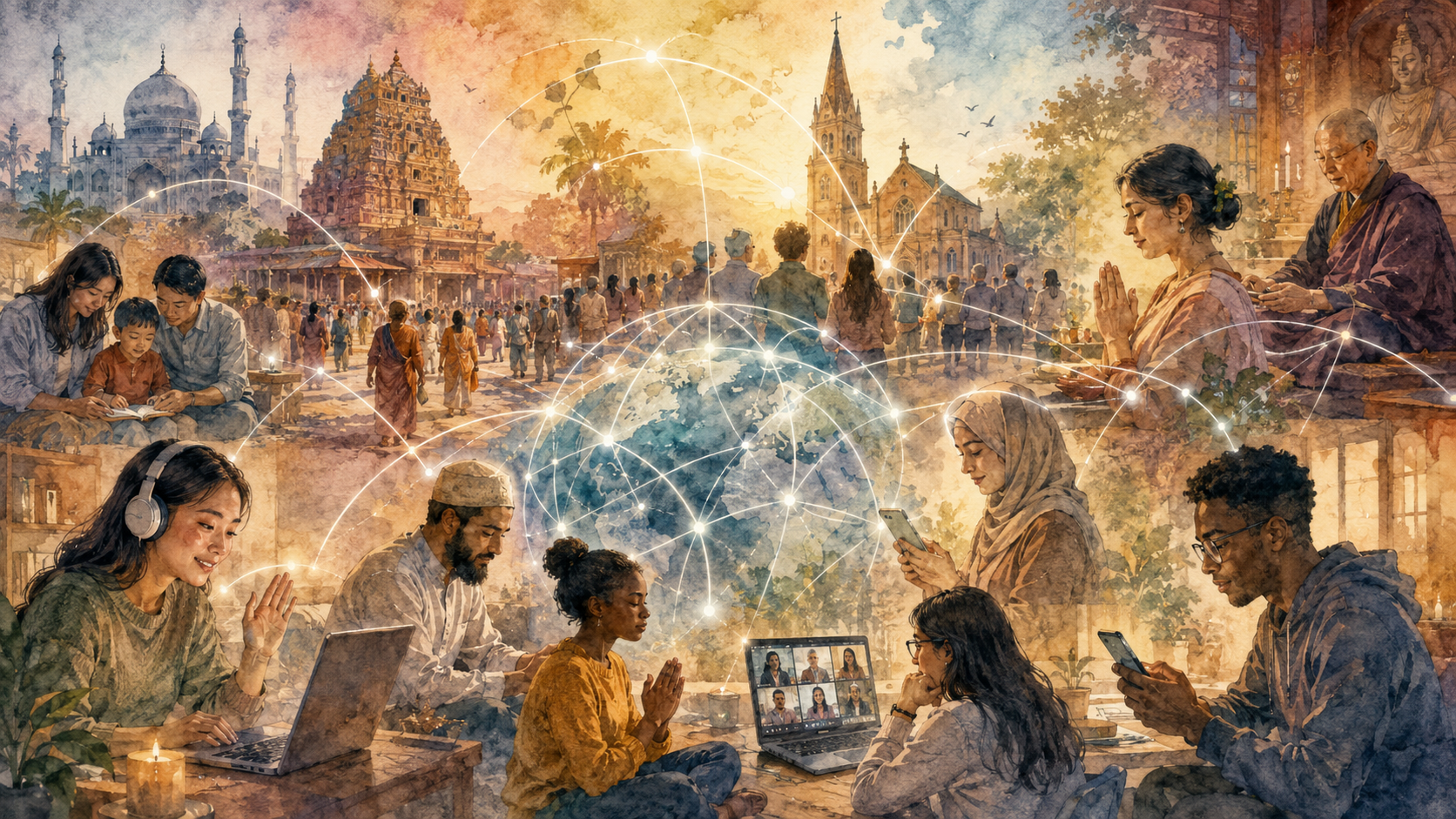
How Digital Communities Are Reshaping Belief, Religious Authority, and the Meaning of Belonging
Religion has always depended on connection.
People gather to worship, listen to religious teachings, celebrate rituals, share moral traditions, and support one another through important moments of life. For centuries, these activities were closely connected to physical places—churches, mosques, temples, synagogues, shrines, homes, and local communities.
Digital technology is changing that relationship.
A person can now watch a religious service thousands of kilometers away, join an online prayer group, listen to a spiritual teacher through a podcast, discuss scripture on social media, or encounter religious traditions they may never have experienced in their local community.
The COVID-19 pandemic dramatically accelerated this transformation, but digital religion did not disappear when physical places of worship reopened.
Instead, online and offline religious life increasingly coexist.
This raises a deeper question:
Are digital networks simply giving traditional religion new tools—or are they changing what religious belief and community actually mean?
1. What Is Digital Religion?
Faith Beyond Physical Places
Digital religion is more than putting sermons or religious texts online.
It describes the growing interaction between religious life and digital environments. Worship, education, prayer, discussion, community building, and even religious authority can now operate partly through digital networks.
For believers who live far from a religious community, have disabilities, work irregular hours, or cannot easily attend services, online participation can make religious life more accessible.
The pandemic made this especially visible.
When religious buildings around the world were temporarily closed or restricted, many communities moved services, prayer meetings, study groups, and pastoral communication online.
For millions of people, screens became temporary doors into religious communities.
But an important change followed.
Once people discovered that religious participation did not always require physical presence, some began asking whether geography should continue to define religious belonging at all.
A believer may live in one city while regularly listening to a religious leader in another country and discussing faith with people scattered across several continents.
Religion has therefore entered a world in which community can exist without physical proximity.
2. Are Online Religious Communities Real Communities?
Belonging Without Geography
Traditional religious communities usually develop through repeated face-to-face interaction.
People worship together, share meals, celebrate marriages and births, attend funerals, care for the sick, volunteer, and participate in the ordinary routines of communal life.
Online communities offer something different.
They can connect people who would otherwise never meet.
A member of a minority religion living in an isolated area may find others who share the same faith. Migrants can maintain connections with religious communities in their countries of origin. People questioning their beliefs can explore religious ideas anonymously before entering a physical community.
This can create genuine forms of belonging.
Yet something may also be lost.
Can watching a service on a laptop reproduce the experience of standing among other worshippers?
Can an online community provide the same support when someone becomes ill, loses a family member, or experiences financial hardship?
And can rituals whose meaning depends on physical presence be fully transferred to a screen?
The answer may not be simply yes or no.
Digital communities can create meaningful connections, but they may not replace every function of embodied community.
The future of religion may therefore be increasingly hybrid—part physical, part digital.
3. Does the Internet Strengthen Religious Diversity—or Weaken Traditional Faith?
Digital networks have dramatically expanded people’s exposure to different beliefs.
In the past, someone’s understanding of religion was often shaped primarily by family, local community, schools, and nearby religious institutions.
Today, a few searches can introduce someone to Christianity, Islam, Buddhism, Hinduism, Judaism, indigenous spiritual traditions, atheism, agnosticism, and countless interpretations within each tradition.
This can encourage curiosity.
A Christian may learn about Buddhist approaches to suffering. A Muslim may encounter discussions of Christian theology. A person raised without religion may explore several spiritual traditions before deciding what, if anything, they believe.
Greater exposure can promote religious literacy and tolerance by showing that people understand fundamental questions—life, death, suffering, morality, transcendence—in very different ways.
But openness also creates challenges for established religious institutions.
When believers can compare teachings instantly, religious leaders no longer have the same control over information. Traditional interpretations can be questioned by alternative voices, including voices from within the same faith.
Some people may develop more individualized forms of spirituality, combining ideas and practices from several traditions.
For religious institutions, this can look like fragmentation.
For individuals, it can look like freedom.
Digital networks therefore create a paradox:
They can expand religious understanding while simultaneously weakening the boundaries that once kept religious traditions distinct.
4. Is Social Media Changing Religious Authority?
From Religious Institutions to Religious Influencers
One of the most important consequences of digital religion may concern authority.
Traditionally, religious knowledge was often mediated through institutions and recognized leaders: clergy, scholars, teachers, seminaries, monasteries, or established religious organizations.
The internet has lowered those barriers.
Today, almost anyone can publish religious interpretations through YouTube, podcasts, livestreams, blogs, or social media.
This has obvious advantages.
Religious education becomes easier to access. Believers can hear scholars and teachers from around the world. Small religious communities can reach audiences that would once have been impossible to contact.
But popularity and expertise are not the same thing.
Algorithms often reward content that generates attention, emotion, and engagement. A careful theological explanation may attract less attention than a dramatic claim, controversial interpretation, or emotionally charged video.
This creates a new kind of religious authority:
the religious influencer.
A person with a large digital following may influence thousands or millions of believers without holding a traditional institutional position.
This raises difficult questions.
Who decides which religious voices are trustworthy?
What happens when algorithmic popularity becomes more influential than scholarship or institutional authority?
And what happens when religious teaching becomes inseparable from personal branding, advertising, donations, or online entertainment?
Digital technology does not simply transmit religious authority.
It can redistribute it.
5. Does Digital Religion Promote Tolerance—or Polarization?
The internet gives people unprecedented opportunities to encounter different religions.
But access to diversity does not automatically produce understanding.
Digital platforms can expose users to unfamiliar perspectives, interfaith dialogue, and educational resources. They can allow members of different religious communities to communicate directly rather than relying on stereotypes.
This can strengthen religious tolerance.
Yet the same networks can produce the opposite result.
Algorithms may repeatedly show users content similar to what they already watch. Religious communities can become digital echo chambers in which members encounter increasingly narrow interpretations of their own beliefs.
Controversial or emotionally provocative religious messages can also spread quickly.
As a result, digital networks may simultaneously encourage religious pluralism and religious polarization.
From a multicultural perspective, this distinction matters.
Simply encountering diversity is not the same as understanding it.
A digitally connected society still needs the ability to interpret unfamiliar beliefs, distinguish disagreement from hostility, and live alongside people whose deepest convictions may differ from one’s own.
Technology can create contact.
It cannot guarantee dialogue.
6. What Is Lost When Faith Moves Online?
Religious life involves more than information.
It often involves bodies, places, sounds, smells, gestures, objects, food, architecture, silence, and shared rituals.
Lighting candles, kneeling in prayer, singing with others, breaking bread, fasting together, making pilgrimages, sitting in meditation, or gathering during mourning cannot always be reduced to digital content.
This may be the greatest limitation of online religion.
Digital networks are exceptionally good at transmitting words and images.
Religion, however, often depends on presence.
There is also the risk of turning faith into another form of content consumption.
A person can switch between sermons as easily as switching between entertainment videos. Religious messages can be shortened to fit social-media formats. Spiritual teachers may compete for attention, followers, and engagement.
When this happens, religious practice can become personalized and convenient—but perhaps also more temporary and consumer-like.
The question is therefore not whether technology is good or bad for religion.
It is whether convenience changes the kinds of commitment, discipline, community, and shared responsibility that religious traditions have historically required.
Conclusion: Will Digital Networks Change Faith—or Only How We Practice It?
Digital networks are unlikely to eliminate religion.
They are doing something more complicated.
They are changing where religious life happens, how believers find communities, who can claim religious authority, and how people encounter beliefs different from their own.
These changes bring genuine opportunities.
People who were once isolated can find communities. Religious education can cross borders. Minority traditions can reach global audiences. Interfaith encounters can become easier. Believers can remain connected even when physical participation is impossible.
But the same technologies create new tensions.
Online participation may weaken local community ties. Algorithms can amplify polarization. Religious authority can shift from institutions toward charismatic online personalities. And faith itself can risk becoming another product competing for attention in the digital marketplace.
The future of religion will therefore probably not be a choice between online faith and traditional faith.
More likely, religious communities will continue developing hybrid forms that combine digital accessibility with physical presence.
The deeper challenge is deciding what technology should enhance—and what should not be surrendered to it.
Religious traditions have always adapted to new forms of communication, from manuscripts and printing presses to radio and television.
Digital networks are the latest transformation.
But they leave us with a question that technology itself cannot answer:
If faith can exist anywhere online, what still makes a religious community a community?
Reader Question
Digital networks can make religious communities more accessible and connect believers across borders, but faith has traditionally depended heavily on physical presence, shared rituals, and local communities.
If worship, religious education, and spiritual communities increasingly move online, what parts of religious life can technology genuinely replace—and what still requires people to be physically together?
Related Reading
If digital technology can reshape how people practice and experience religion, an even more provocative question follows: could technology eventually become a source of religious belief itself?
In If AI Created a Religion, Would You Believe in It?, we explore whether artificial intelligence could generate a belief system capable of inspiring faith—and what such a possibility might reveal about religious authority, meaning, and the human need to believe.
References
1. Campbell, H. A., & Tsuria, R. (Eds.). (2022). Digital Religion: Understanding Religious Practice in Digital Media (2nd ed.). Routledge.
This comprehensive volume examines how digital media are reshaping religious practice, identity, community, authority, and ritual. Covering multiple religious traditions, it provides an important framework for understanding how faith is increasingly practiced across both online and offline environments.
2. Campbell, H. A. (Ed.). (2013). Digital Religion: Understanding Religious Practice in New Media Worlds. Routledge.
This influential collection helped establish digital religion as a field of study. It explores how religious communities use new media and shows that online religious practices should be understood in relation to, rather than completely separate from, offline religious life.
3. Campbell, H. A. (2010). When Religion Meets New Media. Routledge.
Campbell examines how religious communities negotiate the adoption of new communication technologies according to their traditions, values, and structures of authority. The book demonstrates that technology does not simply transform religion; religious communities also actively shape how technology is accepted and used.
4. Pew Research Center. (2023). Online Religious Services Appeal to Many Americans, but Going in Person Remains More Popular.
This report examines the continuing use of virtual religious services after the COVID-19 pandemic. Its findings show that online worship has become an enduring option for many people while also demonstrating that physical participation remains especially important for community, connection, and religious experience.
5. Akhmetova, A., Rakhimova, G., Onngar, Y., Issakhan, M., & Baitenova, N. (2026). “Digital Religion and Hybrid Religious Authority in Algorithmically Mediated Environments.” Frontiers in Sociology, 11.
This recent study explores how digital platforms and algorithms are reshaping religious authority and visibility. It is particularly relevant to the rise of online religious influencers and to questions about how platform popularity, traditional authority, and religious expertise interact in digital environments.