Tag: digital memory

  • If Memory Can Be Manipulated, What Can We Really Trust?

    If Memory Can Be Manipulated, What Can We Really Trust?

    Truth, Technology, and the Fragility of Human Memory

    Have you ever argued with someone about the same event—
    both of you completely certain, yet remembering it differently?

    “I clearly remember it happening this way.”
    “No, that’s not what happened.”

    What if memory is not a fixed record—
    but something constantly rewritten?

    In the age of AI and deepfake technology,
    memory is no longer shaped only by the human mind.

    If what we remember can be altered or fabricated,
    what can we truly trust?


    1. Memory Is Not Stored—It Is Reconstructed

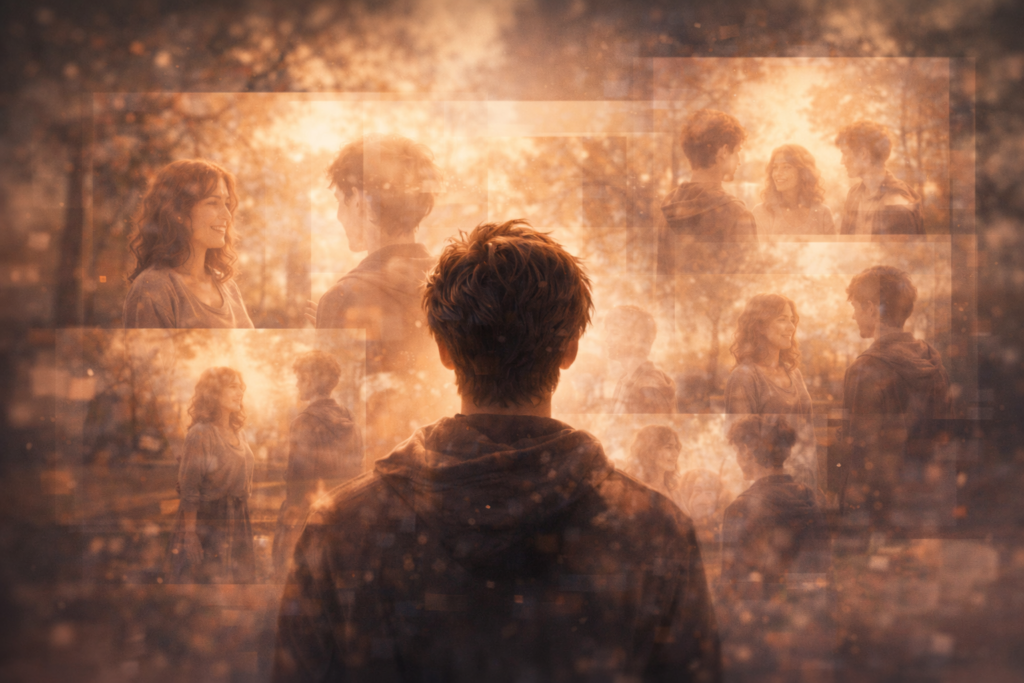
    overlapping reconstructed memories scene

    Scientific research shows that memory does not function like a recording.
    Each time we recall an event, we reconstruct it.

    Emotions, context, and present beliefs reshape the past.

    This explains why two people can remember the same moment differently.
    Memory is not pure truth—it is a narrative continuously rewritten.


    2. Digital Memory: The Externalization of the Self

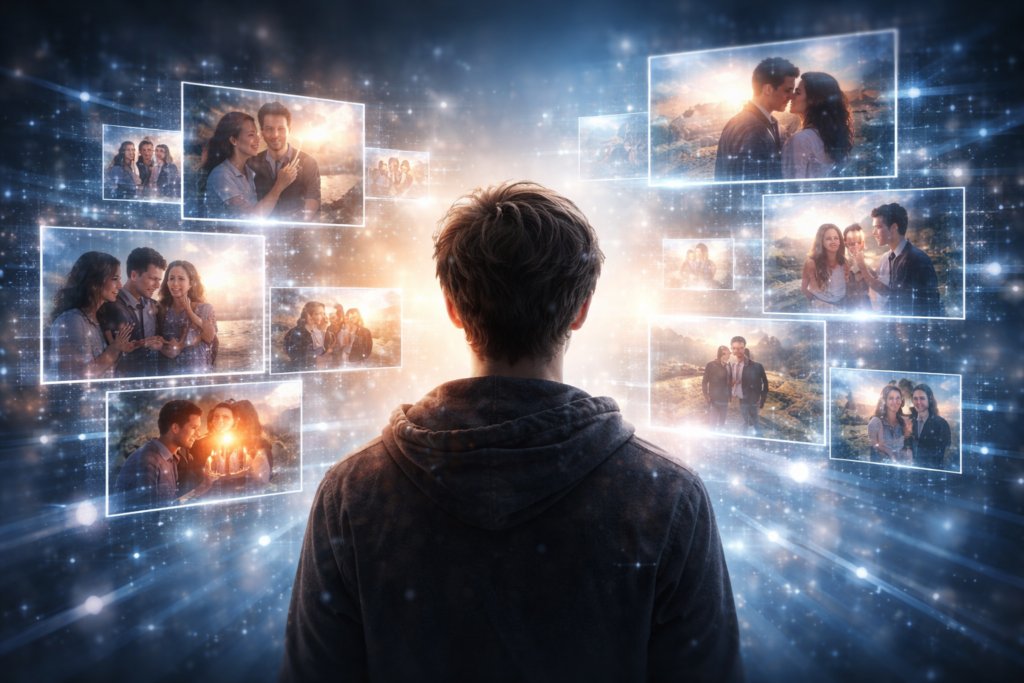
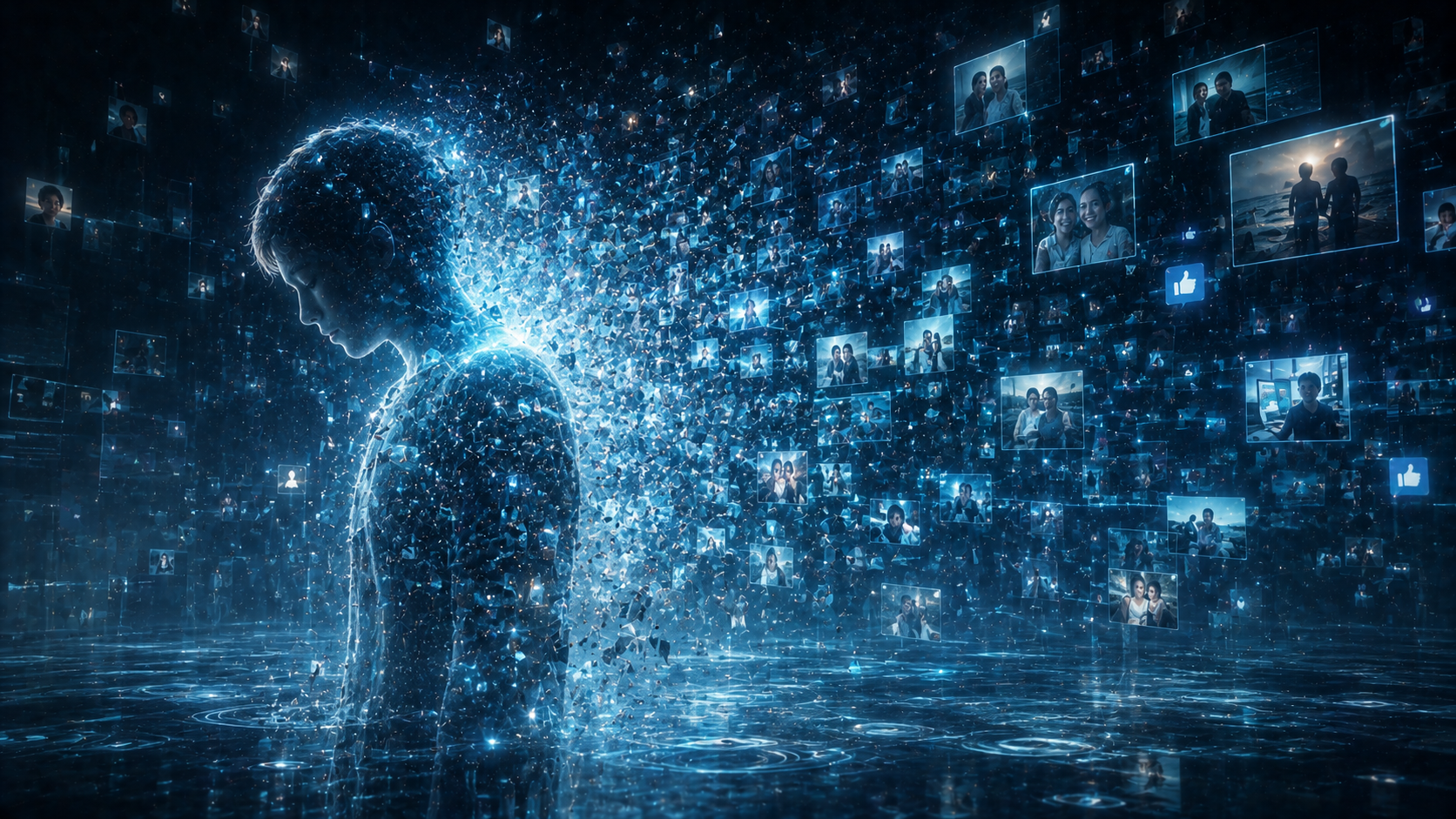
    person viewing digital memories floating

    Today, memory is no longer confined to the brain.

    Photos, messages, and videos stored in digital systems act as extensions of ourselves.
    Yet these memories are not fully under our control.

    Algorithms select what we see. Platforms reshape how we remember.

    Even a simple “memory reminder” can reinterpret the past.


    3. Deepfakes and False Memory

    The rise of AI introduces a more dangerous possibility: fabricated memory.

    Deepfake technology can create events that never happened—
    yet appear completely real.

    If people begin to “remember” things that never occurred,
    truth itself becomes unstable.

    Memory is no longer just personal—it becomes a social vulnerability.

    For example, in several widely discussed cases, manipulated videos have led people to believe events occurred that never actually happened, demonstrating how easily false memories can spread.


    4. Can We Protect Truth?

    Perfect memory may be impossible.
    But we can resist manipulation.

    • Verify sources
    • Practice critical thinking
    • Compare multiple perspectives
    • Demand transparency in AI systems

    Truth may not be absolute—but it must be actively defended.

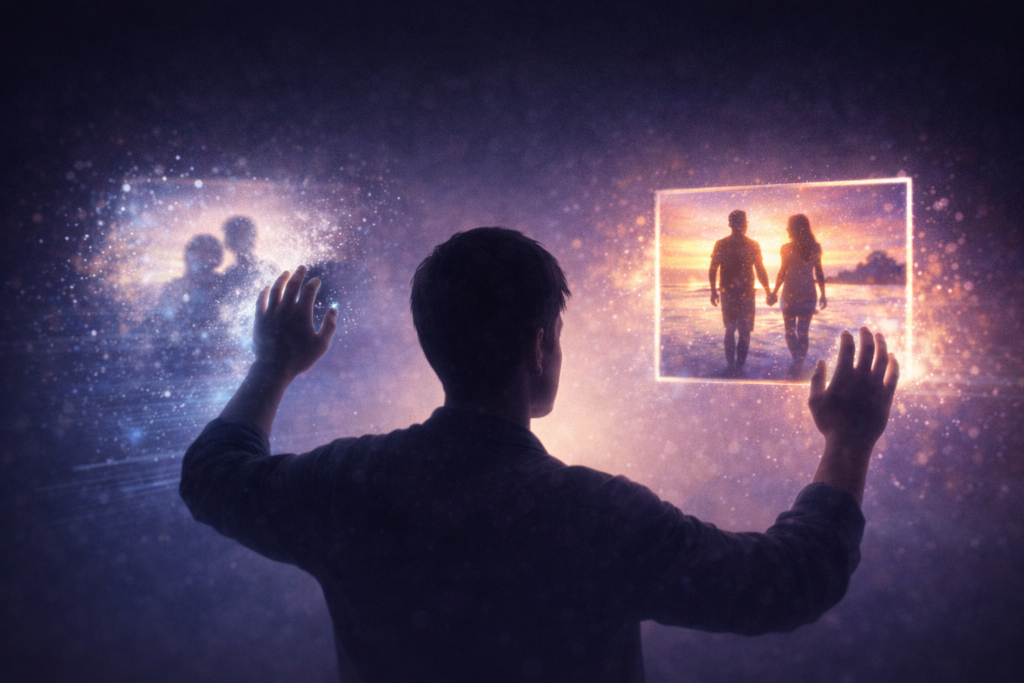
    face morphing deepfake distortion

    Conclusion

    “I saw it.”
    “I remember it clearly.”

    These statements feel certain—but may be fragile.

    Memory can be altered.
    But that does not mean truth disappears.

    It means we must search for it more carefully.

    Memory is not just about the past—
    it shapes the reality we live in.

    And in a world where memory can be manipulated,
    the responsibility to question, verify, and reflect becomes more important than ever.

    A Question for Readers

    Have you ever been absolutely certain about a memory—
    only to later realize it might not have been true?


    Related Reading

    The fragility of memory becomes even more complex when we consider how truth itself is interpreted.
    In Is There a Single Historical Truth—or Many Narratives?, the tension between objectivity and interpretation reveals how collective memory can shape what we accept as reality.

    At the same time, the limits of human judgment are further explored in Why We Excuse Ourselves but Blame Others, where cognitive biases demonstrate how our perception of events—and fairness—is often influenced more by perspective than by objective truth.

    The way we remember and interpret reality is also shaped by the systems we use to search and filter information (see How Search Boxes Shape Thinking).

    If even our memories can be shaped and reconstructed, then the freedom we believe we exercise through choice may also be more fragile than it seems (see Is Freedom an Expansion of Choice — or an Expansion of Anxiety?).


    References

    1. Loftus, E. F. (2005). Planting misinformation in the human mind: A 30-year investigation of the malleability of memory. Learning & Memory, 12(4), 361–366.
      → This study summarizes decades of research on false memory formation, showing how easily external information can alter personal recollection. It provides strong experimental evidence that memory is reconstructive rather than fixed.
    2. Schacter, D. L. (2001). The Seven Sins of Memory: How the Mind Forgets and Remembers. Boston: Houghton Mifflin.
      → Schacter identifies systematic patterns of memory distortion, including misattribution and suggestibility. The book demonstrates that memory errors are not random but structured features of human cognition.
    3. Hirst, W., & Echterhoff, G. (2012). Remembering in conversations: The social sharing and reshaping of memories. Annual Review of Psychology, 63, 55–79.
      → This research explains how memory is socially constructed through communication and interaction. It highlights how collective memory emerges and changes within groups.
    4. Chesney, R., & Citron, D. K. (2019). Deep Fakes: A Looming Challenge for Privacy, Democracy, and National Security. California Law Review, 107, 1753–1819.
      → This paper examines the societal risks of deepfake technology, including its potential to distort public memory and undermine trust in visual evidence.
    5. Vaccari, C., & Chadwick, A. (2020). Deepfakes and Disinformation: Exploring the Impact on Trust in News. Social Media + Society, 6(1), 1–13.
      → This study investigates how manipulated media affects public trust and perception. It shows how deepfakes can contribute to collective false memories and misinformation.
  • Are We Still the Same Person If Our Memories Are Digitized?

    Are We Still the Same Person If Our Memories Are Digitized?

    Memory, Identity, and the Limits of the Self

    Memory is not just data.

    It is the narrative through which we understand who we are,
    the structure that shapes our relationships with the world,
    and the emotional foundation of our identity.

    But what if every memory we have — from the faintest childhood moment to the most recent conversation — could be perfectly digitized, stored, and retrieved at will?

    What if memories could be exchanged, edited, or even erased?

    Would we still be the same person?


    1. Is Memory the Core of Personal Identity?

    personal memories forming human identity narrative

    Philosopher John Locke argued that personal identity is grounded in the continuity of memory.

    According to his “memory theory,” a person remains the same individual as long as they can remember past experiences as their own.

    From this perspective, perfectly digitizing and preserving memory might appear to stabilize identity.

    However, human memory is not designed for perfect preservation.

    It is shaped by forgetting, distortion, and reinterpretation.

    To digitize memory completely is to remove these imperfections —
    and perhaps, in doing so, remove something essential to being human.


    2. Memory Copying and the Multiplication of the Self

    multiple copies of a person representing duplicated identity

    If memory can be fully digitized, it can theoretically be copied.

    Imagine an artificial intelligence that contains all your memories.

    Would that entity be you?

    Or would it be something else — a replica of your narrative without your present consciousness?

    This raises a deeper philosophical question:

    Is personal identity defined by memory alone,
    or does it also require a specific body, perception, and lived experience in the present?

    If multiple entities share identical memories,
    can they all be considered the same person?


    3. Memory Editing and the Transformation of Identity

    If we could remove painful memories or implant artificial ones,
    would that make our lives better?

    Popular culture has explored this idea, most notably in Eternal Sunshine of the Spotless Mind,
    where characters erase memories of love and loss.

    Psychologically, memory is not a passive archive of the past.

    It is an active process that continuously shapes the present self.

    To alter memory is not merely to change the past —
    it is to reconstruct identity itself.

    This suggests a shift from the idea of identity as continuity
    to identity as ongoing reconstruction.


    4. Social and Ethical Implications

    The digitization of memory transforms private experience into data.

    This raises serious concerns about privacy and control.

    If governments or corporations gain access to memory data,
    they could potentially monitor, manipulate, or even rewrite personal identity.

    Furthermore, if memory technologies become commodified,
    they may create new forms of inequality.

    Those with resources could preserve, enhance, or curate their memories,
    while others may be excluded from such possibilities.

    This leads to a troubling scenario:

    a society where memory itself becomes a site of power and inequality.


    Conclusion: Identity Beyond Storage

    person editing memories representing identity transformation

    The digitization of memory is not merely a technological development.
    It is a fundamental challenge to how we define the self.

    If memory becomes data, can identity remain human?

    Perhaps the answer lies in recognizing that memory is not just something we store,
    but something we continuously live through, reinterpret, and sometimes forget.

    Even in a future where memory can be perfectly preserved,
    our humanity may depend on our ability to choose how we remember —
    and how we forget.

    A Question for Readers

    If your memories could be perfectly copied or edited, would you still consider yourself the same person — or would you become someone new?

    Related Reading

    The philosophical tension between memory, identity, and the limits of human completeness is also reflected in Why Do Humans Seek Perfection While Knowing They Are Incomplete?, where the desire to overcome human limitations reveals deeper questions about self-awareness, imperfection, and the nature of being.

    At a more introspective level, the role of memory and personal experience in shaping the self can be further explored in The Psychology of Handwriting, where subtle human expressions—often overlooked in the digital age—offer insight into how identity is continuously formed through embodied and imperfect acts of cognition.


    References

    1. Locke, J. (1690/1975). An Essay Concerning Human Understanding. Oxford University Press.
      → Locke establishes the philosophical foundation of the memory theory of personal identity, arguing that continuity of consciousness defines the self. This work remains central to debates on whether digitized memory could preserve identity.
    2. Parfit, D. (1984). Reasons and Persons. Oxford University Press.
      → Parfit explores complex scenarios involving identity, duplication, and psychological continuity. His arguments challenge the idea of a single, stable self and are crucial for understanding memory copying and identity fragmentation.
    3. Sandel, M. J. (2007). The Case Against Perfection: Ethics in the Age of Genetic Engineering. Harvard University Press.
      → Sandel examines the ethical implications of human enhancement technologies, including those affecting cognition and memory. His work extends to broader concerns about human dignity and the limits of technological intervention.
    4. Roediger, H. L., & McDermott, K. B. (2000). “Tricks of Memory.” Current Directions in Psychological Science, 9(4), 123–127.
      → This study highlights how human memory is inherently reconstructive and prone to distortion. It provides an empirical foundation for questioning whether “perfect” digital memory would fundamentally alter human cognition.
    5. Kurzweil, R. (2005). The Singularity Is Near: When Humans Transcend Biology. Viking Press.
      → Kurzweil discusses the possibility of digitizing human consciousness and memory within the context of technological singularity. His work offers a forward-looking perspective on how identity might evolve alongside technology.

  • The Memory of Receipts – How Everyday Consumption Leaves Social Traces

    Reflections sparked by a discarded piece of paper

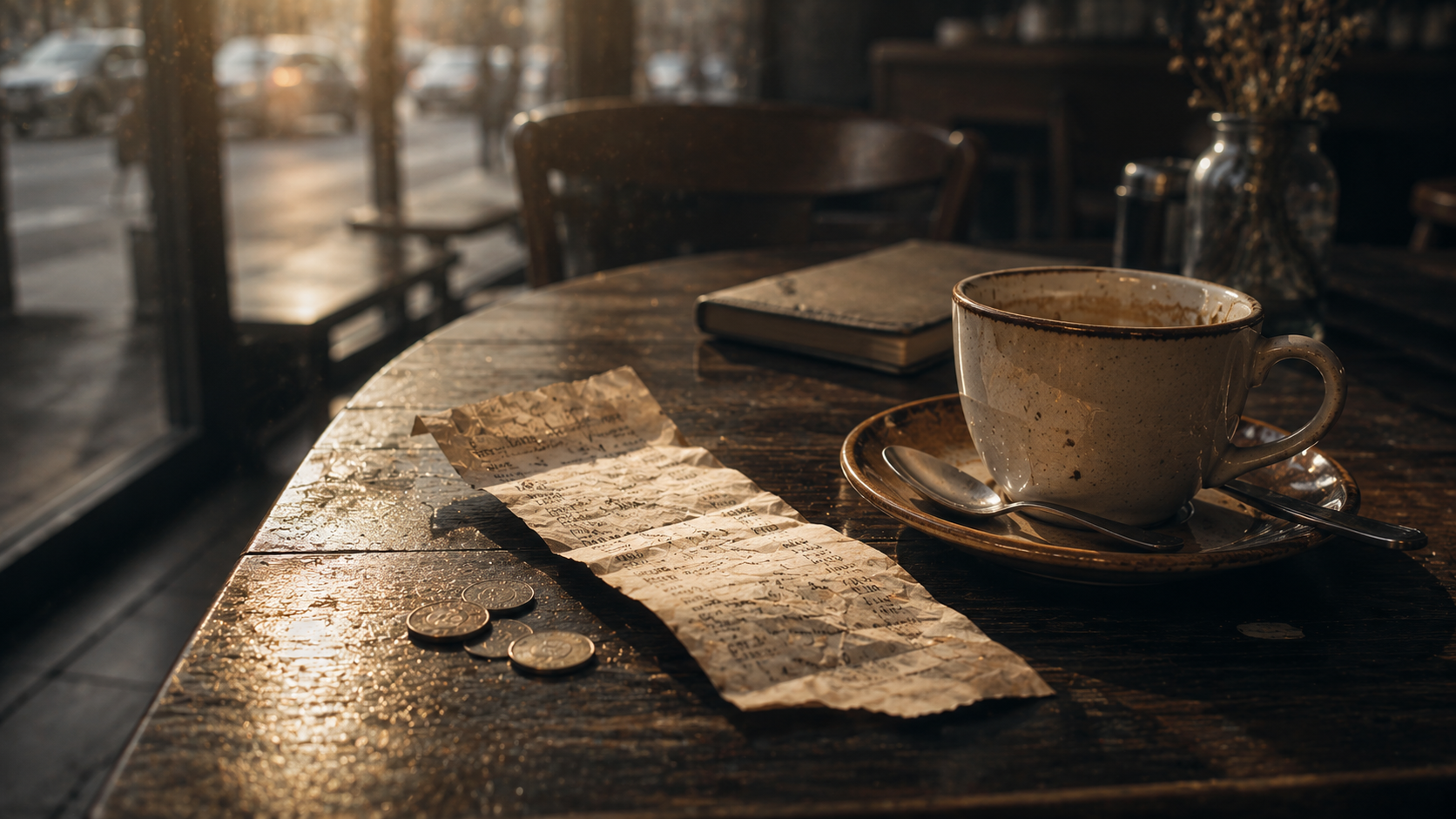
    Faded receipt on a café table capturing a moment of everyday consumption

    A Discarded Receipt, A Social Trace

    A few days ago, while organizing my wallet, I found a receipt from a café I had visited months earlier.
    The text had faded, leaving only fragments — the price of a cup of coffee, the time of payment, part of a familiar card number.

    For a moment, I paused.

    It was just a small piece of paper, yet it quietly preserved where I had been and, in some subtle way, how I had felt at the time. What we casually throw away as receipts are, in fact, traces of a day — and records of society itself.

    A single receipt reflects not only personal consumption, but also the rhythm of a city, the preferences of a generation, and the flow of an economy. In that sense, it becomes a small yet powerful piece of sociological evidence.

    1. A Transparent Society, Recorded Consumption

    Modern society places great value on transparency.
    Card payments, loyalty points, and digital receipts ensure that nearly all consumption is stored, tracked, and analyzed as data.

    This brings convenience — but it also signals the surveillance of memory.

    In the past, spending money meant that the moment disappeared as soon as the transaction ended. Today, we live in a society where every act of consumption remains as a record.

    French philosopher Jean Baudrillard, in The Consumer Society, argued that modern consumption is not merely an economic act but a symbolic one. Receipts function as evidence of this symbolic consumption, revealing our social position, preferences, and psychological desires.

    Even a casually discarded receipt contains traces of the social self — a reminder that individual consumption has become a social signal. What we buy, where we eat, and which brands we choose now speak a language of identity on our behalf.

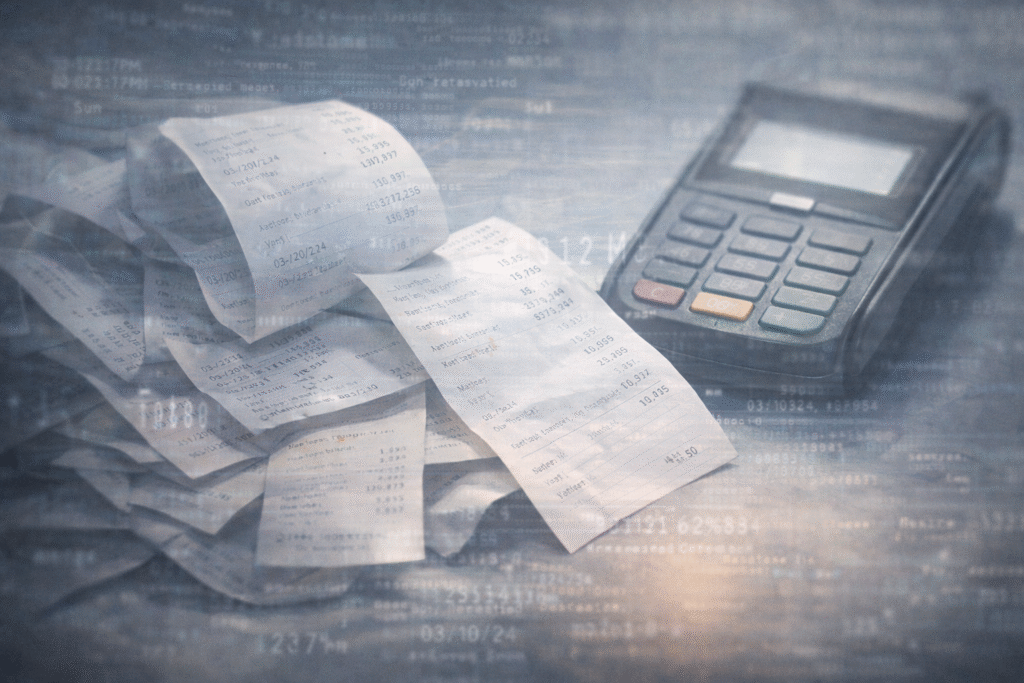
    Discarded receipts symbolizing recorded consumption in a data-driven society

    2. Receipts as Personal Diaries

    Sociologist Zygmunt Bauman described modern individuals as consuming beings. Consumption, in this sense, is not a simple act but a form of self-expression.

    Receipts are the most concrete records of that expression.

    If one were to glance at someone else’s receipt, it would not be difficult to imagine their preferences — what they like to eat, where they spend time, even hints of their mood that day. Beneath the numbers lies far more context than accounting alone can capture.

    A receipt is not just a financial document. It is a fragment of a human story written through consumption.


    3. Discarded Memories, Persistent Traces

    A pile of discarded receipts next to a card reader — a quiet symbol of everyday records being left behind.

    The problem is how easily these fragments of memory are thrown away.

    Receipts piled on café tables or dropped into street-side trash bins reflect a society in which consumption ends in immediate forgetting. When we say, “I don’t need the receipt,” we may unknowingly be erasing a small trace of memory.

    And yet, the data does not disappear.

    While the paper vanishes, the record remains — stored in corporate databases, used for marketing strategies, tax policies, and consumption pattern analysis. The receipt as an object may be gone, but the system remembers.


    4. Conclusion: Receipts and the Shadow of Transparency

    Sociologist Maurice Halbwachs argued that memory is formed within social frameworks. A receipt, then, is not merely a private record of a transaction, but a fragment of collective memory.

    A café receipt from a journey, a purchase made on the day of one’s first paycheck — these small records trace the ways individuals relate to their time and society. Through such fragments, personal experience quietly becomes social history.

    Receipts also symbolize the promise — and the shadow — of a transparent society. Within them coexist convenience and accountability, remembrance and erasure. While the paper itself may disappear, the data it represents continues to circulate, shaping markets, policies, and identities.

    We live between what is easily forgotten and what is endlessly stored. A faded receipt tucked inside a wallet becomes a silent portrait of the self — a social self written through consumption.

    And the numbers printed on that fragile paper ask us, quietly but persistently:

    “For what purpose, and with what state of mind, did you choose to consume?”

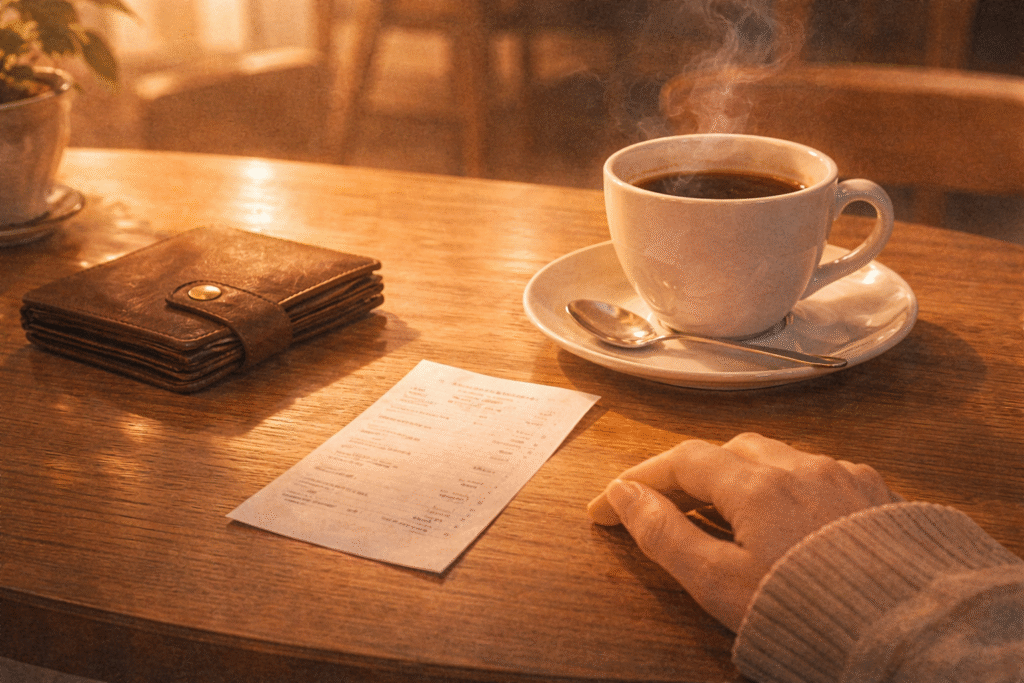
    Hand holding an old receipt inviting reflection on personal consumption

    References

    1. Baudrillard, J. (1970). The Consumer Society. Paris: Gallimard.
      This seminal work interprets modern consumption as a system of signs and symbols. It provides a theoretical foundation for reading receipts not as neutral transaction records but as social texts encoding symbolic meaning.
    2. Halbwachs, M. (1950). The Collective Memory. Paris: Presses Universitaires de France.
      Halbwachs’ concept of collective memory emphasizes that memory is socially constructed. His framework is essential for understanding receipts as social artifacts that extend beyond individual experience.
    3. Hoskins, A. (2011). Digital Memory Studies: Media Pasts in Transition. London: Routledge.
      This work explores how memory is stored, transmitted, and erased in the digital age. It is particularly useful for interpreting the transition from paper receipts to digital records as a process of memory dematerialization.