Tag: digital literacy

  • Digital Aging: When Technology Moves Faster Than We Do

    “Where do I click?”
    “Can you show me again? Everything changed after the update.”
    “Is this a DM or a message?”

    Most of us have said—or heard—something like this at least once.

    Technology keeps accelerating, yet many of us experience a quiet, unsettling feeling:
    even without standing still, we somehow fall behind.

    That moment is often described as digital aging.

    A person hesitating in front of a complex digital interface, symbolizing digital aging

    1. What Is Digital Aging?

    Digital aging refers to the growing difficulty people experience as technology evolves faster than their ability—or willingness—to adapt.

    This is not simply about chronological age.
    It includes:

    • Feeling disoriented when interfaces change overnight
    • Knowing a feature exists but lacking the energy to relearn it
    • Feeling exhausted by constant updates rather than curious about them
    • Interpreting difficulty as personal failure instead of design overload

    Digital aging is less about incapacity and more about cognitive fatigue caused by relentless change.

    Importantly, this phenomenon affects all age groups.
    Many people in their twenties already describe themselves as “falling behind” certain platforms.


    2. Why Does Technology Evolve Without Waiting for Us?

    Technology claims to aim for convenience and efficiency.
    In practice, however, innovation often prioritizes novelty over familiarity.

    Common patterns include:

    • Menus relocating after updates
    • Essential settings buried deeper in interfaces
    • Gestures replacing buttons
    • Voice commands replacing visual cues

    Most digital systems are designed with speed-oriented, highly adaptable users in mind.
    As a result, those who value stability or need more time are unintentionally excluded.

    The message becomes subtle but clear:
    This system was not designed for you.
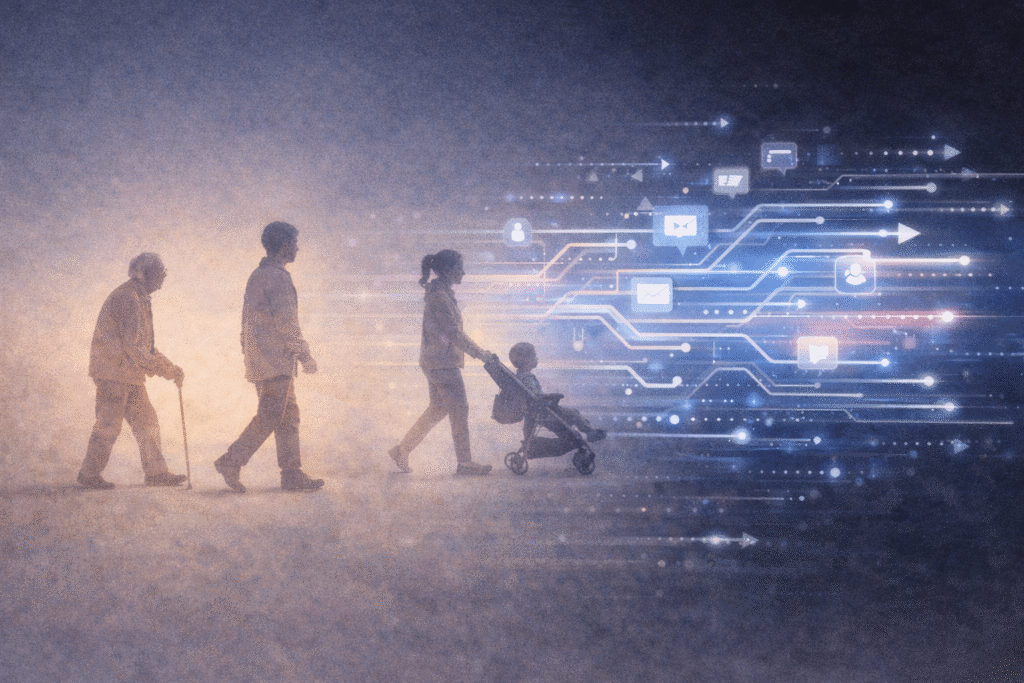
    Technology advancing faster than people, showing the growing digital gap

    3. How Technology Creates New Generational Divides

    Today, generational gaps are shaped less by age and more by technological fluency.

    • Some grew up before the internet
    • Some adapted during its expansion
    • Others have never known a world without smartphones

    Even within the same age group, digital confidence can vary dramatically depending on professional exposure, learning opportunities, and cultural context.

    Technology no longer just reflects generational difference—it produces it.


    4. From Discomfort to Digital Exclusion

    Digital aging becomes socially significant when it leads to exclusion.

    Examples include:

    • Older adults unable to use self-service kiosks
    • People missing invitations because communication moved to unfamiliar platforms
    • Students falling behind due to unfamiliar digital tools
    • Workers struggling with AI-driven systems introduced without support

    Over time, repeated difficulty can erode confidence and create avoidance.

    The psychological barrier often becomes stronger than the technical one.

    Inclusive digital design allowing people of all ages to use technology comfortably

    5. Can Technology Slow Down for Humans?

    There is growing recognition of the need for digital inclusion.

    Encouraging developments include:

    • Simplified device modes
    • Accessibility-focused design standards
    • Larger text and clearer interfaces
    • Digital literacy programs for all ages

    True inclusion, however, requires more than features.
    It requires design that respects human pacing, not just technological capability.

    Progress should not mean leaving people behind.


    Related Reading

    The sense of temporal mismatch between humans and systems is explored philosophically in If AI Can Predict Human Desire, Is Free Will an Illusion?.

    Practical effects of accelerated systems on daily judgment are also examined in Algorithmic Bias: How Recommendation Systems Narrow Our Worldview.

    Conclusion: Falling Behind Is a Shared Experience

    Digital aging is not a personal weakness.
    It is a structural consequence of rapid innovation without sufficient care.

    Everyone experiences moments of falling behind.

    The question is not whether technology advances—but whether it advances with people, not past them.

    You do not need to master every new tool.
    What matters is preserving curiosity without shame and designing systems that value humans as much as efficiency.

    Digital society becomes more humane when it moves at a pace people can actually live with.

    Related Reading

    The exhaustion that follows moral expectation connects to broader reflections on social pressure discussed in The Praise-Driven Society: Recognition and Self-Worth in the Digital Age.

    Similar emotional dynamics in daily life are also explored in How Social Media Amplifies Feelings of Lack and Comparison.

    References

    1. Selwyn, N. (2004). Adult Learning in the Digital Age: Information Technology and the Learning Society. London: Routledge.
    This book examines how adults engage with rapidly evolving digital technologies and highlights structural inequalities in access, skills, and confidence. Selwyn emphasizes that difficulties with technology are not individual failures but socially produced gaps shaped by design, education, and policy. It provides a foundational framework for understanding digital aging beyond chronological age.

    2. Prensky, M. (2001). Digital Natives, Digital Immigrants. On the Horizon, 9(5).
    Prensky introduces the influential distinction between “digital natives” and “digital immigrants,” arguing that generational exposure to technology shapes thinking patterns and learning styles. While widely cited, this work is best read as a starting point for debates on digital generational gaps rather than a definitive explanation.

    3. Bennett, S., Maton, K., & Kervin, L. (2008). The ‘Digital Natives’ Debate: A Critical Review of the Evidence. British Journal of Educational Technology, 39(5), 775–786.
    This critical review challenges the oversimplified native–immigrant divide, showing that digital competence varies widely within age groups. The authors argue that social, educational, and cultural factors matter more than age alone, offering an important corrective perspective for discussions of digital aging and inclusion.
  • The New Inequality of the AI Age: The Rise of Digital Refugees

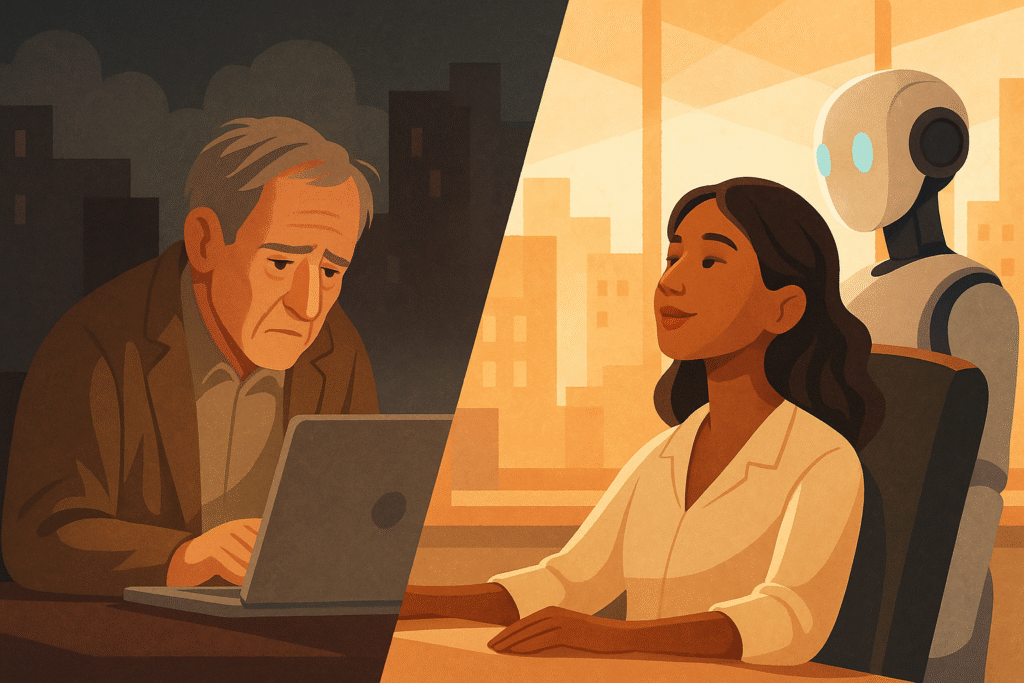
    A visual contrast between connected AI users and people struggling with technology, symbolizing digital inequality.

    Introduction — Those Left Behind in a Connected World

    We now live in a world where AI assistants manage our schedules, banking happens on smartphones, and education unfolds on digital platforms.
    But not everyone can access these tools—or understand how to use them.

    What feels like a simple click for some becomes an insurmountable barrier for others.

    This is where the term “digital refugee” emerges.

    Technology was meant to connect us, but for those excluded from the digital ecosystem, it creates a new form of social isolation and inequality.

    Today, the vulnerable population is no longer defined only as
    “those without internet,”
    but increasingly as
    “those who cannot interact with AI.”


    1. What Are Digital Refugees? — Invisible Migrants of the Information Age

    Digital refugees are not people crossing physical borders.
    They are people pushed to the margins of society because they cannot cross the technological border of the digital world.

    This includes individuals who lack:

    • access to devices
    • stable internet
    • digital literacy
    • the ability to use AI-driven systems

    For example:

    When government services move entirely online, many seniors or low-income citizens struggle with complex application systems. As a result, they become excluded—not legally, but digitally.

    UNESCO defines this as a Digital Access Rights issue, arguing that access to the internet and digital tools is now a fundamental human right.

    This is no longer a matter of convenience but a matter of dignity and civic participation.


    2. Technology’s New Inequality — Who Truly Has the Freedom to Connect?

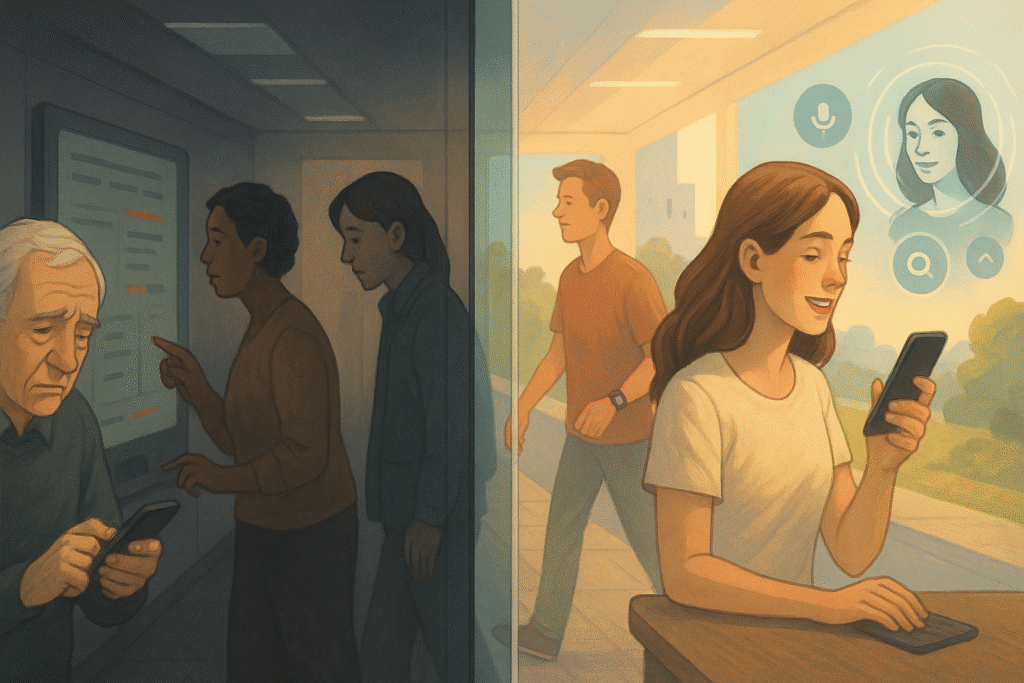
    A contrasting scene showing AI-powered life beside those excluded from technology.

    AI and automation bring efficiency, but they also sort society into new classes:

    • those who understand and utilize digital tools, and
    • those who cannot

    People with advanced digital skills gain better jobs, information, and influence.
    Those without them gradually lose access to healthcare, finance, transportation, and even public voice.

    For someone unfamiliar with smartphones, tasks like medical appointments, transportation schedules, banking, and government forms become overwhelming.

    In such cases, technology stops being a tool and becomes a barrier.

    AI also filters the information we see.
    Low digital literacy increases exposure to narrow or biased content, reinforcing social division and weakening democratic participation.

    Thus, digital inequality is not just economic—it is structural, cultural, and political.


    3. Expanding Human Rights — Technology Access Is Not a Luxury but a Right

    In 2016, the UN Human Rights Council declared internet access a prerequisite for freedom of expression.
    Since then, Digital Access Rights have become central to global human rights discourse.

    This shift demands that states treat digital inclusion as a form of social welfare.

    Some examples:

    • Finland declared broadband access a legal right in 2010.
    • South Korea is expanding digital education for seniors and people with disabilities.

    Yet despite progress, rural communities, low-income citizens, and elderly populations remain cut off from AI-driven services.

    As AI becomes embedded in public policy, education, and healthcare,
    digital literacy becomes a condition for survival, not a privilege.

    People who cannot interact with AI systems risk becoming citizens who exist but cannot participate.


    4. Is Technology a Liberation—or a New Language of Discrimination?

    AI reads text, interprets images, and even writes.
    But behind this intelligence lies:

    • biased data
    • unequal representation
    • structural discrimination

    AI often replicates the inequalities it learns.

    For instance, if AI hiring systems are trained on biased historical data, they reproduce those disparities—reinforcing societal injustice under the illusion of neutrality.

    Thus, digital inequality expands beyond “access” to become a question of design:

    Who is technology built for?
    Whose needs were ignored?
    Who gets left out of the system entirely?

    AI-era human rights must address not only access but also inclusive design.


    5. Conclusion — Does Technology Make Us More Equal?

    Technology can enhance human life—but only if its benefits are shared.

    Digital refugees are not people who “failed to adapt.”
    They are people whom the system failed to include.

    In the AI era, equality requires more than distributing devices.
    It requires rethinking how technologies are built, implemented, and accessed.

    Digital literacy is the new civic education.
    Digital access is the new condition of existence.

    We must ask:

    “Does technology liberate humanity—or does it divide us further?”

    The answer depends not on the machines,
    but on the choices we make as a society.

    📚 References

    1. Gurumurthy, A., & Chami, N. (2020). Digital Justice: Reflections on the Digitalization of Governance and the Rights of Citizens. IT for Change.
    https://itforchange.net
    A foundational work examining how digital governance reshapes citizenship, rights, and power structures.


    2. UNESCO. (2021). Reimagining Our Futures Together: A New Social Contract for Education. UNESCO Publishing.
    https://unesco.org
    A global report proposing a future-oriented educational framework with emphasis on equity, digital access, and social justice.


    3. Selwyn, N. (2016). Education and Technology: Key Issues and Debates. Bloomsbury Publishing.
    https://bloomsbury.com
    A critical analysis of technology’s promises and limits in education, challenging techno-optimism and highlighting structural inequalities.


    4. Couldry, N., & Mejias, U. A. (2019). The Costs of Connection: How Data is Colonizing Human Life and Appropriating It for Capitalism. Stanford University Press.
    https://sup.org
    An influential critique of the data economy arguing that digital systems extract, commodify, and govern human experience.


    5. Eubanks, V. (2018). Automating Inequality: How High-Tech Tools Profile, Police, and Punish the Poor. St. Martin’s Press.
    https://us.macmillan.com
    A groundbreaking investigation into how automated decision systems disproportionately harm marginalized communities.