
The Paradox of Human Liberty
The Double Face of Freedom
Every day, we make countless choices—what to wear, what to study, what to buy, what opinions to express online, and even which news to trust. Modern societies often celebrate this abundance of choice as evidence of freedom. Yet psychologists and philosophers have long suggested that unlimited freedom can also produce anxiety, uncertainty, and an unexpected desire for guidance.
Freedom has long been one of humanity’s most celebrated ideals.
Revolutions have been fought in its name.
Movements for civil rights, democracy, and independence have all been driven by the promise of freedom.
Yet freedom has always carried a hidden tension.
For some, it represents possibility, self-determination, and the chance to shape one’s own life.
For others, freedom brings anxiety, responsibility, and the burden of choosing.
This raises a difficult question:
Do human beings truly desire freedom, or do we secretly fear it?

1. The Philosophical Paradox: Freedom and Anxiety
Sartre and the Burden of Freedom
The existentialist philosopher Jean-Paul Sartre famously claimed that human beings are “condemned to be free.”
For Sartre, freedom is unavoidable.
We cannot escape the responsibility of choosing, and every decision becomes an act through which we define ourselves.
But this freedom is not always liberating.
Because if we are truly free, we must also accept full responsibility for the consequences of our actions.
In this sense, freedom is both possibility and burden.
The Fear of Unrestricted Freedom
Other philosophers approached freedom with caution.
Plato worried that unrestrained freedom could lead to chaos within a political community.
Thomas Hobbes warned that without strong authority, society would collapse into a “war of all against all.”
From this perspective, freedom requires limits in order to preserve social order.
Thus, the philosophical tradition reveals a recurring tension:
freedom is both a cherished value and a potential danger.
2. The Social Dimension: Freedom and Order
Freedom within Rules
Freedom rarely exists in isolation.
Democratic societies aim to protect individual liberty, yet they also establish laws and institutions that restrict certain actions.
Freedom of expression, for example, cannot justify harming others through defamation or incitement.
Similarly, personal freedom must coexist with collective security.
Freedom therefore exists not as absolute independence, but as a negotiated balance between liberty and order.
Unequal Access to Freedom
Another complication is that freedom is rarely distributed equally.
Social class, gender, race, and nationality all influence how much freedom individuals actually experience.
In one society, expressing political opinions may be protected speech.
In another, the same act could result in punishment.
Thus, while freedom is often described as a universal value, its reality is deeply shaped by social and political conditions.
3. The Psychological Dimension: The Burden of Choice
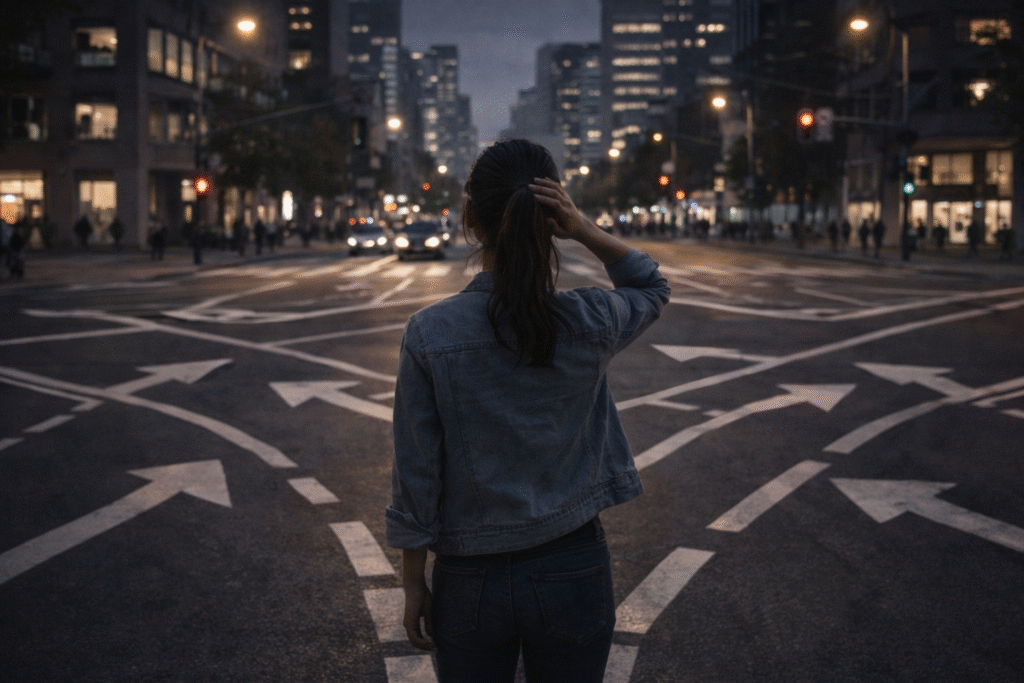
The Paradox of Choice
Psychological research suggests that freedom can sometimes undermine happiness.
Psychologist Barry Schwartz, in The Paradox of Choice, argues that while greater choice appears to expand freedom, excessive choice often increases decision fatigue, regret, and dissatisfaction. Rather than feeling liberated, individuals may become overwhelmed by the pressure to make the “best” possible decision.
More freedom can mean more responsibility — and more potential regret.
The Comfort of Authority
Because freedom brings responsibility and uncertainty, people may sometimes seek security in authority, conformity, or established social structures.
Erich Fromm explored this paradox in Escape from Freedom. He argued that modern freedom can liberate individuals from traditional constraints while also leaving them feeling isolated, uncertain, and burdened by responsibility. Under such conditions, freedom itself can become psychologically difficult to bear.
Rules and institutions can provide stability, while traditions and established communities may offer guidance and a sense of belonging.
The danger begins when the desire for security becomes so strong that people willingly surrender the freedom they once sought.
4. Freedom in the Digital Age

The Expansion of Expression
In the digital age, the question of freedom has become even more complex.
The internet has dramatically expanded freedom of expression, allowing individuals across the world to share ideas instantly.
Yet the same digital platforms have also produced misinformation, online harassment, and new forms of manipulation.
Governments and societies increasingly debate how much regulation is necessary — and how much freedom should remain unrestricted.
Algorithmic Influence
Another challenge comes from the growing influence of algorithms.
Artificial intelligence and data-driven platforms shape what we see, read, and purchase.
In many cases, they subtly guide our decisions.
This raises an unsettling possibility:
Are we still exercising genuine freedom, or are our choices quietly being steered by invisible systems?
Conclusion: Between Desire and Fear
Freedom is never a simple gift.
It is inseparable from responsibility, uncertainty, and the weight of decision.
Some people embrace that burden.
Others seek the safety of rules, traditions, or authority.
Perhaps the truth is that human beings both desire freedom and fear it at the same time.
The real question, then, is not simply whether we possess freedom.
It is whether we are prepared to live with everything that freedom demands.
Perhaps genuine freedom is not the absence of all limits, but the willingness to make responsible choices despite uncertainty. In that sense, freedom is not something we simply possess—it is something we continuously learn to practice.
A Question for Readers
If human beings were given complete freedom without restrictions or guidance, would they truly feel liberated?
Or would unlimited freedom eventually become another form of fear and uncertainty?
Related Reading
The broader debate over freedom and political authority is explored further in Is the State a Guardian of Freedom—or a Leviathan of Control?, which examines whether the state exists primarily to protect individual liberty or whether expanding political power gradually limits the very freedom it claims to defend. This wider perspective provides an essential framework for understanding why human beings often experience both a desire for freedom and a longing for security.
The subtle psychological tension between autonomy and social perception is explored further in Why It Feels Like Everyone Is Watching You: The Spotlight Effect, where the tendency to overestimate how closely others observe us reveals how internal pressure and self-consciousness quietly shape our sense of freedom.
At a broader technological level, the invisible forces shaping modern choice are examined in Algorithmic Bias: How Recommendation Systems Narrow Our Worldview, which explores how digital recommendation systems increasingly influence what we see, think, and ultimately decide. Together, these discussions suggest that the limits of freedom arise not only from governments, but also from psychological expectations and technological environments.
References
1. Fromm, Erich. (1941). Escape from Freedom. New York: Farrar & Rinehart.
In this influential work, Fromm argues that modern individuals often experience freedom as a source of anxiety rather than liberation. Faced with the burden of responsibility, many people seek psychological refuge in authority, conformity, or submission. His analysis reveals the paradox that humans may escape from the very freedom they claim to desire.
2. Berlin, Isaiah. (1969). Two Concepts of Liberty. Oxford: Oxford University Press.
Berlin distinguishes between “negative liberty,” the absence of external constraints, and “positive liberty,” the capacity to be one’s own master. This distinction has become central to modern political philosophy, highlighting how freedom can be understood both as protection from interference and as the realization of self-governance.
3. Mill, John Stuart. (1859). On Liberty. London: John W. Parker & Son.
Mill defends individual liberty as a fundamental condition for human progress and social development. At the same time, he introduces the “harm principle,” arguing that freedom should only be limited to prevent harm to others. His work remains one of the most influential philosophical defenses of liberal freedom.
4. Arendt, Hannah. (1958). The Human Condition. Chicago: University of Chicago Press.
Arendt interprets freedom not simply as independence from constraint but as the capacity for action within a shared public world. For her, genuine freedom emerges when individuals participate in collective life and take responsibility for their actions within the political sphere.
5. Taylor, Charles. (1991). The Ethics of Authenticity. Cambridge, MA: Harvard University Press.
Taylor examines the modern pursuit of authenticity and personal freedom, arguing that contemporary individualism often produces both empowerment and alienation. His work explores how the modern ideal of self-expression can deepen personal meaning while also creating new forms of social and psychological tension.
6. Schwartz, Barry. (2004). The Paradox of Choice: Why More Is Less. New York: Harper Perennial.
Schwartz explains that while modern societies offer unprecedented freedom of choice, excessive options often increase anxiety, regret, and decision fatigue. His work demonstrates that greater freedom does not always lead to greater satisfaction.