
Tag: digital divide

  • The New Inequality of the AI Age: The Rise of Digital Refugees

    The New Inequality of the AI Age: The Rise of Digital Refugees

    1. Those Left Behind in a Connected World

    Artificial intelligence is transforming education, healthcare, finance, and everyday life. Yet as AI becomes more deeply embedded in society, a new form of inequality is emerging—one that separates those who can participate in the AI economy from those who cannot.
    But not everyone can access these tools—or understand how to use them.

    What feels like a simple click for some becomes an insurmountable barrier for others.

    We might describe people facing this new form of exclusion as “digital refugees”—not in the legal sense of refugees, but as a metaphor for those increasingly displaced from essential parts of social life by technological barriers.

    Technology was meant to connect us, but for those excluded from the digital ecosystem, it creates a new form of social isolation and inequality.

    Today, digital vulnerability is no longer defined only by whether people have internet access.
    It increasingly depends on whether they can understand, navigate, and meaningfully use digital and AI-mediated systems.


    2. What Are Digital Refugees? — Invisible Migrants of the Information Age

    Here, “digital refugees” is used as a metaphor rather than a legal or demographic category. It describes people who risk being pushed toward the margins of social life because they face persistent barriers to participating in an increasingly digital society.

    This includes individuals who lack:

    • access to devices
    • stable internet
    • digital literacy
    • the ability to use AI-driven systems

    For example:

    When government services move entirely online, many seniors or low-income citizens struggle with complex application systems. As a result, they become excluded—not legally, but digitally.

    UNESCO has emphasized universal access to information and digital inclusion as essential to inclusive knowledge societies, while also linking meaningful internet access to the realization of rights such as freedom of expression, education, and participation in social and political life.

    This is no longer a matter of convenience but a matter of dignity and civic participation.


    3. Technology’s New Inequality — Who Truly Has the Freedom to Connect?

    AI and automation bring efficiency, but they also sort society into new classes:

    • those who understand and utilize digital tools, and
    • those who cannot

    People with stronger digital skills may gain important advantages in employment, information access, education, and participation.
    Those with limited access or digital skills may face growing difficulties in navigating healthcare, finance, transportation, government services, and public communication.

    For someone unfamiliar with smartphones, tasks like medical appointments, transportation schedules, banking, and government forms become overwhelming.

    In such cases, technology stops being a tool and becomes a barrier.

    Algorithmic systems increasingly influence the information people encounter online.
    Without sufficient digital and media literacy, users may find it more difficult to recognize biased, misleading, or narrowly filtered information—creating additional challenges for informed democratic participation.

    Thus, digital inequality is not just economic—it is structural, cultural, and political.


    4. Expanding Human Rights — Technology Access Is Not a Luxury but a Right

    In 2016, the UN Human Rights Council reaffirmed that the same rights people have offline must also be protected online and emphasized the importance of expanding access to the Internet.
    Some examples:

    • Finland made access to a minimum level of broadband service part of its universal-service framework in 2010, strengthening citizens’ legal entitlement to basic connectivity.
    • Many governments, including South Korea, have introduced programs aimed at improving digital access and literacy among groups that may face greater barriers to digital services.

    Yet despite progress, rural communities, low-income citizens, and elderly populations remain cut off from AI-driven services.

    As AI becomes embedded in public policy, education, and healthcare,
    digital literacy increasingly becomes a condition for meaningful participation in everyday social life, rather than merely an optional skill.

    People who cannot interact with AI systems risk becoming citizens who exist but cannot participate.

    This is why digital inclusion should also be understood as a question of citizenship.

    Citizenship in a digital society requires more than formal political rights. People must be able to access public information, navigate essential services, evaluate digital information critically, and participate in public life through increasingly digital channels.

    From this perspective, digital literacy is not simply technical training. It is becoming part of the civic capacity required to participate meaningfully in contemporary democracy.


    5. Is Technology a Liberation—or a New Language of Discrimination?

    AI reads text, interprets images, and even writes.
    AI systems can reproduce or amplify existing inequalities when biased historical data, unrepresentative datasets, or poorly designed decision-making processes are built into their development and deployment.

    For instance, if an AI-assisted hiring system is trained on biased historical data without adequate safeguards, it may reproduce or amplify existing disparities—reinforcing societal injustice under the illusion of neutrality.

    Thus, digital inequality expands beyond “access” to become a question of design:

    Who is technology built for?
    Whose needs were ignored?
    Who gets left out of the system entirely?

    AI-era human rights must address not only access but also inclusive design.


    Conclusion — Does Technology Make Us More Equal?

    Technology can enhance human life—but only if its benefits are shared.

    People facing digital exclusion should not simply be described as having “failed to adapt.”
    Their exclusion may also reflect how technologies, institutions, and public services were designed and implemented.

    In the AI era, equality requires more than distributing devices.
    It requires rethinking how technologies are built, implemented, and accessed.

    Digital literacy is becoming an essential dimension of civic education.
    Meaningful digital access is increasingly a condition for full participation in social and civic life.

    We must ask:

    “Does technology liberate humanity—or does it divide us further?”

    The answer depends not on the machines,
    but on the choices we make as a society.

    Reader Question

    As AI becomes part of everyday life,
    what responsibilities do societies have toward people who cannot fully access or understand these technologies?

    Related Reading

    Digital inequality is part of a broader question about what meaningful equality requires in modern society. In Social Justice and the Welfare State: How Much Should Governments Reduce Economic Inequality?, we examine how unequal resources and social conditions can limit substantive opportunity even when formal rights are shared equally. The same question becomes increasingly important in the AI age: can citizens participate as equals if access to digital tools, skills, and services remains deeply unequal?

    References

    1. United Nations Human Rights Council. (2016). The Promotion, Protection and Enjoyment of Human Rights on the Internet (A/HRC/RES/32/13). United Nations.
      → The resolution affirms that rights protected offline should also be protected online and emphasizes the importance of expanding access to the Internet, providing an important human-rights foundation for discussions of digital inclusion. United Nations — Human Rights on the Internet
    2. UNESCO. (2021). Recommendation on the Ethics of Artificial Intelligence. Paris: UNESCO.
      → UNESCO emphasizes inclusion, non-discrimination, accessibility, and the protection of human rights in the development and use of AI, providing a global framework for understanding AI inequality. UNESCO — Recommendation on the Ethics of Artificial Intelligence
    3. van Dijk, J. (2020). The Digital Divide. Cambridge: Polity.
      → Van Dijk explains that digital inequality extends beyond physical access to differences in skills, usage, and social outcomes, directly supporting the article’s argument that connectivity alone does not guarantee meaningful participation.
    4. Eubanks, V. (2018). Automating Inequality: How High-Tech Tools Profile, Police, and Punish the Poor. New York: St. Martin’s Press.
      → Eubanks examines how automated public systems can disproportionately affect economically and socially vulnerable populations, illustrating how technological systems can reinforce existing inequalities.
    5. Selwyn, N. (2016). Education and Technology: Key Issues and Debates (2nd ed.). London: Bloomsbury Academic.
      → Selwyn critically examines assumptions that technology automatically produces educational and social progress, emphasizing the importance of access, skills, institutions, and existing inequalities.
  • The Future of Voting: Can Digital Democracy Make Elections More Accessible—and More Secure?

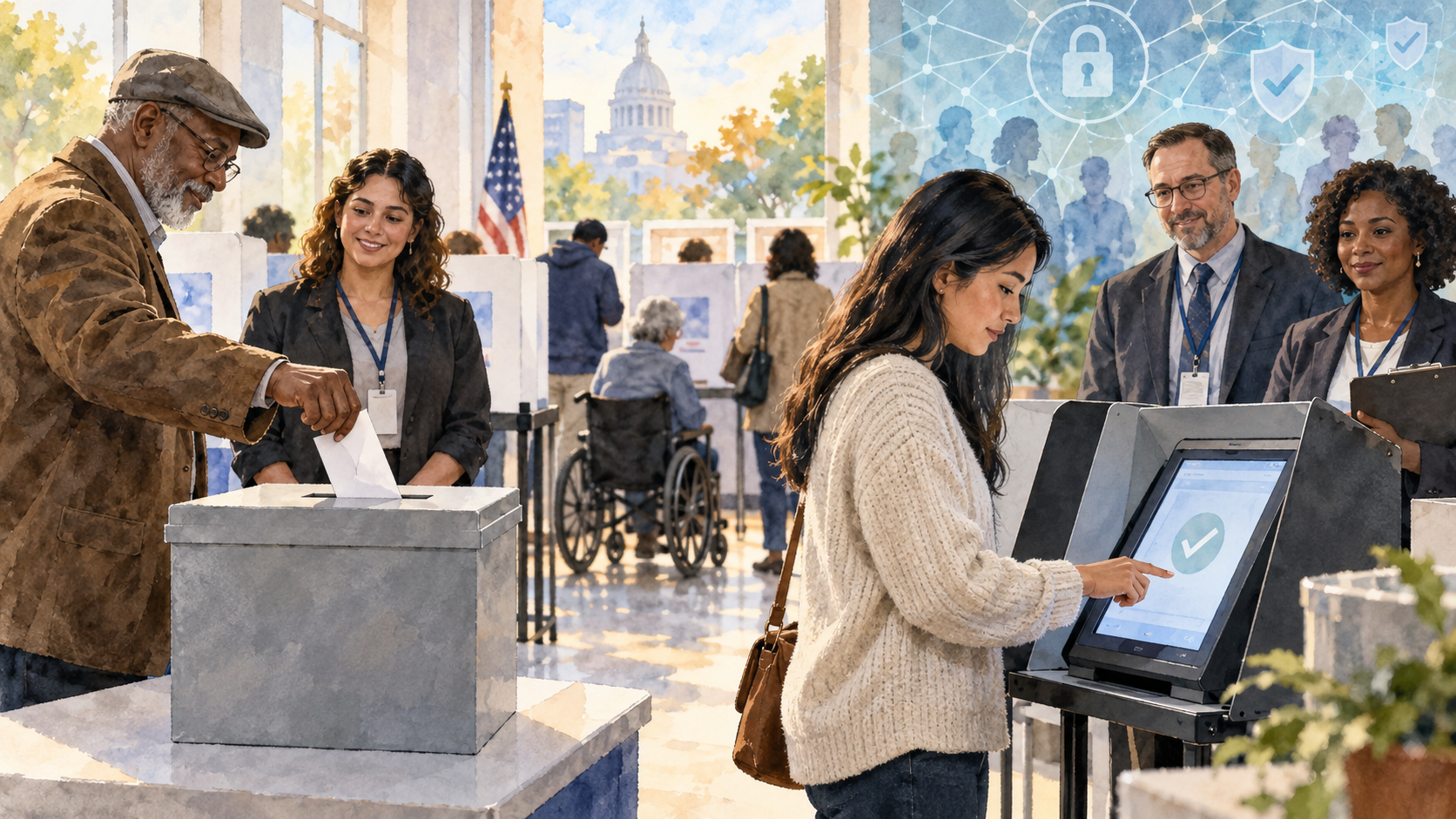
    The Future of Voting: Can Digital Democracy Make Elections More Accessible—and More Secure?

    From Internet Voting to Blockchain, Technology Could Transform Elections—but Democracy Requires More Than Technological Efficiency

    Imagine an election with no polling station.

    There is no line to wait in, no paper ballot to mark, and perhaps no need even to leave home.

    You authenticate your identity on a secure device, select a candidate, submit your vote, and receive confirmation that your ballot has been recorded.

    For citizens living abroad, people with mobility difficulties, or voters far from polling places, the attraction is obvious.

    If we can conduct banking, medical appointments, education, and government services online, why shouldn’t we also be able to vote online?

    This question lies at the center of an emerging debate about digital democracy.

    Internet voting and blockchain-based voting have been proposed as ways to make elections more accessible, efficient, transparent, and verifiable.

    But voting is unlike most online transactions.

    If someone steals money from a bank account, the transaction can potentially be identified and reversed.

    A democratic election must satisfy several requirements simultaneously: the voter must be authenticated, the ballot must remain secret, the vote must be recorded correctly, and the final result must be verifiable—all without creating evidence that allows someone to prove how they voted.

    That makes digital voting an extraordinarily difficult technological and democratic problem.

    The central question is therefore not simply:

    Can we build a digital voting system?

    It is:

    Can we build one that citizens have good reason to trust?


    1. What Is Digital Voting—and Where Does Blockchain Fit In?

    The terms electronic voting, internet voting, and blockchain voting are often used as though they mean the same thing.

    They do not.

    Electronic voting is the broadest category. It can include voting machines located inside supervised polling places.

    Internet voting allows voters to submit ballots remotely through an online system.

    Blockchain voting is a more specific proposal in which distributed-ledger technology is used for some part of recording or verifying election data.

    The appeal of blockchain is understandable.

    Because distributed ledgers are designed to make recorded transactions difficult to alter without detection, advocates have suggested that similar technology could strengthen the integrity or auditability of digital ballots.

    But there is an important distinction:

    protecting a record after it enters a system is not the same as protecting the entire voting process.

    What happens if malware changes a voter’s selection before it reaches the blockchain?

    How do we know that the person using the device is really the voter?

    How do we preserve ballot secrecy?

    What happens if an attacker prevents thousands of voters from connecting?

    How can an ordinary citizen verify a highly technical system?

    The National Academies of Sciences, Engineering, and Medicine has emphasized that putting ballots on a blockchain does not eliminate the vulnerabilities associated with internet voting. Electronic ballots remain dependent on software, devices, networks, and cybersecurity protections.

    Blockchain may therefore become one component of future election technology.

    But it should not be confused with a complete solution to election security.


    2. Why Is Estonia Important to the Future of Online Voting?

    Estonia provides one of the world’s most important real-world examples of nationwide internet voting.

    But an important misconception should be corrected.

    Estonia’s national internet voting system is not simply a blockchain voting system.

    Its official election documentation describes a system using digital identification, encryption, digital signatures, verification mechanisms, and cryptographic key management. Voters can cast ballots online and can verify through a separate application that their vote was received correctly.

    Estonia also provides an interesting democratic safeguard.

    A voter can change an internet vote during the voting period, and a subsequent paper ballot cast at a polling place can override the electronic vote.

    This illustrates an important principle.

    Successful digital democracy depends on much more than one technology.

    It requires digital identity infrastructure, election administration, cybersecurity, legal safeguards, public institutions, voter education, and—perhaps most importantly—institutional trust.

    Estonia therefore teaches us something more interesting than “blockchain can make elections secure.”

    It shows that digital voting is an institutional system, not merely a technological product.


    3. Could Online Voting Make Democracy More Accessible?

    The strongest argument for digital voting may not be blockchain at all.

    It may be access.

    Voting can be difficult for citizens living abroad, people with certain disabilities, individuals living far from polling places, and people whose work or personal circumstances make attending a polling station difficult.

    Remote voting could reduce some of these barriers.

    Convenience might also encourage participation among citizens accustomed to conducting much of their lives digitally.

    But we should be careful about assuming that convenience automatically increases democratic participation.

    People abstain from elections for many reasons.

    Some lack political interest.

    Some distrust institutions.

    Some believe their vote will not matter.

    Others feel poorly represented by available candidates.

    Technology cannot solve all of these problems.

    Making voting easier can remove practical barriers.

    It cannot by itself create political trust or civic engagement.

    This distinction matters because digital democracy should not be measured simply by how quickly a vote can be cast.

    A democracy becomes stronger when citizens have a meaningful and equal opportunity to participate.


    4. Could Digital Voting Create a New Form of Voting Inequality?

    Here lies one of the greatest contradictions of digital democracy.

    A technology designed to increase access could exclude some citizens.

    Reliable internet access is not universal.

    Neither is digital literacy.

    People differ in their ability to use smartphones, computers, authentication systems, passwords, digital certificates, and security applications.

    Age is one factor, but it is not the only one.

    Income, education, disability, infrastructure, language, and previous exposure to technology can all affect digital participation.

    If voting increasingly depends on technological competence, an old democratic inequality could take a new form.

    Historically, voting rights debates asked:

    Who is legally allowed to vote?

    Digital democracy adds another question:

    Who can actually use the system through which voting takes place?

    This distinction is fundamental.

    A right that formally belongs to everyone may not be an equal right in practice if exercising it requires resources or skills that are unequally distributed.

    For this reason, digital voting should not automatically mean the disappearance of traditional voting methods.

    Maintaining accessible alternatives may itself become a democratic safeguard.


    5. Is Online Voting Secure Enough for National Elections?

    This is where optimism about digital voting encounters its hardest challenge.

    Remote internet voting creates risks that do not disappear simply because the central election system is well designed.

    A voter’s personal computer or smartphone can be compromised.

    Communication networks can be attacked.

    Authentication credentials can be stolen.

    Systems can face denial-of-service attacks.

    And unlike an attack on one physical ballot, a successful cyberattack can potentially affect large numbers of voters very quickly.

    U.S. cybersecurity guidance has characterized electronic ballot return as high risk, particularly because attacks can potentially affect ballot integrity, voter privacy, and system availability at scale.

    There is another democratic problem.

    Elections do not merely have to be secure.

    Citizens must be able to trust that they are secure.

    Imagine an election decided by 0.2 percent of the vote.

    One candidate claims that malicious software altered thousands of digital ballots.

    Election authorities respond that cryptographic verification proves the result is correct.

    How many citizens can independently understand the proof?

    This creates what might be called a trust paradox.

    A technologically sophisticated election system may be highly secure in some respects while becoming more difficult for ordinary citizens to understand.

    Democratic legitimacy therefore requires not only technical security but publicly comprehensible verification and accountability.


    6. What Can We Learn From Switzerland’s Cautious Approach?

    Switzerland provides another useful example—but again, the original 2024 description needs updating.

    Switzerland has conducted hundreds of e-voting trials rather than simply adopting blockchain voting nationwide. Its official policy follows the principle of “security before speed.”

    As of 2026, several cantons are conducting limited e-voting trials using the Swiss Post system with complete verifiability. The systems are subject to independent examination, publication requirements, public scrutiny, and a permanent bug-bounty process.

    In June 2026, Switzerland also authorized Lucerne to resume limited e-voting trials, with the authorization extending to a restricted electorate rather than the entire population.

    The Swiss example therefore offers an important lesson.

    Technological innovation in elections does not have to follow the Silicon Valley model of:

    launch first, improve later.

    Elections are different.

    If a social-media application fails, users may be inconvenienced.

    If an election system fails, political legitimacy itself can be damaged.

    For democratic infrastructure, caution may not represent resistance to innovation.

    It may represent responsible innovation.


    7. Is the Future of Voting Really About Blockchain?

    Probably not.

    At least, not primarily.

    Blockchain attracts attention because it offers an appealing technological story: decentralization, transparency, immutability, and resistance to manipulation.

    But democratic elections require much more.

    Democratic elections require much more than secure technology. They must ensure equal access, ballot secrecy, reliable verification, and public trust.

    These principles depend not only on software but also on strong institutions, effective cybersecurity, transparent auditing, and public accountability.

    No single technology can guarantee all of these simultaneously.

    The National Academies has argued that no known technology currently guarantees the secrecy, security, and verifiability necessary for returning marked ballots over the internet and has emphasized the continuing importance of human-readable paper records and auditing.

    This does not mean digital voting will never become sufficiently trustworthy.

    Cryptographic methods, end-to-end verifiability, digital identity systems, cybersecurity, and auditing techniques will continue to develop.

    But the future of voting should not be determined by asking:

    What is the newest technology available?

    The better question is:

    What combination of technologies and institutions best protects democratic rights?


    Conclusion: Voting Is a Right Before It Is a Technology

    Digital voting could make elections easier for millions of people.

    It could help citizens living abroad.

    It could improve accessibility for some voters with disabilities.

    It might eventually provide new methods of verification and make election administration more efficient.

    These possibilities deserve serious exploration.

    But voting is fundamentally different from online shopping, banking, or social media.

    A vote is an exercise of political equality.

    From the perspective of citizenship education, that distinction is crucial.

    The purpose of an election system is not simply to process the greatest number of ballots at the lowest cost or highest speed.

    It is to ensure that each citizen can participate equally, privately, securely, and with justified confidence that every legitimate vote will be counted correctly.

    That is why the digital divide is not merely a technology problem when it affects elections.

    It becomes a voting-rights problem.

    And cybersecurity is not merely an engineering problem.

    It becomes a democratic legitimacy problem.

    The future may well include more digital forms of voting. Estonia demonstrates that nationwide internet voting is possible under particular institutional conditions, while Switzerland demonstrates the value of gradual experimentation and rigorous scrutiny.

    But perhaps the greatest mistake would be to believe that making voting more technologically advanced automatically makes democracy more advanced.

    The ultimate standard should remain much older and simpler:

    Does the system allow every citizen to exercise an equal vote—and give citizens good reason to trust the result?

    Reader Question

    Online voting could make elections more convenient and accessible, but even a technically sophisticated system may create new risks to security, equality, and public trust.

    Would you feel comfortable casting your vote online in a national election—or would you still trust a paper ballot more?

    Related Reading

    Making voting available online does not mean that everyone can participate on equal terms. Access to devices, confidence with digital tools, and the availability of support can shape who benefits—and who struggles to take part. In The Digital Generation Gap: Is Technology Bringing Generations Together—or Driving Them Apart?, we examine how technological change affects different generations and why digital inclusion requires more than providing access to technology.

    References

    1. National Academies of Sciences, Engineering, and Medicine. (2018). Securing the Vote: Protecting American Democracy. The National Academies Press.

    This major report examines the security and integrity of election technologies, including internet voting. It emphasizes that blockchain does not eliminate the fundamental security risks of transmitting marked ballots over the internet and highlights the importance of auditable, human-readable records in trustworthy elections.

    2. Estonian National Electoral Committee. (n.d.). Internet Voting in Estonia.

    Estonia provides one of the world’s most important examples of nationwide internet voting. Its system relies on digital identification, encryption, digital signatures, verification procedures, and institutional safeguards, demonstrating that successful digital voting depends on an entire technological and administrative ecosystem rather than blockchain alone.

    3. Swiss Federal Chancellery. (2026). E-Voting.

    Switzerland has pursued e-voting through controlled trials, independent examination, verifiability requirements, and gradual authorization rather than immediate nationwide implementation. Its “security before speed” approach illustrates how democratic institutions can experiment with digital voting while treating election integrity and public trust as higher priorities than rapid technological adoption.

    4. Cybersecurity and Infrastructure Security Agency. (2020). Risk Management for Electronic Ballot Delivery, Marking, and Return.

    This guidance examines cybersecurity risks associated with electronic ballot systems, particularly remote electronic ballot return. It is relevant to the article’s discussion of compromised personal devices, network attacks, ballot secrecy, system availability, and the potentially large-scale consequences of cyberattacks on elections.

    5. Council of Europe. (2017). Recommendation CM/Rec(2017)5 of the Committee of Ministers to Member States on Standards for E-Voting.

    The Council of Europe sets out principles for electronic voting that connect technological design with universal suffrage, equal voting rights, free elections, secrecy, transparency, accountability, and reliability. It reinforces the article’s central argument that digital voting must be evaluated according to democratic standards, not technological efficiency alone.

  • The Digital Generation Gap: Is Technology Bringing Generations Together—or Driving Them Apart?

    The Digital Generation Gap: Is Technology Bringing Generations Together—or Driving Them Apart?

    How Smartphones, Social Media, AI, and Changing Values Are Reshaping Relationships Between Generations

    Every generation grows up with different technologies.

    For one generation, television may once have represented a revolutionary new medium. For another, personal computers transformed work and education. Younger generations have grown up with smartphones, social media, streaming services, and increasingly artificial intelligence as ordinary parts of everyday life.

    Technology itself is not new.

    What may be different today is the speed of change.

    Digital tools can transform communication, education, work, shopping, banking, entertainment, and even relationships within only a few years. People who adapt quickly may experience these changes as greater freedom and convenience. Others may feel that familiar ways of living are disappearing faster than they can adjust.

    This creates more than a technological divide.

    It can create differences in values, communication, trust, privacy, learning, and even perceptions of what constitutes a normal life.

    But is technology really dividing generations?

    Or can the same technologies that create misunderstanding also become tools for bringing generations closer together?


    1. What Is the Digital Generation Gap?

    Age Matters—but It Is Not the Whole Story

    The digital generation gap refers broadly to differences between generations in their access to, familiarity with, and attitudes toward digital technology.

    Younger people who have used digital devices from an early age may move naturally between messaging apps, social media, online video, cloud services, digital payments, and AI tools.

    Older adults may have learned many of these technologies later in life.

    But it would be misleading to divide society neatly into “digital young people” and “non-digital older people.”

    Many older adults are highly proficient with technology, while some younger people lack advanced digital skills. Income, education, occupation, disability, infrastructure, and previous exposure to technology can be as important as age.

    The deeper divide is therefore not simply about who owns a smartphone.

    It concerns who can confidently use digital systems to participate in society.

    As banking, government services, healthcare appointments, transportation, shopping, and communication move online, limited digital skills can become a form of social disadvantage.

    What begins as a technological gap can therefore become an opportunity gap.


    2. Does Technology Create Different Values Between Generations?

    Privacy, Convenience, and Different Ideas About Normal Life

    Generational differences become more complicated when technology begins to influence values.

    Consider privacy.

    Some people are comfortable sharing photographs, locations, personal opinions, and everyday experiences online. Others regard the same behavior as unnecessarily exposing private life.

    Neither attitude can be explained entirely by age.

    But generations that encountered social media at different stages of life may develop different assumptions about what should remain private and what can appropriately become public.

    Similar differences appear around convenience.

    A younger person may wonder why anyone would visit a bank when a transaction can be completed on a phone.

    An older person may wonder why an important financial decision should be entrusted to an interface with no human being present.

    One sees efficiency.

    The other may see the disappearance of human contact and an additional security risk.

    The disagreement is therefore not always about whether someone understands the technology.

    Sometimes it reflects different ideas about trust, safety, relationships, and the kind of society people want to live in.


    3. Is Social Media Changing Family Relationships?

    Connected to Everyone—and Sometimes Distant from the Person Beside Us

    Few situations illustrate the generation gap more clearly than a family gathering where several people are looking at their phones.

    An older family member may interpret this as disengagement:

    Why are you talking to people online when your family is sitting beside you?

    A younger person may experience the same behavior differently.

    The smartphone may be maintaining friendships, coordinating work, participating in a group conversation, sharing photographs, or responding to people who are also important parts of their social world.

    Digital communication has changed what it means to be “together.”

    Physical presence no longer guarantees attention, while physical distance no longer necessarily means social separation.

    This creates a genuine tension.

    Online networks can maintain relationships across cities and countries, allowing grandparents to see grandchildren, migrants to remain connected with families, and friends to sustain relationships over long distances.

    At the same time, constant digital connection can compete with face-to-face attention.

    The important question may therefore not be whether online relationships are real.

    They clearly can be.

    The question is whether we are learning to manage different forms of connection without allowing one to continually displace the other.


    4. Is Digital Learning Creating a New Educational Divide?

    Education provides another revealing example.

    Digital technology has dramatically expanded access to information. Students can watch lectures, search academic resources, collaborate online, learn languages, conduct simulations, and increasingly use AI to explain difficult concepts or assist with writing and research.

    This can make learning more flexible and individualized.

    But access to information is not the same as education.

    Students still need to evaluate sources, distinguish evidence from misinformation, develop sustained attention, formulate their own questions, and understand rather than merely retrieve answers.

    This becomes especially important in the age of generative AI.

    Older educators may sometimes distrust AI because they see the danger of dependency, plagiarism, superficial learning, or declining independent thought.

    Younger learners may see the same technology as an ordinary intellectual tool.

    Both concerns deserve attention.

    From an educational perspective, the goal should not be to decide which generation understands learning better. Education has always involved both preserving valuable knowledge and adapting to new ways of acquiring it.

    Intergenerational learning can therefore work in both directions.

    Younger people may help older generations understand new technologies.

    Older generations can contribute experience, historical perspective, judgment, and forms of knowledge that cannot simply be downloaded.

    A digitally mature society should not ask only:

    How can older people catch up with younger people?

    It should also ask:

    What can generations teach one another?


    5. Will AI Make the Generation Gap Even Wider?

    Artificial intelligence may become the next major test.

    Generative AI is increasingly influencing writing, information search, education, translation, programming, creative work, and professional decision-making.

    People who learn to use these systems effectively may gain significant advantages.

    Those who do not may find themselves increasingly dependent on others in workplaces and institutions redesigned around AI-assisted processes.

    This resembles earlier digital divides—but potentially at greater speed.

    At the same time, familiarity does not automatically equal wisdom.

    A person who can use an AI system quickly may not necessarily understand its limitations, biases, privacy implications, or tendency to produce confident but inaccurate information.

    Older adults may lack familiarity with some AI tools while possessing professional or life experience that helps them recognize when an answer does not make sense.

    The emerging divide may therefore not simply be between AI users and non-users.

    It may be between people who can use AI critically and those who cannot.

    That is a challenge for every generation.


    6. Should Society Adapt to Technology—or Should Technology Adapt to People?

    This may be the most important question behind the digital generation gap.

    When a government service becomes online-only, efficiency may improve for millions of users.

    But what happens to people who cannot navigate the system?

    When restaurants replace menus with QR codes, banks close physical branches, and customer service becomes automated, technological convenience for the majority can create difficulty for a minority.

    Should everyone simply be expected to adapt?

    There is a strong argument that digital literacy has become an essential modern skill. Societies cannot preserve every older system simply because technological change is uncomfortable.

    But technological progress should not automatically mean eliminating alternatives before people can make the transition.

    A genuinely inclusive digital society needs accessible design, digital education, human assistance, and reasonable alternatives for people who cannot easily use new systems.

    The goal should not be to stop innovation.

    It should be to ensure that innovation does not become exclusion.


    Conclusion: The Generation Gap Is Not Just About Technology

    The digital generation gap is often described as a conflict between young people who embrace technology and older people who resist it.

    Reality is far more complicated.

    The disagreement is partly about skills, but it is also about values.

    It concerns privacy and openness, speed and patience, convenience and human contact, innovation and continuity.

    And increasingly, it concerns who can participate fully in a society whose institutions are becoming digital by default.

    The solution is therefore not simply to teach older generations how to use smartphones or AI.

    Nor is it to tell younger generations that older ways of communicating and learning were inherently better.

    A healthier approach is intergenerational exchange.

    Younger generations can share digital knowledge without assuming that technological fluency makes them wiser in every respect. Older generations can question technological change without assuming that unfamiliarity makes new forms of communication or learning inferior.

    Technology will continue to change.

    Every generation will eventually encounter innovations developed by people younger than themselves.

    So perhaps the digital generation gap contains a lesson larger than technology itself:

    Can generations learn from one another without requiring either the past or the future to win?

    Reader Question

    Digital technology can make life faster, easier, and more connected, but people of different generations do not always experience those changes in the same way.

    When technological progress leaves some generations struggling to participate, who should adapt—the individual to the technology, or the technology to the needs of different generations?

    Related Reading

    Education is one setting where differences in digital confidence and access become especially important. In Can AI Replace Human Teachers? Why Human Interaction Still Matters in the Classroom, we examine why technological support does not remove the need for human judgment, relationships, and guidance. Read alongside the discussion of generational differences, it raises a shared question: how can learning environments help people use new technologies without leaving those who need more support behind?

    References

    1. OECD. (2025). Trends Shaping Education 2025. OECD Publishing.

    This report examines major technological, demographic, social, and economic changes affecting education and society. It is particularly relevant to understanding how digital transformation and artificial intelligence are changing learning across generations and why digital competence has become increasingly important.

    2. International Telecommunication Union. (2024). Measuring Digital Development: Facts and Figures 2024. ITU.

    The ITU provides global data on internet connectivity and digital access across different populations and regions. The report demonstrates that the digital divide is shaped not only by age but also by factors such as income, geography, infrastructure, and socioeconomic conditions.

    3. United Nations Department of Economic and Social Affairs. (2023). World Social Report 2023: Leaving No One Behind in an Ageing World. United Nations.

    This report examines the social consequences of global population ageing and the challenges older adults face in rapidly changing societies. It provides useful context for understanding why digital inclusion is becoming increasingly important as essential services and social participation move online.

    4. UNESCO. (2023). Global Education Monitoring Report 2023: Technology in Education—A Tool on Whose Terms? UNESCO.

    UNESCO examines both the opportunities and risks associated with the growing use of technology in education. The report supports the article’s argument that access to digital tools alone does not guarantee better learning and that technology should serve educational needs rather than determine them.

    5. World Health Organization. (2021). Global Report on Ageism. World Health Organization.

    This report examines age-based stereotypes and discrimination across societies. It is relevant to the digital generation gap because assumptions that all older adults are technologically incapable—or that younger people are automatically digitally competent—can reinforce misleading generational stereotypes.