Tag: digital culture

  • Where Is the Boundary Between Professionalism and Amateurism?

    Where Is the Boundary Between Professionalism and Amateurism?

    When Hobbies Become Work, and Passion Becomes Responsibility

    A person who enjoys photography uploads beautiful landscape images to social media and receives praise from friends and followers. Over time, people begin hearing a new kind of request:

    “Could you photograph my wedding?”

    At that moment, a hobby quietly begins crossing into professional territory.

    What was once personal enjoyment suddenly carries responsibility, expectation, and risk. A wedding is not simply another casual photo session. It is a once-in-a-lifetime memory. If the photographer lacks experience, technical skill, or emotional judgment, disappointment may follow.

    This is where an important social question emerges:

    When does a passionate amateur become a professional? And should every hobby eventually pursue professional standards?

    In the digital age, where platforms like YouTube, Instagram, TikTok, and online marketplaces allow almost anyone to share creative work publicly, the boundary between hobby and profession has become increasingly blurred. This transformation is changing not only creative industries, but also society’s understanding of expertise itself.


    1. When Does a Hobby Become More Than a Hobby?

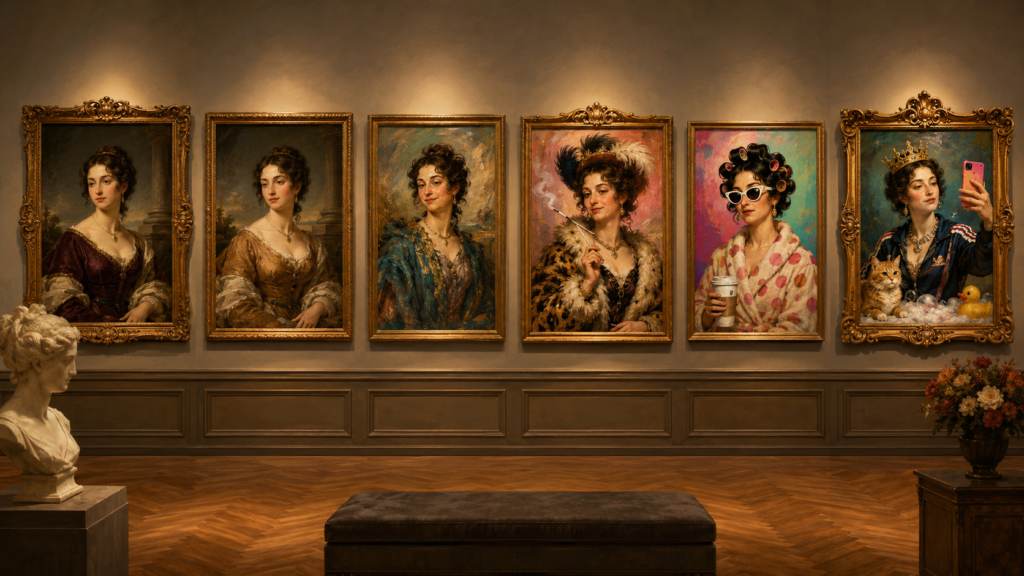
    amateur photographer enjoying creative hobby

    Passion and Personal Identity

    For some people, hobbies remain simple forms of relaxation. Painting, cooking, writing, gaming, photography, or music may exist purely for enjoyment and self-expression.

    For others, however, hobbies gradually become serious personal pursuits. A casual interest can evolve into deep commitment, skill development, and even professional ambition.

    A person who enjoys cooking at home may eventually wonder:
    “Could I open a restaurant someday?”

    A gamer may begin livestreaming professionally. A hobby musician may upload original songs online and attract thousands of listeners. A writer posting stories online may eventually receive publishing offers.

    The modern digital environment encourages this transition by making creative exposure easier than ever before.

    The Pressure to Monetize Passion

    At the same time, modern society increasingly pressures people to monetize their hobbies.

    Social media culture constantly promotes the idea that:

    • passion should become productivity
    • creativity should become income
    • hobbies should become side businesses

    As a result, some people begin feeling that “simply enjoying” a hobby is no longer enough.

    This creates a psychological tension:
    Should hobbies remain spaces of freedom, or should they become opportunities for professional success?


    2. What Separates Professionals from Amateurs?

    Responsibility and Economic Pressure

    One major difference between amateurs and professionals involves responsibility.

    Amateurs usually create for personal enjoyment, curiosity, or emotional satisfaction. Their activities are not necessarily tied to financial survival.

    Professionals, however, must maintain consistent quality because clients, audiences, or employers depend on their work.

    A wedding photographer cannot simply “experiment” freely in the same way a hobby photographer might. A professional chef cannot casually fail during restaurant service. Expertise becomes tied to accountability.

    This economic pressure fundamentally changes the nature of creative activity.

    Trust and Standards

    Another important distinction involves trust.

    Professionals are expected to:

    • meet technical standards
    • deliver reliable results
    • handle pressure consistently

    Amateurs often possess greater freedom to experiment creatively because mistakes carry fewer consequences.

    Ironically, however, amateurs sometimes introduce innovation precisely because they are less constrained by professional norms.

    Historically, many creative revolutions began outside institutional systems. Independent filmmakers, online creators, self-taught artists, and amateur musicians have often challenged traditional industries by approaching creativity differently.

    This is why the relationship between professionals and amateurs is often both cooperative and competitive.


    3. Conflict Between Traditional Experts and New Creators

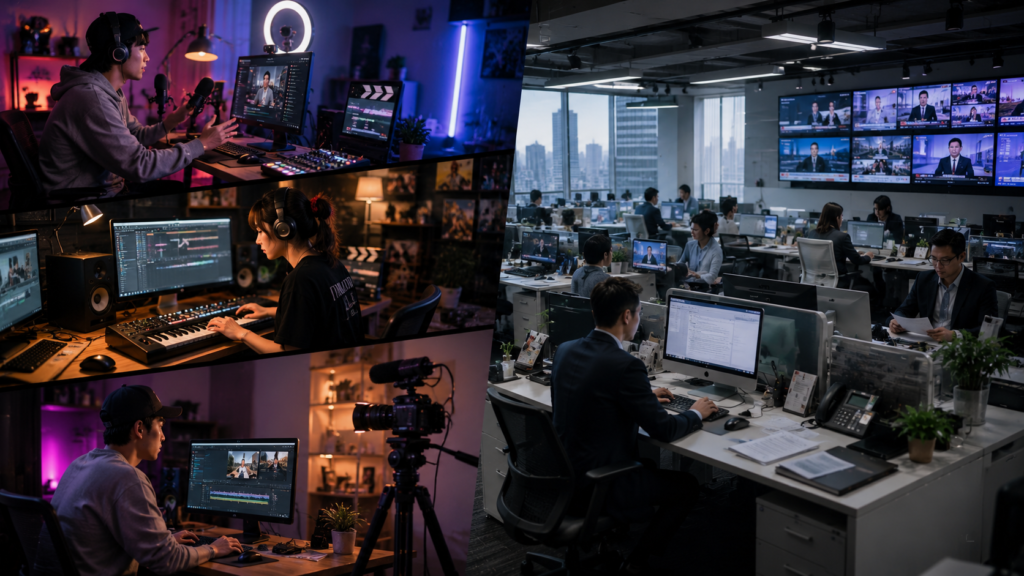
    digital creators challenging traditional industries

    YouTubers and Traditional Journalism

    One of the clearest examples appears in media.

    In the past, news production was dominated by trained journalists working within established institutions. Today, independent creators can produce commentary, interviews, documentaries, and live broadcasts using only smartphones and online platforms.

    Traditional journalists sometimes criticize this shift by arguing that untrained creators may spread misinformation or weaken professional standards.

    Independent creators respond differently. They argue that digital platforms democratize communication and allow more diverse voices to participate in public discussion.

    This conflict reflects a larger social question:

    Should expertise belong only to formally trained professionals, or can digital participation create new forms of legitimacy?

    Independent Artists and Platform Culture

    Music provides another example.

    In previous decades, musicians often needed record labels and industry approval to reach audiences. Today, artists can independently upload songs to streaming platforms and build global fanbases without traditional gatekeepers.

    Some professionals welcome this openness. Others worry that unlimited accessibility lowers artistic standards and creates oversaturated markets.

    At the same time, audiences themselves increasingly value authenticity over institutional prestige. Many people now prefer independent creators precisely because they feel more personal, experimental, and emotionally honest.

    The rise of amateur creators therefore challenges not only economic systems, but also cultural authority itself.


    4. Should Every Hobby Become Professional?

    Fields That Require Expertise

    Certain activities genuinely require professional standards because mistakes may cause harm.

    Fields involving:

    • medicine
    • psychological counseling
    • aviation
    • diving
    • technical safety

    cannot rely solely on enthusiasm.

    In these areas, professional training protects public trust and ethical responsibility.

    The Importance of Free Creative Spaces

    Other hobbies flourish precisely because they remain open and accessible.

    Drawing, journaling, creative writing, casual music-making, gardening, or recreational cooking do not necessarily require professional validation. Their value often comes from emotional expression rather than economic productivity.

    In fact, excessive professionalization may sometimes destroy the original joy of a hobby.

    A person who once loved photography may begin experiencing stress once every image becomes connected to money, client expectations, and performance metrics.

    This is why many people intentionally keep hobbies separate from work. They wish to preserve spaces untouched by economic pressure.


    5. Finding Balance Between Passion and Expertise

    Responsibility from New Creators

    When amateurs enter professional spaces, responsibility becomes important.

    Passion alone is not always enough. People who wish to turn hobbies into careers often need:

    • technical education
    • ethical awareness
    • practical experience
    • emotional maturity

    Professionalism is not simply about talent. It is also about reliability and accountability.

    Openness from Traditional Experts

    At the same time, professionals may also need flexibility.

    Digital culture has permanently changed how creative work is produced and distributed. Attempting to completely exclude newcomers is neither realistic nor healthy for cultural development.

    Instead of viewing amateurs purely as threats, professional communities may benefit from mentorship, collaboration, and openness toward new creative approaches.

    Many industries evolve precisely because outsiders introduce fresh perspectives.


    Conclusion

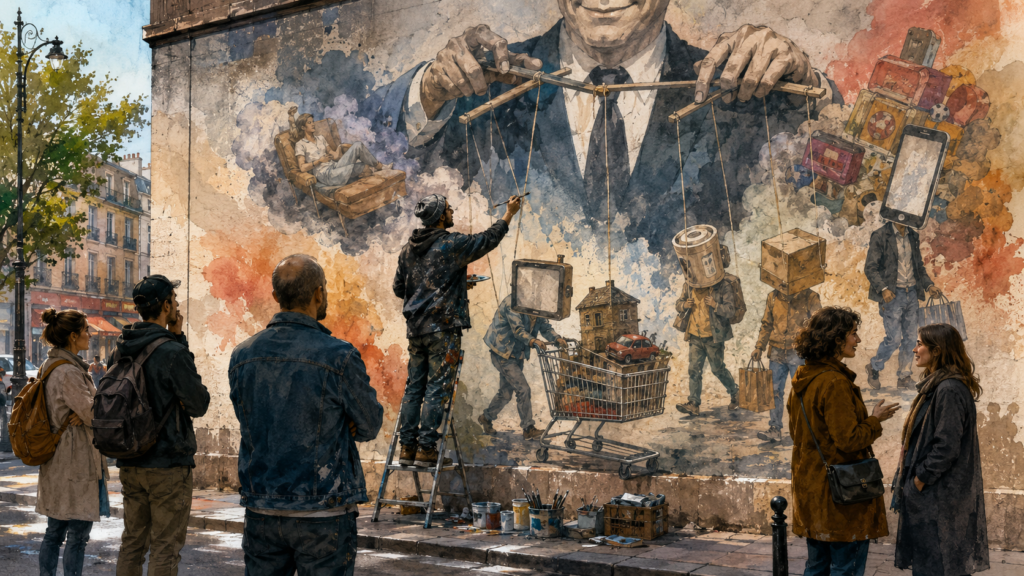
    balance between hobbies and professionalism

    The boundary between amateurism and professionalism is becoming increasingly fluid.

    Digital platforms allow ordinary individuals to publish creative work instantly, challenge established industries, and even build careers from personal passions. This creates exciting opportunities, but also raises important questions about quality, responsibility, and expertise.

    Not every hobby needs to become a profession. Some activities are valuable precisely because they remain personal, playful, and free from economic pressure.

    At the same time, professionalism still matters in fields that require trust, consistency, and accountability.

    Perhaps the healthiest society is not one that forces everyone to become professionals, nor one that dismisses expertise entirely.

    Instead, it may be a society where:

    • amateurs are free to explore creatively
    • professionals are respected for the discipline and responsibility they bring

    In the end, hobbies and professions do not have to be enemies.

    Sometimes, the most meaningful creativity emerges precisely where passion and expertise meet.

    Reader Question

    Should every passion eventually become a profession, or do hobbies lose their meaning once they become work?

    Related Reading

    If digital platforms continue allowing ordinary individuals to compete with traditional experts, how will technology reshape the meaning of work, expertise, and social authority?
    In Will Hyper-Personalization Reshape the Future of Work?, we explore how AI and automation may transform labor, identity, and economic systems.

    If hobbies increasingly become symbols of productivity and status, can leisure still remain a space of genuine freedom and personal expression?
    In Can Everyone Afford a Hobby? The Hidden Cost of Leisure and Access, we examine how economics, class, and accessibility shape modern leisure culture.


    References

    1. Bourdieu, P. (1993). The Field of Cultural Production: Essays on Art and Literature. Columbia University Press.

    Pierre Bourdieu analyzes how cultural authority and legitimacy are formed within artistic and professional fields. The book helps explain why professionals often defend boundaries against amateurs and how cultural status becomes socially constructed.

    2. Becker, H. S. (1982). Art Worlds. University of California Press.

    Howard Becker argues that art and creativity emerge through collaborative social systems rather than isolated genius. His work highlights how amateurs, professionals, audiences, and institutions collectively shape creative industries.

    3. Csikszentmihalyi, M. (1996). Creativity: Flow and the Psychology of Discovery and Invention. Harper Perennial.

    This book explores creativity, immersion, and “flow,” explaining how passionate amateurs often produce innovation through intrinsic motivation rather than economic pressure.

    4. Thornton, S. (2008). Seven Days in the Art World. W. W. Norton & Company.

    Sarah Thornton examines how expertise, prestige, criticism, and institutional power operate inside the contemporary art world, revealing how professional authority is socially maintained.

    5. Carr, D. (2011). Open-Source Democracy: How Online Communication Is Changing Offline Politics. Demos.

    This work discusses how digital communication allows ordinary individuals to participate in influence, activism, and content creation, challenging traditional expert-centered systems.

  • When Fans Become a Political Force: The Rise of Fandom Power

    When Fans Become a Political Force: The Rise of Fandom Power

    Digital Communities, Collective Identity, and the New Politics of Fan Culture

    Fandom was once seen as simple entertainment.

    Fans bought albums, attended concerts, collected merchandise, and passionately supported celebrities they admired.

    But in the digital age, fandom has evolved into something much larger.

    Today, online fan communities can:

    • organize global campaigns
    • raise millions of dollars
    • influence public opinion
    • dominate social media trends
    • and even participate in political activism

    Modern fandom is no longer only about consumption.

    It is becoming a form of cultural power.

    Global fan communities such as the fandom surrounding BTS have demonstrated how emotionally connected digital communities can transform into organized social forces.

    This raises an important question:

    Are fandoms still just groups of consumers—
    or are they becoming a new form of collective political identity?

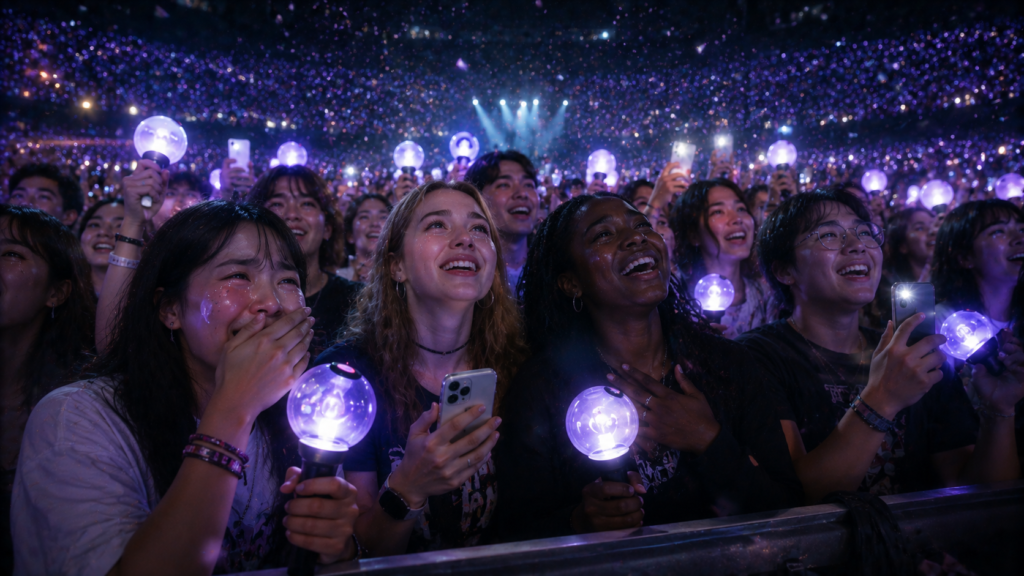
    fans emotionally connected at concert

    1. Fandom Is More Than Admiration

    From Entertainment to Civic Participation

    Modern fandoms increasingly operate beyond entertainment culture.

    One of the most visible examples emerged in 2020, when BTS donated one million dollars to the Black Lives Matter movement.

    Shortly afterward, BTS fans known as ARMY collectively matched the donation within twenty-four hours through online fundraising efforts.

    This moment revealed something significant:

    Fans were not simply supporting artists.

    They were participating in coordinated social action.


    Emotional Connection and Collective Action

    Online fandoms frequently organize:

    • charity campaigns
    • hashtag movements
    • fundraising projects
    • social awareness campaigns

    In many cases, fans mobilize faster and more efficiently than traditional organizations.

    Digital emotional connection becomes a source of collective power.

    As a result, fandom increasingly resembles a form of civic participation rather than passive consumption.


    2. Fandom as a Digital Community

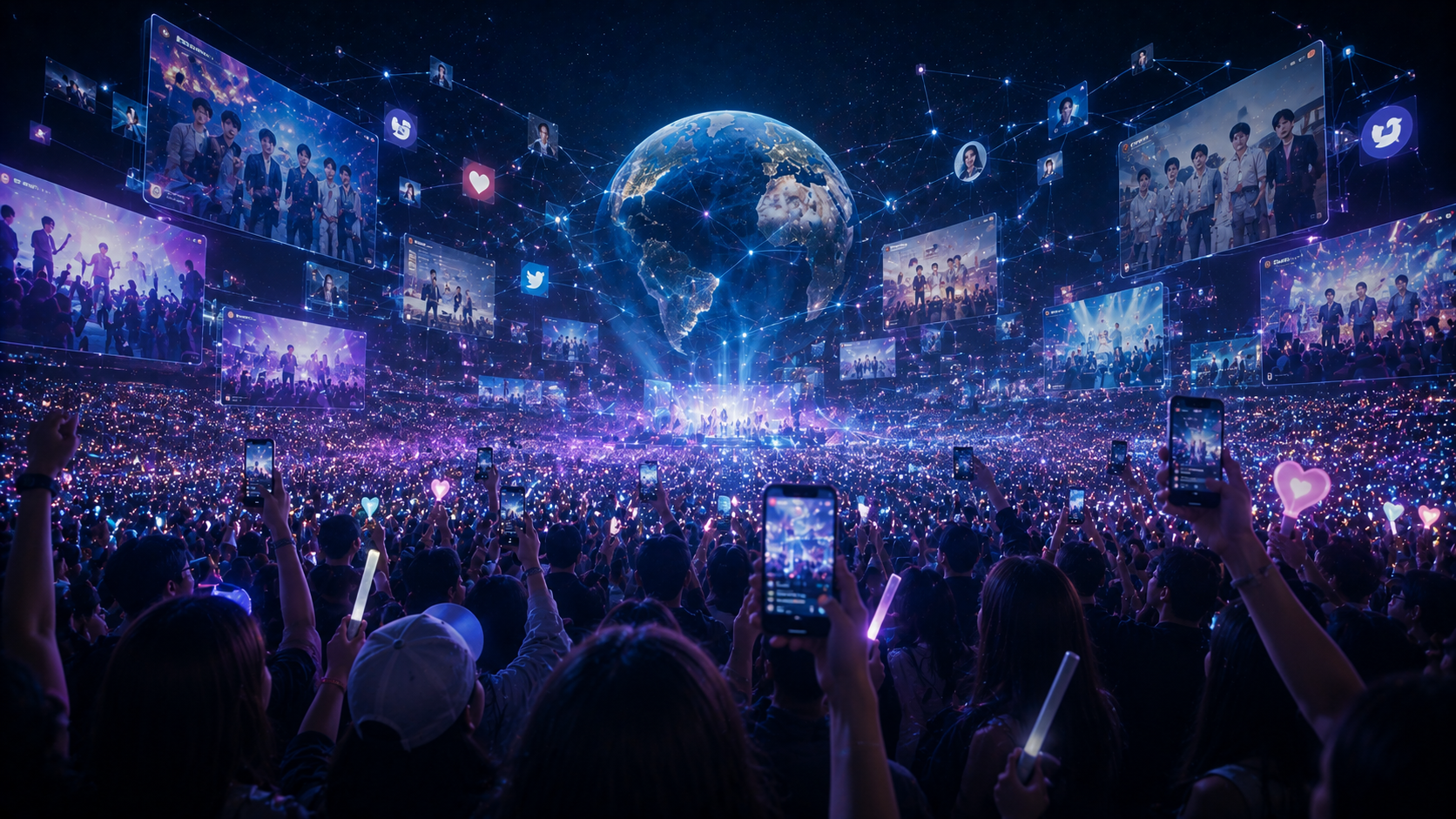
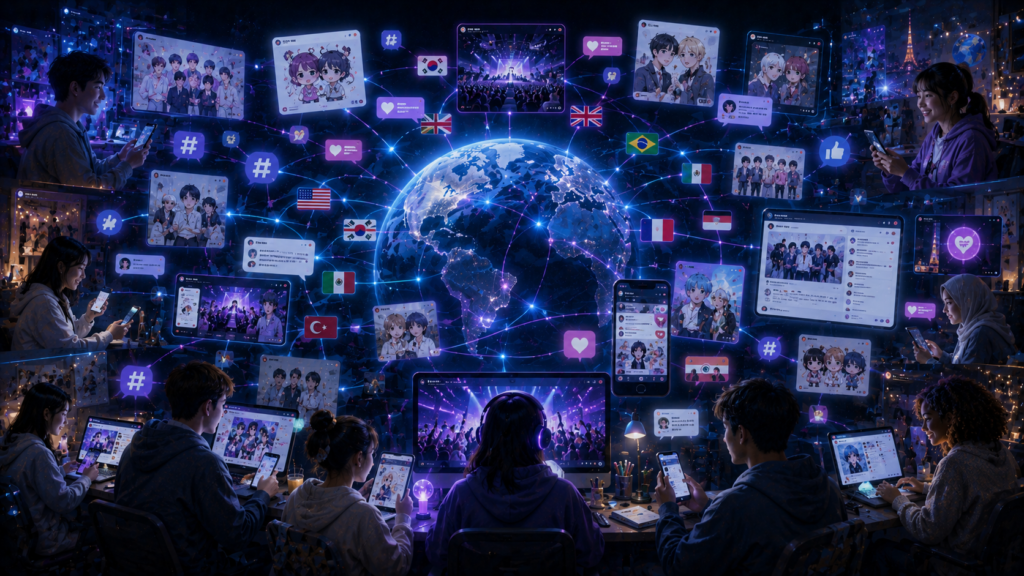
    global online fandom community

    Identity in Online Spaces

    Unlike traditional fan clubs centered on physical gatherings, modern fandoms exist primarily through digital platforms.

    Fans communicate across:

    • social media
    • streaming platforms
    • online forums
    • group chats
    • fan-created media spaces

    Through these interactions, fandom becomes part of personal identity itself.

    People do not simply follow artists.

    They belong to communities.


    Hierarchy and Internal Power

    However, fandom communities are not always equal spaces.

    Internal hierarchies often emerge.

    Long-term fans, people who attend concerts frequently, collectors of rare merchandise, and influential fan creators may gain symbolic authority within the community.

    At the same time, newer or more critical fans may become marginalized or attacked.

    This reveals that fandoms can reproduce their own systems of:

    • status
    • inclusion
    • exclusion
    • and cultural power

    Even communities built around emotional solidarity may contain hidden structures of authority.


    3. Between Politics and Entertainment

    “We Just Want to Enjoy Music”

    Some fans resist political involvement entirely.

    They argue that fandom should remain a space for enjoyment rather than ideological conflict.

    For these individuals, music functions as emotional escape rather than political expression.


    The Politicization of Fan Culture

    However, many fandoms increasingly engage with issues such as:

    • racial justice
    • climate activism
    • LGBTQ+ rights
    • disability advocacy
    • gender equality

    For example, BTS fan communities have participated in environmental campaigns, anti-discrimination movements, and global fundraising efforts connected to human rights causes.

    As a result, fandom occupies an unusual position.

    It often claims to be apolitical while simultaneously engaging in highly political actions.


    4. Are Fandoms Becoming New Social Movements?

    Politics Through Emotion and Culture

    Traditional political participation among younger generations has declined in many countries.

    However, cultural participation has expanded dramatically through digital communities.

    For many younger people, fandom provides:

    • emotional belonging
    • political expression
    • social connection
    • and collective identity

    This creates a new model of participation where culture and politics become deeply intertwined.


    A New Form of Collective Identity

    In this environment, fandom may function as a transnational social movement.

    Fans from different countries cooperate across borders through shared emotional investment rather than nationality, religion, or traditional political ideology.

    In other words, fandom transforms emotion into organized collective action.

    This may represent one of the defining political and cultural shifts of the digital age.


    Conclusion: Fandom as Cultural Power

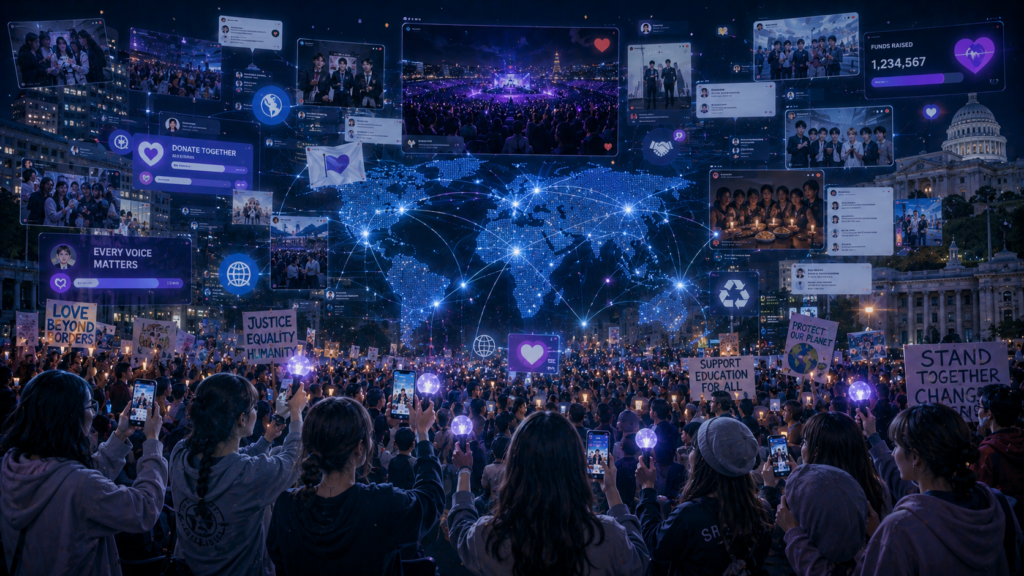
    online fandom participating in social activism

    In the past, fans were often dismissed as emotional consumers.

    Today, fandoms increasingly shape:

    • online discourse
    • political visibility
    • social activism
    • and cultural influence

    The digital age has transformed fandom into something far more powerful than entertainment alone.

    Modern fandoms connect emotion, identity, technology, and politics into massive global communities capable of real social impact.

    Ultimately, fandom may no longer simply represent admiration for artists.

    It may represent a new form of citizenship built through emotional connection and digital participation.

    And perhaps the most important question is this:

    When millions of emotionally connected people act together online,
    where does fandom end—and where does political power begin?

    Reader Question

    Have online fan communities become more than spaces for entertainment and emotional support?

    When millions of people organize, donate, campaign, and shape public opinion together through shared cultural passion—

    Does fandom remain a form of consumption, or does it become a new kind of political power?

    Related Reading

    If emotions can be socially organized and amplified through digital platforms, is fandom ultimately driven more by personal affection—or by collective emotional structures?
    In Are Our Emotions Truly Ours—or Socially Constructed?, we explore how emotions are shaped, managed, and politically amplified within modern digital society.


    If online communities increasingly shape identity, belonging, and activism across borders, are digital spaces creating entirely new forms of citizenship and collective identity?
    In Can Society Move Beyond the Gender Binary?, we examine how social identity is continuously constructed, negotiated, and performed within changing cultural environments.


    References

    1. A. N. Andini & G. N. Akhni (2021). Exploring Youth Political Participation.
      This study examines how K-pop fandoms in Indonesia and Thailand participate in digital activism through hashtags, fundraising, and political campaigns. It argues that fandom can function as an alternative model of political participation for younger generations.
    2. W. J. Chang & S. E. Park (2019). The Fandom of Hallyu: The Case of ARMY of BTS.
      This research conceptualizes BTS ARMY as a “digital tribe” shaped by emotional belonging, online hierarchy, and collective identity within global network culture.
    3. C. Kim (2023). Fandom as New Transnational Political Actor.
      Kim analyzes fandom as a transnational political actor capable of influencing democratic discourse, global activism, and social justice movements across national borders.
    4. R. Kanozia & G. Ganghariya (2021). More than K-pop Fans.
      This work explores how BTS fandom communities participated in public health campaigns, anti-hate activism, and online solidarity during the COVID-19 pandemic.
    5. J. Galvan (2021). Fans of Change.
      Galvan examines how fandom communities organize around shared ideals and social values, describing fandom as a form of aspirational collective action and community-based activism.

  • Why Do We So Easily Turn Away from Others’ Suffering?

    Why Do We So Easily Turn Away from Others’ Suffering?

    Scenes We See Every Day—and Look Away From

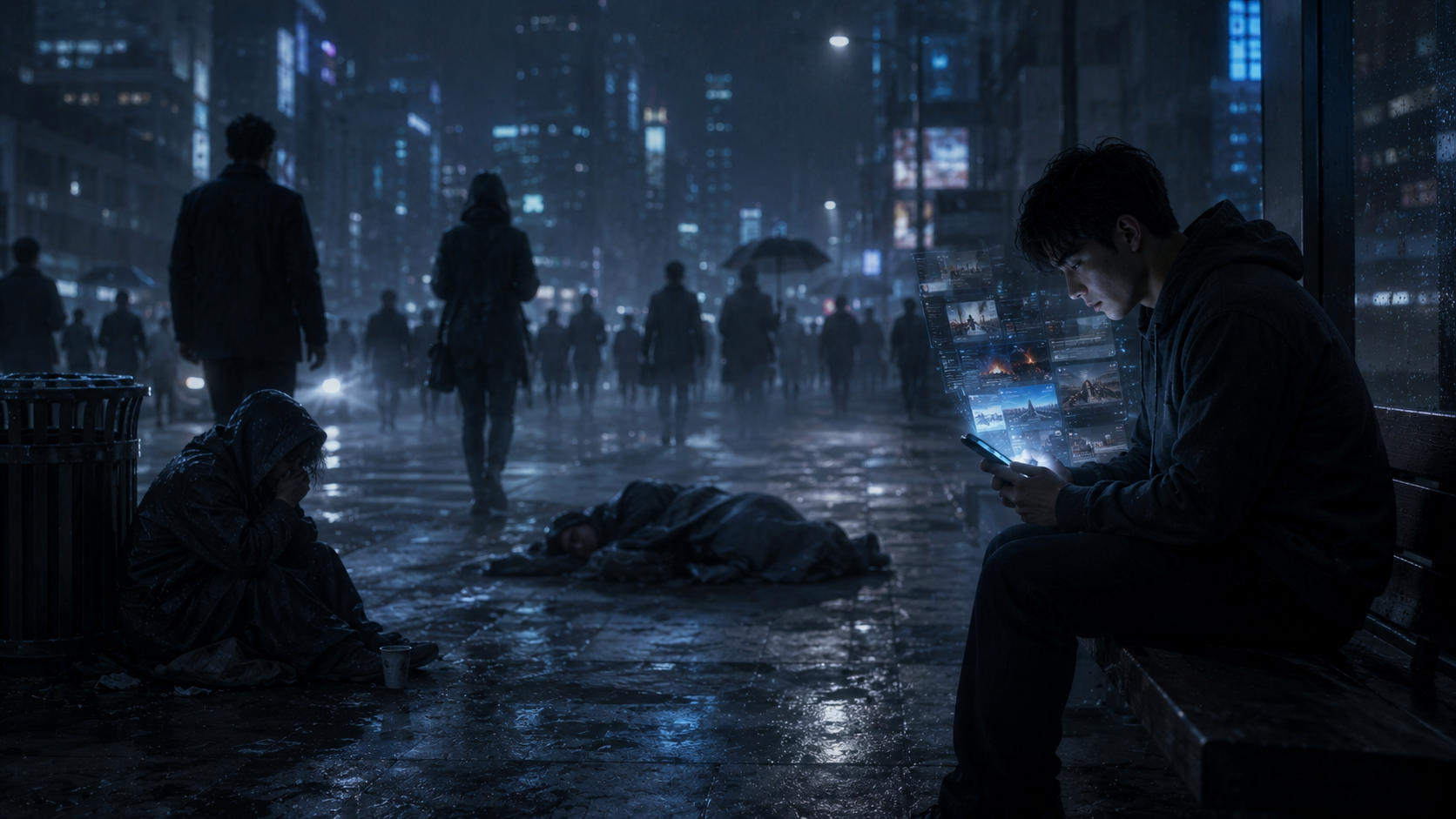
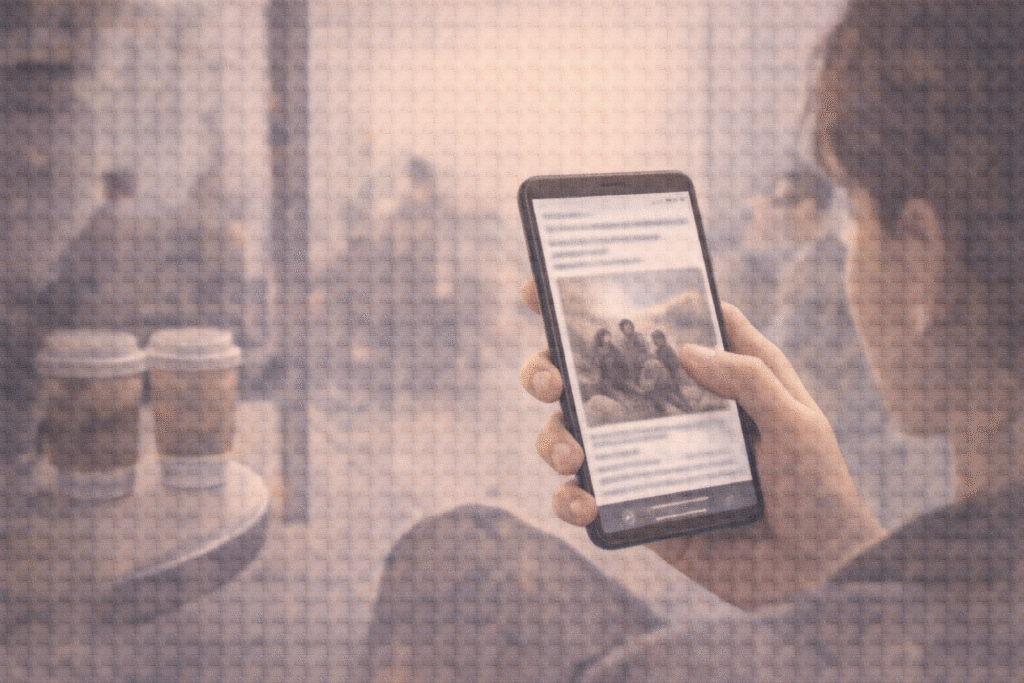
    A person scrolling past crisis news on a smartphone

    Images of war on the news.
    A homeless person shivering in a subway station.
    Hate-filled comments flooding online spaces.

    We encounter other people’s suffering every day.
    Yet most of the time, we scroll past it, avert our eyes, or quietly tell ourselves, “This has nothing to do with me.”

    We are taught that humans are empathetic beings.
    So why is it that we so often—and so easily—turn away from the pain of others?


    1. A Psychological Perspective: Empathy Fatigue and the Bystander Effect

    The Limits of Emotional Capacity

    Psychology offers important explanations for why humans cannot absorb others’ suffering indefinitely.

    Empathy fatigue refers to the gradual emotional exhaustion that occurs when we are repeatedly exposed to distress.
    When news about war, natural disasters, or humanitarian crises arrives daily, initial shock often gives way to numbness. This emotional shutdown is not indifference—it is self-protection.

    Another well-documented phenomenon is the bystander effect.
    In emergency situations, individuals are less likely to intervene when others are present, assuming that someone else will take responsibility. Ironically, the more witnesses there are, the easier it becomes to do nothing.

    Not Cruelty, but Psychological Structure

    In this sense, turning away from suffering is not always a sign of moral failure.
    It is often the result of emotional limits and the diffusion of responsibility embedded in human psychology.


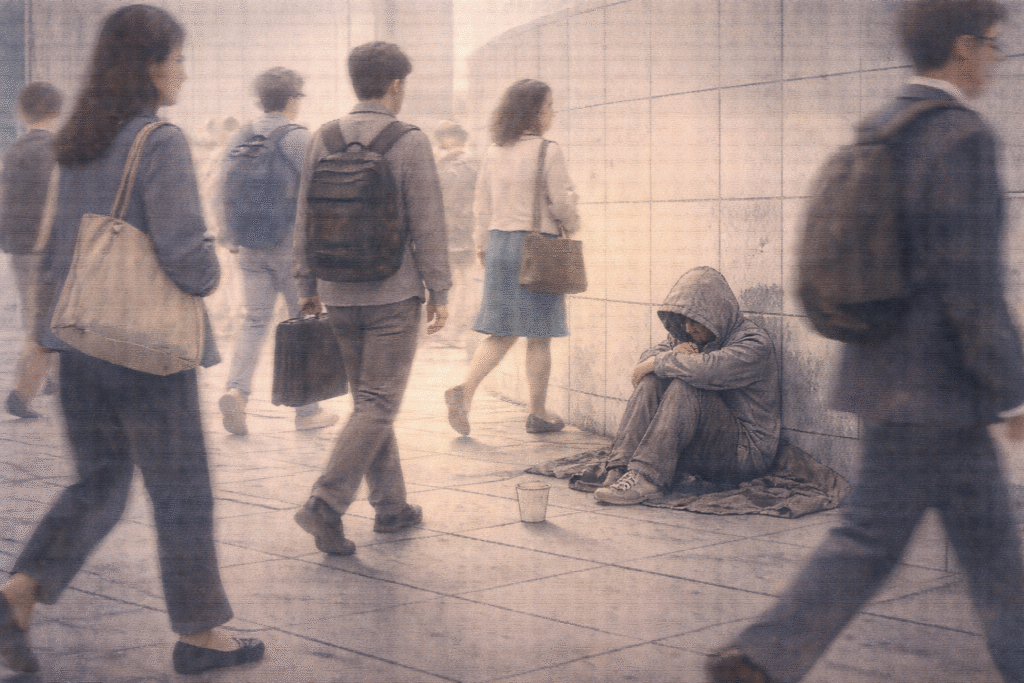
    Passersby avoiding a vulnerable person in a public space

    2. A Social Perspective: The Normalization and Consumption of Suffering

    When Pain Becomes Information

    Modern societies have transformed suffering into consumable content.

    Through television, social media, and online news, images of violence, disaster, and tragedy circulate endlessly. Over time, suffering loses its exceptional status and becomes part of the everyday visual landscape.

    At the same time, not all suffering receives equal attention.
    Disasters in wealthy or geopolitically central regions may dominate headlines, while prolonged crises in poorer parts of the world are reduced to brief mentions—or ignored entirely.

    Hierarchies of Compassion

    As a result, suffering becomes ranked and filtered.
    Some lives are framed as urgent and grievable, while others fade into the background noise of global information flows.

    This selective visibility shapes not only what we see, but also what we feel compelled to care about.


    3. An Ethical Perspective: The Face of the Other and Moral Responsibility

    The Ethical Call of the Other

    The philosopher Emmanuel Levinas argued that the face of the other makes an ethical demand upon us.
    To encounter another person’s vulnerability is to be called into responsibility—even before we choose it.

    In theory, this means that suffering cannot be morally neutral.
    To see pain is already to be implicated in it.

    The Desire to Avoid Responsibility

    In practice, however, responding to suffering often requires action.

    Looking at a homeless person may lead to the expectation of giving money or food.
    Acknowledging social injustice may demand protest, solidarity, or political engagement.

    Turning away, then, can function as a way to avoid responsibility.
    By not seeing, we protect ourselves from the burden of having to respond.


    4. The Contemporary Context: Empathy and Cynicism in the Digital Age

    Expanded Awareness, Diluted Action

    Digital platforms have radically expanded our exposure to others’ pain.

    Hashtag campaigns, viral videos, and online petitions allow millions to express concern instantly. Yet this visibility does not always translate into sustained action or structural change.

    In many cases, digital empathy becomes a momentary emotional release rather than a commitment.

    From Compassion to Cynicism

    At the same time, online spaces often foster cynicism and hostility.
    Suffering is mocked, politicized, or dismissed as self-inflicted. Comment sections turn pain into ammunition for ideological battles.

    The digital sphere thus becomes both a site of expanded empathy and a space where suffering is easily trivialized or denied.

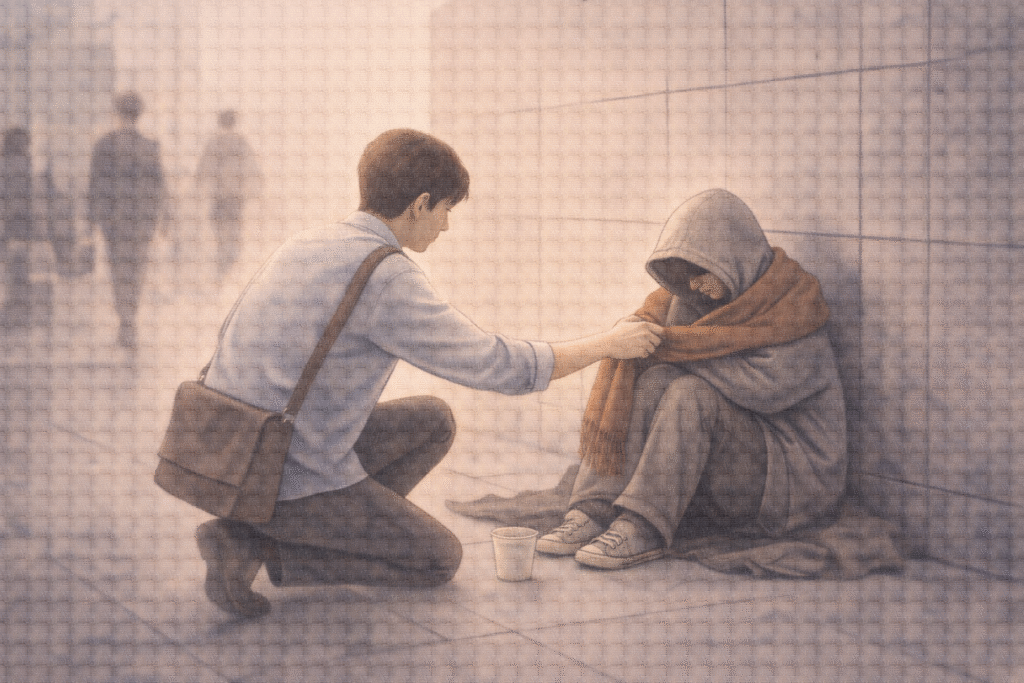
    A person pausing to offer help with quiet compassion

    Conclusion: Turning Away—and Turning Back

    We turn away from others’ suffering for many reasons:
    psychological limits, social structures, ethical avoidance, and digital cultures that reward distance over responsibility.

    But looking away does not make suffering disappear.

    To face another’s pain is uncomfortable. It can disrupt our sense of safety and challenge our routines. Yet this discomfort is not a flaw—it is the foundation of ethical life.

    When we refuse to look away, suffering ceases to be a private misfortune and becomes a shared social concern.
    In that moment, we move closer to becoming more connected, more responsible, and more fully human.

    A Question for Readers

    Do humans turn away from suffering because they lack empathy?

    Or because modern life overwhelms people with more pain than they are emotionally capable of carrying?

    Related Reading

    Moral responsibility and the limits of ethical judgment are questioned in Can Humans Be the Moral Standard?

    Everyday habits that normalize emotional distance are explored in The Wall of Earphones – Why Do We Choose to Isolate Ourselves?


    References

    1. Altruism in Humans
      Batson, C. D. (2011). Altruism in Humans. Oxford University Press.
      This work provides a comprehensive psychological account of altruism and empathy, explaining why humans sometimes help others and sometimes withdraw.
    2. Against Empathy
      Bloom, P. (2016). Against Empathy: The Case for Rational Compassion. Ecco/HarperCollins.
      Bloom challenges the assumption that empathy is always morally beneficial, arguing that it can lead to bias, fatigue, and selective concern.
    3. The Psychology of Good and Evil
      Staub, E. (2003). The Psychology of Good and Evil. Cambridge University Press.
      This book analyzes how individuals and groups come to help or harm others, with particular attention to bystander behavior and moral disengagement.
    4. Totality and Infinity
      Levinas, E. (1969). Totality and Infinity: An Essay on Exteriority. Duquesne University Press.
      A foundational philosophical text that frames ethics as arising from responsibility to the Other, especially in the face of vulnerability.
    5. The Spectatorship of Suffering
      Chouliaraki, L. (2006). The Spectatorship of Suffering. Sage Publications.
      This sociological study examines how media representations of suffering shape public response, compassion, and indifference.
  • Algorithmic Bias: How Recommendation Systems Narrow Our Worldview

    Algorithmic Bias: How Recommendation Systems Narrow Our Worldview

    1. Do Algorithms Have “Preferences”?

    A person viewing a personalized digital feed shaped by recommendation algorithms

    Behind platforms we use every day—YouTube, Netflix, Instagram—are recommendation algorithms working silently.
    Their task seems simple: to show content we are likely to enjoy.

    The problem is that these recommendations are not neutral.

    Algorithms analyze what we click, what we watch longer, and what we like.
    Based on these patterns, they decide what to show next.
    It is as if a well-meaning but stubborn friend keeps saying,
    “You liked this, so you’ll like more of the same.”


    2. Filter Bubbles and Echo Chambers

    When recommendations repeat similar content, a phenomenon known as the filter bubble emerges.
    A filter bubble traps users inside a limited set of information, filtering out alternative views.

    A figure inside a transparent bubble surrounded by repeated information patterns

    For example, if someone repeatedly watches videos supporting a particular political candidate,
    the algorithm is likely to recommend more favorable content about that candidate—
    while opposing perspectives quietly disappear.

    This effect becomes stronger when combined with an echo chamber,
    where similar opinions are repeated and amplified.
    Like sound bouncing inside a hollow space, the same ideas echo back,
    gradually transforming opinions into unshakable beliefs.


    3. How Worldviews Become Narrower

    Algorithmic bias does more than simply provide skewed information.

    • Reinforced confirmation bias: People encounter only ideas that match what they already believe.
    • Loss of diversity: Opportunities to discover unfamiliar interests or viewpoints decrease.
    • Social fragmentation: People in different filter bubbles struggle to understand one another,
      fueling political polarization and cultural conflict.

    Consider someone who frequently watches videos about vegetarian cooking.
    Over time, the algorithm recommends only plant-based recipes and content emphasizing the harms of meat consumption.
    Eventually, this person may come to see meat-eating as entirely wrong,
    leading to friction when interacting with people who hold different dietary views.


    4. Why Does This Happen?

    The primary goal of recommendation algorithms is not user understanding, but engagement.
    The longer users stay on a platform, the more profitable it becomes.

    Content that triggers strong reactions—likes, comments, prolonged viewing—gets prioritized.
    Since people naturally spend more time on content that aligns with their beliefs,
    algorithms “learn” to reinforce those patterns.

    In this feedback loop, personalization slowly turns into polarization.


    5. How Can We Respond?

    Escaping algorithmic bias does not require abandoning technology, but using it more consciously.

    • Consume diverse content intentionally: Seek out unfamiliar topics or opposing viewpoints.
    • Reset or limit personalized recommendations when platforms allow it.
    • Practice critical thinking: Ask, “Why was this recommended to me?” and “What perspectives are missing?”
    • Use multiple sources: Check the same issue across different platforms and media outlets.
    A person standing before multiple paths representing diverse perspectives

    Conclusion

    Recommendation algorithms are powerful tools that efficiently connect us with information and entertainment.
    However, when their built-in biases go unnoticed, they can quietly narrow our understanding of the world.

    Technology itself is not the enemy.
    The real challenge lies in maintaining awareness and balance.

    Even in the age of algorithms,
    the responsibility to broaden our perspective—and the power to choose—still belongs to us.

    A Question for Readers

    If algorithms continuously show us only what we already prefer, are they helping us understand the world more clearly—

    or quietly limiting the range of perspectives we are able to see?


    Related Reading

    The cognitive framing power of digital interfaces is examined further in How Search Boxes Shape the Way We Think.

    These technical patterns also raise deeper philosophical questions addressed in If AI Can Predict Human Desire, Is Free Will an Illusion?

    References

    1. Pariser, E. (2011). The Filter Bubble: What the Internet Is Hiding from You.
      This book popularized the concept of the filter bubble, explaining how personalized algorithms limit exposure to diverse information and intensify social division.
    2. O’Neil, C. (2016). Weapons of Math Destruction: How Big Data Increases Inequality and Threatens Democracy.
      O’Neil analyzes how algorithmic systems reinforce bias, deepen inequality, and undermine democratic values through real-world examples.
    3. Noble, S. U. (2018). Algorithms of Oppression: How Search Engines Reinforce Racism.
      This work examines how search and recommendation algorithms can reproduce structural social biases, particularly related to race and gender.
  • How Search Boxes Shape the Way We Think

    How Search Boxes Shape the Way We Think

    The Invisible Influence of Algorithms in the Digital Age

    Every day, billions of questions begin with a search box.

    We type a few words,
    receive suggestions,
    and follow links that appear almost instantly.

    But what if the search box is shaping our thoughts
    before we even finish the question?

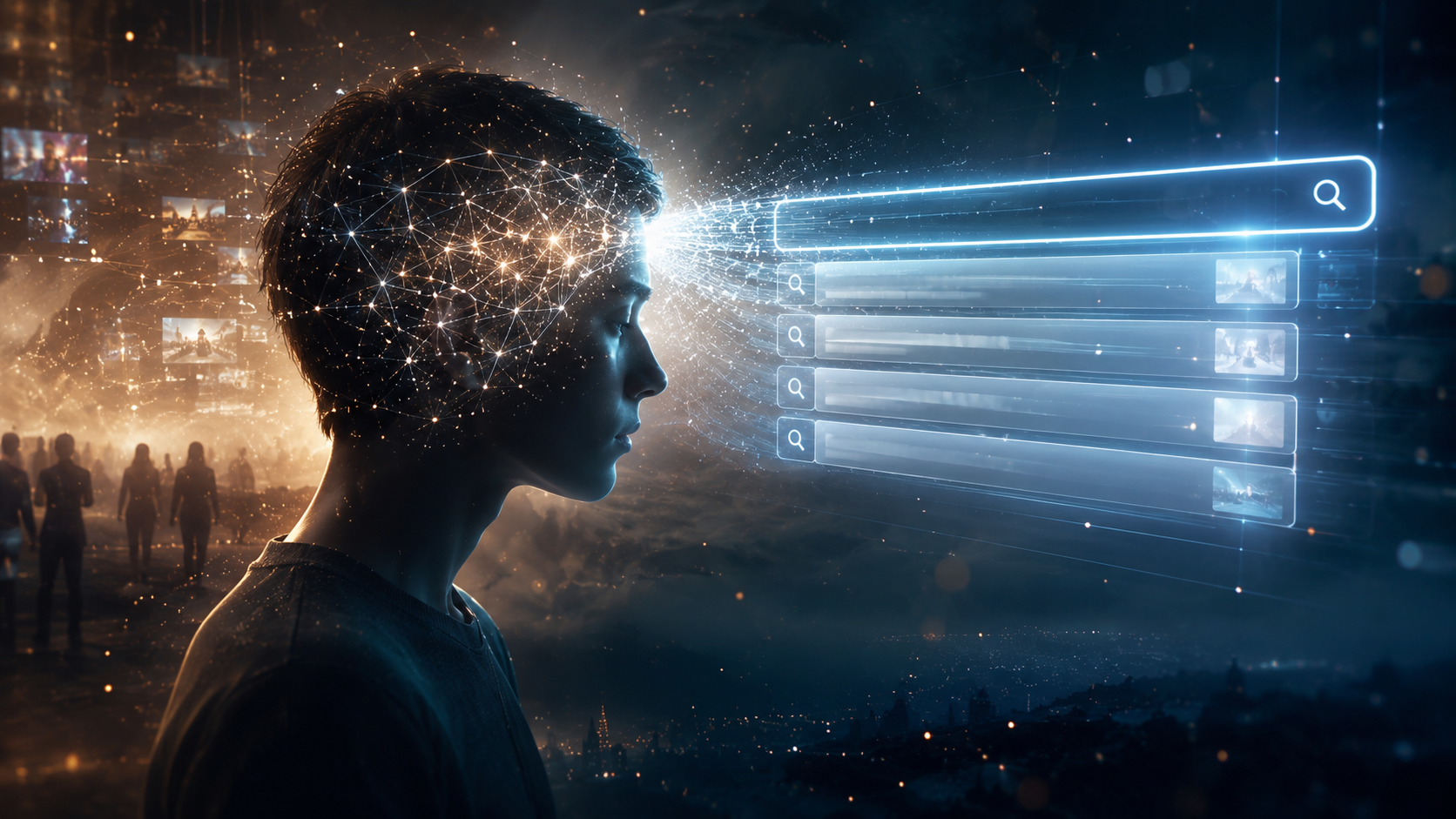
    Search box autocomplete shaping user questions

    1. When Search Boxes Decide the Question

    Search boxes do more than provide answers.
    They subtly change the way we ask questions in the first place.

    Think about autocomplete features.
    You begin typing “today’s weather,” and before finishing, the search box suggests
    “today’s weather air pollution.”

    Without intending to, your attention shifts.
    You were looking for the weather, but now you are thinking about air quality.

    Autocomplete does not simply predict words.
    It redirects thought.
    Questions that once originated in your mind quietly become questions proposed by an algorithm.


    2. How Search Results Shape Our Thinking

    Algorithmic bias in ranked search results

    Search results are not neutral lists.
    They are ranked, ordered, and designed to capture attention.

    Most users focus on the first page—often only the top few results.
    Information placed at the top is easily perceived as more accurate, reliable, or “true.”

    For example, when searching for a diet method, if the top results emphasize dramatic success,
    we tend to accept that narrative, even when contradictory evidence exists elsewhere.

    In this way, search results do not merely reflect opinions.
    They actively guide the direction of our thinking.


    3. The Invisible Power Behind the Search Box

    At first glance, a search box appears to be a simple input field.
    Behind it, however, lie powerful algorithms shaped by commercial and institutional interests.

    Sponsored content often appears at the very top of search results.
    Even when labeled as advertisements, users unconsciously associate higher placement with credibility.

    As a result, companies invest heavily to secure top positions,
    knowing that visibility translates directly into trust and choice.

    Our decisions—what we buy, read, or believe—are often influenced
    long before we realize it.


    4. Search Boxes Across Cultures and Nations

    Search engines differ across countries and cultures.
    Google dominates in the United States, Naver in South Korea, Baidu in China.

    Searching the same topic on different platforms can yield strikingly different narratives,
    frames, and priorities.

    A historical event, for instance, may be presented through contrasting lenses depending on the search environment.

    We do not simply search the world as it is.
    We see the world through the window our search box provides—and each window has its own tint.


    5. Learning to Question the Search Box

    How can we avoid being confined by algorithmic guidance?

    The answer lies in cultivating critical habits:

    • Ask whether an autocomplete suggestion truly reflects your original question
    • Look beyond the top-ranked results
    • Compare information across platforms and languages

    These small practices widen the intellectual space in which we think.

    Critical awareness of algorithmic influence

    Conclusion

    Search boxes are not passive tools for finding answers.
    They shape questions, guide attention, and quietly train our ways of thinking.

    In the digital age, the challenge is not to reject these tools,
    but to use them without surrendering our autonomy.

    True digital literacy begins when we recognize
    that the most powerful influence of a search box
    lies not in the answers it gives,
    but in the questions it encourages us to ask.

    A Question for You

    Have you ever searched for something—and felt the results were guiding your thinking?

    If what you see is filtered,
    how much of your thinking is truly your own?


    Related Reading

    The invisible filtering mechanisms behind everyday searches are explored further in
    Algorithmic Bias: How Recommendation Systems Narrow Our Worldview, where digital systems subtly shape what we see and how we interpret information.

    The fragility of human perception goes even deeper in
    If Memory Can Be Manipulated, What Can We Really Trust?,
    which examines how memory itself can be altered, raising fundamental questions about truth, identity, and reality.

    Digital participation is not shaped by citizens alone; it is also shaped by the systems that guide attention.
    This issue is further explored in Clicktivism in Digital Democracy: Participation or Illusion?, where online political action is examined as both a new form of participation and a possible substitute for deeper engagement.

    References

    Pariser, E. (2011). The Filter Bubble: What the Internet Is Hiding from You. New York: Penguin Press.
    → Explores how personalized algorithms narrow users’ worldviews while shaping perception and judgment.

    Noble, S. U. (2018). Algorithms of Oppression: How Search Engines Reinforce Racism. New York: NYU Press.
    → Critically examines how search engines reflect and amplify social biases rather than remaining neutral tools.

    Beer, D. (2009). Power through the Algorithm? New Media & Society, 11(6), 985–1002.
    → Analyzes algorithms as invisible forms of power that structure everyday cultural practices.

  • The Standardization of Experience

    The Standardization of Experience

    Why Travel, Hobbies, and Life Are Becoming Increasingly Similar

    1. Why Are Our Experiences Becoming So Alike?

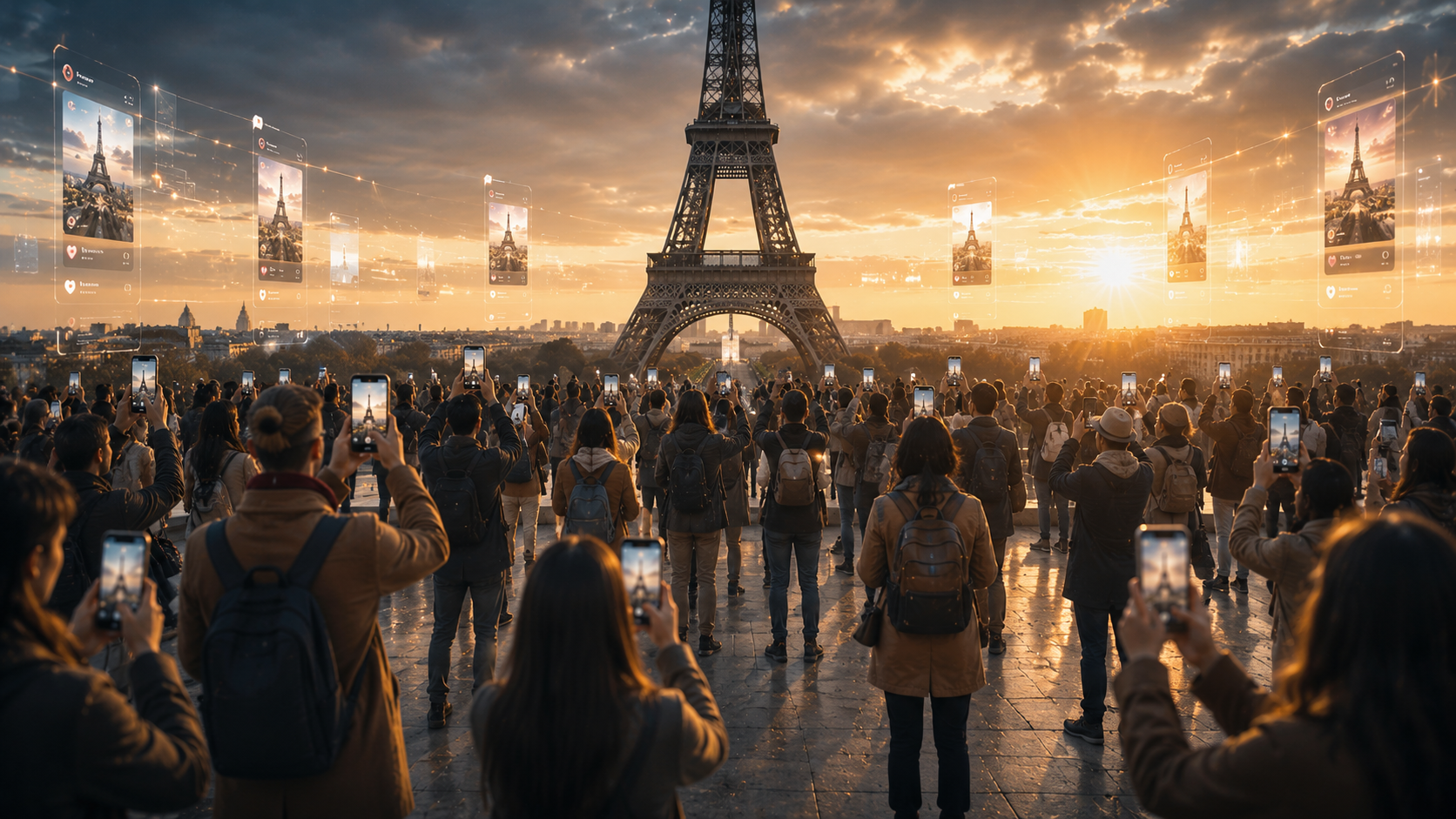
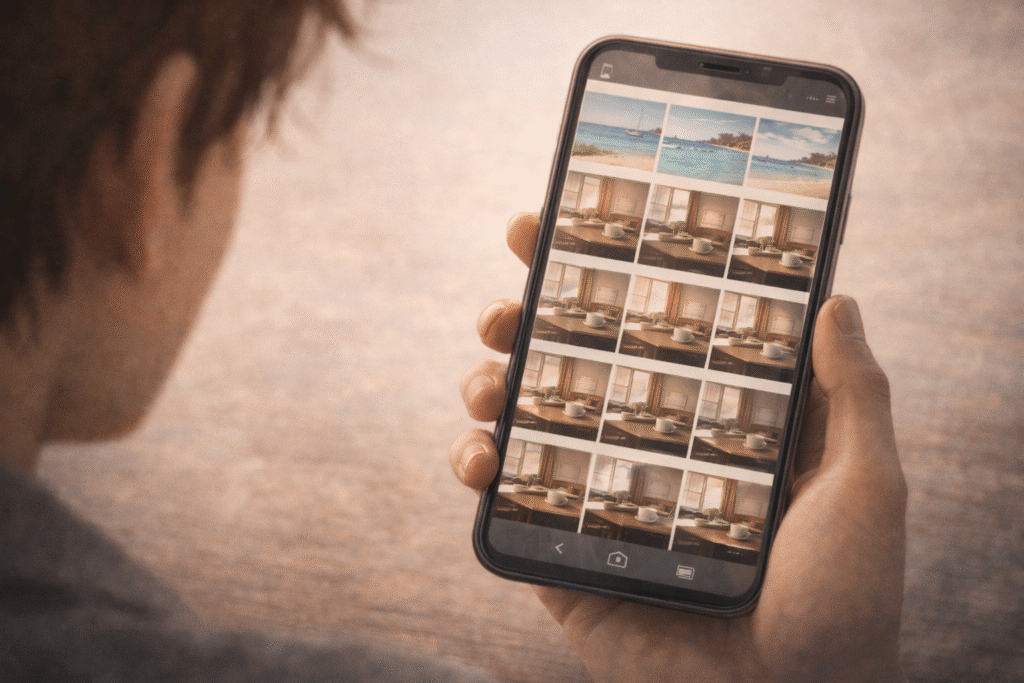
    Similar travel photos repeating across social media

    Scrolling through travel photos online, familiar scenes appear again and again.

    Similar cafés, identical poses, the same backdrops, almost interchangeable captions.

    Hobbies follow the same pattern.
    Trending workouts, recommended activities, and “hot right now” interests spread rapidly.

    Although we live separate lives,
    the shape of our experiences is becoming strikingly similar.

    This question naturally arises:

    Why are “personal experiences” slowly disappearing?


    2. How Recommendation Systems Flatten Experience

    The Age of Algorithmic Choice

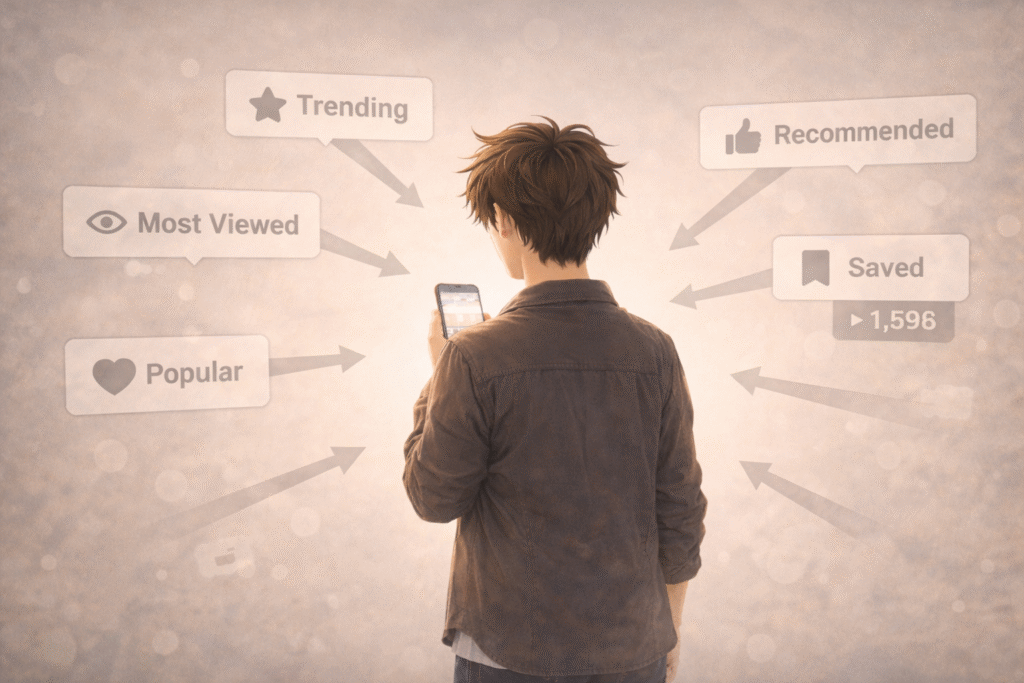
    Today, many experiences begin not with exploration, but with recommendation.

    Travel destinations are introduced as “most saved places.”
    Music arrives as “playlists curated for you.”
    Hobbies are presented as “what people are doing most right now.”

    Algorithms reduce decision fatigue efficiently,
    but they also guide experiences along similar paths.

    In exchange for convenience,
    we receive experiences that are increasingly standardized.

    Algorithm recommendations shaping similar life choices

    Social Proof and the Comfort of Safe Choices

    Psychology describes our tendency to value what many others choose as social proof.

    Likes, reviews, and view counts function as indicators of quality.
    As a result, people select experiences that seem less likely to fail.

    Unfamiliar or uncertain experiences are avoided,
    and this repetition gradually erodes diversity.


    When Experience Becomes Performance

    Experience is no longer just something we live through.

    It becomes something to display, document, and explain.

    Places that photograph well are favored.
    Experiences that are easy to describe are preferred.
    Personal yet inexpressible moments quietly disappear.


    3. Is Experience a Commodity — or a Trace of Being?

    Philosophically, experience is not something to be consumed or exchanged.

    It is a trace of time that shapes who we are.

    Standardized experience shifts the question from
    “What did this mean to me?”
    to
    “How will this look to others?”

    At that moment, experience becomes an external product rather than internal accumulation.

    True experience is often inefficient, difficult to explain,
    and sometimes includes failure.

    Yet it is precisely there that people discover their own rhythm and sensibility.


    Conclusion: Reclaiming One’s Own Experience

    The problem is not recommendation systems themselves,
    but our uncritical dependence on them.

    When we follow the same paths without asking what they mean to us,
    our lives begin to resemble one another.

    Wisdom today does not lie in endlessly seeking novelty.

    Quiet reflection on reclaiming personal experience

    It lies in pausing before a given choice and asking:

    “Why does this experience matter to me?”

    Returning experience to the individual —
    that is the most personal form of resistance
    in an age of standardization.

    A Question for Readers

    When algorithms increasingly guide what we watch, visit, and enjoy, are our experiences still truly personal?

    Or are modern societies gradually teaching people to desire the same things in the same ways?

    Related Reading

    Recommendation systems not only influence information consumption, but also shape how people experience culture, travel, and daily life.
    Algorithmic Bias explores how algorithms gradually narrow human perspectives and choices.

    Modern experiences increasingly function as visible social performance rather than deeply personal moments.
    When Experience Becomes Competition examines how experiences become forms of symbolic social capital.


    References

    1. Han, B.-C. (2017). The Expulsion of the Other. Cambridge: Polity Press.
      Han analyzes how sameness replaces difference in contemporary society, offering insight into how standardized experiences weaken individuality.
    2. Zuboff, S. (2019). The Age of Surveillance Capitalism. New York: PublicAffairs.
      Zuboff examines how platforms and algorithms predict and shape human behavior, revealing how experience design is shifting from individuals to systems.
    3. Pine, B. J., & Gilmore, J. H. (1999). The Experience Economy. Boston: Harvard Business School Press.
      This foundational work explains how experiences become economic goods, providing a framework for understanding the commodification and standardization of experience today.
  • The Sociology of Selfies

    The Sociology of Selfies

    How Self-Representation and the Desire for Recognition Shape Digital Identity

    A selfie is never just a photograph.

    It is often a carefully chosen moment,
    shared not only to remember—
    but also to be seen.

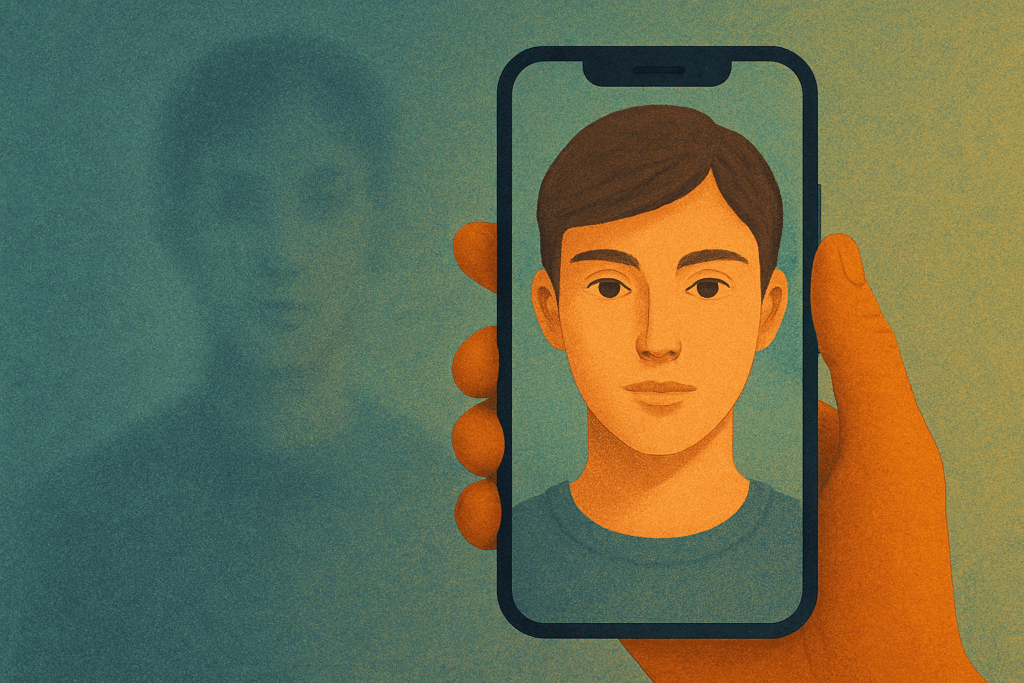
    selfie and digital identity reflection

    1. A Selfie Is Not Just a Photo

    On the subway, in cafés, or while traveling, we instinctively raise our smartphones.
    In the frame, we appear slightly brighter, slightly more confident, slightly more composed.

    A selfie is not merely a record of the self.
    It is a carefully constructed moment shaped by the awareness of being seen.

    Behind this seemingly casual gesture lies a deeper social message—
    a desire for recognition and a question that quietly follows us:
    How do I want to be perceived by others?


    2. Selfies as a Technology of Self-Presentation

    The evolution of smartphone cameras has turned everyday users into curators of their own personal brands.

    Lighting, filters, angles, and backgrounds are not neutral choices.
    They function as symbols that communicate identity.

    A selfie taken against a scenic landscape performs freedom.
    A selfie at a desk performs discipline and diligence.

    In this sense, selfies are not simple records of reality.
    They are acts of self-presentation, or what sociologists describe as a performance of identity.


    3. Recognition and the Social Psychology of “Likes”

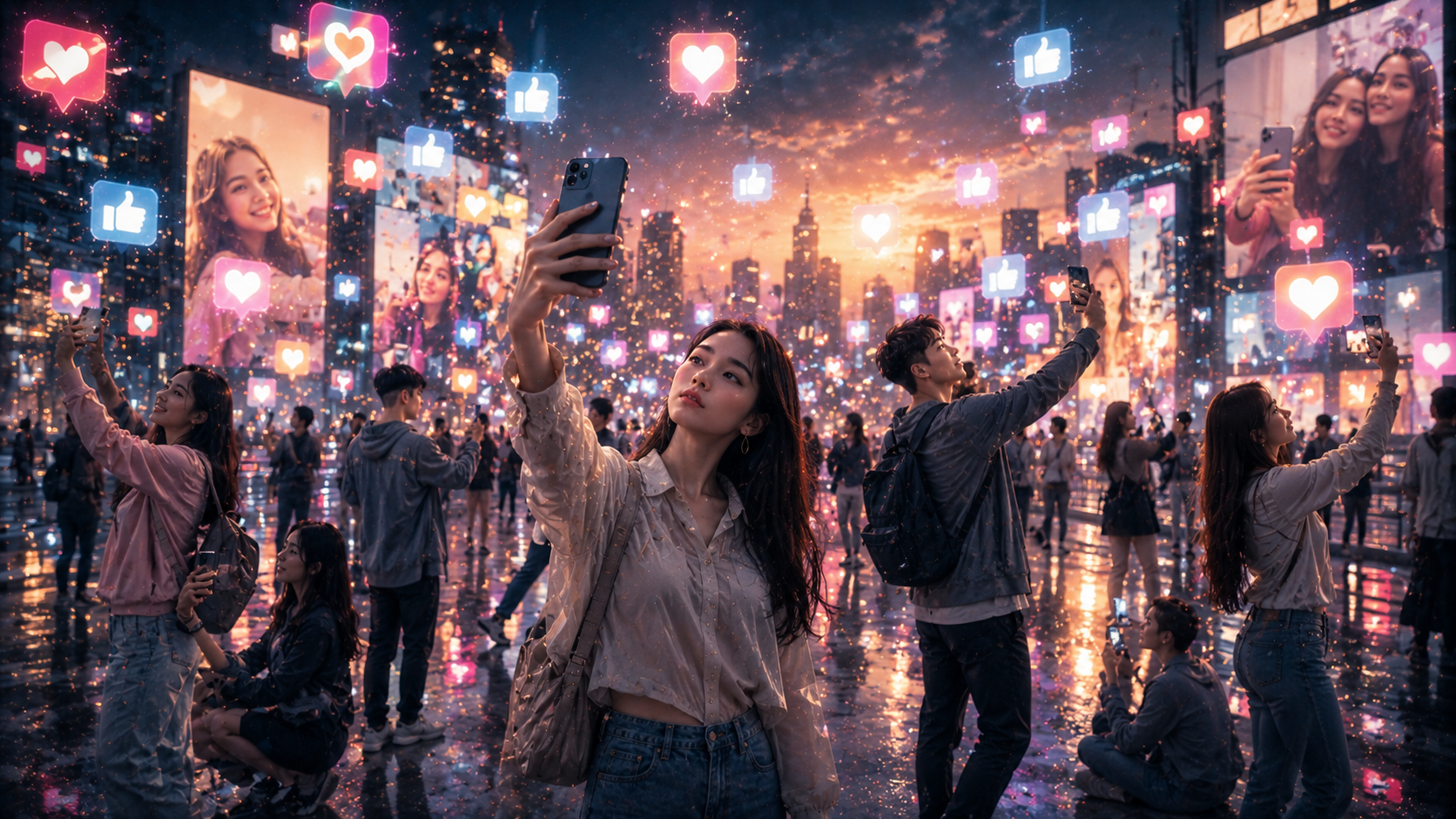
    When we upload a selfie, we are not simply waiting for numbers to increase.
    We are waiting for acknowledgment.

    Each “like” operates as a social signal that says, I see you.

    Sociologist Charles Horton Cooley famously described the looking-glass self
    the idea that individuals form their self-image through the imagined reactions of others.

    In the digital age, selfies place this mirror directly onto the smartphone screen.
    As a result, people often begin to prioritize the visible self over the experienced self.

    Self-expression becomes inseparable from social validation,
    and identity turns into a negotiation between who we are and how we are received.

    social media likes and recognition desire

    4. The Paradox of Freedom and Anxiety

    Selfies promise freedom.
    We choose how to present ourselves, when to post, and what to reveal.

    Yet this freedom often coexists with anxiety.

    Filters subtly reflect perceived social expectations.
    Endless streams of perfected faces invite comparison and self-doubt.

    For younger generations especially, selfies can become tools of proof—
    evidence that one is worthy, attractive, or socially accepted.

    Thus, selfie culture exists at the boundary between autonomy and control,
    where self-expression is constantly shaped by imagined audiences.


    5. From the Seen Self to the Lived Self

    Selfies are mirrors of contemporary society.
    They express a human desire to be acknowledged, remembered, and valued.

    But when attention shifts entirely to the seen self,
    there is a risk of losing contact with the lived self.

    Occasionally lowering the camera and stepping outside the frame
    allows space to reconnect with experience beyond representation.

    Only then can selfies transform from instruments of performance
    into tools of self-understanding.

    stepping away from social media reflection

    Conclusion

    Selfies are neither shallow nor inherently harmful.
    They are social languages shaped by recognition, identity, and visibility.

    The challenge is not to abandon selfies,
    but to remain aware of the difference between being seen and truly existing.

    In that awareness, digital self-representation can become
    not a performance for approval,
    but a reflection of a life genuinely lived.

    A Question for You

    When you share a photo online,
    are you expressing yourself—
    or seeking recognition from others?

    Related Reading

    The desire for recognition often begins with small symbolic rewards in childhood.
    Why Is Candy a Symbol of Reward for Children? explores how emotional approval became connected to reward systems long before digital self-presentation emerged.

    The emotional relationship between recognition and self-worth is further explored in The Praise-Driven Society: Recognition and Self-Worth in the Digital Age, where digital approval systems reshape confidence, identity, and emotional dependence.

    The gap between how we see ourselves and how we interpret others is deeply connected to modern self-presentation.
    Why We Excuse Ourselves but Blame Others examines how perspective shapes judgment and misunderstanding.


    References

    Senft, T. M., & Baym, N. K. (2015).
    What Does the Selfie Say? Investigating a Global Phenomenon.
    International Journal of Communication, 9, 1588–1606.
    This study frames selfies as social and communicative acts rather than trivial images, explaining how identity and recognition are negotiated through digital self-representation.

    Goffman, E. (1959).
    The Presentation of Self in Everyday Life.
    New York: Anchor Books.
    Goffman’s theory of social performance provides a foundational framework for understanding selfies as staged expressions of identity in everyday interactions.

    Marwick, A. E. (2013).
    Status Update: Celebrity, Publicity, and Branding in the Social Media Age.
    New Haven, CT: Yale University Press.
    This work explores how social media encourages self-branding and visibility-seeking behaviors, offering crucial insight into recognition economies that shape selfie culture.