Tag: Democracy

  • How Much Surveillance Is Too Much?

    How Much Surveillance Is Too Much?

    Technology, Privacy, and the Future of Civil Liberties

    Every day, we trade privacy for convenience.

    Our phones track where we go.
    Our purchases reveal what we want.
    Cameras record how we move through the world.

    It all feels efficient—almost invisible.

    But this raises a deeper question:

    Are we becoming more free through technology—
    or more closely watched than ever before?

    smartphone tracking user data

    1. Technology Is Not Neutral

    It Depends on Who Uses It

    Technology itself is neither good nor bad—
    but its use is never neutral.

    Facial recognition can help find missing persons
    or prevent crime.

    Yet the same system can track everyday movements,
    monitor expressions, and build detailed personal profiles.


    Infrastructure or Control System?

    Smart cities promise efficiency—
    better traffic flow, optimized energy use, safer streets.

    But they also risk becoming invisible surveillance networks,
    where control is embedded into daily life.

    At its core, the question is not just about technology—
    but about who holds power.


    2. The Evolution of Privacy

    “I Have Nothing to Hide”

    Many people say,
    “I have nothing to hide, so surveillance doesn’t matter.”

    But surveillance is not only about detecting wrongdoing—
    it is about predicting and shaping behavior.


    From Observation to Influence

    Data collected from searches, purchases, and social media
    can reveal political views, emotional states, and personal habits.

    Over time, surveillance shifts from watching behavior
    to influencing it.

    Privacy, then, is not just about secrecy—
    but about freedom of thought.


    3. Surveillance Capitalism and Democracy
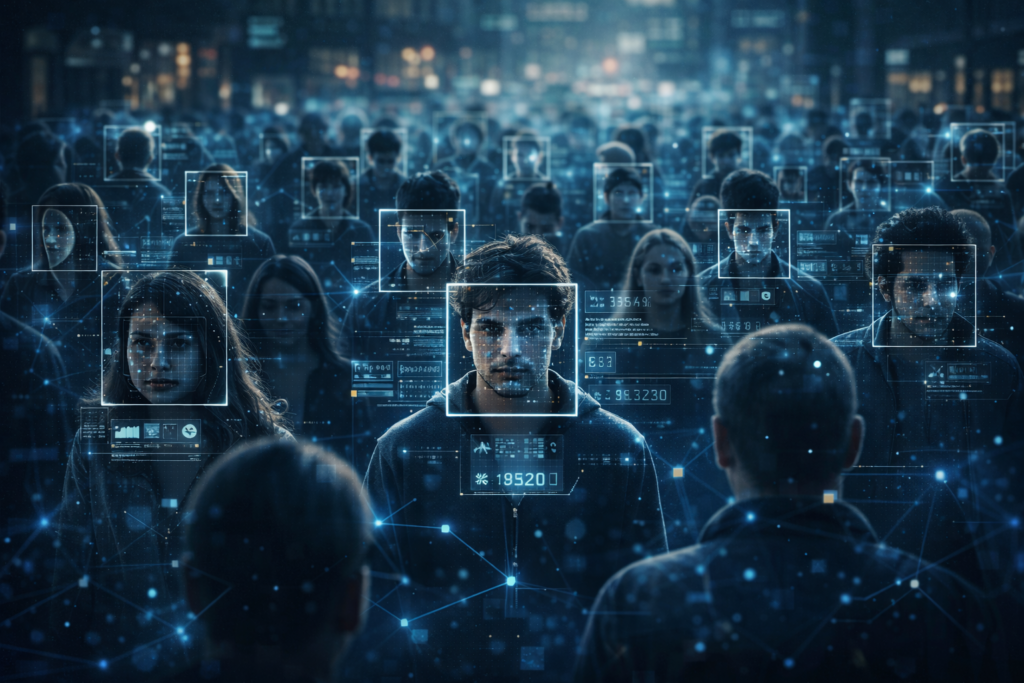
    facial recognition tracking people

    Data as a Commodity

    Scholar Shoshana Zuboff describes this system
    as “surveillance capitalism.”

    Personal data is extracted, analyzed,
    and transformed into predictive models.


    The Democratic Risk

    This creates two major tensions:

    • Self-censorship:
      When people feel watched, they may limit expression.
    • Power imbalance:
      Governments and tech companies accumulate data,
      while individuals lose control over their own information.

    This imbalance can quietly erode democratic systems.


    4. Where Should We Draw the Line?

    The Expansion of Surveillance

    AI-powered monitoring, real-time tracking,
    and predictive algorithms are rapidly expanding.

    The question is no longer whether surveillance exists—
    but how far we allow it to go.


    Citizens, Not Just Users

    In this context, people are not just users of technology—
    they are citizens with rights.

    The challenge is to move from passive acceptance
    to active questioning.

    Who watches?
    Who is watched?
    And who holds the watchers accountable?


    Conclusion: Progress Without Losing Freedom

    person choosing between surveillance and freedom

    Technological progress is inevitable.
    But the erosion of rights should not be.

    The true measure of a society
    is not how efficiently it processes data—
    but how carefully it protects human dignity.

    Convenience can be seductive.
    But freedom, once lost, is difficult to recover.

    If we do not question surveillance today,
    we may one day find that the choice has already been made for us.


    A Question for Readers

    How much surveillance are you willing to accept
    in exchange for safety and convenience?


    Related Reading

    The tension between surveillance and individual autonomy becomes even more complex when we consider how transparency itself can reshape society.
    In The Transparency Society: Foundation of Trust or Culture of Surveillance?, the idea of openness reveals how visibility can both strengthen trust and expand mechanisms of control.

    At a deeper level, the influence of technology extends beyond observation to cognition itself.
    In How Search Boxes Shape the Way We Think, the role of algorithms highlights how digital systems not only monitor behavior but subtly guide how we form thoughts and decisions.

    Debates over surveillance often reflect a deeper political question:
    how much power should the state possess in the name of security and order?
    This tension is further explored in The Minimal State: An Ideal of Liberty or a Neglect of the Common Good?

    Digital platforms do not only monitor citizens; they also shape how citizens participate.
    Clicktivism in Digital Democracy: Participation or Illusion? explores whether online political action expands democracy or reduces it to symbolic participation.


    References


    1. Zuboff, S. (2019). The Age of Surveillance Capitalism. New York: PublicAffairs.
    → Zuboff analyzes how digital platforms extract and monetize personal data, revealing how surveillance becomes an economic system that reshapes autonomy and privacy.

    2. Cohen, J. E. (2012). Configuring the Networked Self. New Haven: Yale University Press.
    → Cohen explores how legal and technological systems shape individual identity, arguing that privacy is essential for maintaining personal agency.

    3. Solove, D. J. (2008). Understanding Privacy. Cambridge: Harvard University Press.
    → Solove provides a comprehensive framework for understanding privacy, emphasizing its role in protecting freedom and dignity in modern societies.

    4. Nissenbaum, H. (2009). Privacy in Context. Stanford: Stanford University Press.
    → Nissenbaum introduces the concept of contextual integrity, explaining how privacy depends on appropriate information flow within social contexts.

    5. Morozov, E. (2011). The Net Delusion. New York: PublicAffairs.
    → Morozov critiques the assumption that technology inherently promotes freedom, highlighting its potential use in surveillance and authoritarian control.
  • Why Does Politics Create Conflict While Promising Solutions?

    Why Does Politics Create Conflict While Promising Solutions?

    Struggle, Mediation, and the Paradox of Political Life

    When we turn on the news, politics often appears as noise—
    raised voices, accusations, and endless division.

    Yet behind every conflict, there is always a promise:
    to solve problems, to serve the public, to move society forward.

    This contradiction raises a deeper question:

    If politics is meant to resolve problems,
    why does it so often begin by creating conflict?

    1. Politics as the Institutionalization of Conflict

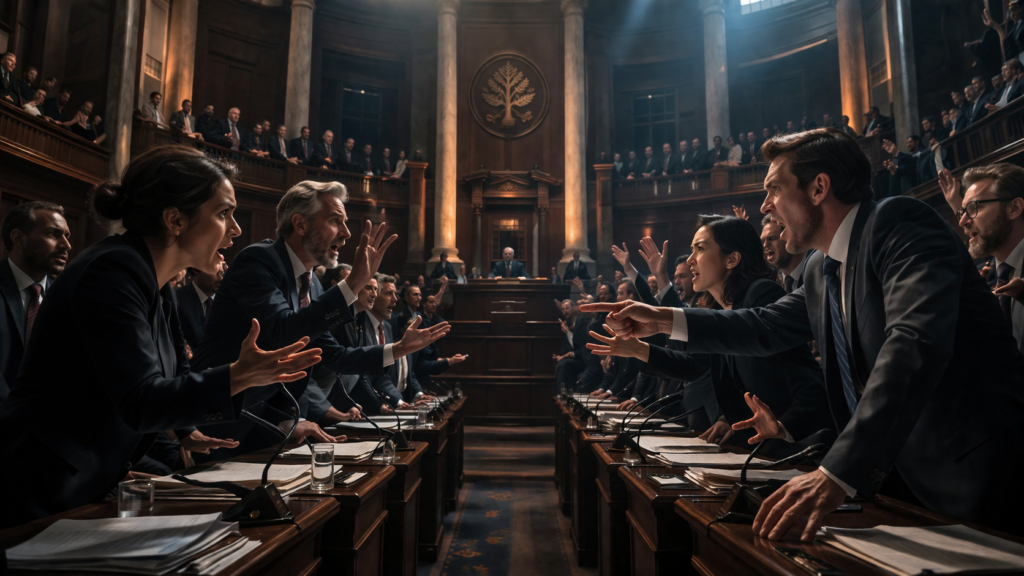
    heated political argument scene

    A Plural Society Cannot Avoid Disagreement

    No society operates with a single voice.
    Individuals and groups hold different values, interests, and priorities.

    Politics exists precisely because of these differences—
    it provides a structured way to manage conflict rather than eliminate it.


    Conflict Without Violence

    Political theorist Bernard Crick described politics as
    “the art of resolving conflict without violence.”

    In this sense, conflict is not a failure of politics,
    but its very starting point.

    The real issue is not whether conflict exists,
    but how it is handled.


    2. Why Politics Often Creates “Enemies”

    Visibility and Mobilization

    Politics depends on attention and support.

    However, peaceful and stable governance often goes unnoticed.
    Conflict, on the other hand, captures public attention.

    As a result, some political actors deliberately frame issues
    in terms of “us versus them.”


    The Simplicity of Division

    This strategy simplifies complex policies into emotional narratives.

    By defining an opponent,
    politicians can unite supporters and present themselves as problem-solvers.

    Yet this approach comes at a cost:
    it deepens polarization and weakens dialogue.


    3. Politics as Continuous Adjustment, Not Final Resolution

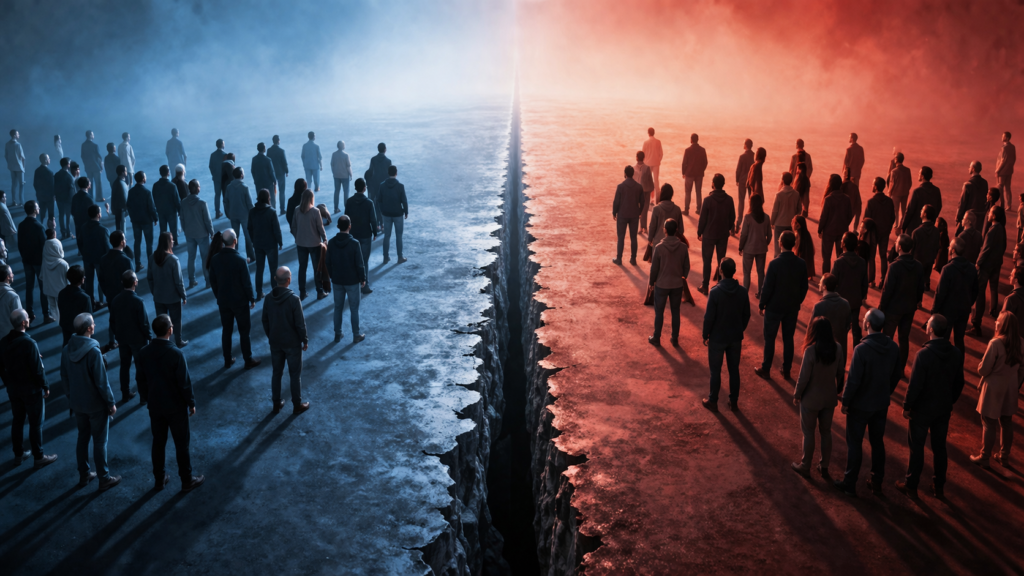
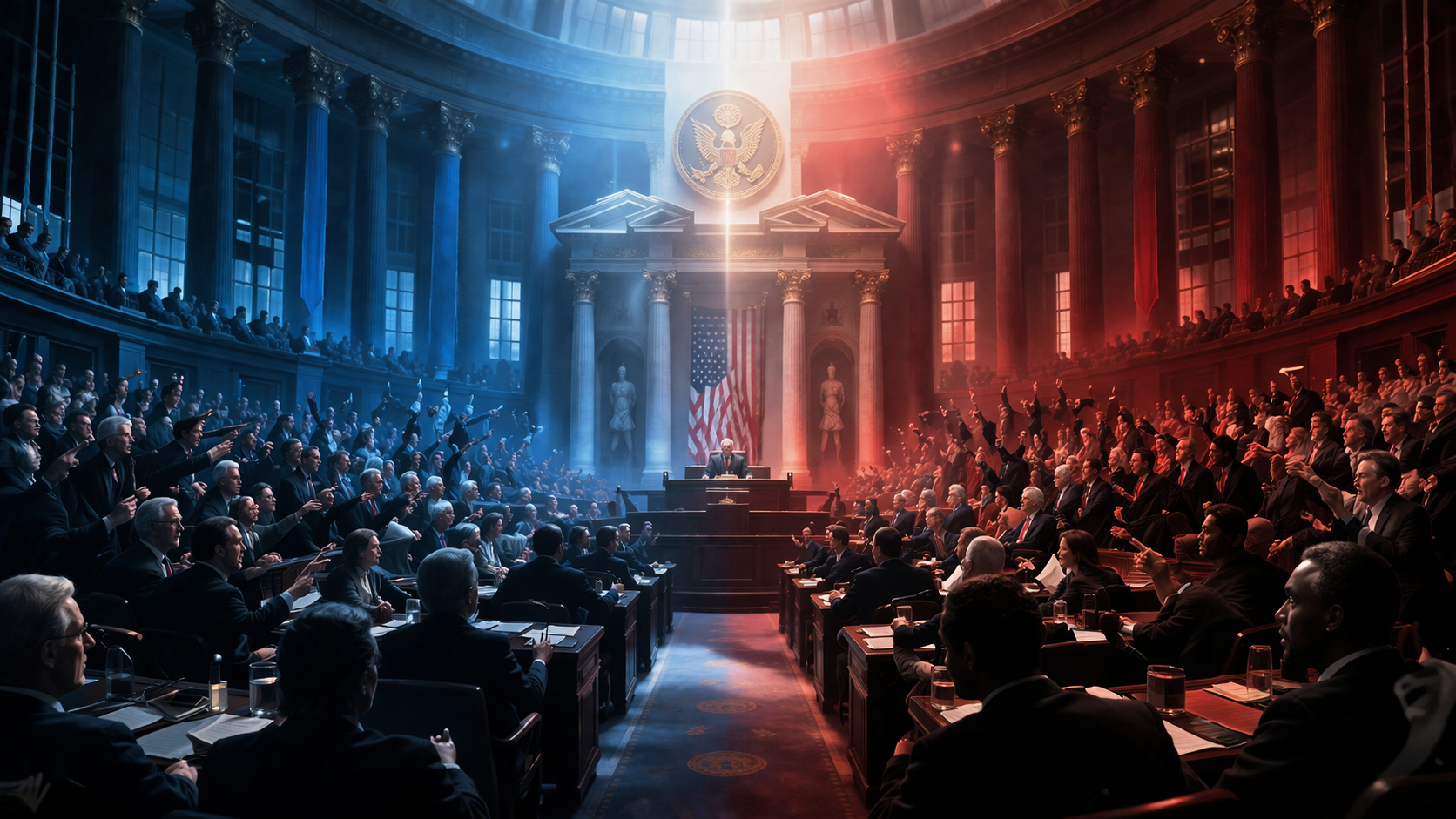
    two groups divided political polarization

    The Myth of Complete Solutions

    We often expect politics to deliver definitive answers.

    In reality, politics is built on compromise.
    In a society with competing interests,
    a perfect solution is rare.


    The Cycle of Temporary Agreements

    What is resolved today
    may return as conflict tomorrow.

    Politics, therefore, is not a destination
    but an ongoing process of negotiation and adjustment.

    This explains the paradox:
    politics promises solutions,
    yet continuously revisits problems.


    4. The Productive Role of Conflict

    Conflict as a Driver of Change

    Not all conflict is destructive.

    Debates between ideological positions,
    generational disagreements, and policy disputes
    can help societies refine their direction.


    Politics as an Alternative to Force

    Without political processes,
    conflicts might be resolved through coercion or violence.

    Politics allows disagreement to be expressed,
    contested, and reshaped within a shared framework.

    The question, then, is not whether politics involves conflict—
    but whether that conflict is productive.


    Conclusion: Between Division and Cooperation

    people negotiating across differences

    Politics is a constant balancing act
    between conflict and resolution.

    At times, conflict is amplified for strategic purposes.
    At others, it reflects genuine attempts to reconcile differences.

    We become disillusioned
    when this balance appears insincere—
    when conflict feels like performance rather than necessity.

    Yet politics remains the space
    where collective life is negotiated.

    Conflict is its starting point.
    Adjustment is its method.

    So perhaps the real question is not:

    “Why does politics create conflict?”

    But rather:

    Where does that conflict lead us—and who does it ultimately serve?


    A Question for Readers

    Do you believe political conflict is a necessary part of democracy— or has it become a tool that undermines it?


    Related Reading


    The role of conflict in politics becomes even more complex when we consider how societies construct shared meaning despite disagreement.
    In Is There a Single Historical Truth—or Many Narratives?, the dynamics of collective memory reveal how competing perspectives shape what communities accept as truth.

    At a more psychological level, the instinct to defend our own side while judging others more harshly appears in Why We Excuse Ourselves but Blame Others, where cognitive bias helps explain why political conflict so easily hardens into division rather than dialogue.


    References

    1. ReferencesArendt, H. (1969). On Violence. New York: Harcourt, Brace & World.
    → Arendt distinguishes between power and violence, arguing that genuine political authority relies on collective agreement rather than coercion, highlighting how conflict can signal both vitality and breakdown in politics.

    2. Lasswell, H. D. (1936). Politics: Who Gets What, When, How. New York: Whittlesey House.
    → Lasswell frames politics as the distribution of resources and power, showing how conflict is embedded in the very structure of political decision-making.

    3. Mouffe, C. (2000). The Democratic Paradox. London: Verso.
    → Mouffe argues that democracy necessarily involves ongoing tension and disagreement, proposing that conflict should be transformed into productive “agonism” rather than eliminated.

    4. Habermas, J. (1984). The Theory of Communicative Action. Boston: Beacon Press.
    → Habermas emphasizes rational dialogue and communication as mechanisms for resolving conflict, presenting politics as a space for deliberative coordination.

    5. Tilly, C. (2003). The Politics of Collective Violence. Cambridge: Cambridge University Press.
    → Tilly analyzes how political conflict can escalate into collective violence, offering insights into how in