Tag: decision making

  • If AI Can Imitate Human Intuition, Are We Still Special?

    If AI Can Imitate Human Intuition, Are We Still Special?

    Intuition as a Human Capacity

    Intuition has long been considered a uniquely human ability.

    Even without complete information or explicit reasoning, we often make important decisions based on a sudden sense of knowing.
    Scientific breakthroughs, artistic inspiration, and life-changing choices have frequently emerged from such intuitive moments.

    Intuition appears to operate beneath conscious thought, guiding us before logic fully catches up.

    But today, artificial intelligence systems—trained on vast amounts of data—are producing remarkably accurate predictions, often in ways that look intuitive.

    If AI can one day perfectly imitate human intuition, what, then, remains uniquely human?

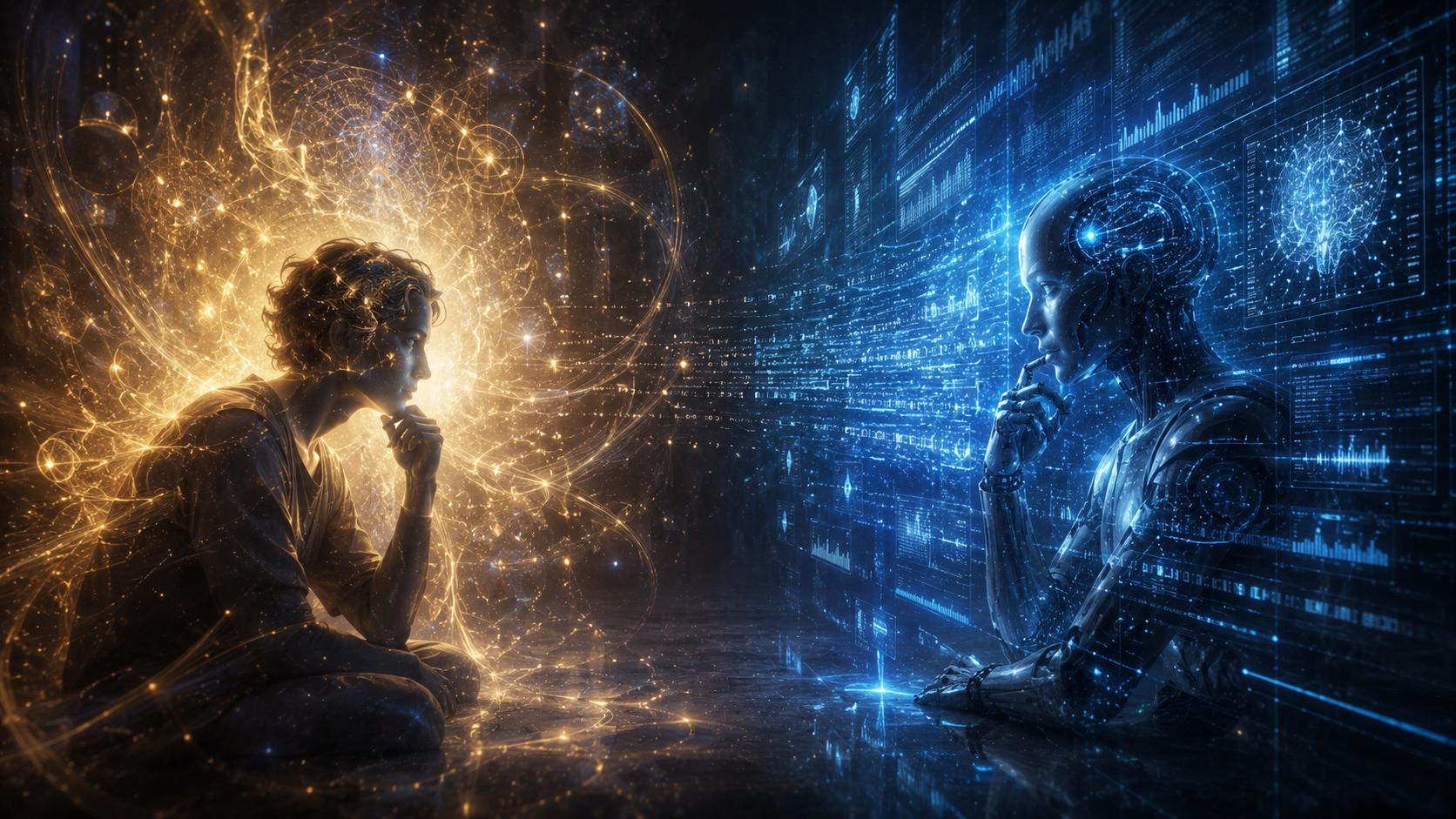
    A person pausing thoughtfully, representing human intuition

    1. The Nature of Intuition: Unconscious Wisdom

    Fast Thinking and Hidden Knowledge

    Psychologist Daniel Kahneman describes intuition as System 1 thinking: fast, automatic, and largely unconscious.

    This form of thinking allows humans to respond quickly without deliberate calculation.
    It is efficient, adaptive, and deeply rooted in experience.

    Intuition as Compressed Experience

    Intuition is not a random emotional impulse.
    It is the result of accumulated learning, memory, and pattern recognition operating below awareness.

    In this sense, intuition represents a form of compressed wisdom:
    complex knowledge distilled into immediate judgment.


    2. AI and the Imitation of Intuition
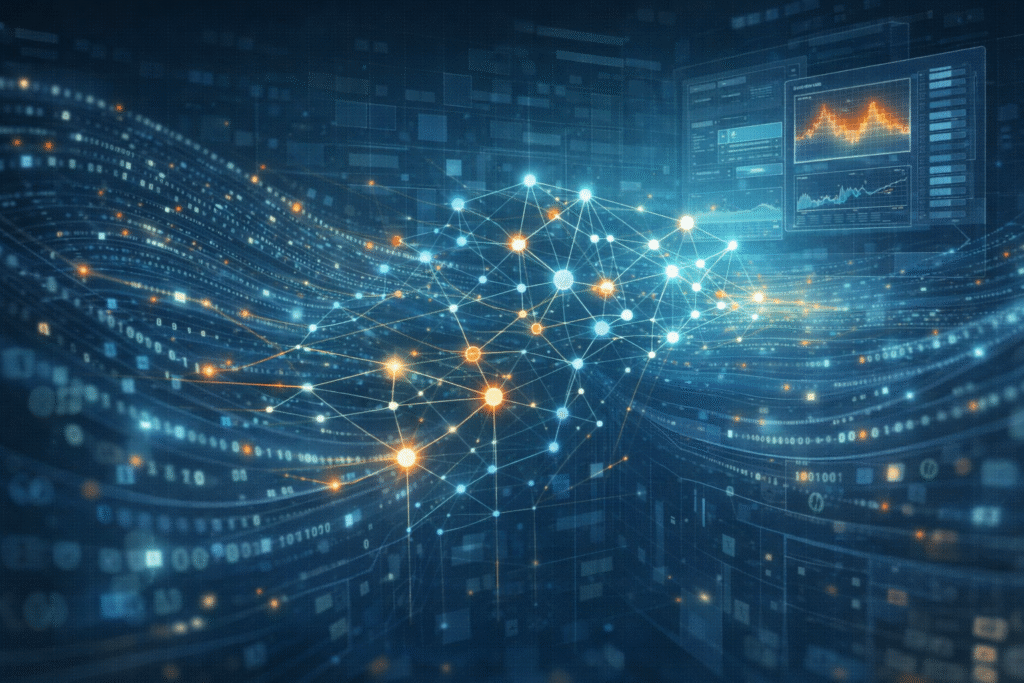
    Abstract visualization of artificial intelligence making predictions

    Data-Driven Prediction

    Modern AI systems generate instant predictions by processing enormous datasets.

    In medicine, for example, AI can analyze X-ray images and detect diseases faster—and sometimes more accurately—than human experts.
    These outputs resemble intuitive judgments.

    A Fundamental Difference

    Yet there is a crucial distinction.

    Human intuition integrates perception, emotion, and lived experience within a holistic context.
    AI, by contrast, calculates statistical patterns and outputs probabilities.

    AI may simulate intuition, but it does not experience it.
    Its judgments are produced without awareness, embodiment, or meaning.


    3. Crisis and Opportunity in Human Uniqueness

    The Threat to Human Specialness

    If AI were to replicate intuition flawlessly, one of humanity’s long-held markers of uniqueness would be challenged.

    Intuition has been central to how we understand creativity, expertise, and insight.
    Its automation raises understandable existential anxiety.

    Intuition as Collaboration

    Yet this development can also be interpreted differently.

    Rather than replacing human intuition, AI may serve as a complementary tool—handling probabilistic complexity while freeing humans to engage in deeper reflection, creativity, and ethical judgment.

    In this partnership, intuition becomes a bridge rather than a battleground.


    4. Beyond Intuition: What Makes Us Human

    Meaning, Not Just Judgment

    Even if AI can imitate intuitive decision-making, human intuition is not merely instrumental.

    It is embedded in narrative, emotion, and personal history.
    An artist’s inspiration, a parent’s sudden sense of danger, or a visionary leap into the unknown cannot be reduced to pattern recognition alone.

    Humans as Meaning-Makers

    AI may calculate intuition.
    Humans, however, assign meaning to it.

    We interpret intuitive insights within ethical frameworks, emotional relationships, and life stories.
    This capacity to care about intuition—to treat it as meaningful rather than functional—marks a fundamental difference.

    A reflective human moment emphasizing meaning and values

    Conclusion: Rethinking Intuition in the Age of AI

    If AI can perfectly imitate human intuition, human uniqueness will no longer rest on intuition alone.

    Instead, it will lie in our ability to interpret, evaluate, and weave intuition into narratives of value and purpose.

    The question, then, shifts:

    If AI can possess intuition, how must humans rethink what intuition truly is?

    Within that question, the distinction between human and machine becomes visible once again.

    Related Reading

    The ethical dimension of artificial cognition is further examined in If AI LIf AI Learns Human Morality, Can It Become an Ethical Agent?earns Human Morality, Can It Become an Ethical Agent?, questioning whether imitation can evolve into responsibility.

    The cultural implications of technological mediation are explored in LiLiving with Virtual Beings: Companionship, Comfort, or Replacement?ving with Virtual Beings: Companionship, Comfort, or Replacement?, where emotional substitution becomes a central theme.


    References

    1. Thinking, Fast and Slow
      Kahneman, D. (2011). Thinking, Fast and Slow. Farrar, Straus and Giroux.
      → Distinguishes intuitive (System 1) and analytical (System 2) thinking, framing intuition as experience-based cognitive efficiency.
    2. Gut Feelings
      Gigerenzer, G. (2007). Gut Feelings: The Intelligence of the Unconscious. Viking.
      → Interprets intuition as an evolved adaptive strategy rather than irrational impulse.
    3. How to Use Intuition Effectively in Decision-Making
      Sadler-Smith, E. (2015). Journal of Management Inquiry, 24(3), 246–255.
      → Examines intuition in organizational decision-making and contrasts it with data-driven systems.
    4. The Tacit Dimension
      Polanyi, M. (1966). The Tacit Dimension. University of Chicago Press.
      → Introduces the idea that humans know more than they can explicitly articulate, grounding intuition philosophically.
    5. What Computers Still Can’t Do
      Dreyfus, H. L. (1992). What Computers Still Can’t Do. MIT Press.
      → A philosophical critique of artificial reason, highlighting limits of machine imitation of human understanding.

  • If AI Can Predict Human Desire, Is Free Will an Illusion?

    If AI Can Predict Human Desire, Is Free Will an Illusion?

    We believe our choices are our own.
    What to wear in the morning, what to eat for lunch, even life-changing decisions—
    we trust that they come from our inner will.

    Yet today, artificial intelligence analyzes our search histories, purchases, and online behavior with startling accuracy.
    It often knows what we want before we consciously decide.

    If AI can predict our desires almost perfectly,
    is free will still real—or merely a convincing illusion?


    1. The Age of Predictive Algorithms

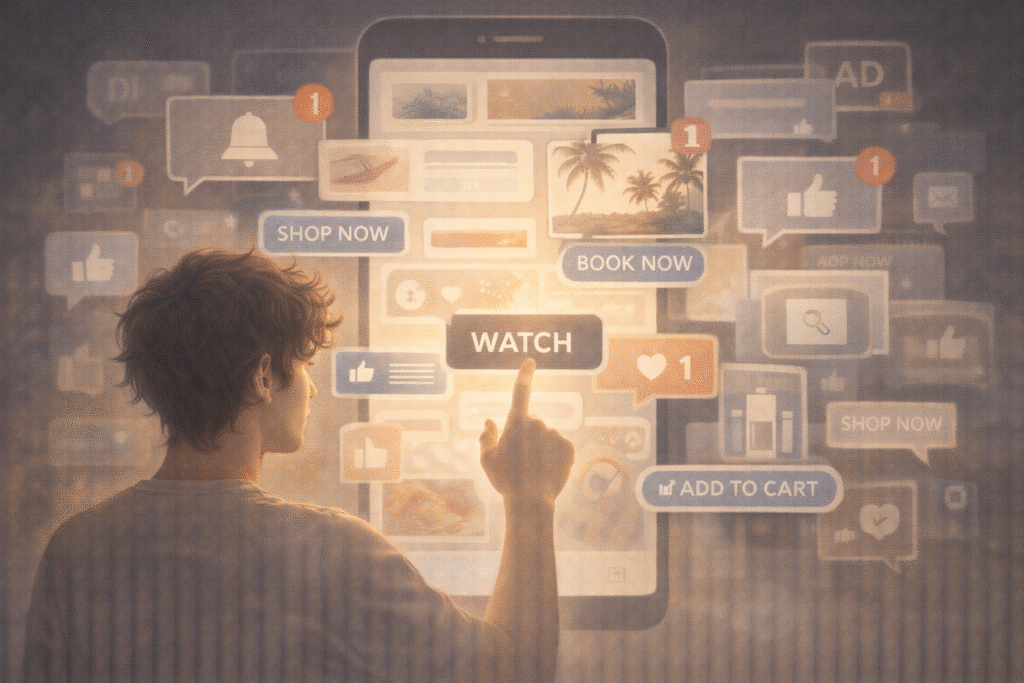
    Individual facing algorithm-driven choices on a digital screen

    Recommendation systems already guide much of our everyday decision-making.
    Streaming platforms anticipate which films we will enjoy, online stores predict what we might buy next, and social media curates content tailored to our emotional responses.

    In many cases, we believe we choose freely,
    but what we encounter has already been filtered, ranked, and presented by algorithms.

    This raises a disturbing possibility:
    our decisions may not be independent acts of will, but statistically predictable outcomes embedded in data patterns.


    2. Free Will and Determinism Revisited

    Philosophically, this dilemma is not new.
    If human behavior is shaped by genetics, environment, and past experiences, does free will truly exist?

    In a deterministic universe, AI does not eliminate freedom—it merely reveals how predictable our choices already are.

    However, if free will is not absolute independence from all causes,
    but rather the capacity to reflect, assign meaning, and take responsibility within given conditions,
    then prediction does not necessarily negate freedom.

    Human freedom may lie not in escaping patterns,
    but in interpreting and responding to them consciously.


    3. The Danger of Desire Manipulation

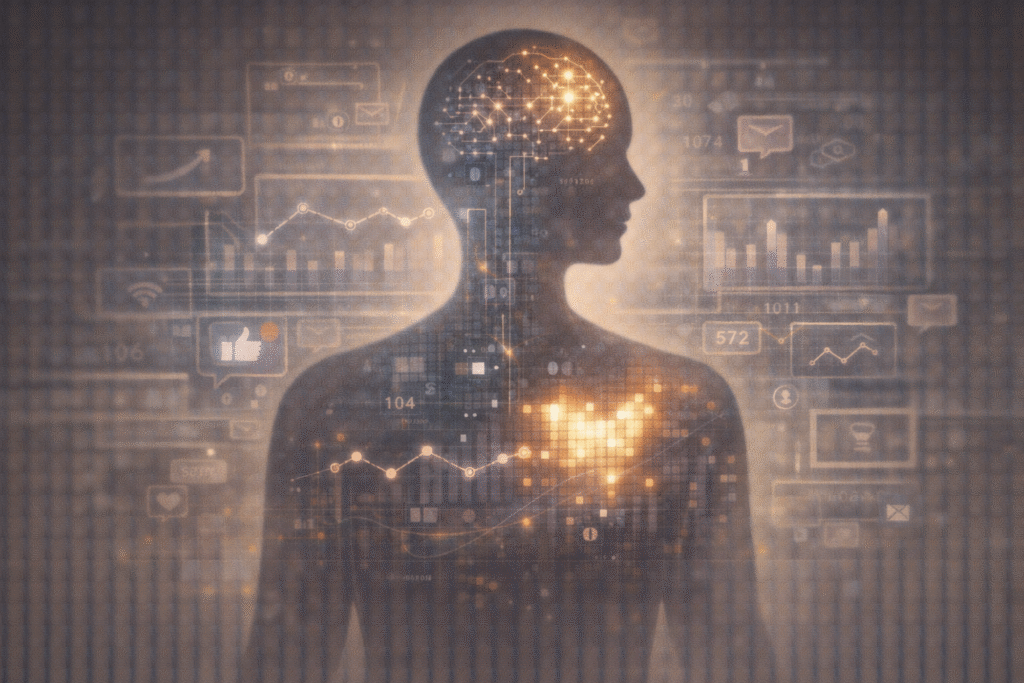
    Visualization of human desire shaped by algorithms and data patterns

    The real danger emerges when prediction turns into manipulation.

    Targeted advertising, emotionally optimized content, and data-driven political messaging no longer merely anticipate desire—they actively shape it.
    In such cases, individuals feel autonomous while unknowingly following pre-designed behavioral paths.

    When desire is engineered rather than chosen,
    free will risks becoming a carefully maintained illusion,
    and societies become vulnerable to subtle forms of control.


    4. Rethinking Freedom in the AI Era

    If freedom depends on unpredictability alone,
    then AI threatens its very existence.

    But if freedom means the ability to reflect on one’s desires,
    to accept or reject them,
    and to act with responsibility despite external influence,
    then human agency remains intact.

    AI may predict our impulses,
    but it cannot replace the reflective capacity to question them.

    5. Reclaiming Your Agency: Practicing Freedom in an Algorithmic World

    If freedom is not the absence of prediction, but the capacity for reflection,
    then freedom must be practiced, not assumed.

    You do not need to abandon technology to protect your agency.
    What you need is deliberate friction — moments that interrupt automated desire.

    One way to do this is through what might be called strategic randomness:
    small, intentional disruptions that remind us we are not merely reactive beings.


    Conclusion

    Human agency emerging within an algorithmic world

    The rise of AI prediction forces us to confront an uncomfortable question:
    Is free will an illusion, or simply misunderstood?

    Even if our desires follow recognizable patterns,
    the human capacity to interpret, resist, and redefine those desires has not disappeared.

    Perhaps the real question is not
    “Can AI predict human desire?”
    but rather,

    “How will we redefine freedom in a world where prediction is everywhere?”

    A Question for You

    If your desires can be predicted, do you still feel they are truly yours?


    Related Reading

    The broader relationship between technology and human autonomy is explored further in Do Humans Control Technology, or Does Technology Control Us?, which examines whether artificial intelligence remains a tool serving human intentions or gradually becomes a force that shapes human choices, values, and behavior. This wider perspective provides an essential foundation for understanding whether predictive AI challenges the very meaning of free will.

    On a practical level, similar questions emerge in Algorithmic Bias: How Recommendation Systems Narrow Our Worldview, which explores how recommendation systems quietly influence what we see, read, and believe. Together, these discussions illustrate how prediction and personalization may shape human decisions long before we become aware of their influence.

    References

    1.Libet, B. (1985). Unconscious cerebral initiative and the role of conscious will in voluntary action. Behavioral and Brain Sciences, 8(4), 529–566.
    A foundational experiment suggesting that neural activity precedes conscious awareness of decision-making, igniting modern debates on free will.

    2.Dennett, D. C. (2003). Freedom Evolves. New York: Viking.
    Argues that free will is compatible with determinism and emerges through evolutionary and social complexity rather than metaphysical independence.

    3.Zuboff, S. (2019). The Age of Surveillance Capitalism. New York: PublicAffairs.
    Analyzes how data-driven prediction and behavioral modification threaten autonomy and democratic agency.

    4.Frankfurt, H. G. (1971). Freedom of the will and the concept of a person. Journal of Philosophy, 68(1), 5–20.
    Introduces the idea of second-order desires, redefining freedom as reflective endorsement rather than mere choice.

    5.Bostrom, N. (2014). Superintelligence: Paths, Dangers, Strategies. Oxford: Oxford University Press.
    Explores how advanced AI could reshape human autonomy, control, and moral responsibility.

  • The Illusion of “Free”: How Zero Price Changes Our Decisions

    The Illusion of “Free”: How Zero Price Changes Our Decisions

    Why does paying nothing sometimes make us want something more?

    I recently found myself adding one more item to an online shopping cart.

    I did not particularly need it.

    In fact, a few minutes earlier, I had no intention of buying it at all.

    Then a message appeared:

    “Add $8 more to qualify for free shipping.”

    Suddenly, spending more money felt strangely preferable to paying a small delivery fee.

    I paused for a moment.

    Why was I willing to buy something I did not need simply to avoid paying for shipping?

    The numbers were easy enough to understand.

    My reaction was not.

    That small moment reveals something surprisingly powerful about human decision-making.

    When a price becomes zero, we do not always treat it simply as a lower price. “Free” can change the way we think.

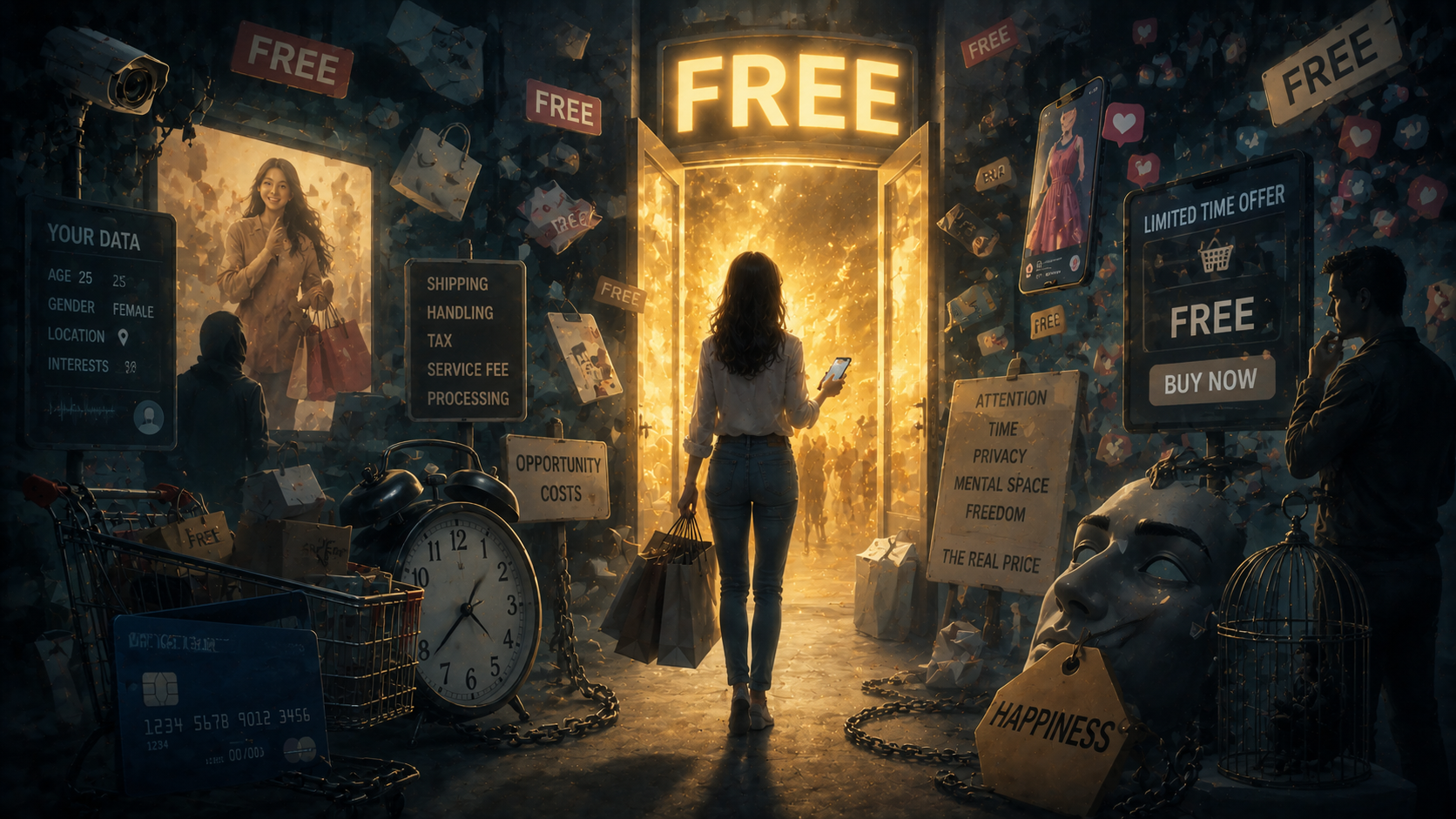
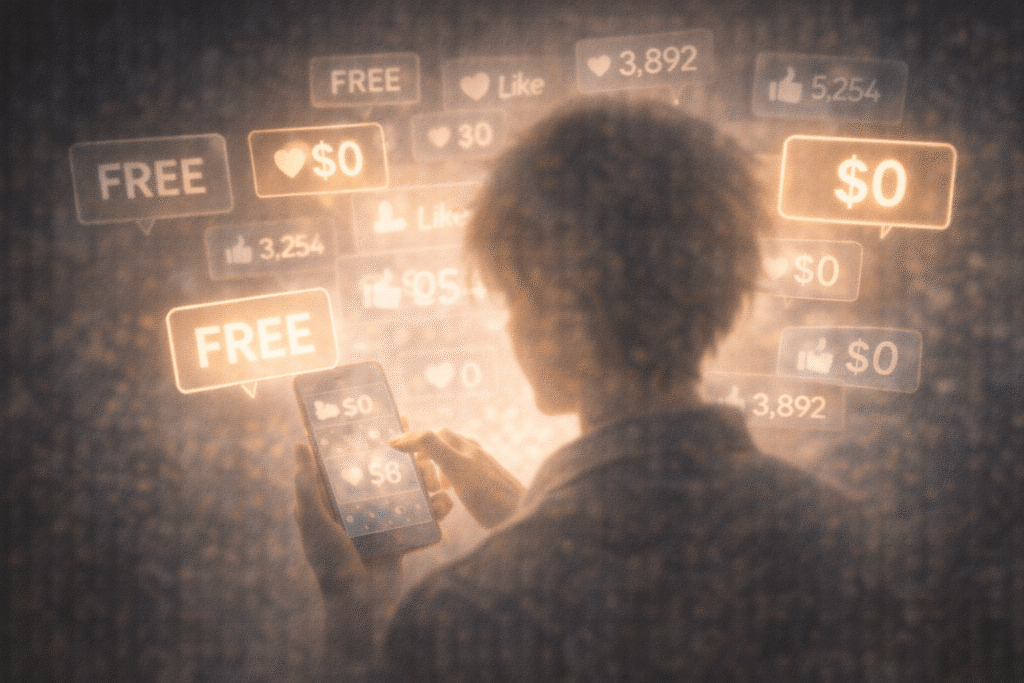
    A consumer drawn toward a free offer in a store

    1. The Magic of Free: The Belief That We Lose Nothing

    From an economic perspective, “free” does not necessarily mean beneficial.

    A free offer can encourage us to acquire something we never intended to have—or even spend more money elsewhere in order to obtain it.

    Yet psychologically, zero has a peculiar attraction.

    When something costs even a small amount, we tend to consider the trade-off:

    Is it worth the price?

    When the price disappears, that calculation can weaken.

    The word FREE seems to remove the possibility of loss, leaving only the feeling of gain.

    Behavioral economist Dan Ariely, together with Kristina Shampanier and Nina Mazar, demonstrated this phenomenon through experiments involving chocolate.

    Participants chose between a more desirable chocolate at a higher price and a less expensive chocolate at a very low price. When both prices were reduced by the same amount—but the cheaper chocolate became free—preferences shifted disproportionately toward the free option.

    The monetary difference had changed only slightly.

    Psychologically, however, crossing the boundary from almost nothing to nothing changed the decision dramatically.

    Researchers describe this as the zero-price effect.


    2. The Psychological Reward Behind Free

    Why is zero so powerful?

    One explanation is that free offers do more than save money.

    They also create positive emotion.

    Getting something without paying can feel like a small victory. There is no obvious financial sacrifice to weigh against the pleasure of receiving it.

    Consider free shipping.

    Suppose delivery costs $2.50, but an online store offers free shipping once the order reaches a certain amount.

    A shopper may add an unnecessary item costing considerably more than $2.50 simply to avoid the delivery charge.

    From a purely financial perspective, this makes little sense.

    Yet emotionally, paying for shipping can feel like a loss, while receiving “free shipping” feels like winning.

    The strange result is that we may spend more in order to feel that we paid less.

    Psychological bias triggered by free digital offers

    3. The Hidden Costs of Free

    Of course, many things described as free still involve an exchange.

    A free app may require us to watch advertisements.

    A free digital service may collect information about our behavior.

    A free trial may lead automatically to a paid subscription unless we remember to cancel it.

    What disappears as monetary cost can reappear as attention, data, time, or future commitment.

    This does not mean that every free service is deceptive.

    Many free products and services provide genuine value.

    The important question is different:

    What am I giving in return?

    Sometimes the answer really is very little.

    Sometimes the cost is simply hidden somewhere other than the price tag.


    4. When “Free” Enters Social Relationships

    There is another kind of free offer that operates through a somewhat different psychological mechanism.

    Imagine walking through a store and receiving a free sample from a salesperson.

    After accepting it, you may suddenly feel slightly more inclined to listen to the sales pitch—or even purchase something.

    Here the effect is not simply the attraction of a zero price.

    It can also involve what psychologist Robert Cialdini describes as the principle of reciprocity: when someone gives us something, we often feel an impulse to give something back.

    A gift therefore carries psychological meaning even when no repayment has been requested.

    This helps explain why free samples, complimentary trials, and small promotional gifts can be commercially effective.

    The product costs us nothing.

    But receiving it may subtly change the relationship between giver and receiver.


    5. How Can We Think More Clearly About “Free”?

    We live surrounded by free trials, free shipping, free apps, free samples, and free content.

    There is nothing inherently wrong with enjoying them.

    The challenge is simply to prevent the word FREE from ending our thinking.

    Three questions can help:

    • Would I want this if it were not free?
    • What am I giving up besides money—time, attention, data, or future commitment?
    • Am I choosing this because it is valuable to me, or because zero makes it feel valuable?

    These questions do not eliminate the psychological attraction of free.

    But they restore something important: a moment of reflection between the offer and the decision.


    Conclusion

    Mindful decision making beyond free offers

    The most interesting thing about “free” is not that it saves us money.

    It is that zero can change the way value itself feels.

    A product we barely wanted can suddenly become attractive. A shipping fee we could easily afford can persuade us to spend even more. A small gift can create an unexpected sense of obligation.

    This does not mean that free offers are traps.

    Sometimes free really is a good deal.

    But perhaps the wisest response is to remember the question I should have asked when that free-shipping message appeared on my screen:

    If this were not free, would I still want it?

    The moment we ask that question, zero loses some of its magic.

    And our decision becomes ours again.

    A Question for You

    Have you ever bought something unnecessary
    simply because a “free” offer made it feel worthwhile?


    Related Reading

    Everyday experiences of perceived value, delay, and fairness are also discussed in The Sociology of Waiting in Line.

    At a political level, this economic logic feeds into debates about freedom and responsibility in The Minimal State: An Ideal of Liberty or a Neglect of the Common Good?

    Human decision-making is deeply influenced by reward systems and emotional reinforcement.
    Why Is Candy a Symbol of Reward for Children? explores how simple rewards shape behavior and emotional expectation from an early age.

    References

    1. Ariely, D. (2008). Predictably Irrational: The Hidden Forces That Shape Our Decisions.
      Explains the “zero price effect” and how free offers distort rational decision-making.
    2. Cialdini, R. B. (2006). Influence: The Psychology of Persuasion.
      Introduces the principle of reciprocity and why people feel compelled to respond to free gifts.
    3. Shampanier, K., Mazar, N., & Ariely, D. (2007).
      Zero as a Special Price: The True Value of Free Products. Marketing Science, 26(6), 742–757.
      Empirically demonstrates why free products trigger emotional rather than rational responses.