Tag: daily-reflection

  • Familiar Solitude – The Quiet Comfort of Being Alone

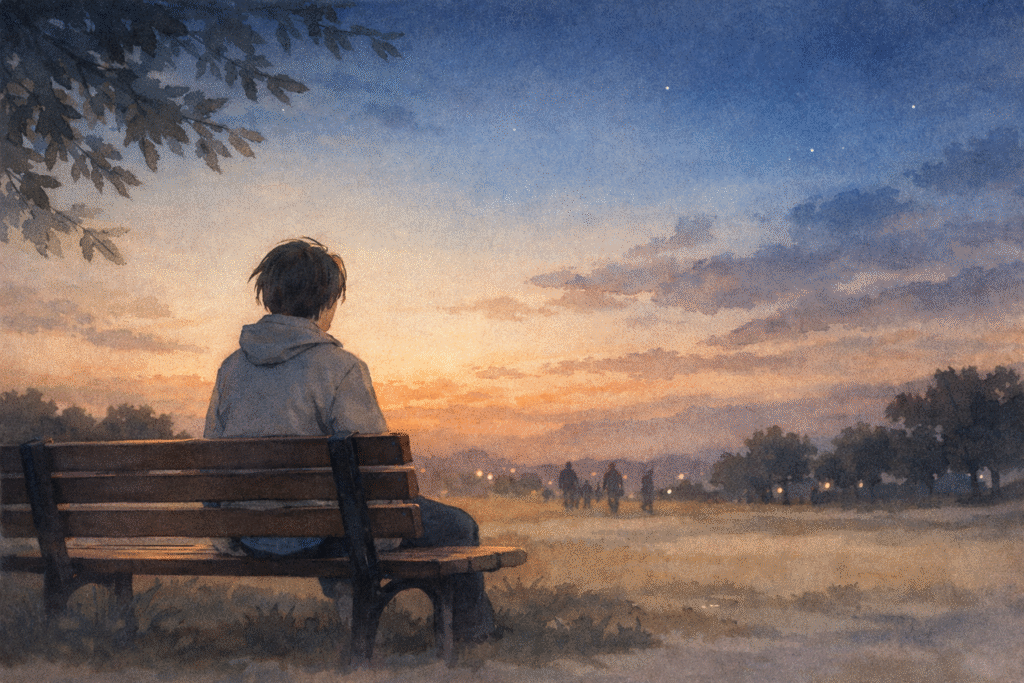
    Emotional watercolor illustration, person sitting alone on a park bench

    1. A Small Moment of the Day

    On a weekend evening, a park bench feels more inviting than a café.
    The sun slips away, the afterglow softens, and a gentle breeze moves through the trees.
    From a distance, children’s laughter drifts by.

    A smile appears—unexpectedly.
    There is no loneliness here.
    In fact, this calm feels comforting.

    Moments arrive when being alone feels entirely enough.
    Solitude turns out to be less empty than expected,
    and surprisingly, it becomes the time when understanding oneself comes most easily.


    2. A Light Thought for Today

    “Loneliness is like a battery-saving mode for people.”
    “Then how do we recharge?”
    “Sometimes, by being alone—
    the heart charges itself.”

    A quiet chuckle lingers.


    3. Reflection – What This Moment Revealed

    There was a time when being alone felt difficult.
    Meals were eaten with a phone for company,
    and empty weekends brought unease.

    Then a question quietly surfaced:
    “Is loneliness always something to avoid?”

    Solitude is not isolation.
    It is a reconnection—with oneself.

    Without expectations or watchful eyes,
    thoughts slow to a natural pace.
    Inner noise begins to fade.

    And a realization settles in:
    “When alone, honesty comes more easily.”

    Emotional watercolor illustration, solitary walk under streetlights

    4. A Gentle Practice

    Designing a Personal Walking Route

    Find a quiet path near home.
    Leave music and notifications behind.
    Focus only on footsteps and breath.

    Notice what thoughts arise.
    Write them down afterward.

    This simple walk becomes a diary for the mind.


    5. A Small Action for the Day

    Tonight’s walk feels different.
    Under streetlights, fallen leaves rustle softly—
    a sound that feels oddly reassuring.

    There is no need for company.
    A whisper forms:
    “This isn’t loneliness.
    It’s a conversation with myself.”

    At the end of the path, the sky is lifted into view.
    Darkness has settled, yet starlight remains.

    Quiet does not mean empty.
    Light still finds its way through.


    6. Quote of the Day

    “In solitude the mind gains strength and learns to lean upon itself.”
    — Laurence Sterne


    Emotional watercolor illustration, calm night sky with soft starlight

    7. Closing – Returning Gently to Ourselves

    Loneliness can trouble us,
    but hidden within it is time reclaimed.

    Time without comparison.
    Time free from borrowed pace.

    Familiar solitude becomes a gentle companionship—
    a calm walk alongside oneself.

    And in that quiet presence,
    peace begins to grow.


    8. A Thought to Remember

    Philosophers have long reflected on solitude.
    Some describe it as a fundamental condition of human existence—
    a space where genuine thought and reflection are possible.

    In this sense, being alone is not a lack,
    but a ground for growth.


    9. Today’s One-Line Insight

    “Time alone is not absence—
    it is the quiet pause that restores us.”

  • A Night Sky Narrative – A Quiet Story Told by Starlight

    Emotional watercolor illustration, person gazing at starlight through a window

    1. A Small Moment of the Day

    Late at night, the lights are turned off and a pause is taken by the window.
    The city remains awake below,
    but the sky above quietly gathers the dark.

    Between drifting clouds, starlight appears in scattered fragments.
    It is neither bright nor dramatic,
    yet it is strangely difficult to look away.

    “The stars have always been there…
    why do they feel as if they’re speaking tonight?”

    Breathing slows.
    Words fall away.
    For a while, the night sky is simply watched in silence.


    2. A Light Thought for Today

    Counting stars seems like a good idea—
    until it quickly isn’t.

    “One, two, three… wait, is that a star or an airplane?”

    A small laugh follows.
    “Right.
    Tonight, what matters more than the number of stars
    is the state of my own heart.”


    3. Reflection – What This Moment Revealed

    Stars do not speak.
    Yet when people look at them,
    their own stories begin to surface.

    Waiting.
    Farewell.
    Hope.
    Regret.

    Starlight refuses none of these emotions.
    It does not correct, interrupt, or judge.
    It simply remains.

    And that is when a realization arrives:
    the night sky comforts not because it offers answers,
    but because it allows space for one’s own story to emerge.

    Stars never rush.
    They wait patiently—even for feelings not yet ready to be named.

    Emotional watercolor illustration, quiet figure looking up at stars

    4. A Gentle Practice

    Speaking to the Stars

    Tonight, look up at the sky
    and bring to mind one sentence you have been carrying.

    It may be something you never said to another,
    or a question you left unanswered within yourself.

    Then say it quietly, inwardly if you wish:
    “This is the story I am holding right now.”

    The stars will not respond—
    yet in their silence,
    the heart often feels lighter.


    5. A Small Action for the Day

    Set the phone aside.
    Breathe in the night air slowly.

    And say, without urgency:
    “Today, I carried this much—and I made it here.”

    That acknowledgement alone
    is enough to soften the night.

    The starlight remains unchanged,
    but the darkness no longer feels empty.


    6. Quote of the Day

    “We are all in the gutter, but some of us are looking at the stars.”
    — Oscar Wilde


    7. Closing – Returning Gently to Ourselves

    Emotional watercolor illustration, silent night sky filled with soft stars

    The night sky does not tell grand stories.
    Instead, it quietly makes room
    for the stories already within you.

    Under the stars,
    you are allowed to lay your narrative down for a moment.

    Starlight does not judge.
    It does not hurry you forward.
    It simply stays.

    And sometimes, that is all the comfort we need.


    8. A Thought to Remember

    Psychology describes a cosmic perspective effect
    the tendency to perceive personal concerns as smaller
    when gazing at the night sky or the vastness of space.

    This shift in perspective can ease anxiety
    and restore emotional balance.

    Looking at the stars, then,
    is not merely an aesthetic act—
    it is a quiet way of tuning the heart.


    9. Today’s One-Line Insight

    “Starlight says nothing,
    yet it listens to our stories until the end.”

  • Digital Nostalgia – Why Analog Feelings Still Call to Us

    1. A Small Moment of the Day

    Emotional illustration, person pausing at an old record shop

    On the way home after work, an old record shop in a narrow alley brings footsteps to a pause.
    From the slightly open door comes the faint crackle of a needle touching vinyl—
    a sound that feels strangely familiar.

    “This sound… it’s been a while.”

    Music on a phone is always clean.
    No noise, perfect quality, endlessly selectable.
    And yet, something imperfect and warm feels deeply missed.

    After a moment, a quiet realization surfaces:
    “Perhaps I’ve grown too used to a world that is only smooth.”


    2. A Light Thought for Today

    “Why do people like analog things?”
    “Thinking back… changing batteries used to be exciting.”
    “Why?”
    “Because when the batteries wore out, it felt like proof that time—and even my feelings—were being used.”

    A soft laugh follows.


    3. Reflection – Why the Analog Heart Longs

    Emotional illustration, hands holding a vintage analog object

    Life in the digital age is fast and convenient.
    But convenience often smooths away the texture of emotion.

    We take hundreds of photos that never stay with us.
    Messages leave only a “read” mark behind.
    Music flows in algorithmic order.
    Even meeting people is managed by scheduling apps.

    Everything is precise and efficient—
    yet we continue living inside unorganized feelings.

    This is why analog sensibility lingers.

    Because it is imperfect.
    Because it is inconvenient.
    Because it is slow and slightly unsteady.

    Within that unpolished space,
    we feel the true temperature of the heart.

    Memories surface of a film camera once held in childhood.
    Photos couldn’t be checked immediately.
    Waiting was required.
    The shutter sounded different every time.

    Yet the excitement of receiving developed photos
    is something thousands of digital images can never replace.

    And then it becomes clear:
    “It’s not analog objects I miss—
    it’s the version of myself that lived through them.”


    4. A Gentle Practice

    Creating One Analog Moment Today

    Try one small analog act today:

    • Write a single sentence by hand
    • Open an old book at random
    • Take one unfiltered photo
    • Listen to the radio instead of streaming
    • Send a voice message instead of text

    These moments are imperfect—
    and that imperfection becomes a record of feeling.


    5. A Small Action for the Day

    At home, a small notebook opens.
    One simple sentence is written:

    “Today, I breathed in something analog.”

    The handwriting is uneven.
    Ink blurs slightly.

    Yet in those imperfect lines,
    the heart quietly settles back into its own place.


    6. Quote of the Day

    “The more digital we become, the more analog our hearts remain.”


    7. Closing – Returning Gently to Ourselves

    Emotional illustration, handwritten notes under warm light

    A perfectly edited world can sometimes erase us.
    Analog feeling, however, allows us to exist as we are—
    unsteady, incomplete, real.

    When perfection steps aside,
    emotion returns to its natural shape.

    May one small analog moment today
    become a warm breath for your heart.


    8. A Thought to Remember

    The word “analog” comes from the Greek analogos,
    meaning “proportional” or “corresponding.”

    Analog warmth is not mere nostalgia—
    it reflects a way of experiencing the world
    by resemblance, rhythm, and shared feeling.


    9. Today’s One-Line Insight

    “Convenience cannot replace emotion;
    at heart, we remain slow, warm beings.”

  • A Rainy Afternoon – Learning Calm When the Heart Grows Wet

    Emotional illustration, person pausing under an umbrella

    1. A Small Moment of the Day

    On a rainy afternoon, the sound of raindrops brushing past the window brings footsteps to a pause.
    Walking home after getting off the subway, the sudden rain seems to slow the world itself.

    Raindrops tapping on an umbrella.
    The faint scent rising from wet streets.
    A gentle rhythm that seeps quietly into the heart.

    A thought appears without effort:
    “When it rains… my heart seems to grow damp as well.”

    Yet this dampness feels strangely comforting.
    There is a steady calm in it—
    one that wraps around the body like a soft weight.


    2. A Light Thought for Today

    As the umbrella flips inside out in the wind, a quiet mutter slips out:
    “Ah… maybe umbrellas and I were never meant for each other.”

    When it happens again, the thought shifts:
    “Alright then. Let’s just get wet—both of us.”

    A small laugh follows.
    Hidden within the rain, it feels lighter than expected.


    3. Reflection – What This Moment Revealed

    The calm of a rainy afternoon is not only about the weather.

    ① Rain slows the pace of the heart
    Raindrops fall with steady patience.
    In their rhythm, tangled thoughts begin to loosen.
    A question surfaces quietly:
    “Why have I been living in such a hurry?”

    ② Rain becomes a window for emotion
    On rainy days, emotions rise more easily—
    loneliness, gentleness, courage, reflection.
    Within them are feelings we may have rushed past earlier in the day.

    ③ Wetness signals a pause
    Though being soaked sounds uncomfortable,
    this moment of wetness gently asks us to stop
    and look inward.

    The realization settles:
    “Rain is telling me it’s okay to rest.”


    Emotional illustration, quiet reflection by a rainy window

    4. A Gentle Practice

    A Five-Minute Rain Walk

    On a rainy day like today,
    take five slow minutes walking under an umbrella.

    Then write down three words that echo inside you.

    Silence
    Warmth
    Pause
    Thought
    Longing

    These words reveal the pace your inner world is learning.


    5. A Small Action for the Day

    After returning home, hang up the damp coat.
    Prepare a warm cup of tea.

    Watch the steam rise slowly.
    Close your eyes for a moment.

    And say, gently:
    “It’s okay to be a little wet.
    Resting this much today is enough.”

    The sound of rain outside and the warmth in the cup
    blend into a quiet, steady calm.


    6. Quote of the Day

    “Rain is grace; rain is the sky descending to the earth.”
    — John Updike


    7. Closing – Returning Gently to Ourselves

    Emotional illustration, warm tea steam in a calm room

    A rainy afternoon softens the pace of the world.
    The heart shifts, resists briefly,
    and then settles into ease.

    Without explanation, without demand,
    the rain seems to whisper:
    “It’s alright. You may move slowly today.”

    And in that softness,
    calm arrives—not suddenly, but gently.


    8. A Thought to Remember

    Psychology describes the white noise effect of rain.
    Natural, repetitive sounds reduce unnecessary stimulation,
    lower mental tension,
    and support emotional stability.

    This is why rain often feels comforting—
    it quiets what overwhelms.


    9. Today’s One-Line Insight

    “On a rainy afternoon, calm quietly seeps in when the heart allows itself to pause.”

  • Late-Night Comfort – In the Quiet Hours No One Notices

    Emotional watercolor illustration, person sitting under a desk lamp late at night

    1. A Small Moment of the Day

    Late at night, under the soft glow of a small desk lamp, everything finally grows quiet.
    The conversations of the day, the noise from screens, the thoughts that demanded attention—
    all of them fade away, leaving a rare stillness behind.

    Outside, the darkness deepens.
    Inside, the air feels warm.

    Holding a cup with both hands, a thought gently settles in:
    “This hour that no one notices… somehow feels the most peaceful.”

    For a moment, there are no eyes watching, no voices reaching in—
    only a space that belongs entirely to oneself.


    2. A Light Thought for Today

    A quiet murmur breaks the silence:
    “Everything feels so calm at this hour… Is everyone else asleep?”

    Then comes an immediate reply, almost amused:
    “Yes. And the reason you’re still awake is simple—
    your thoughts refused to go to bed.”

    A small smile lingers in the dim light.


    3. Reflection – What This Moment Revealed

    Late nights are strange.
    The same room, the same desk, the same self—
    yet everything feels subtly different.

    Concerns that felt heavy during the day
    sometimes soften at night.
    Thoughts that seemed harmless suddenly feel tender.

    Night asks questions gently:
    “How was today?”
    “Was it harder than you expected?”
    “Did you push yourself too much?”

    It does not demand answers.
    It simply listens.

    Perhaps that is why, late at night,
    we finally allow ourselves to be honest.

    Emotional watercolor illustration, person pausing to write in a quiet night room

    4. A Gentle Practice

    Keeping a Quiet Night Note

    Tonight, take just three minutes.
    Write one sentence about this quiet moment.

    For example:

    • “The air in my room feels warm.”
    • “Which words stayed with me the longest today?”
    • “Even in unseen hours, I still recognize myself.”

    This small note may become
    an unexpected comfort for tomorrow.


    5. A Small Action for the Day

    Lower the lamp just a little.
    Look at the cup as it slowly cools.

    Take one deep breath in, and let it out slowly.

    Then say—silently, if you wish:
    “You did well today.
    Even if no one else knows this hour, I do.”

    No one else needs to hear it.
    Sometimes, that is precisely what makes it comforting.


    6. Quote of the Day

    “At night, when the world sleeps, the soul finally speaks.”


    Emotional watercolor illustration, warm light filling a calm room at night

    7. Closing – Returning Gently to Ourselves

    Late-night comfort is never loud.
    Yet within its quietness lies a gentle warmth—
    one that carefully folds the day away.

    In hours no one notices,
    we become softer with ourselves,
    more honest,
    and quietly human again.

    May you remember this time tonight.
    And may you be able to say, before sleep arrives:

    “Well done. Today, too.”


    8. A Thought to Remember

    Psychological studies describe a night-time calming effect.
    As external stimulation decreases,
    the brain’s emotional processing slows,
    and stress hormones such as cortisol begin to decline.

    This is why late nights often feel deeper,
    and unexpectedly gentle.


    9. Today’s One-Line Insight

    “In unseen hours of the night, we quietly return to ourselves.”

  • The Name That Lingers – When Memory Refuses to Fade

    Emotional watercolor illustration, person pausing by a window in quiet reflection

    1. A Small Moment of the Day

    Today, an unexpected name surfaced from long ago.
    A name that still, when gently touched, causes a quiet stir in the heart.
    A face that time has not fully erased.

    “Why now?”
    Leaning against the window, a slow breath slipped out.

    The words once shared, fleeting scenes, a single laugh—
    all of them have blurred into distant scenery.
    Yet the name itself remains clear.

    Some names do not fade easily.
    They settle deep, leaving a quiet imprint that endures.


    2. A Light Thought for Today

    A soft murmur escaped:
    “Why do people from memory live so long?”

    Then came a smile.
    “Ah… maybe I never charged rent.
    No wonder they’re still here.” 😄

    Even memory allows room for humor.


    3. Reflection – What This Moment Revealed

    Memory is a curious thing.
    The harder we try to forget, the sharper it becomes.
    Just when we think something has passed, it returns.

    Sometimes we keep names alive without realizing it—
    making space for them quietly, over time.

    Was that person truly special?
    Or was it who we were back then?

    Perhaps names that linger do so
    because they left even the smallest mark
    in the process of becoming who we are now.

    Such people are not remnants of regret.
    They are traces of meaning.
    Not pain—but growth.


    Emotional watercolor illustration, person writing a quiet sentence from memory

    4. A Gentle Practice

    Leaving a Sentence for Memory

    Today, think of someone whose name has stayed with you longer than expected.
    Write one sentence you never said.

    For example:

    • “Your words helped me hold on.”
    • “A single name still moves me.”
    • “We were more sincere than we knew.”

    This sentence may become a quiet garden—
    a place where the heart can settle.


    5. A Small Action for the Day

    Close your eyes for a moment.
    Silently speak that name once.

    Then say, gently:

    “Thank you—for leaving a trace that kept me standing
    when I didn’t yet know how.”

    The words may never reach them.
    But they often reach us.

    Memory, at times, becomes comfort.
    At times, strength for tomorrow.


    6. Quote of the Day

    “Some people stay in our hearts even when they no longer stay in our lives.”


    7. Closing – Returning Gently to Ourselves

    Having an unforgettable name in memory
    is not a weakness.

    Remembering allows us to understand who we were—
    and to accept who we are now.

    Names that linger do not hold us back.
    They quietly prepare us to move forward.

    And perhaps it helps to say:

    “A name in memory helped shape me.
    And because of that, I am okay.”

    Emotional watercolor illustration, calm figure walking forward with soft light

    8. A Thought to Remember

    Neuroscience explains this through emotional memory encoding.
    Experiences paired with strong emotion activate the amygdala,
    storing memory more deeply and vividly.

    This is why some people are remembered long after brief encounters,
    and certain words remain untouched by time.

    An unforgettable name is not chosen by logic—
    but by the heart.


    9. Today’s One-Line Insight

    “The names that remain are the quiet traces that made us who we are.”