A Wooden Sculpture, a Memory of Roots, and a Reflection on Human Dignity
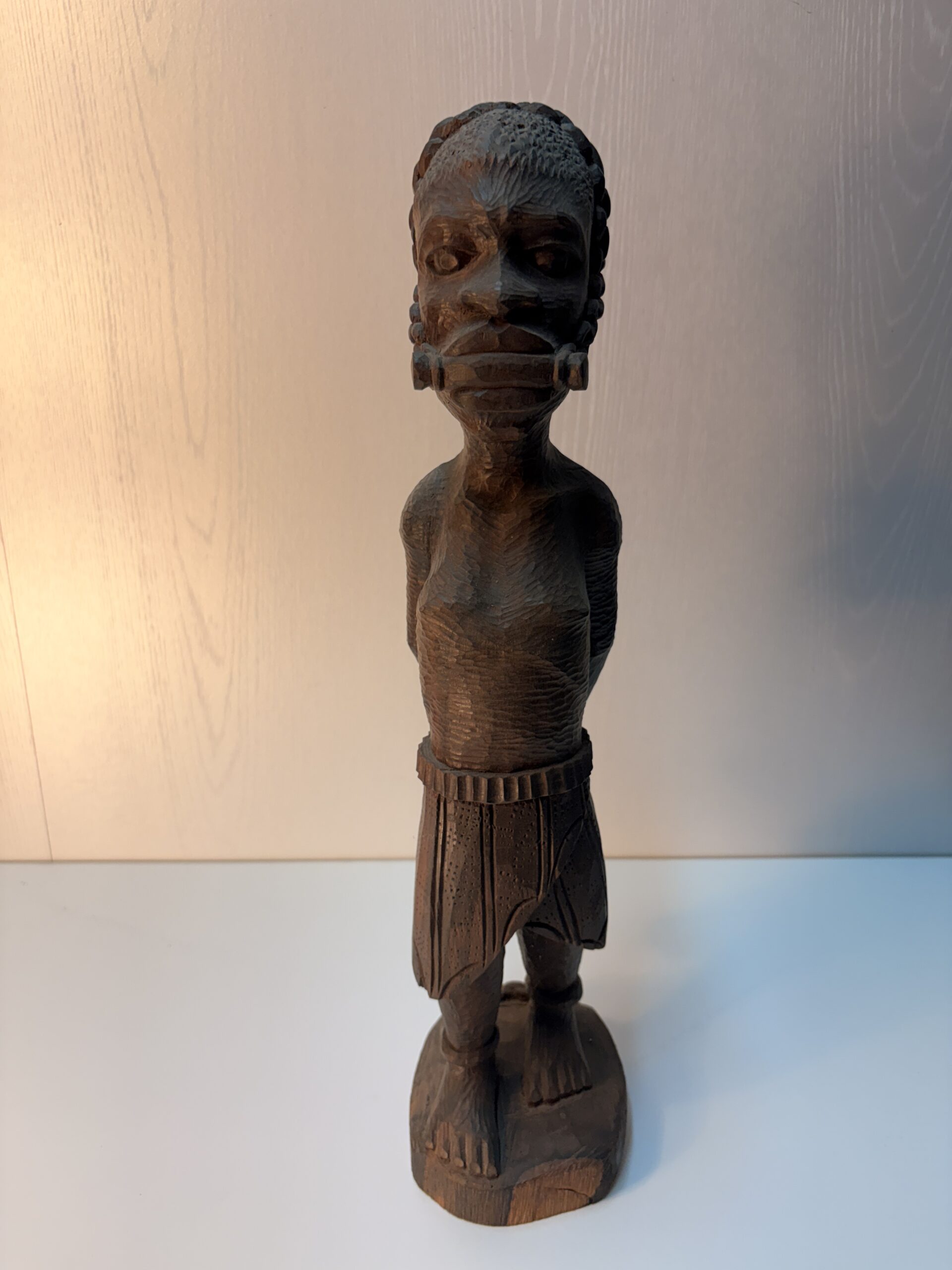
There is a wooden figure in my collection that I have lived with for more than thirty years.
It stands about 16.5 inches tall, with a narrow body carved from dark, heavily grained wood.
Among the many objects I have collected over the years, few have unsettled me as deeply as this one.
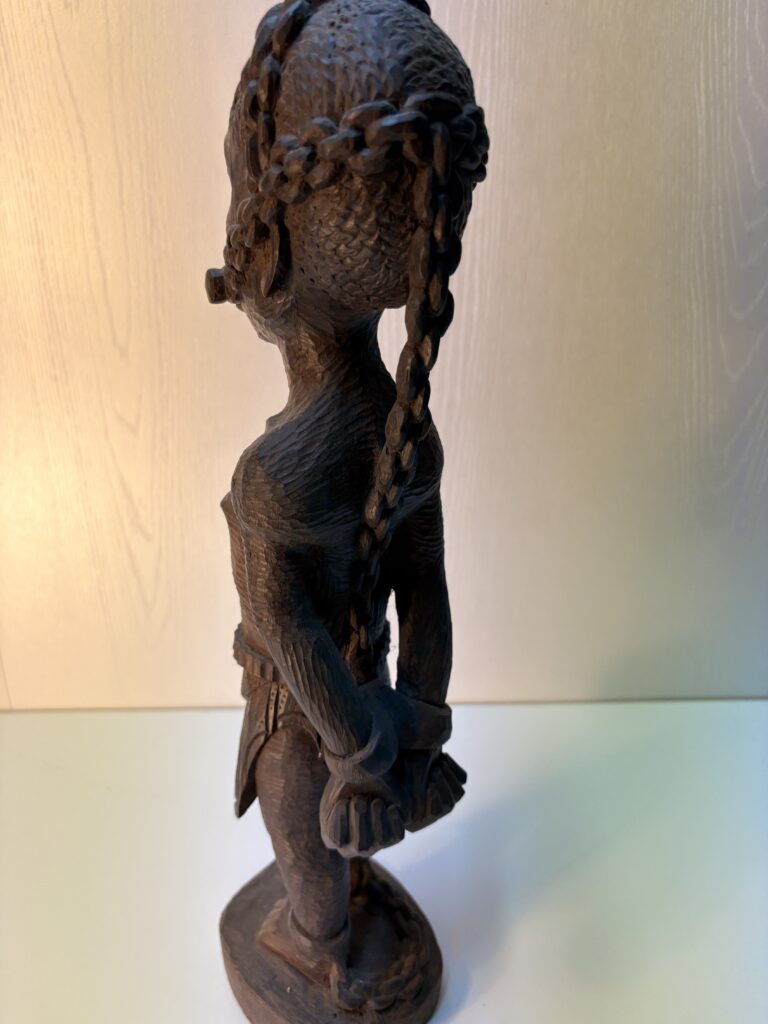
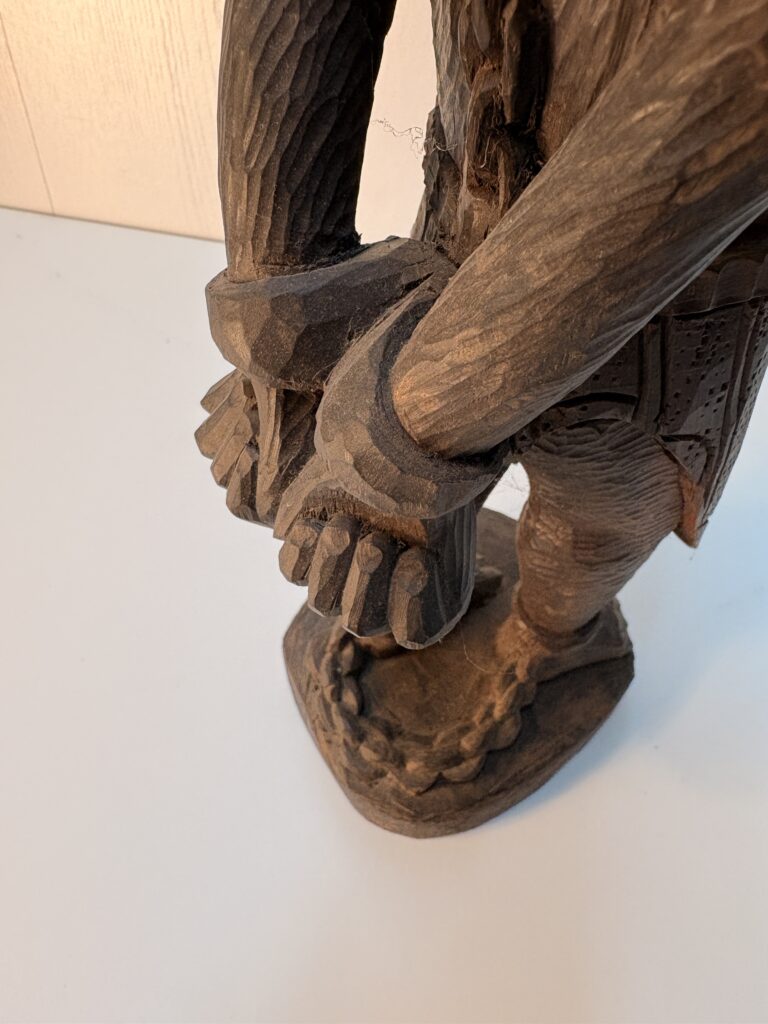
The hands appear bound.
The ankles seem restrained.
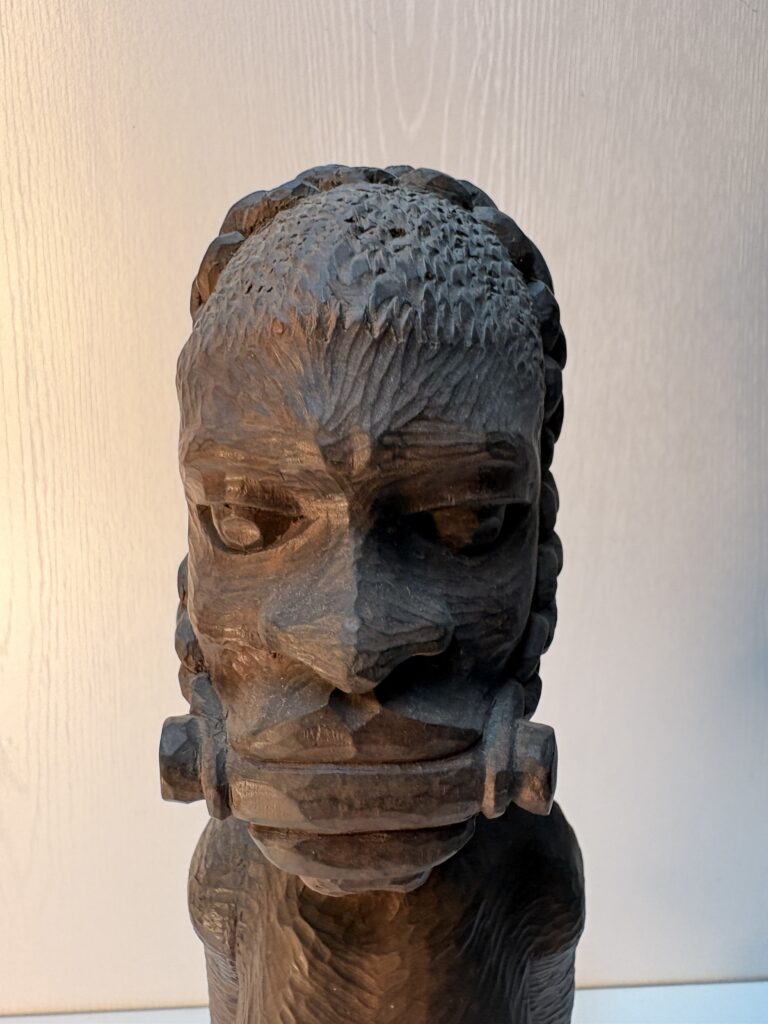
Across the mouth is what looks like a gag.
When I first saw it, I stood silently for a long time.
I did not know the story of the person who carved it. I did not know precisely where it had been made, when it had been created, or what meaning its maker intended.
And I still do not.
So I cannot claim that I know exactly what this figure represents.
But I know what I saw in it.
I saw a human being prevented from speaking.
This should be the clearest full-length photograph showing the entire sculpture. Let the reader encounter the object before you explain what it came to mean to you.
A Memory of Roots
Looking at the figure brought back a television series that had left a deep impression on me many years earlier: Roots.
The 1977 American television miniseries, based on Alex Haley’s novel, brought the history of slavery into millions of homes through the story of generations of an African American family.
One of its most enduring figures was Kunta Kinte.
What stayed with me was not simply the physical violence inflicted upon him, but the attempt to take away something even more fundamental—his name.
To erase a person’s name is to attack more than identity.
It is an attempt to tell that person:
Your story no longer belongs to you.
Yet Kunta’s struggle to hold on to his name became, for many viewers, a powerful image of dignity resisting erasure.
Years later, standing before this wooden figure, that memory returned.
The figure could not speak.
And perhaps because it could not speak, I found myself listening more carefully.
The Name I Gave It
Over time, I began privately calling the figure:
The Unspoken Name.
It was not the sculpture’s original title. I do not know whether it ever had one.
It was simply the name that emerged from my own encounter with it.
The more I looked, the more I noticed the contradiction in its posture.
The hands appear restrained.
The feet appear bound.
The mouth cannot speak.
And yet the body remains upright.
That uprightness became important to me.
I began to see it not merely as an image of suffering, but as an image of something suffering had failed to destroy.
Dignity.
Of course, that is my interpretation.
Another viewer might see something different.
But perhaps that is part of what old objects sometimes do.
They do not give us complete stories.
They leave spaces.
And into those spaces come memory, history, imagination, and questions.
Use a closer photograph showing the face, covered mouth, bound hands, and upright posture.
This is the emotional center of the article.
Why I Collected African Sculpture
For a period of my life, I collected African wooden figures and sculptures.
What drew me to them was not simply their visual form.
I was fascinated by the sense that objects could carry stories across enormous distances.
But today I also approach such objects with more caution.
A sculpture removed from its original cultural setting can easily lose its context. Without reliable information about its maker, community, purpose, or history, it is tempting for a collector to create a story that may never have belonged to the object at all.
That realization has changed the way I look at this figure.
I no longer want to say:
“This is what the sculpture means.”
I would rather say:
“This is what the sculpture has made me think about.”
That distinction matters.
The figure has made me think about slavery.
About forced silence.
About people whose names disappeared from written history.
About the distance between possessing an object and truly understanding the world from which it came.
And above all, about dignity.
When Silence Becomes a Voice
There is something paradoxical about this sculpture.
Its mouth appears silenced, yet it has prompted me to ask questions for more than thirty years.
Who made it?
Whom did the maker imagine?
Was it intended to represent captivity, punishment, resistance, memory—or something entirely different?
I cannot answer those questions.
Perhaps I never will.
But uncertainty does not make the object meaningless.
It simply asks me to look with humility.
History contains countless people whose voices never reached official records.
We know about kings, presidents, generals, and wealthy families because documents preserved their names.
Far fewer traces remain of ordinary people who were enslaved, displaced, colonized, silenced, or simply excluded from the written record.
Their absence is not evidence that they had no stories.
Sometimes absence itself tells us something about who had the power to record history.
A detailed photograph of the bound hands or ankles would work especially well here.
Rather than repeating another full-body shot, let this photograph reveal something the reader may have missed in the first image.
Thirty Years Later
The figure has aged beside me.
Its wooden base has become worn.
Its surface carries marks that seem more visible now than when I first acquired it.
And I have changed too.
Thirty years ago, I looked at it primarily with emotion.
Today, I look at it with emotion—but also with questions.
Perhaps that is what happens when we live with an object for a long time.
At first, we think we are examining it.
Eventually, we discover that it has been examining us.
What did I once assume too quickly?
What histories have I heard only from one side?
Whose voices have I failed to notice because they were quieter than the voices surrounding them?
The sculpture cannot answer.
It remains where it has always been.
Silent.
Upright.
Waiting.
Conclusion — Remembering Those Who Could Not Speak
Sometimes I sit near the figure with a cup of tea and look at it for a while.
I no longer try to give it a history I cannot verify.
Instead, I allow it to remind me of histories that must not be forgotten.
People whose words were never written down.
People whose names were changed or erased.
People who lived under systems that tried to control not only their bodies, but their identities.
And people who, in ways history may never fully record, preserved their dignity.
Perhaps that is why this small wooden figure has remained with me for more than thirty years.
Not because I know its story.
But because I do not.
Its silence leaves a question behind:
When history cannot tell us someone’s name, can we still learn to recognize their humanity?
For me, that question has become more powerful with time.
The figure says nothing.
And still, I find myself listening.
Reader Question
Have you ever encountered an object, image, or work of art that made you think about the voices history has forgotten? What did its silence say to you?
Related Reading
Sometimes silence invites us to listen more carefully. In Nipper and the Art of Listening, an old Victor keepsake becomes a quiet reminder of what it means to truly hear another voice.
In A Thousand-Year Kiss – When a Stone Begins to Tell a Love Story, another object kept for decades reveals how time, memory, and imagination can transform the meaning we discover in the things around us.