Tag: cultural heritage

  • Cultural Tourism and Commercialization

    Cultural Tourism and Commercialization

    Preserving Heritage or Turning Tradition into a Product?

    Every year, millions of travelers cross borders not simply to see famous landmarks but to experience cultures different from their own. Traditional festivals, historic villages, local crafts, music, cuisine, and rituals have become powerful attractions that shape the global tourism industry.

    Cultural tourism creates jobs, supports local businesses, and encourages the preservation of heritage. Yet its rapid growth also raises an important question: When culture becomes a tourist attraction, does it remain authentic, or does it gradually become a commercial product?

    From Venice struggling with overtourism to Kyoto balancing visitor demand with local traditions, communities around the world are searching for ways to protect cultural identity while benefiting from tourism. The debate is not whether tourism is good or bad, but how economic opportunity and cultural integrity can coexist.


    1. Why Cultural Tourism Matters

    More Than Sightseeing

    Cultural tourism allows visitors to engage with history, traditions, architecture, performing arts, and everyday local life. Unlike conventional tourism, it encourages deeper understanding between people from different cultures.

    UNESCO has repeatedly emphasized that cultural heritage is not only about preserving old buildings but also about protecting living traditions passed from one generation to another.

    An Economic Lifeline for Communities

    For many regions, cultural tourism provides a significant source of income.

    Historic towns, traditional markets, museums, and festivals generate employment for artisans, performers, guides, restaurants, and small businesses. Tourism often supplies the financial resources needed to maintain historical sites that might otherwise deteriorate.

    For example, South Korea’s Andong Hahoe Folk Village and Japan’s Gion Festival both demonstrate how cultural heritage can become an important economic asset while introducing local traditions to international visitors.


    2. The Case for Commercialization

    Economic Growth and Employment

    Supporters argue that tourism transforms cultural heritage into sustainable economic opportunities.

    Communities that once depended on declining traditional industries may find new sources of income through cultural experiences, handicrafts, local cuisine, and heritage-based tourism.

    Rather than replacing tradition, tourism can provide the financial support necessary to preserve it.

    Greater Global Appreciation

    International visitors often leave with a deeper understanding of cultures different from their own.

    Cultural exchange reduces stereotypes, encourages mutual respect, and strengthens international relationships through shared experiences rather than political narratives.

    Investment in Preservation

    Governments and private organizations are more likely to invest in restoring historical sites when tourism generates long-term economic value.

    Without visitors, many heritage sites might struggle to secure adequate funding for conservation.
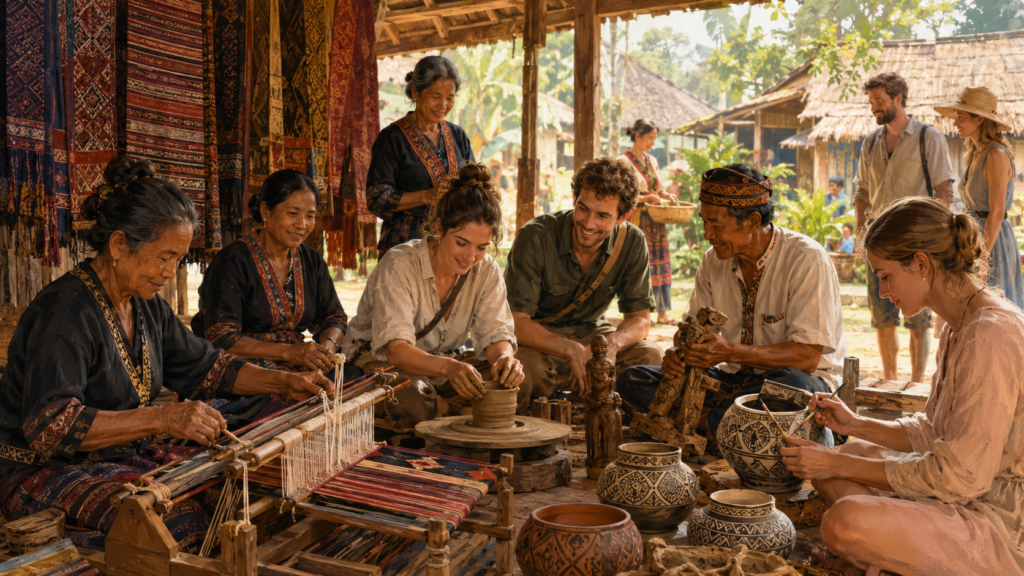
    local artisans sharing traditional culture with international visitors

    3. The Risks of Turning Culture into a Product

    When Authenticity Becomes Performance

    Critics argue that traditions sometimes change to satisfy tourist expectations.

    Traditional ceremonies may be shortened, modified, or performed outside their original cultural context simply because visitors prefer entertainment over authenticity.

    As a result, culture risks becoming a staged performance rather than a living tradition.

    Overtourism and Community Displacement

    Successful destinations can also become victims of their own popularity.

    Venice, Barcelona, Kyoto, and Mont Saint-Michel have all experienced tensions between tourism growth and residents’ quality of life. Rising housing costs, overcrowding, and commercialization may gradually push local communities away from the very places that represent their cultural identity.

    Environmental Costs

    Heavy tourist traffic increases waste, pollution, and pressure on fragile historical environments.

    Natural landscapes surrounding cultural sites also suffer when visitor numbers exceed sustainable limits.

    Economic success without environmental responsibility ultimately threatens the long-term survival of tourism itself.
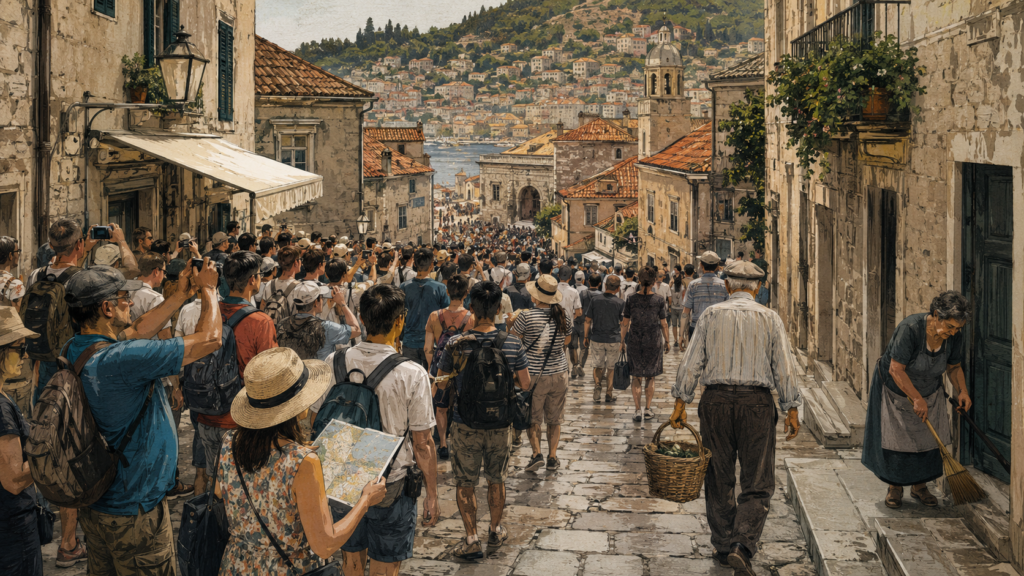
    historic town experiencing overtourism and pressure on local communities

    4. Finding a Sustainable Balance

    Community-Based Tourism

    Many experts argue that local residents should remain the primary decision-makers in tourism development.

    When communities control how their culture is presented, tourism is more likely to benefit local people while respecting traditional values.

    Protecting Living Heritage

    Culture should not simply be displayed—it should continue to evolve naturally within the community.

    Educational programs, traditional apprenticeships, and local participation help preserve heritage beyond commercial performances.

    Responsible Travelers Matter Too

    Sustainable tourism is not only the responsibility of governments or businesses.

    Visitors also influence whether destinations remain authentic.

    Respecting local customs, supporting family-owned businesses, reducing waste, and learning about cultural history all contribute to preserving the places people travel to experience.


    5. The Future of Cultural Tourism

    Beyond Profit Toward Partnership

    Increasingly, tourism is shifting away from mass consumption toward meaningful cultural experiences.

    Travelers today often seek authentic interactions rather than simply collecting photographs or checking famous landmarks off a list.

    This shift offers an opportunity to redefine tourism as a partnership between visitors and host communities rather than a purely commercial transaction.


    Conclusion
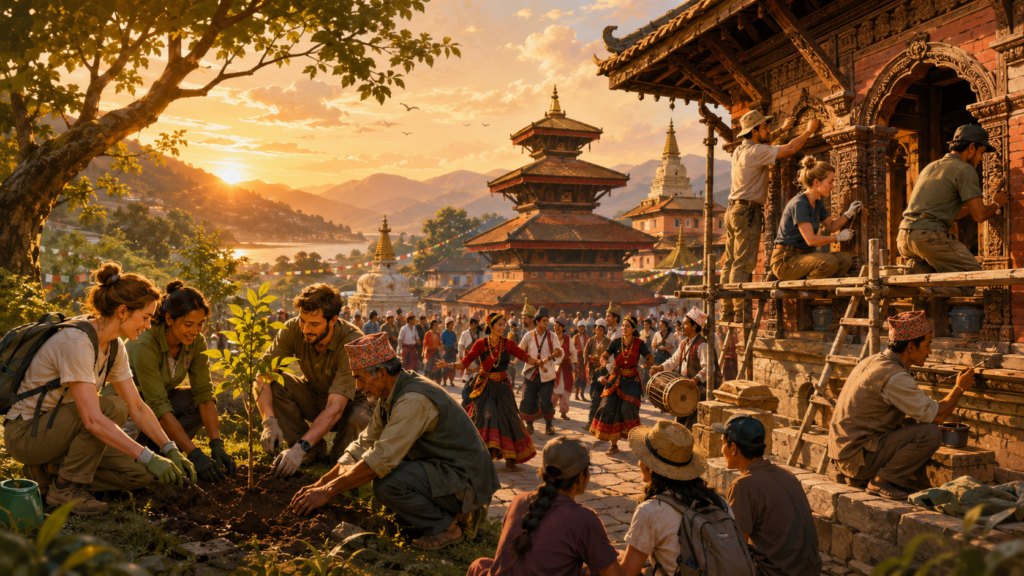
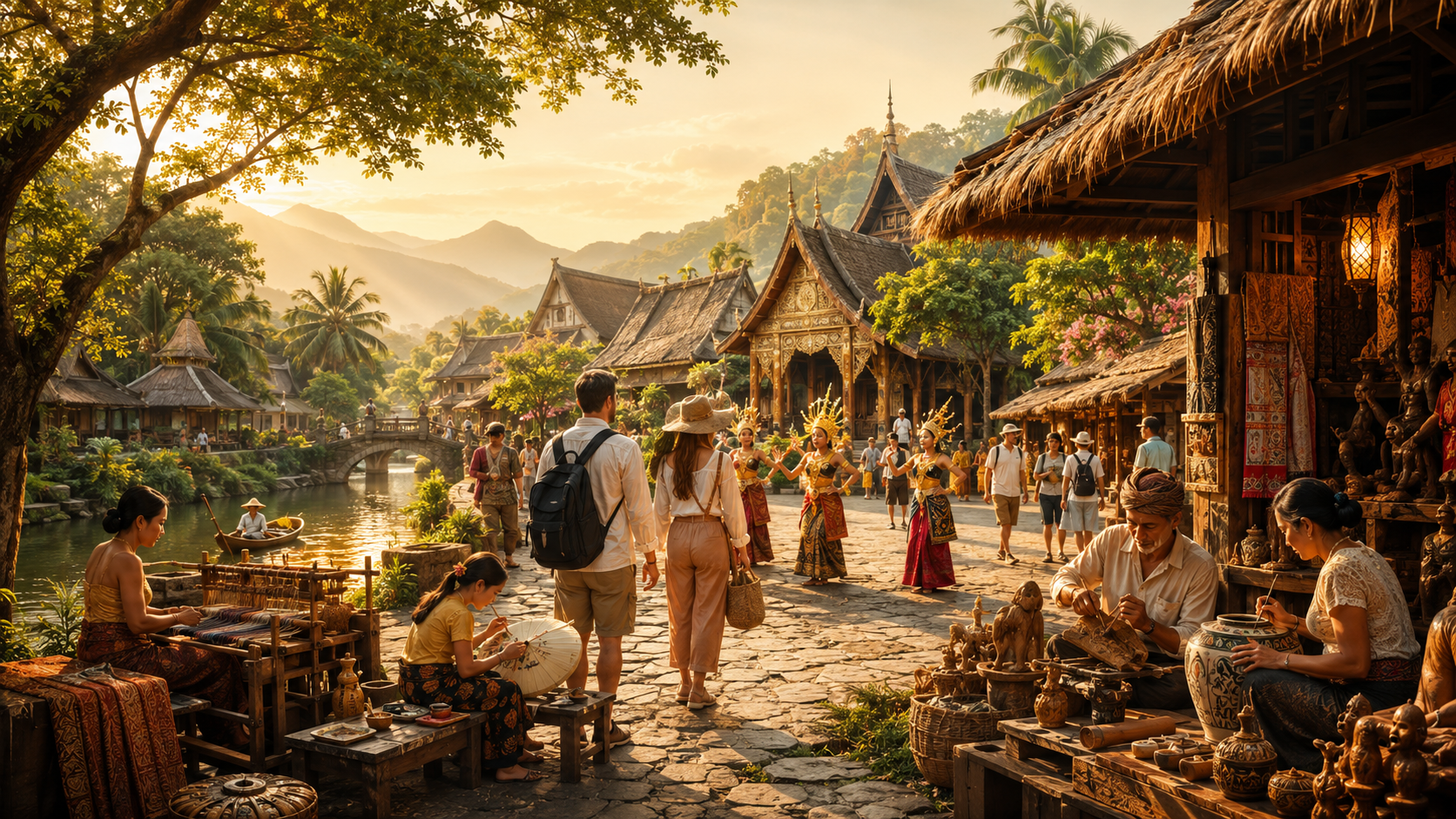
    local communities and travelers supporting sustainable cultural tourism together

    Cultural tourism offers remarkable opportunities for economic development, cultural exchange, and heritage preservation.

    At the same time, excessive commercialization can weaken the authenticity that makes cultural traditions meaningful in the first place.

    The challenge is not to stop tourism but to guide it responsibly.

    When local communities remain at the center of decision-making, governments invest in sustainable policies, businesses act ethically, and travelers respect the places they visit, tourism becomes more than an industry.

    It becomes a bridge between cultures—one that preserves the past while creating opportunities for the future.

    Rather than asking whether culture should generate economic value, perhaps the better question is how economic value can strengthen rather than replace cultural identity.

    Reader Question

    Can cultural traditions remain authentic when they become major tourist attractions, or does commercialization inevitably change their original meaning?

    How can travelers support local communities while enjoying meaningful cultural experiences without contributing to overtourism?


    Related Reading

    If history is interpreted differently across cultures and generations, how should we preserve cultural heritage without losing its original meaning?

    In Is There a Single Historical Truth, or Many Narratives?, we explore how history is shaped by evidence, memory, and interpretation—and why preserving cultural identity requires more than protecting historic sites.

    If local traditions become increasingly influenced by global markets and modern lifestyles, can cultural identity survive rapid social change?

    In Are Our Emotions Truly Ours—or Socially Constructed?, we examine how society, culture, and collective experience shape human identity, traditions, and the values communities choose to preserve.


    References

    1. Richards, G., & Munsters, W. (2010). Cultural Tourism Research Methods. CABI.

    This book provides comprehensive research methods for understanding cultural tourism and examines how tourism influences local heritage, identity, and community development. It offers valuable insights into balancing economic benefits with cultural preservation.


    2. UNESCO. (2012). Culture: A Driver and an Enabler of Sustainable Development. UNESCO Publishing.

    UNESCO explains how cultural heritage contributes to sustainable development while emphasizing that local communities should remain central to tourism planning. The report highlights the importance of protecting both tangible and intangible cultural heritage.


    3. MacCannell, D. (1999). The Tourist: A New Theory of the Leisure Class. University of California Press.

    A classic work in tourism studies, MacCannell argues that modern tourism often transforms authentic cultural experiences into staged performances for visitors. His analysis remains highly influential in debates about authenticity and commercialization.


    4. Smith, M. K., & Robinson, M. (Eds.). (2006). Cultural Tourism in a Changing World: Politics, Participation and (Re)Presentation. Channel View Publications.

    This collection explores how politics, community participation, and globalization shape cultural tourism. It examines the challenges of representing local traditions while responding to the demands of an international tourism market.

    5. UN Tourism (formerly World Tourism Organization). (2018). Tourism and Culture Synergies. UN Tourism.

    This report presents international case studies showing how tourism and cultural heritage can support one another through sustainable policies. It emphasizes cooperation among governments, local communities, and the tourism industry to ensure long-term cultural preservation.
  • Classical and Modern Art

    Classical and Modern Art

    How Artists Have Expressed Human Emotion Across the Ages

    Art has always been more than decoration.

    Long before written history, people painted on cave walls, carved figures from stone, and created symbols that reflected fear, hope, love, and faith. Across every civilization, art has served as one of humanity’s oldest languages—a language capable of expressing emotions that words alone often cannot capture.

    Although artistic styles have changed dramatically over thousands of years, one purpose has remained remarkably constant: to explore the inner world of human experience.

    Classical art sought harmony, balance, and timeless beauty. Modern art, by contrast, embraced uncertainty, individuality, and emotional complexity.

    At first glance, these two artistic worlds appear completely different.

    Yet both ask the same timeless question:

    What does it mean to be human?


    1. Classical Art: The Pursuit of Ideal Beauty and Universal Emotion

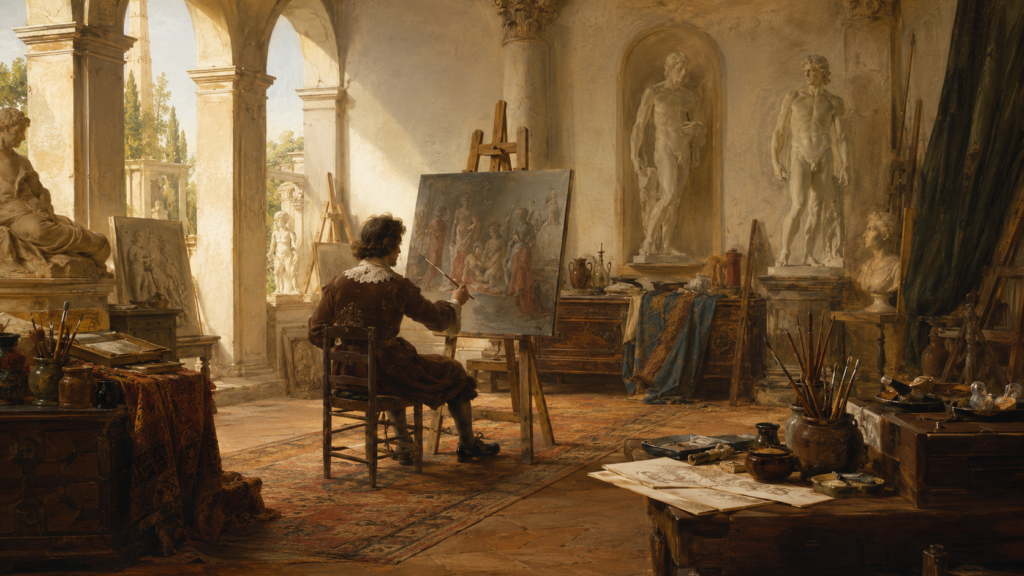
    classical artist creating harmonious and idealized human beauty

    Classical art, particularly in ancient Greece, Rome, and later during the Renaissance, emphasized harmony, proportion, and idealized human beauty.

    Artists believed that beauty reflected order, and that order revealed deeper truths about humanity and nature.

    Rather than portraying temporary emotions, classical artists often sought to express universal human virtues such as courage, compassion, wisdom, dignity, and love.

    Michelangelo’s David is one of the finest examples.

    Although the sculpture depicts the biblical hero before his battle with Goliath, it is not merely a representation of physical strength. David’s calm expression and poised body communicate confidence, determination, and self-control.

    Similarly, Leonardo da Vinci’s Mona Lisa continues to fascinate audiences because of its subtle emotional ambiguity.

    Her mysterious smile seems to shift between serenity, warmth, confidence, and melancholy depending on how each viewer interprets it.

    The painting reminds us that even quiet emotions can possess extraordinary depth.

    Rather than overwhelming viewers with dramatic feelings, classical art invites contemplation through balance and elegance.


    2. From Ideal Beauty to Personal Experience

    As society changed, so did artistic priorities.

    The nineteenth century marked an important transition.

    Instead of portraying idealized perfection, artists increasingly focused on individual perception and personal experience.

    The Impressionists, including Claude Monet and Pierre-Auguste Renoir, were less concerned with precise realism than with capturing fleeting moments of light, atmosphere, and emotion.

    A sunrise, reflections on water, or sunlight passing through trees became worthy artistic subjects.

    These paintings suggested that emotion does not always emerge from dramatic events.

    Sometimes it appears quietly—in ordinary moments that pass almost unnoticed.

    This shift prepared the way for modern art, where personal experience would become even more central.


    3. Modern Art: Exploring the Inner Mind

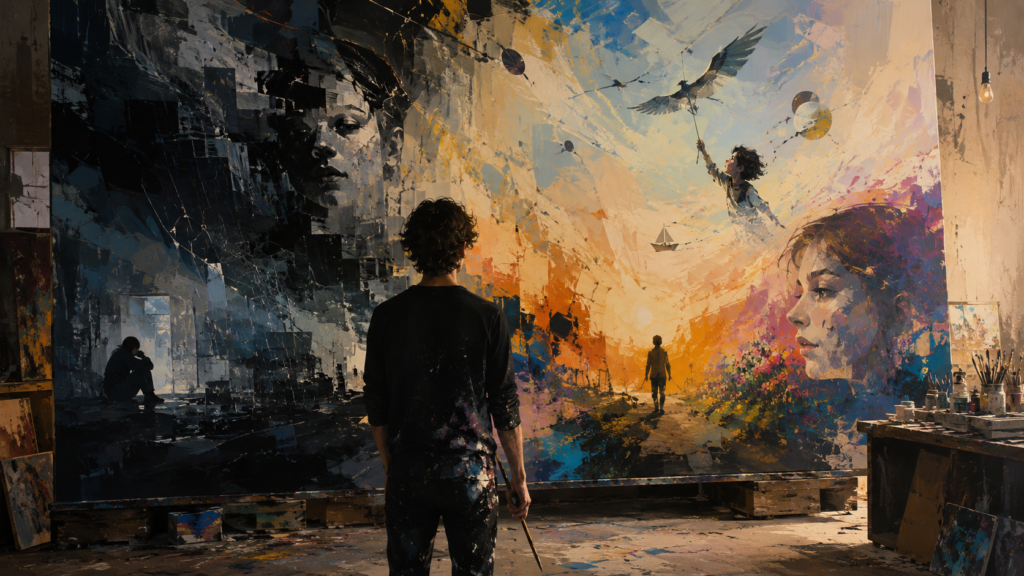
    artist expressing complex human emotions through modern painting

    Modern art expanded the emotional range of artistic expression far beyond classical ideals.

    Rather than searching for universal perfection, many modern artists explored anxiety, loneliness, fear, identity, and psychological conflict.

    The goal was no longer simply to create beauty.

    It was to reveal emotional truth.

    Edvard Munch’s The Scream remains one of the most recognizable examples.

    The distorted figure, swirling sky, and intense colors do not represent physical reality.

    Instead, they visualize inner psychological distress.

    Viewers often recognize something deeply human within the painting because fear and uncertainty are emotions shared across cultures.

    Modern artists increasingly accepted that emotional honesty could be more important than visual perfection.


    4. Pablo Picasso: A Bridge Between Classical and Modern Art

    Few artists transformed art as dramatically as Pablo Picasso.

    Although famous for Cubism, Picasso received rigorous classical training during his youth.

    Rather than rejecting tradition entirely, he reimagined it.

    His masterpiece Guernica demonstrates how modern artistic techniques can express timeless human emotions.

    Created in response to the bombing of the Spanish town of Guernica during the Spanish Civil War, the painting does not depict war realistically.

    Instead, fragmented forms, distorted faces, and broken bodies communicate chaos, suffering, and despair.

    The emotional impact comes not from accurate representation, but from psychological intensity.

    In this way, Picasso connected classical themes—human tragedy and moral reflection—with modern visual language.

    His work reminds us that while artistic styles evolve, human suffering and compassion remain constant.


    5. Abstract Expressionism: When Emotion Became the Subject

    As the twentieth century progressed, some artists moved even further away from recognizable images.

    Abstract Expressionists believed that emotion itself could become the artwork.

    Jackson Pollock’s famous action paintings abandoned traditional composition altogether.

    Instead of carefully arranging subjects, Pollock allowed movement, rhythm, and spontaneous gestures to become central elements of creation.

    At first glance, these paintings may appear chaotic.

    Yet many viewers experience powerful emotional responses precisely because there is no predetermined story.

    Each person is invited to interpret the work through personal memories, emotions, and imagination.

    Modern art increasingly shifted from providing answers to encouraging questions.

    Instead of asking,

    “What is this painting about?”

    it asks,

    “What do you feel when you look at it?”


    6. Different Artistic Languages, Shared Human Questions

    Classical and modern art often appear to stand at opposite ends of artistic history.

    One celebrates order.

    The other embraces uncertainty.

    One searches for timeless ideals.

    The other welcomes individuality and emotional complexity.

    Yet beneath these differences lies a remarkable similarity.

    Both seek to understand human existence.

    Whether through the graceful proportions of Renaissance painting or the fragmented forms of modern expressionism, artists continue exploring love, fear, hope, loss, courage, loneliness, and joy.

    The artistic language changes.

    Human emotion does not.

    Throughout history, art has served as a mirror reflecting not only society, but also the emotional landscape within ourselves.


    Conclusion: Art as the Memory of Human Emotion

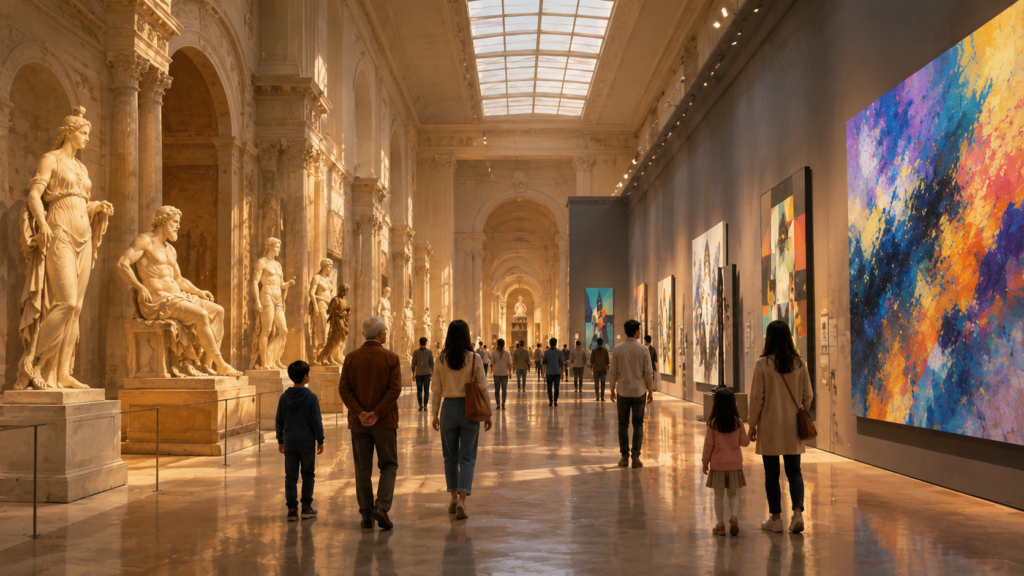
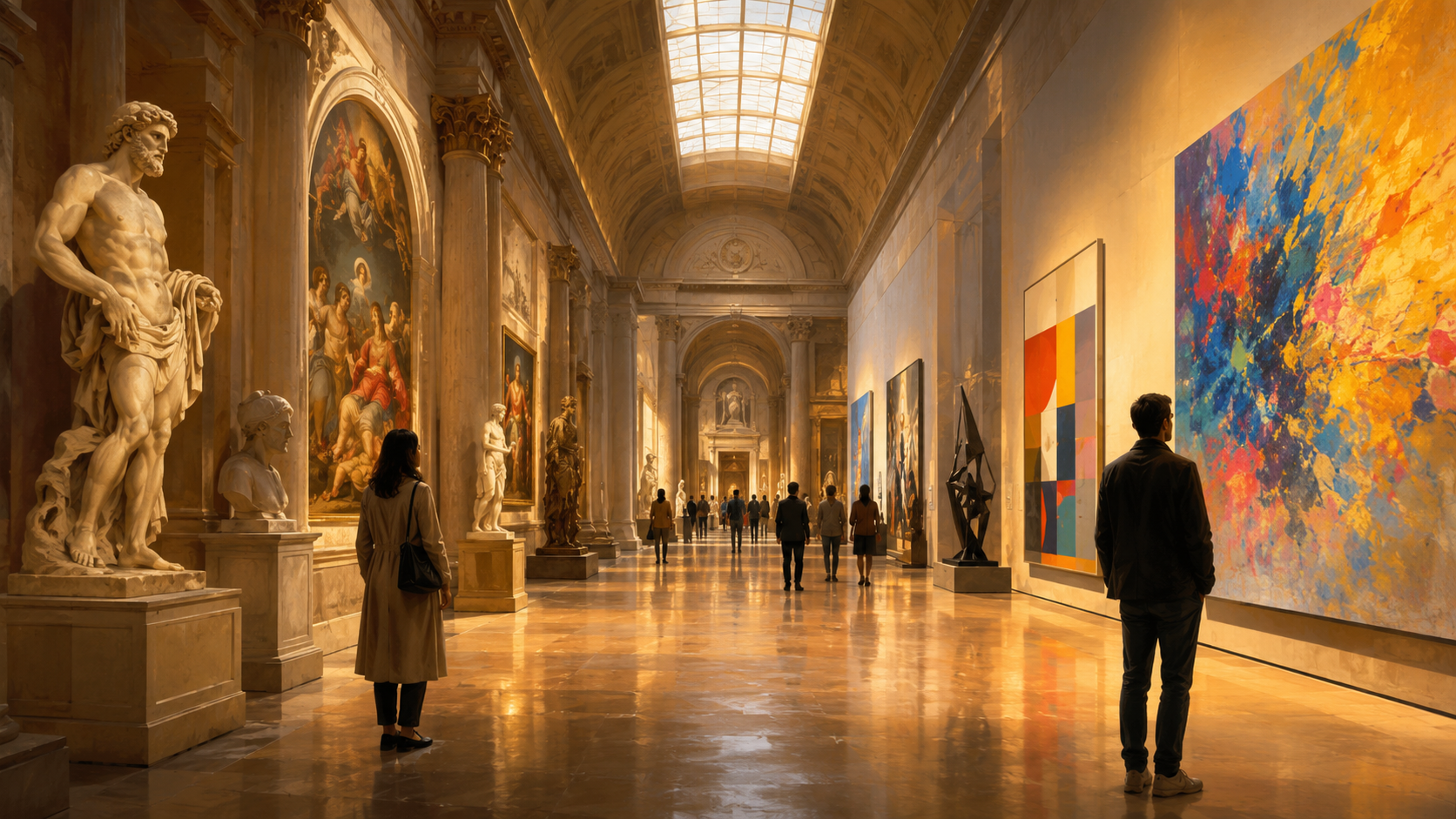
    people exploring the evolution of art across different historical periods

    Every civilization leaves behind monuments, buildings, and written records.

    Perhaps its greatest legacy, however, is the art through which it expressed its emotions.

    Classical art teaches us the beauty of harmony, dignity, and timeless ideals.

    Modern art reminds us that vulnerability, uncertainty, and emotional honesty are equally meaningful parts of being human.

    Together, they tell a continuous story.

    The story is not merely about changing artistic styles.

    It is about humanity’s endless attempt to understand itself.

    As cultures evolve and technologies transform the way we live, art continues to preserve something that remains unchanged:

    our desire to express what cannot always be spoken.

    Perhaps that is why great works of art never truly become old.

    Although created centuries apart, they continue speaking to people across generations because the emotions they portray are, ultimately, our own.

    A Question for Readers

    When you stand before a great work of art, what moves you more—the harmony and balance of classical masterpieces, or the emotional honesty and bold experimentation of modern art?

    Perhaps the answer says as much about our own experiences as it does about the artwork itself.


    Related Reading

    Related Reading

    Art has always reflected humanity’s search for meaning, beauty, and a deeper understanding of life. This enduring pursuit of human wisdom connects naturally with The Origins of Medicine, which explores how different ancient civilizations sought to understand the human body, health, and the relationship between people and the natural world.

    At the same time, works of art often invite viewers to interpret reality from different perspectives rather than offering a single definitive answer. This philosophical dimension is further explored in The Nature of Truth, which examines how perception, interpretation, and context shape the way we understand both truth and the world around us.

  • Cities of Memory—or Cities of Forgetting?

    Cities of Memory—or Cities of Forgetting?

    How Can We Balance Development and Preservation?

    Have you ever returned to a place you once knew—
    only to find it completely changed?

    A familiar street replaced by glass towers.
    A small shop gone without a trace.

    In moments like these, we are not just losing buildings.
    We are losing pieces of memory.

    This raises a deeper question:

    Are cities meant to preserve our past—
    or to constantly erase and rebuild it?


    1. Cities as Spaces of Memory

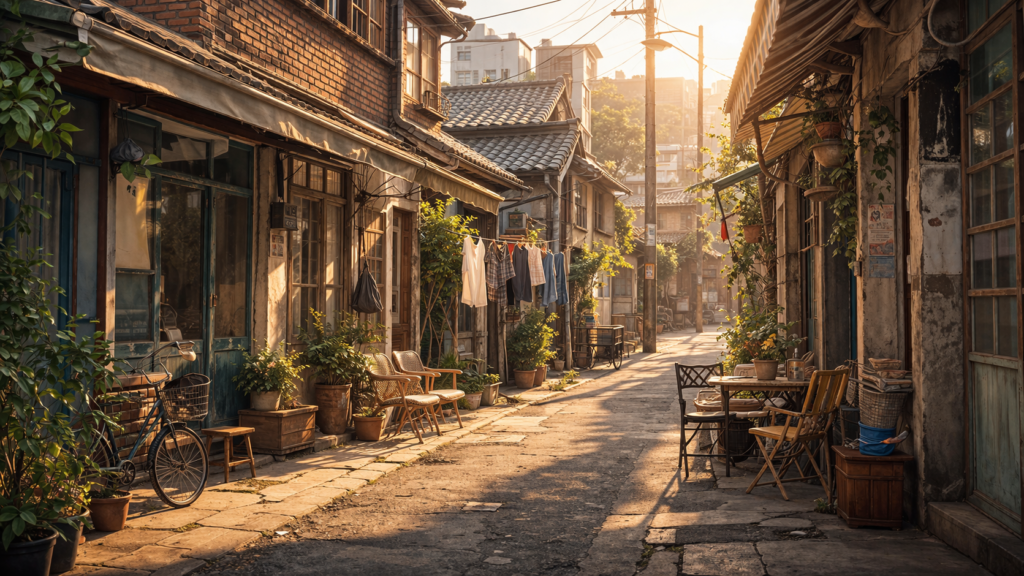
    old alley with traces of daily life

    Cities are not just collections of buildings and infrastructure.
    They are living archives of human experience.

    Old alleys, schools, cinemas, factories, and even faded signs—
    these are not simply outdated structures.

    They are carriers of collective memory.

    Yet, across the world, such places are disappearing rapidly.
    Urban redevelopment often replaces them with standardized spaces—
    efficient, modern, but emotionally detached.


    2. Why Memory and Development Collide

    The disappearance of historical spaces is not due to neglect alone.
    It is the result of a deeper conflict between two values.

    Development Logic

    Cities must grow—accommodating population, economy, and infrastructure.
    Old structures are often seen as inefficient or unprofitable.

    Preservation Logic

    At the same time, these spaces hold identity, history, and emotional meaning.
    They are not just physical assets—but cultural ones.

    This conflict reflects a fundamental question:
    What role should the past play in the future of cities?

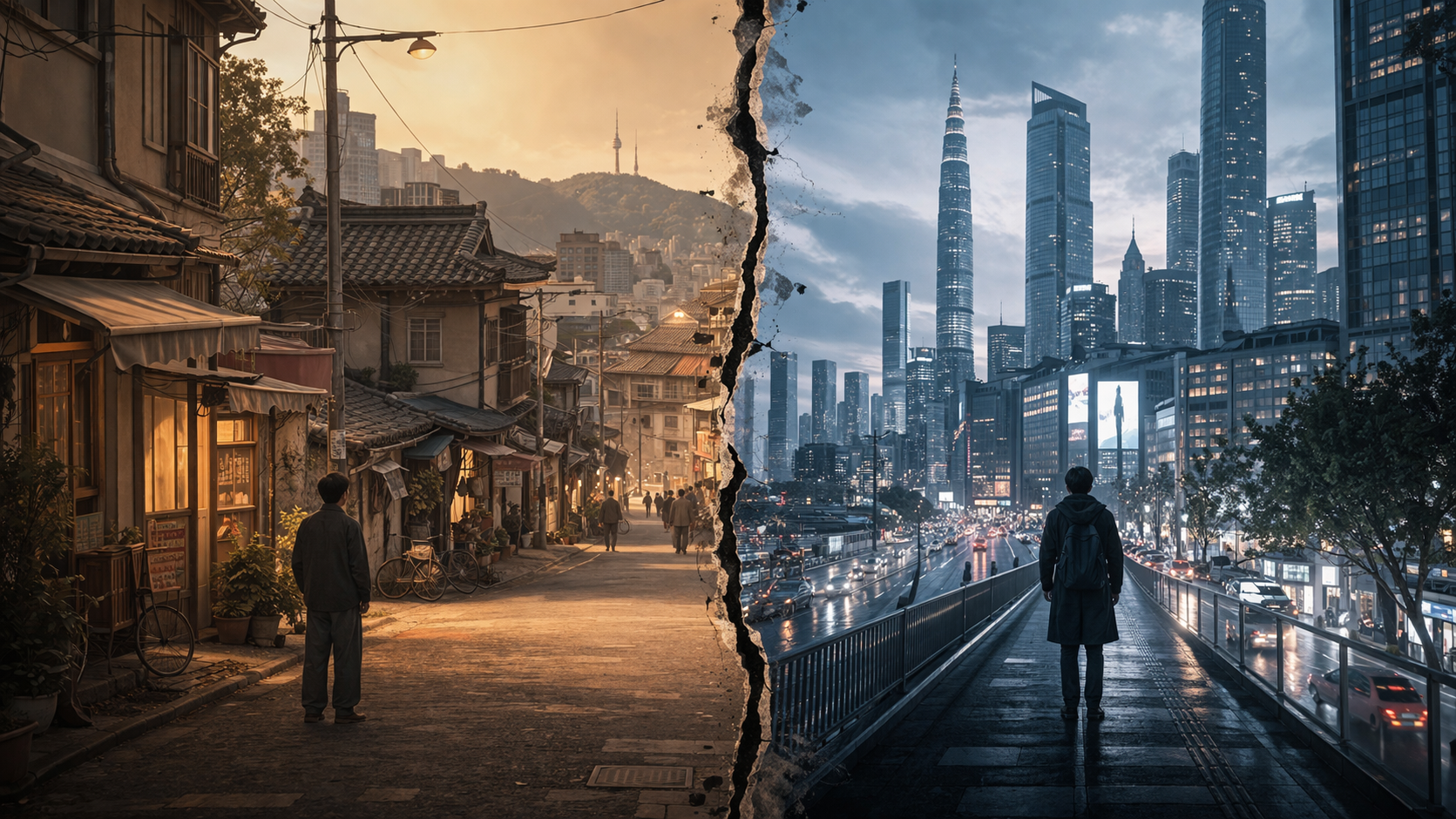
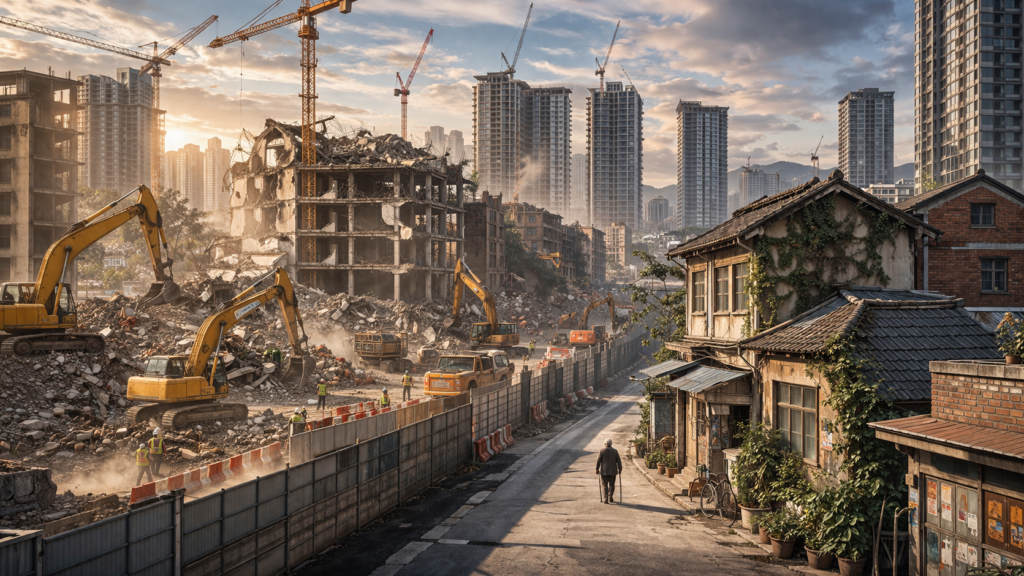
    city redevelopment conflict scene

    3. Case Studies: Conflict in Practice

    Seoul: Cheonggyecheon & Sewoon Arcade

    The restoration of Cheonggyecheon transformed the city into a greener, pedestrian-friendly space.
    Yet it also displaced long-standing communities and local economies.

    Sewoon Arcade, once a symbol of industrial modernization,
    faced repeated threats of demolition before partial preservation efforts emerged.

    Kyoto: Preservation Through Consensus

    Kyoto represents a different approach.
    Strict building regulations, height limits, and cultural protections
    have allowed the city to maintain its historical identity.

    This reflects a strong social agreement:
    the past must coexist with the future.


    4. Can Development and Preservation Coexist?

    Development and preservation are not necessarily opposites.

    Cities can evolve without erasing their past.

    The concept of “places of memory”, introduced by Pierre Nora,
    suggests that physical spaces hold emotional and cultural significance.

    Development, therefore, should not eliminate memory—
    but reinterpret and integrate it.


    5. Toward a Balanced Future

    Preserving urban memory requires more than nostalgia.

    It requires:

    • Institutional systems to evaluate historical value
    • Citizen participation in planning
    • Cultural reinterpretation through art and storytelling
    • Hybrid models combining preservation and development

    Cities must be designed not only for efficiency—
    but for meaning.


    Conclusion

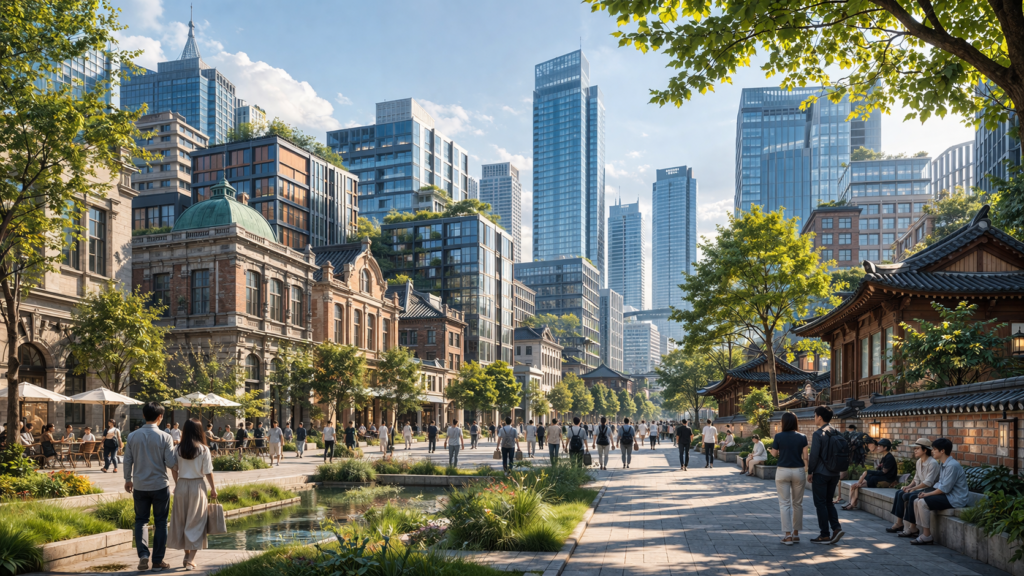
    modern and historic buildings coexist

    Cities are always changing.
    But how they change matters.

    When a place disappears, we do not just lose space—
    we lose memory, relationships, and identity.

    A city that preserves memory becomes more than livable—
    it becomes meaningful.

    So we are left with a choice:

    Will our cities remember—
    or will they forget?

    A Question for Readers

    Have you ever lost a place that mattered to you—
    and felt like a part of your memory disappeared with it?


    Related Reading

    The tension between preservation and change becomes even more complex when we consider how societies interpret the past.
    In Is There a Single Historical Truth—or Many Narratives?, the idea of collective memory reveals how different groups construct and contest the meaning of history.

    At the same time, the fragility of memory itself is further explored in If Memory Can Be Manipulated, What Can We Really Trust?, where the instability of personal and collective memory raises deeper questions about what should be preserved—and why.

    References

    1. Nora, P. (1996). Realms of Memory: Rethinking the French Past. New York: Columbia University Press.
      → This work introduces the concept of “sites of memory,” explaining how physical places carry collective emotional and historical meaning. It provides a foundational framework for understanding cities as spaces where memory is preserved and constructed.
    2. Hayden, D. (1997). The Power of Place: Urban Landscapes as Public History. Cambridge, MA: MIT Press.
      → This book explores how urban spaces function as living histories, especially for marginalized communities. It highlights the importance of incorporating diverse social memories into city planning and development.
    3. Zukin, S. (1982). Loft Living: Culture and Capital in Urban Change. Baltimore: Johns Hopkins University Press.
      → Zukin analyzes how urban redevelopment and gentrification transform cultural spaces into economic assets. It critically examines how such processes often erase historical traces while creating new forms of consumption.
    4. Huyssen, A. (2003). Present Pasts: Urban Palimpsests and the Politics of Memory. Stanford: Stanford University Press.
      → This work conceptualizes cities as layered spaces where past and present coexist and interact. It emphasizes how memory is not static but constantly reshaped through political and cultural forces.
    5. Lynch, K. (1960). The Image of the City. Cambridge, MA: MIT Press.
      → Lynch introduces the idea of the “mental image” of the city, showing how individuals perceive and remember urban environments. His framework connects spatial structure with human experience and urban identity.