Tag: cultural anthropology

  • Masks of the Festival

    The Collective Meaning of Covering the Face

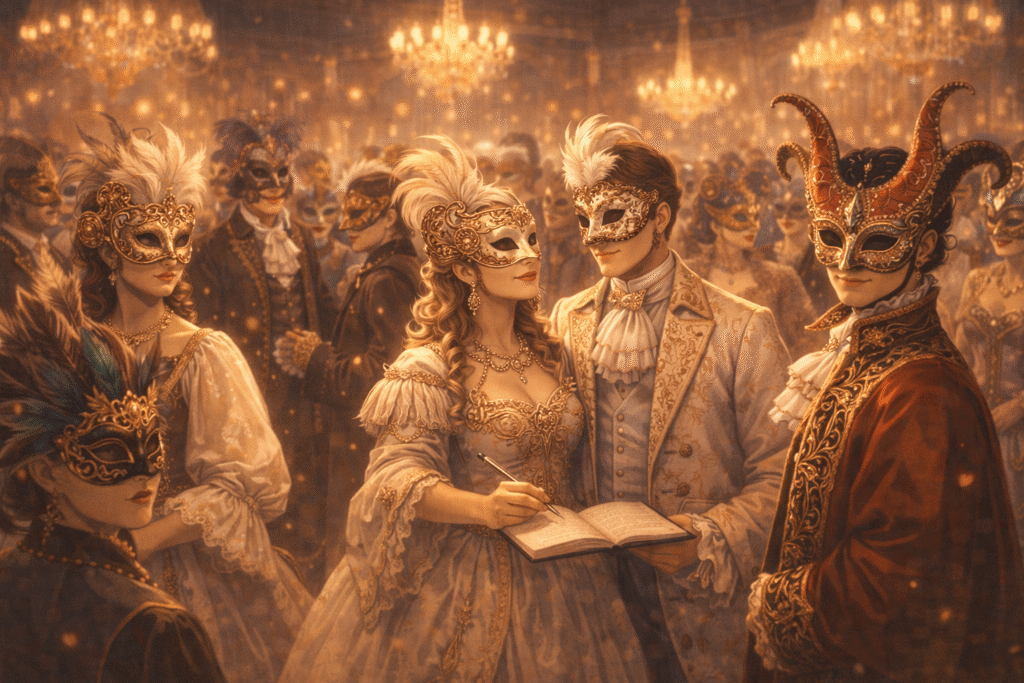
    Masquerade festival scene where individual identities fade into ritual

    1. Masks Call Forth “Another Self”

    When a person puts on a mask, a subtle transformation begins.
    The act does not simply conceal the face; it alters how one relates to oneself and to others.

    Masks are not merely tools for hiding the face. From ancient tribal societies to contemporary festivals, they have functioned as cultural instruments through which humans temporarily set aside their ordinary identities while simultaneously stepping into something new. Through masks, people cross the boundaries of everyday life and enter shared spaces of collective energy, emotion, and cultural meaning.

    1.1 Stepping Away from the Everyday Self

    At the moment a mask is worn, individuals become partially detached from their daily social roles.
    Words and behaviors that would normally feel restrained or inappropriate suddenly become permissible.

    During the Venetian Carnival, for instance, masks erased visible distinctions between nobles and commoners. Social rank was suspended, allowing participants to interact under temporarily equal conditions. Behind the mask, individuals were no longer defined by status but by participation in a collective festive experience.

    1.2 Temporary Identities and Hidden Desires

    By stepping away from fixed social roles,
    individuals acquire temporary identities.

    This is not mere play.
    It reveals a deeply human desire for alternative selves—
    the urge to explore identities suppressed by everyday norms.


    2. Masks Generate Collective Energy

    2.1 From Individuals to Symbols

    Masks amplify power beyond the individual.

    In many African traditional festivals, masks represent ancestral spirits or natural forces.
    Those who wear them are no longer seen as private individuals,
    but as symbolic embodiments of the community itself.

    Through masks, the festival becomes a shared ritual
    in which collective memory and emotion are activated.

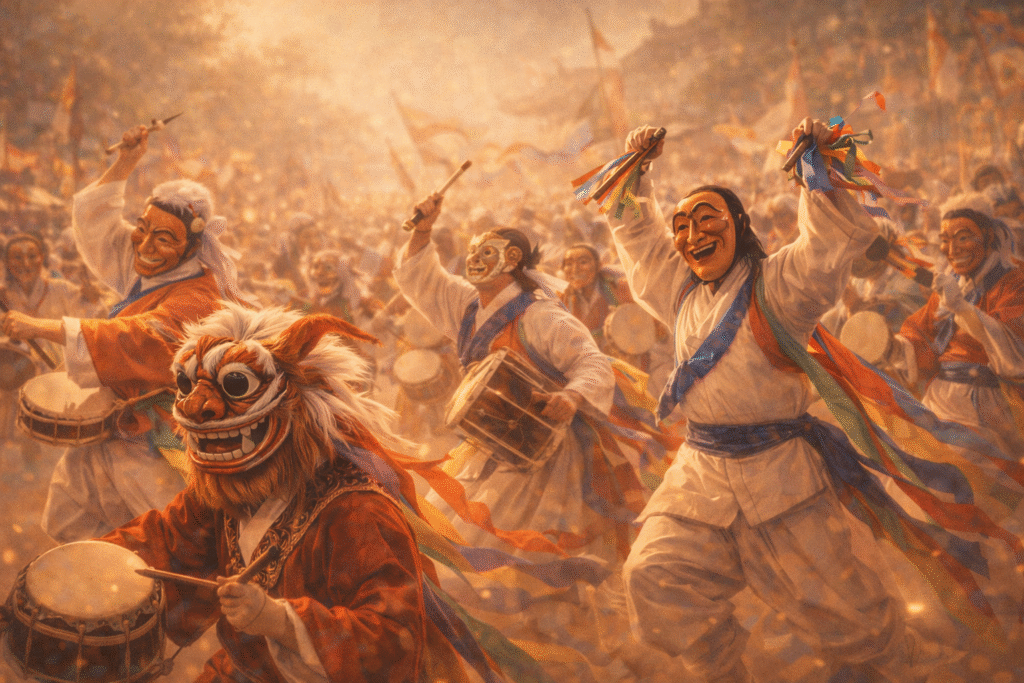
    Masked performers expressing collective energy during a festival

    2.2 Masks and Social Expression in Korea

    Korean talchum (mask dance) offers a similar example.
    Through exaggerated masks of aristocrats, monks, and servants,
    performers express satire, resentment, and hope shared by the community.

    The mask becomes a voice for collective feeling.


    3. Masks as Tools for Crossing Boundaries

    3.1 Reversing Social Order

    Festival masks temporarily overturn social hierarchies.

    Desires normally restrained,
    mockery of authority,
    and critique of power structures
    are permitted behind the mask.

    3.2 Ritualized Disorder and Social Release

    During medieval Europe’s Fête des Fous (Festival of Fools),
    commoners dressed as clergy and filled churches with laughter and satire.

    This was not mere chaos.
    It functioned as a release valve, easing social tension
    before ordinary order was restored.

    Masks, then, serve as keys—
    unlocking the boundary between order and disorder,
    the everyday and the extraordinary.


    4. Modern Masks: Digital Personas

    4.1 Contemporary Forms of Masking

    Even today, masks have not disappeared.

    Online avatars, profile photos, and usernames
    are modern forms of masking.
    They allow individuals to hide their physical faces
    while communicating through constructed identities.

    4.2 Freedom and Its Shadows

    Digital masks can offer freedom and creativity.
    Yet they also carry risks.

    Unlike festival masks that bind communities together,
    digital anonymity can sometimes foster hostility,
    collective aggression, or hate speech.

    The social power of masks remains—
    but its direction has changed.


    5. The Lesson of Masks: Balancing Concealment and Revelation

    Digital avatars representing modern masked identities online

    5.1 Hiding in Order to Reveal

    Masks conceal the face,
    but they reveal suppressed desires and collective messages.

    They show how societies release tension,
    redefine relationships,
    and sustain culture across generations.

    5.2 From Festivals to Digital Space

    In festivals, masks symbolized liberation and shared joy.
    In digital spaces, they represent new modes of interaction.

    The challenge today is recognizing the collective meanings masks produce—
    and deciding how to use them constructively.


    6. Conclusion

    Masks are not decorative objects.
    They are mirrors reflecting human desire and social relationships.

    Festival masks allowed people to step beyond everyday constraints
    and experience the strength of communal life.

    Today, we continue to wear masks in new forms.

    What matters is how we balance the freedom masks provide
    with the responsibility they demand.


    References

    1. Eliade, M. (1958). Rites and Symbols of Initiation: The Mysteries of Birth and Rebirth. New York: Harper & Row.
      Eliade explains how masks function within rites of passage, revealing their role as symbolic tools in collective transformation and rebirth.
    2. Schechner, R. (2003). Performance Theory. New York: Routledge.
      A foundational work in performance studies, analyzing how masks in ritual, theater, and festivals restructure social roles and generate collective energy.
    3. Turner, V. (1969). The Ritual Process: Structure and Anti-Structure. Chicago: Aldine.
      Turner theorizes how festivals and rituals, often involving masks, temporarily invert social order to create shared communal experience.
  • The Cultural Meaning Between Companion Animals and Livestock

    How culture determines whether animals become companions or commodities?

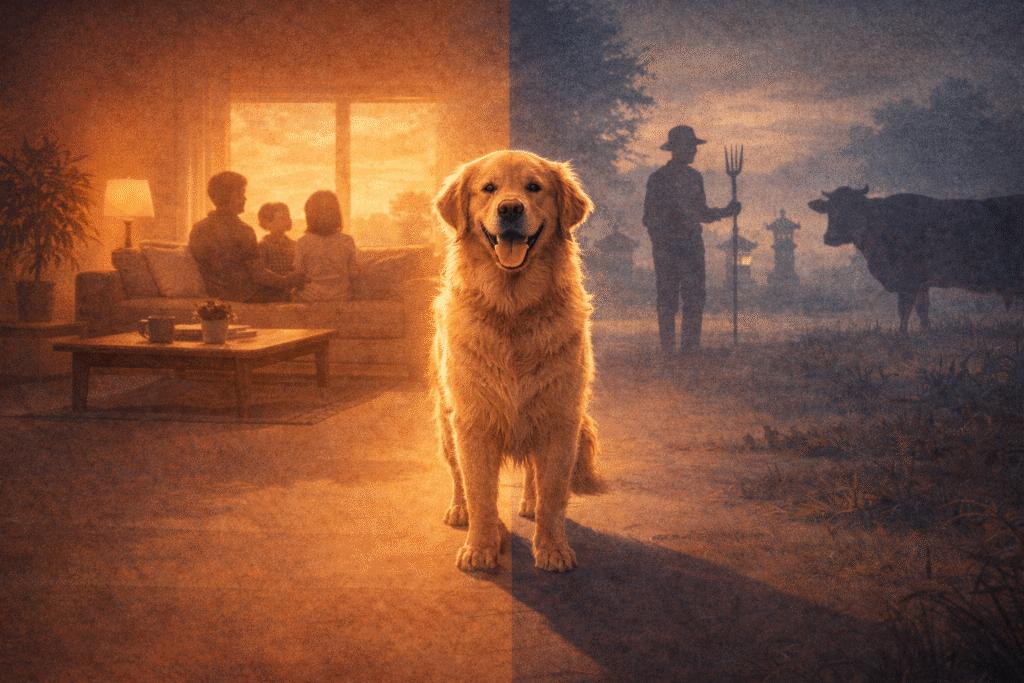
    A pet dog indoors contrasted with farm animals in the distance

    1. Introduction: How Culture Draws the Line Between Animals

    The animals we live alongside often fall into two broad categories.
    Some share our homes and emotional lives, while others provide food, labor, or materials essential for survival.

    At first glance, this difference seems purely functional.
    However, culture plays a far greater role than biology alone.

    In many societies, people treat the same animal as a beloved companion,
    while in others, they raise it as livestock.
    As a result, animals do not carry fixed meanings by nature.

    Instead, humans assign them value through social norms and cultural choices.
    In this sense, the distinction between companion animals and farm animals reveals the cultural meaning of pets and livestock, shaped not by biology, but by social values.


    2. Companion Animals: Animals as Family Members

    In many contemporary societies, companion animals—especially dogs and cats—are treated as members of the family rather than as property.

    2.1 Emotional Bonds

    Companion animals offer emotional comfort, reduce loneliness, and contribute to psychological well-being.
    Numerous studies show that interaction with pets lowers stress hormones and increases feelings of happiness and security.

    2.2 Social Identity

    For some people, the type of animal they keep—and even the animal’s personality—becomes a way of expressing their own identity and lifestyle.
    In this sense, companion animals function as an extension of the self.

    2.3 Legal and Institutional Change

    In several countries, animals are no longer legally defined as mere property, but as living beings deserving protection.
    This shift reflects changing moral attitudes toward animals and their place in society.


    3. Livestock: The Foundation of Survival and Economy

    The same animal shown as a pet in one culture and livestock in another

    Livestock, by contrast, have played a central role in the development of human civilization.

    3.1 Food Production

    Animals such as cattle, pigs, and chickens have long served as vital sources of protein, forming the backbone of agricultural societies.

    3.2 Labor and Energy

    Before industrialization, animals like horses, oxen, and donkeys were essential sources of labor—plowing fields, transporting goods, and powering economies.

    3.3 Materials for Daily Life

    Wool, leather, milk, and other animal-derived resources have shaped clothing, housing, and everyday necessities.

    Livestock have historically been valued for their productivity and economic function. Yet even this meaning is now being questioned and reshaped.


    4. Blurred Boundaries: One Animal, Different Cultures

    One of the most revealing aspects of human–animal relationships is how dramatically meanings shift across cultures.

    4.1 Dogs

    In many Western societies, dogs are celebrated as “humanity’s best friend.”
    In other regions, they have historically been raised for food.

    4.2 Rabbits

    In parts of Europe, rabbits exist simultaneously as pets, food animals, and storybook characters—occupying multiple symbolic roles at once.

    4.3 Cattle

    In India, cows are sacred and protected. Elsewhere, they are central livestock animals raised primarily for meat and dairy.

    These examples illustrate a crucial point: animals do not carry fixed meanings. Culture assigns their status.


    5. Contemporary Shifts: Rethinking the Boundary

    In modern societies, the line between companion animals and livestock is increasingly unstable.

    5.1 Animal Welfare Movements

    There is growing recognition that livestock are sentient beings capable of suffering.
    “Animal welfare farming” reflects an effort to balance production with ethical responsibility.

    5.2 New Forms of Companionship

    Animals once considered strictly livestock—such as pigs or chickens—are now sometimes kept as companions, especially in urban settings.

    5.3 Ethical Consumption

    As emotional bonds with companion animals deepen, some people begin questioning the moral implications of consuming other animals.


    This has contributed to the rise of vegetarian and vegan lifestyles.

    Human–animal relationships are no longer merely practical—they are ethical and philosophical.


    6. Conclusion: Animals as Cultural Mirrors

    A human quietly facing an animal, reflecting on coexistence

    The distinction between companion animals and livestock is not rooted in the animals themselves, but in human culture, values, and historical context.

    Some animals become friends.
    Some become resources.
    Some occupy both roles at once.

    As societies evolve, so do these categories.

    Today, we are increasingly called to reconsider what it means to live alongside animals—not only as users of their labor or bodies, but as co-inhabitants of a shared world.

    When we encounter a dog on the street or a cow on a farm, we are not simply seeing an animal.
    We are seeing a reflection of our own culture, ethics, and choices.


    References

    Serpell, J. (1996). In the Company of Animals: A Study of Human–Animal Relationships. Cambridge: Cambridge University Press.
    → Explores the historical and cultural diversity of human–animal relationships, offering a foundational framework for understanding why animals occupy different social roles.

    Digard, J.-P. (1988). L’homme et les animaux domestiques: Anthropologie d’une passion. Paris: Fayard.
    → An anthropological study of domestication, emphasizing that animals hold symbolic and social meanings beyond their economic functions.

    Franklin, A. (1999). Animals and Modern Cultures: A Sociology of Human–Animal Relations in Modernity. London: SAGE Publications.
    → Examines how modern societies assign animals different statuses—companions, livestock, or commodities—within changing cultural contexts.