Tag: consumer culture

  • When Experience Becomes Competition

    When Experience Becomes Competition

    From Personal Moments to Social Currency in the Experience Economy

    We used to ask, “Did you enjoy your trip?”

    Now we ask, “Where have you been?”

    We used to ask, “Do you like your hobby?”

    Now we ask, “How good are you at it?”

    Somewhere along the way, experience stopped being something we felt
    and became something we displayed.

    What once lived in memory now lives in visibility.
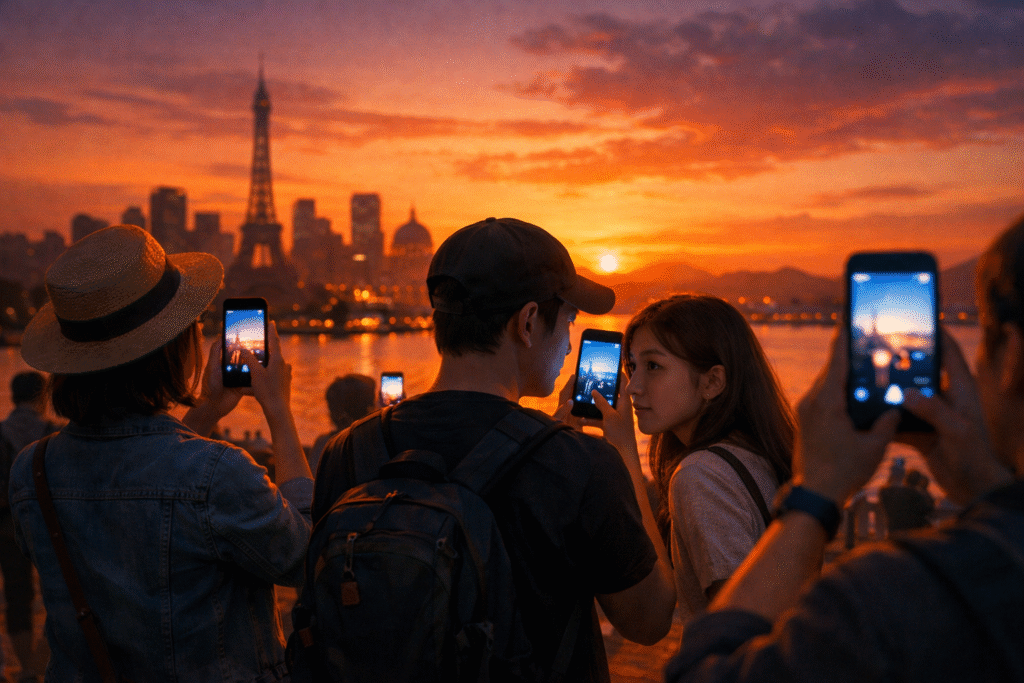
    People photographing a scenic landmark for social media

    1. From Cultural Capital to Experiential Capital

    French sociologist Pierre Bourdieu argued that society is shaped not only by money, but by cultural capital—taste, education, and lifestyle.

    Today, we can extend his idea:

    Experience itself has become capital.

    • The countries you have visited
    • The exhibitions you have attended
    • The hobbies you pursue
    • The stories you can tell

    These are no longer just personal memories.
    They function as social signals.

    They communicate:

    • mobility
    • refinement
    • exposure
    • even privilege

    What appears as personal choice is often structured by
    time, resources, and access.

    Experience becomes symbolic currency.


    2. The Experience Society

    German sociologist Gerhard Schulze described modern society as an “experience society” (Erlebnisgesellschaft).

    In the past:

    • A good life meant stability

    Today:

    • A good life means intensity and uniqueness

    But this shift has consequences.

    • Ordinary moments are rarely shared
    • Moderate experiences rarely trend
    • Quiet satisfaction rarely goes viral

    Digital platforms amplify the spectacular.

    Over time, we internalize this logic.

    We no longer simply live experiences.
    We curate them.


    3. The Platform Effect: Visibility and Comparison

    Contrasting private hobby and public performance culture

    Social media did not invent comparison.

    But it industrialized it.

    Experiences are now measurable:

    • followers
    • likes
    • views
    • places visited
    • achievements earned

    Numbers appear neutral.

    But they quietly create hierarchy.

    This aligns with Leon Festinger’s idea of social comparison:

    We evaluate ourselves by comparing with others.


    The problem today?

    We compare:

    our everyday life
    with someone else’s highlight reel


    The result:

    The more visible experiences become,
    the harder satisfaction becomes.


    4. The Marketization of Feeling

    In today’s economy, we don’t just buy products.

    We buy feelings.

    • “Authentic travel”
    • “Transformative retreat”
    • “Premium lifestyle experiences”

    According to B. Joseph Pine II and James H. Gilmore:

    Modern economies stage experiences as products.


    This creates a powerful shift:

    • Emotions are designed
    • Experiences are packaged
    • Identity becomes consumable

    We are no longer just consumers of goods.

    We are consumers of selves.


    5. What Are We Losing?

    When experience becomes capital, something subtle changes.

    • We visit more places → but feel less depth
    • We try more hobbies → but gain less mastery
    • We share more → but live less

    This creates a quiet anxiety:

    “Am I living fully enough?”


    But this anxiety may not be personal failure.

    It may be structural pressure.

    Person resting quietly without using smartphone at sunset

    Conclusion: Reclaiming Experience

    Once we understand the structure, the question changes.

    Instead of asking:

    “Is my life impressive enough?”

    We begin to ask:

    • Is this meaningful to me?
    • Would it matter if no one saw it?
    • Does it deepen me—or display me?

    Experience does not have to be capital.

    It can return to what it once was:

    a lived moment, not a performed asset


    Perhaps the rarest luxury today is not travel, achievement, or visibility—

    but an experience that is not shared at all.


    When comparison pauses, experience becomes personal.

    And when experience becomes personal,

    it stops being competition.

    A Question for You

    Have you ever felt your experiences being quietly compared?

    If no one could see your life—

    Would you still choose the same experiences?

    Related Reading

    The transformation of everyday life into structured performance is further explored in The Standardization of Experience — How Modern Systems Shape Everyday Life,where personal moments are gradually shaped by invisible social frameworks.

    A deeper reflection on identity in the age of algorithms can be found in AI Beauty Standards and Human Diversity — Does Algorithmic Beauty Threaten Us?, which examines how digital systems redefine human value and perception.

    The pressure to curate meaningful experiences is closely tied to a deeper paradox of modern life—where more freedom can actually produce more anxiety (see Is Freedom an Expansion of Choice — or an Expansion of Anxiety?).

    References

    1. Bourdieu, P. (1984). Distinction: A social critique of the judgement of taste. Harvard University Press.
      → Bourdieu demonstrates that taste and lifestyle choices are socially structured rather than purely individual. His concept of cultural capital explains how travel, hobbies, and aesthetic experiences function as markers of social distinction, making “experience” a form of symbolic capital in modern societies.
    2. Pine, B. J., & Gilmore, J. H. (1999). The experience economy: Work is theatre & every business a stage. Harvard Business School Press.
      → Pine and Gilmore argue that advanced economies increasingly sell memorable experiences rather than goods or services. Their framework clarifies how emotions and staged experiences become economic commodities within contemporary consumer culture.
    3. Schulze, G. (1992). Die Erlebnisgesellschaft: Kultursoziologie der Gegenwart. Campus Verlag.
      → Schulze introduces the idea of the “experience society,” in which individuals pursue intensity, uniqueness, and emotional stimulation as central life goals. His analysis helps explain the cultural shift from stability-oriented values to experience-driven identity formation.
    4. Festinger, L. (1954). A theory of social comparison processes. Human Relations, 7(2), 117–140.
      → Festinger’s foundational theory explains how individuals evaluate themselves through comparison with others. In digital environments, this mechanism becomes amplified as experiences are constantly visible and quantifiable.
    5. Goffman, E. (1959). The presentation of self in everyday life. Doubleday.
      → Goffman conceptualizes everyday interaction as a form of performance. His dramaturgical framework offers a powerful lens for interpreting social media culture, where experiences are curated and identities are staged before an imagined audience.

  • The Memory of Receipts – How Everyday Consumption Leaves Social Traces

    Reflections sparked by a discarded piece of paper

    Faded receipt on a café table capturing a moment of everyday consumption

    A Discarded Receipt, A Social Trace

    A few days ago, while organizing my wallet, I found a receipt from a café I had visited months earlier.
    The text had faded, leaving only fragments — the price of a cup of coffee, the time of payment, part of a familiar card number.

    For a moment, I paused.

    It was just a small piece of paper, yet it quietly preserved where I had been and, in some subtle way, how I had felt at the time. What we casually throw away as receipts are, in fact, traces of a day — and records of society itself.

    A single receipt reflects not only personal consumption, but also the rhythm of a city, the preferences of a generation, and the flow of an economy. In that sense, it becomes a small yet powerful piece of sociological evidence.

    1. A Transparent Society, Recorded Consumption

    Modern society places great value on transparency.
    Card payments, loyalty points, and digital receipts ensure that nearly all consumption is stored, tracked, and analyzed as data.

    This brings convenience — but it also signals the surveillance of memory.

    In the past, spending money meant that the moment disappeared as soon as the transaction ended. Today, we live in a society where every act of consumption remains as a record.

    French philosopher Jean Baudrillard, in The Consumer Society, argued that modern consumption is not merely an economic act but a symbolic one. Receipts function as evidence of this symbolic consumption, revealing our social position, preferences, and psychological desires.

    Even a casually discarded receipt contains traces of the social self — a reminder that individual consumption has become a social signal. What we buy, where we eat, and which brands we choose now speak a language of identity on our behalf.

    Discarded receipts symbolizing recorded consumption in a data-driven society

    2. Receipts as Personal Diaries

    Sociologist Zygmunt Bauman described modern individuals as consuming beings. Consumption, in this sense, is not a simple act but a form of self-expression.

    Receipts are the most concrete records of that expression.

    If one were to glance at someone else’s receipt, it would not be difficult to imagine their preferences — what they like to eat, where they spend time, even hints of their mood that day. Beneath the numbers lies far more context than accounting alone can capture.

    A receipt is not just a financial document. It is a fragment of a human story written through consumption.


    3. Discarded Memories, Persistent Traces

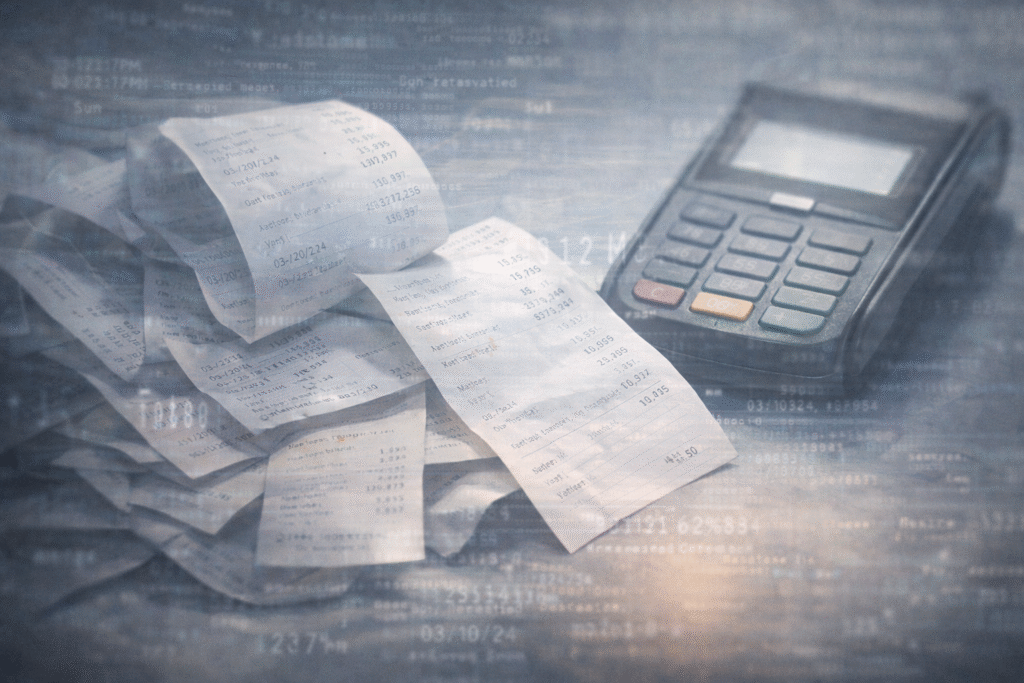
    A pile of discarded receipts next to a card reader — a quiet symbol of everyday records being left behind.

    The problem is how easily these fragments of memory are thrown away.

    Receipts piled on café tables or dropped into street-side trash bins reflect a society in which consumption ends in immediate forgetting. When we say, “I don’t need the receipt,” we may unknowingly be erasing a small trace of memory.

    And yet, the data does not disappear.

    While the paper vanishes, the record remains — stored in corporate databases, used for marketing strategies, tax policies, and consumption pattern analysis. The receipt as an object may be gone, but the system remembers.


    4. Conclusion: Receipts and the Shadow of Transparency

    Sociologist Maurice Halbwachs argued that memory is formed within social frameworks. A receipt, then, is not merely a private record of a transaction, but a fragment of collective memory.

    A café receipt from a journey, a purchase made on the day of one’s first paycheck — these small records trace the ways individuals relate to their time and society. Through such fragments, personal experience quietly becomes social history.

    Receipts also symbolize the promise — and the shadow — of a transparent society. Within them coexist convenience and accountability, remembrance and erasure. While the paper itself may disappear, the data it represents continues to circulate, shaping markets, policies, and identities.

    We live between what is easily forgotten and what is endlessly stored. A faded receipt tucked inside a wallet becomes a silent portrait of the self — a social self written through consumption.

    And the numbers printed on that fragile paper ask us, quietly but persistently:

    “For what purpose, and with what state of mind, did you choose to consume?”

    Hand holding an old receipt inviting reflection on personal consumption

    References

    1. Baudrillard, J. (1970). The Consumer Society. Paris: Gallimard.
      This seminal work interprets modern consumption as a system of signs and symbols. It provides a theoretical foundation for reading receipts not as neutral transaction records but as social texts encoding symbolic meaning.
    2. Halbwachs, M. (1950). The Collective Memory. Paris: Presses Universitaires de France.
      Halbwachs’ concept of collective memory emphasizes that memory is socially constructed. His framework is essential for understanding receipts as social artifacts that extend beyond individual experience.
    3. Hoskins, A. (2011). Digital Memory Studies: Media Pasts in Transition. London: Routledge.
      This work explores how memory is stored, transmitted, and erased in the digital age. It is particularly useful for interpreting the transition from paper receipts to digital records as a process of memory dematerialization.
  • The Social History of Vending Machines

    How Unattended Transactions Reshaped Everyday Life

    Urban vending machine glowing in everyday city life

    1. The Origins of Vending Machines: Convenience Enters Everyday Life

    When walking down the street feeling thirsty, waiting at a subway station, or searching for a late-night alternative to a convenience store, we often encounter a familiar machine: the vending machine. With a single press of a button, drinks or snacks appear instantly. Today, vending machines feel like a natural and almost invisible part of everyday life.

    Yet vending machines are more than simple devices. They are inventions that have quietly transformed how people consume, interact, and organize daily routines. Their history reveals not only technological progress, but also shifting expectations about convenience, time, and human presence in economic exchange.

    1.1 Ancient beginnings of automated exchange

    The idea of automated selling is far older than modern society. Records from ancient Alexandria describe a device that dispensed holy water when a coin was inserted. Even in antiquity, people imagined systems in which exchange could occur without direct human mediation.

    1.2 The rise of the modern vending machine

    Modern vending machines began spreading in the late nineteenth century in Britain and the United States. Early machines sold stamps, postcards, and chewing gum. The possibility of purchasing goods without encountering a seller was initially perceived as novel—and sometimes unsettling. Over time, however, vending machines gained public trust and became symbols of a new kind of convenience: reliable, predictable, and independent of human availability.

    From that moment on, consumption no longer required dialogue, negotiation, or shared time. A button, a coin, and a machine were enough.

    2. The 20th Century: Industrialization Meets Consumer Culture

    2.1 Urban life and efficiency

    As industrialization accelerated and cities expanded, vending machines became increasingly important. After World War II, they spread rapidly in countries such as the United States and Japan, where busy urban life demanded faster and more efficient consumption.

    2.2 The American experience

    In the United States, beverage and cigarette vending machines became iconic. Coca-Cola machines in particular symbolized a new promise of modern consumption: the same taste, available anywhere, at any time.

    2.3 Japan and vending machine density

    In Japan, vending machines proliferated dramatically from the 1960s onward. Compact, reliable, and operating 24 hours a day, they suited dense urban environments. Over time, Japan became the country with the highest vending-machine density in the world.


    3. How Unattended Transactions Changed Daily Life

    Vending machines did more than sell products—they reshaped everyday habits.

    3.1 The rise of 24-hour consumption

    Vending machines introduced the experience of “buying anything at any time.” This expanded the temporal boundaries of consumption and paved the way for 24-hour convenience stores.

    3.2 Normalizing contactless exchange

    By enabling transactions without face-to-face interaction, vending machines became an early form of contactless consumption. Today’s self-service kiosks, unmanned stores, and automated checkout systems all trace their roots back to this experience.

    3.3 Expanding consumption spaces

    Vending machines challenged the assumption that consumption required designated spaces. They appeared in subways, schools, hospitals, streets, and offices, allowing consumption to permeate nearly every corner of daily life.

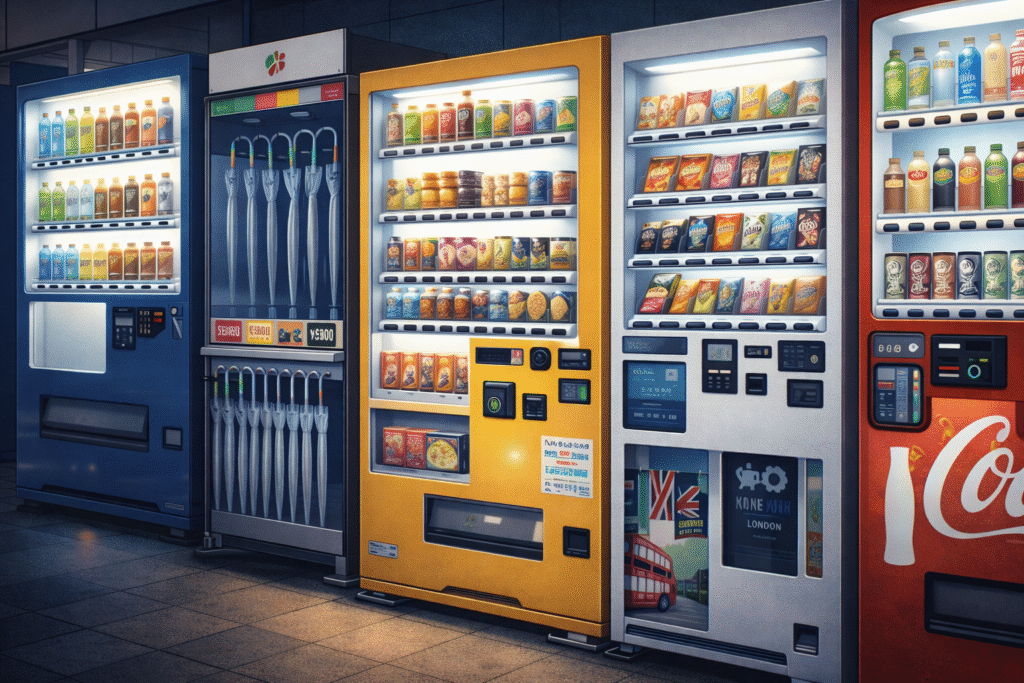
    Japanese vending machines reflecting urban consumer culture

    4. Vending Machines as Cultural Symbols

    Vending machines also function as cultural codes that reflect societal values.

    4.1 Japan: everyday creativity

    In Japan, vending machines sell far more than drinks and snacks—umbrellas, flowers, and even hot meals are available. This reflects how deeply vending machines are integrated into everyday life.

    4.2 The United States: speed and immediacy

    American vending machines align with a culture that values speed and instant gratification. Pressing a button to satisfy a need mirrors the broader logic of fast consumption.

    4.3 Korea: memory and social space

    In South Korea, vending machines—especially coffee machines in the 1980s and 1990s—were part of street and campus culture. They often functioned as informal spaces for conversation and brief rest.


    5. Notable and Contemporary Examples

    • High-tech vending machines in Tokyo: AI-powered machines now recommend drinks based on season and user preferences.
    • Pizza vending machines in New York: Some machines prepare fresh pizza on demand, from dough to toppings.
    • Korean coffee vending culture: Low-cost coffee machines became symbols of everyday leisure and social interaction.
    • Vending machines during the COVID-19 pandemic: Machines selling masks and hand sanitizer demonstrated the value of unattended transactions during crises.
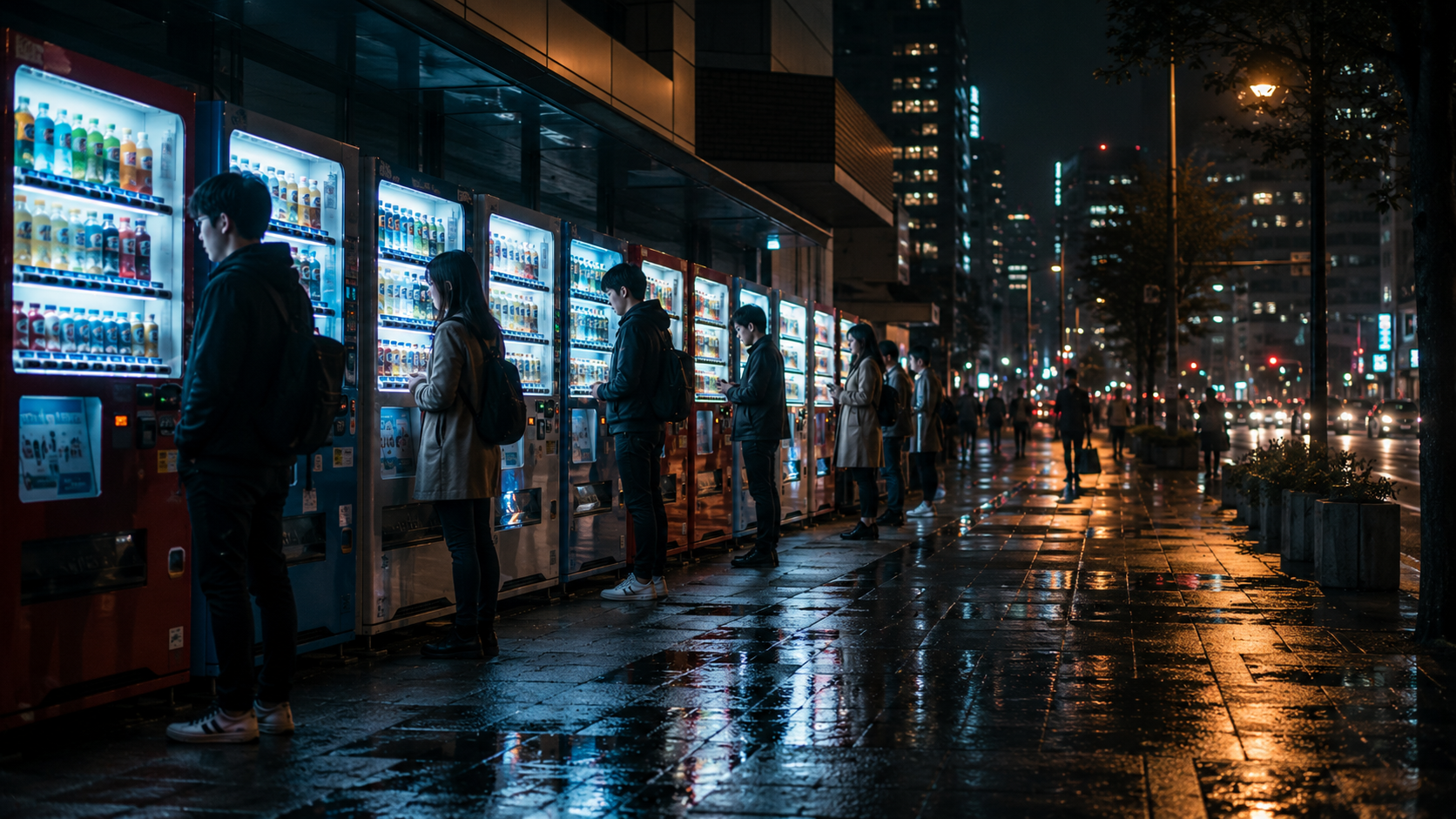
    Solitary vending machine glowing at night in empty street

    6. Conclusion

    Vending machines are not merely mechanical tools. They are agents that have reshaped consumption patterns and everyday life. The experience of purchasing without human interaction expanded consumption across time, space, and social boundaries.

    Today’s unmanned stores, online shopping platforms, and automated kiosks all follow paths first opened by vending machines. They stand simultaneously as nostalgic artifacts and as foundations of future consumption culture—quietly reminding us that even the simplest machines can leave lasting social footprints.


    📚 References

    Fishman, C. (2007). The Wal-Mart Effect: How the World’s Most Powerful Company Really Works—and How It’s Transforming the American Economy. Penguin.
    → While not focused solely on vending machines, this work explains how large-scale, automated distribution systems reshape modern consumption culture, offering valuable context for understanding unattended transactions.

    Miller, D. (1998). A Theory of Shopping. Cornell University Press.
    → A sociocultural analysis of shopping behavior that provides a theoretical framework for understanding how automated consumption devices influence everyday life and identity.

    Bestor, T. C. (2004). Tsukiji: The Fish Market at the Center of the World. University of California Press.
    → An ethnographic study of Japanese market culture that helps contextualize Japan’s unique vending-machine landscape and its broader consumer environment.