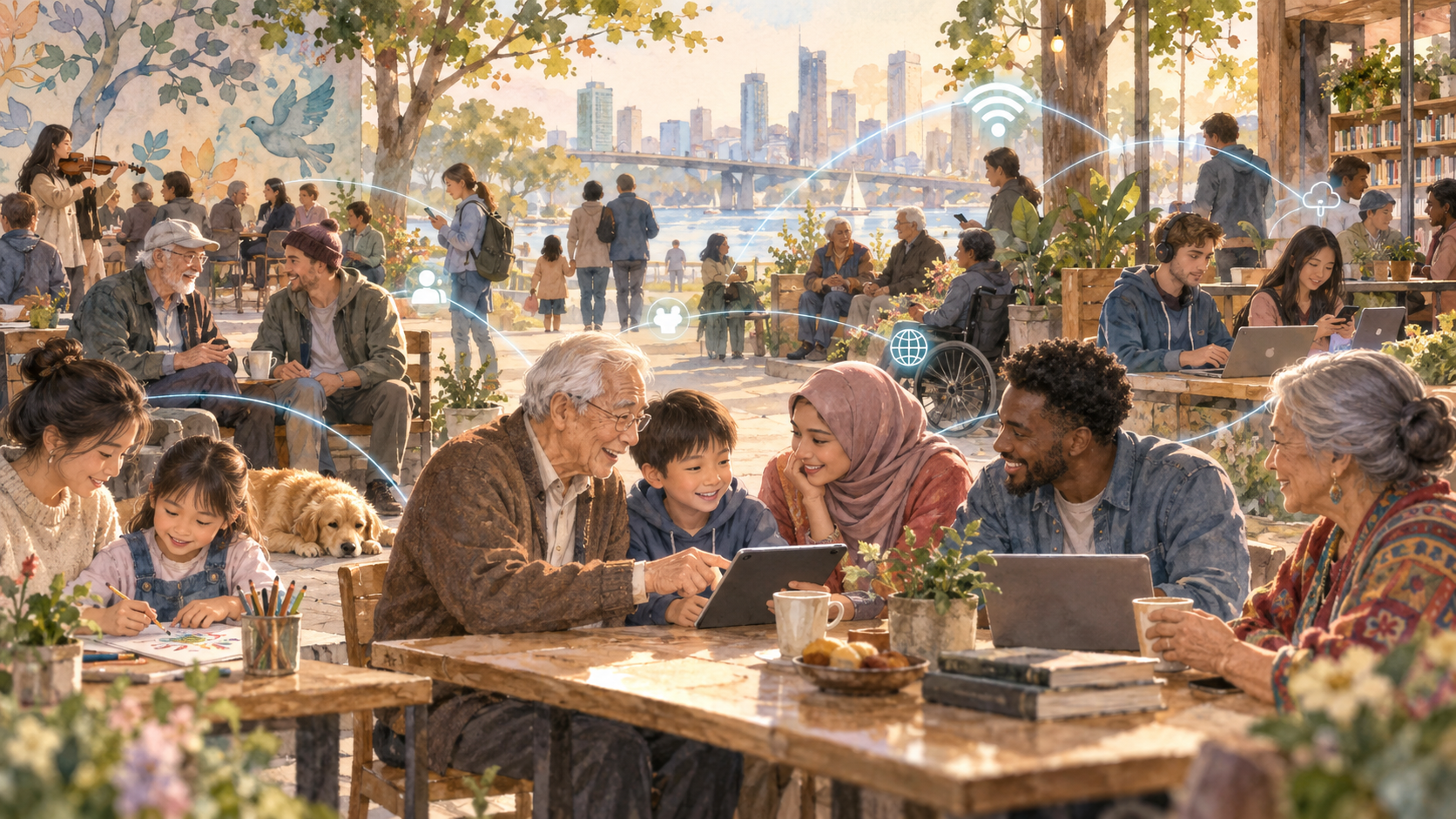
How Digital Culture Is Reshaping Freedom, Identity, Family, and Our Sense of Belonging
A family gathers for dinner.
One generation believes that being together means putting away the phone, sharing the meal, and talking face to face.
Another may see nothing unusual about answering messages during dinner. For them, relationships do not disappear when people look at screens. Friends, colleagues, communities, and conversations continue through the digital world.
Who is right?
The disagreement may appear trivial, but underneath it lies a much larger cultural transformation.
Traditional values are often associated with family, community, continuity, duty, and inherited social norms. Digital culture, by contrast, has expanded opportunities for individual expression, personalized lifestyles, flexible identities, and connections that are less dependent on geography or traditional institutions.
Yet the distinction is not as simple as community versus individualism.
Digital technologies can weaken some traditional relationships while creating entirely new communities. Traditional values can provide belonging and continuity, but they can also place restrictions on individual choice.
The real question is therefore not whether traditional or digital values should win.
It is:
What happens to freedom, responsibility, and belonging when the ways we connect with one another change?
1. What Do We Mean by Traditional Values?
Traditional values vary enormously across societies.
What is considered traditional in India may differ from what is traditional in Sweden, Nigeria, Japan, Brazil, or the United States. Even within the same country, religion, ethnicity, region, class, and generation can produce very different understandings of tradition.
Still, many traditional social arrangements place significant importance on continuity, family obligations, community membership, inherited customs, and reciprocal responsibility.
A person’s decisions may therefore be understood not entirely as private choices but as decisions affecting a wider network of relationships.
Choosing a career, marrying, caring for aging parents, participating in religious practices, or attending family gatherings may carry obligations extending beyond personal preference.
These expectations can create stability and belonging.
They remind individuals that human beings depend on one another.
But traditional expectations can also become restrictive when maintaining social conformity is valued more highly than individual autonomy.
Tradition therefore contains both possibilities:
belonging and obligation, continuity and constraint.
2. What Values Has Digital Culture Changed?
Digital technology has dramatically expanded the space in which individuals can construct and express identity.
A teenager in a small town can discover people around the world who share the same interests.
Someone uncomfortable expressing an opinion within their immediate community may find an online space where that opinion can be discussed openly.
Artists can publish their work without traditional gatekeepers. People can build careers outside conventional professional paths. Individuals can explore cultural, political, or personal identities that may have been difficult to express in their offline environments.
Social media has intensified this shift.
Profiles, photographs, videos, comments, and personal stories allow people to continuously present versions of themselves to others.
This can expand freedom and creativity.
But digital self-expression has another side.
When identity becomes publicly displayed and continuously evaluated through likes, shares, comments, views, and follower counts, self-expression can become self-performance.
We may feel freer to express ourselves while simultaneously becoming more conscious of how others are evaluating that expression.
Digital individualism, therefore, is not always independence from society.
Sometimes it simply means living under a different form of social influence.
3. Are Digital Values Really More Individualistic?
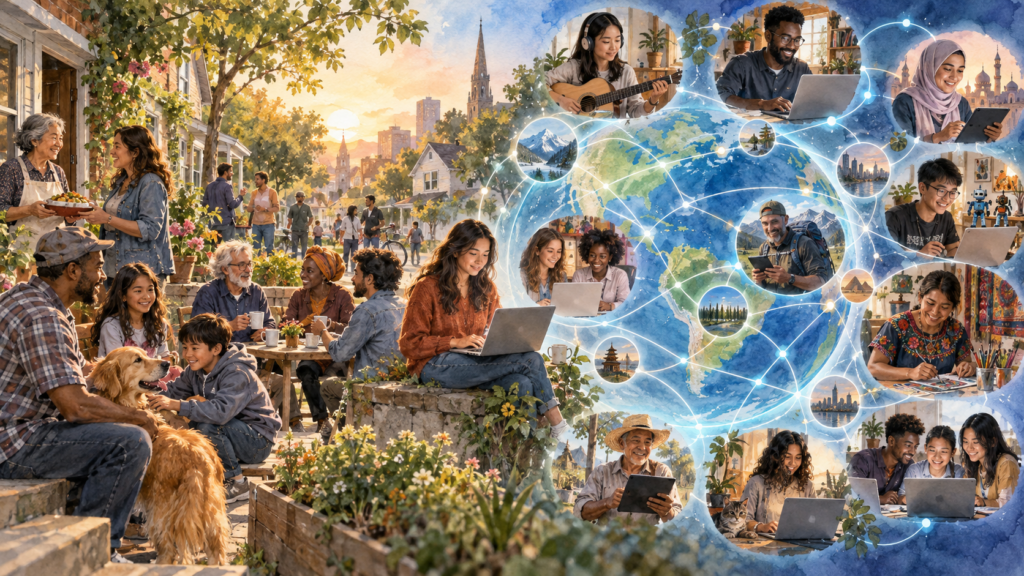
Here the traditional-versus-digital distinction becomes complicated.
The internet did not simply liberate individuals from communities.
It created new communities.
Online gaming groups, professional networks, fan communities, political movements, support groups, hobby communities, and diasporic networks can create genuine feelings of belonging.
A person may feel less connected to neighbors living fifty meters away but deeply connected to people living thousands of kilometers away.
This represents an important transformation.
Historically, many communities were inherited.
People were born into families, villages, religious traditions, ethnic groups, and nations.
Digital culture makes it easier to participate in chosen communities.
We increasingly belong not only because of where we were born but because of what we believe, enjoy, create, or care about.
Yet chosen communities also have weaknesses.
They can disappear quickly.
People can leave when disagreement becomes uncomfortable. Algorithms can surround users with people who share similar opinions. Communities built around common interests can sometimes become echo chambers in which opposing views are rarely encountered.
Digital culture therefore does not necessarily destroy community.
It may be changing what community means.
4. Why Do Traditional and Digital Values Create Generational Conflict?

The Same Behavior Can Carry Different Meanings
Many generational conflicts are not simply disagreements about behavior.
They are disagreements about what behavior means.
Consider family communication.
An older parent may believe that calling regularly demonstrates affection and responsibility.
An adult child may exchange short messages every day and feel that the relationship is perfectly close.
The parent thinks:
Why don’t you call me anymore?
The child thinks:
But we communicate every day.
Neither necessarily cares less.
They are using different cultural languages of connection.
The same applies to careers.
Parents may encourage a stable profession because stability represents responsibility and security. Their child may want to become a content creator, freelancer, digital entrepreneur, or remote worker because autonomy and meaningful work represent success.
What one generation interprets as responsibility, another may experience as restriction.
What one interprets as freedom, another may see as instability.
Generational conflict therefore cannot always be solved by deciding which side has better values.
Sometimes both generations are responding rationally to very different social environments.
5. Has Social Media Turned Self-Expression Into Self-Promotion?
Few areas reveal the clash of values more clearly than social media.
Sharing photographs of travel, achievements, meals, relationships, or everyday experiences may be interpreted very differently depending on cultural expectations.
One person sees:
self-expression.
Another sees:
self-promotion.
Traditional norms in some cultures encourage modesty and discourage drawing excessive attention to oneself. Social media, however, often rewards visibility.
If nobody sees your work, opportunities may disappear.
If nobody follows your account, your influence is limited.
If you run a small business, create art, work independently, or build a professional identity, visibility can have genuine economic value.
This means the distinction between private life and public identity has become increasingly blurred.
But another question follows.
When platforms reward constant visibility, are we expressing ourselves because we want to—or because the digital environment teaches us that being seen means being valuable?
Traditional society could exert pressure through conformity.
Digital society can exert pressure through visibility.
The mechanisms differ, but neither world is free from social expectations.
6. What Should We Preserve From Traditional Values?
Rejecting every traditional value simply because it is old would be as simplistic as rejecting every digital value because it is new.
Some traditional principles remain deeply valuable.
Caring for vulnerable family members, keeping commitments, respecting others, helping neighbors, accepting responsibilities toward a community, and recognizing that individual choices affect other people are not obsolete ideas.
They address a basic fact of human existence:
we depend on one another.
But preserving community should not require preserving every hierarchy or restriction inherited from the past.
Traditions can change.
Indeed, traditions have always changed.
The challenge is to distinguish between traditions that sustain meaningful human relationships and those that unnecessarily limit individual dignity or freedom.
Digital culture presents the opposite challenge.
Individual expression, access to information, flexible identities, and the ability to connect beyond geographical boundaries are genuine achievements.
But freedom without responsibility can weaken trust.
The ability to publish anything does not eliminate obligations concerning privacy, misinformation, harassment, or the dignity of others.
A healthy digital society therefore requires something more substantial than etiquette.
It requires digital citizenship.
7. Can Digital Citizenship Bridge Freedom and Community?
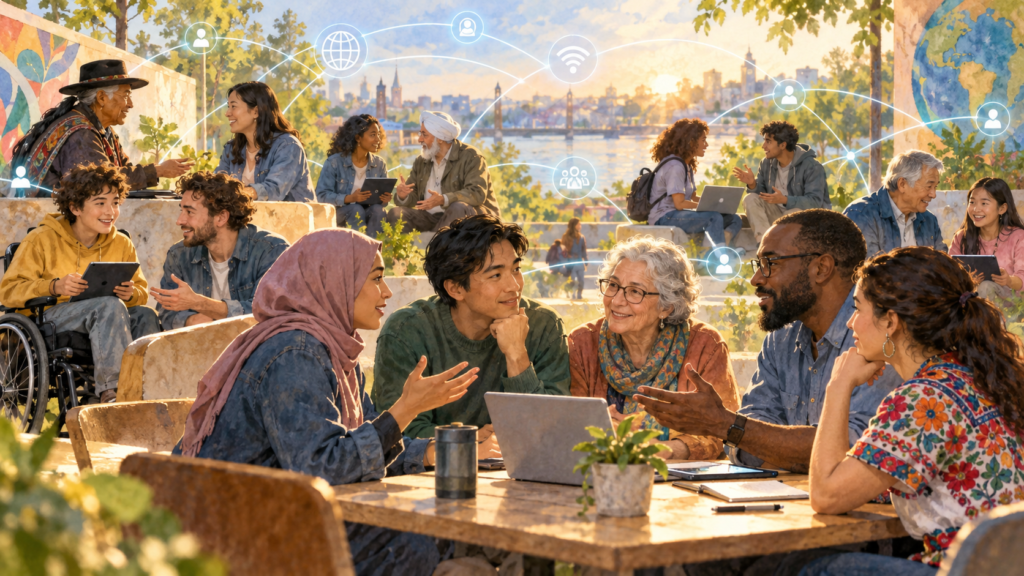
Digital citizenship offers a useful way to move beyond the simple opposition between traditional and digital values.
Citizenship has always involved both rights and responsibilities.
The same principle can apply online.
We may have the freedom to express ourselves while recognizing another person’s right to privacy.
We may participate in online communities while learning to disagree without dehumanizing others.
We may create digital identities without assuming that every aspect of life must become public.
We may enjoy personalized media while deliberately encountering perspectives different from our own.
From the perspective of citizenship and multicultural education, this balance is especially important.
Living together in a diverse society does not require everyone to share identical values.
It requires people with different values to develop rules, habits, and institutions that make coexistence possible.
The digital world does not eliminate that challenge.
It makes it global.
A person can now enter cultural spaces far beyond the community into which they were born. That creates extraordinary opportunities for intercultural understanding—but also new possibilities for misunderstanding, polarization, and conflict.
Digital literacy must therefore mean more than knowing how to operate technology.
It should include learning how to live responsibly with other people through technology.
Conclusion: We Are Not Choosing Between Tradition and the Digital Future
The conflict between traditional and digital values is often described as a battle between two worlds.
Community versus individuality.
Duty versus freedom.
Face-to-face relationships versus online relationships.
Tradition versus progress.
But reality is more complicated.
Traditional communities can provide belonging while restricting autonomy.
Digital culture can expand autonomy while creating new forms of conformity.
Traditional society can connect people who are physically close.
Digital society can connect people who would otherwise never meet.
Neither automatically produces better human relationships.
The challenge is therefore not to decide which age should defeat the other.
It is to preserve what remains valuable from both.
From traditional values, we may need responsibility, continuity, reciprocity, and the recognition that we owe something to other people.
From digital culture, we may need individual autonomy, openness, creativity, access, and the freedom to build identities and communities beyond inherited boundaries.
Perhaps the most important cultural task of the digital age is not choosing between the individual and the community.
It is learning how to create communities that protect individuality without abandoning responsibility.
And that leaves us with a question extending far beyond smartphones and social media:
As technology gives us more freedom to choose who we want to be, how much responsibility do we still owe to the communities that helped make us who we are?
Related Reading
If different generations understand connection, responsibility, and personal freedom in different ways, is technology itself creating the divide—or simply making deeper value differences more visible?
In The Digital Generation Gap: Is Technology Bringing Generations Together—or Driving Them Apart?, we explore how rapid technological change is reshaping relationships between generations and why digital inclusion requires more than simply learning how to use new devices.
But if digital life offers greater speed, convenience, and freedom, why do so many people continue to feel drawn to slower, more tangible experiences from the past?
In Digital Nostalgia – Why Analog Feelings Still Call to Us, we examine why analog experiences continue to evoke comfort and belonging—and what that nostalgia may reveal about the human needs that digital progress cannot completely replace.
References
1. Castells, M. (2010). The Rise of the Network Society (2nd ed.). Wiley-Blackwell.
Castells explains how digital networks have transformed social relationships, communication, identity, and institutions. His concept of the network society provides an important framework for understanding why digital culture does not simply weaken traditional communities but also creates new forms of connection and belonging.
2. Turkle, S. (2011). Alone Together: Why We Expect More from Technology and Less from Each Other. Basic Books.
Turkle examines how digital technologies can expand communication while simultaneously changing the quality of human relationships. Her work is particularly relevant to the tension between constant digital connection and concerns about intimacy, attention, and face-to-face interaction.
3. boyd, d. (2014). It’s Complicated: The Social Lives of Networked Teens. Yale University Press.
boyd challenges simplistic assumptions that young people’s use of social media necessarily reflects isolation or irresponsible individualism. Through research on teenagers’ digital lives, she shows how online spaces have become important environments for identity formation, friendship, social participation, and negotiation of privacy.
4. Jenkins, H., Ito, M., & boyd, d. (2016). Participatory Culture in a Networked Era: A Conversation on Youth, Learning, Commerce, and Politics. Polity.
The authors explore how networked technologies enable people to participate in communities built around shared interests, creativity, learning, and civic engagement. The book supports the article’s argument that digital culture can produce new forms of community rather than simply replacing collective life with individualism.
5. UNESCO. (2024). Global Citizenship Education in a Digital Age: Teacher Guidelines. UNESCO.
This resource connects digital transformation with citizenship, ethical participation, and learning to live with others in increasingly interconnected societies. It supports the article’s concluding argument that digital literacy should extend beyond technical competence toward responsible participation, dialogue, and respect for diversity.