Color Accessibility and Thoughtful Design for a Shared World
Is it red or green?
On maps, blue means water.
Red signals danger.
Green tells us everything is fine.
But what if those colors are not clearly distinguishable?
For millions of people worldwide, information conveyed only through color is not intuitive—it is confusing. Around 8% of men and 0.5% of women globally experience some form of color vision deficiency. For them, a traffic light, a chart, or a digital interface designed without consideration can turn everyday navigation into uncertainty.
This is not a marginal issue of perception.
It is a question of access.

1. Not Color-Blind, but Color-Different
1.1 What color vision deficiency really means
The term “color blindness” often suggests an inability to see color at all. In reality, most people with color vision deficiency do perceive color—but differently.
The most common type is red–green color deficiency, where reds and greens may appear muted, brownish, or indistinguishable. Blue–yellow deficiencies and complete achromatopsia (seeing only in grayscale) exist but are far rarer.
Color vision deficiency is not an absence of sight.
It is a difference in interpretation.
1.2 Why this difference matters
Because color plays a central role in modern communication, this perceptual difference directly affects safety, comprehension, and autonomy. When critical information relies on color alone, accessibility silently collapses.
2. The Risk of Color-Only Communication
2.1 Everyday designs that exclude
Many environments still depend solely on color to convey meaning:
- Transit maps that distinguish routes only by color
- Charts where increases and decreases are color-coded without labels
- Game interfaces where health status changes only from green to red
- Medical dashboards that rely on color intensity to signal urgency
For users with color vision deficiency, these designs slow recognition—or render information unreadable.
2.2 When accessibility becomes a safety issue
In transportation, healthcare, emergency systems, and public infrastructure, color-exclusive design is not merely inconvenient. It can be dangerous.
Accessibility is not about aesthetics.
It is about reliability under diverse conditions.

3. Universal Design Looks Beyond Color
3.1 What universal design means
Universal design aims to create environments usable by as many people as possible, regardless of age, ability, or sensory differences.
In color usage, this means refusing to treat color as a single channel of meaning.
3.2 Practical principles of accessible color design
Effective color-inclusive design often includes:
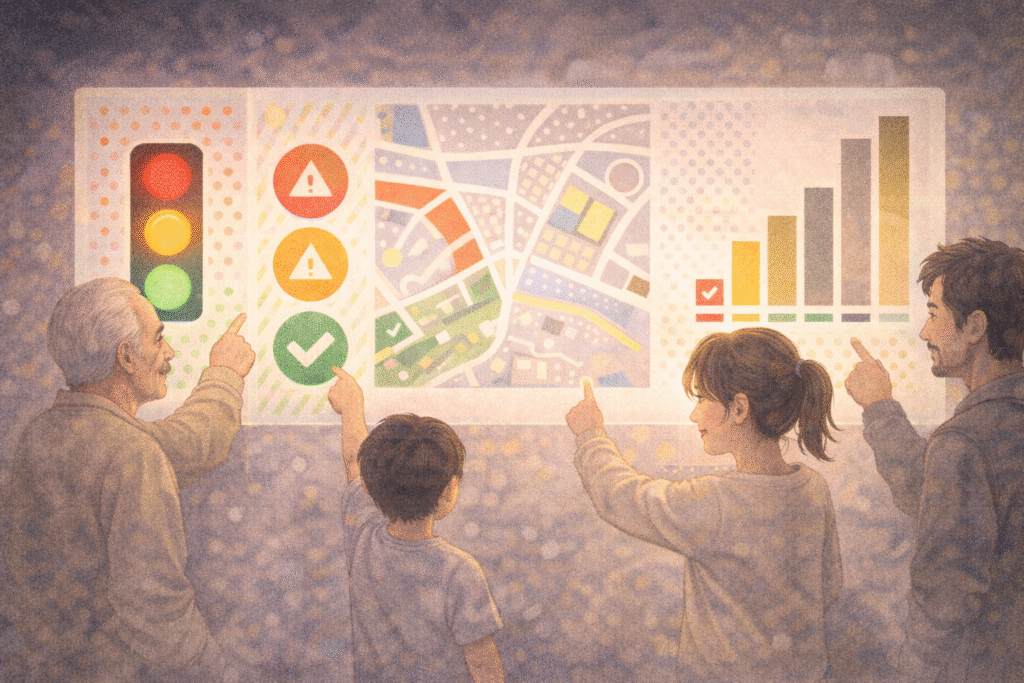
- Redundant cues: combining color with icons, patterns, text, or position
- High contrast between foreground and background
- Pattern overlays or shape distinctions in charts and maps
- Testing designs with color-vision simulation tools
These approaches do not dilute design quality.
They strengthen clarity for everyone.
4. How Global Companies Responded
4.1 Google Calendar
Originally dependent on color alone, Google Calendar introduced icons and layout cues after accessibility feedback, improving usability across perceptual differences.
4.2 X (formerly Twitter)
Beyond color changes, interaction feedback now includes motion and haptic responses, ensuring meaning is conveyed through more than visual color shifts.
4.3 UNO (ColorADD Edition)
The classic card game introduced patterned symbols for each color, allowing color-deficient players to participate without disadvantage—an elegant example of inclusive play.
Thoughtful design does not restrict creativity.
It signals responsibility.
5. Using Color Better, Not Less
5.1 Accessibility is not color avoidance
Color-inclusive design is not about eliminating color.
It is about using color intelligently.
When color works alongside structure, contrast, and context, information becomes clearer—not flatter.
5.2 Color as a relational language
Color is more than a visual signal.
It is a way of inviting others into shared understanding.
Designing with accessibility in mind means noticing what others might miss—and choosing not to leave them behind.
Related Reading
The act of noticing what escapes attention connects to cognitive framing discussed in How Search Boxes Shape the Way We Think.
This sensitivity to the unseen also mirrors existential concerns explored in Solitude in the Digital Age: Recovery or a Deeper Loss?.
Conclusion: A World Designed to Be Seen Together
Color does not appear the same to everyone.
But meaning should remain reachable.
Color accessibility is not a technical constraint.
It is an ethical orientation.
With small adjustments—patterns, contrast, redundancy—we can design systems that are not only beautiful, but fair.
A world truly designed for humans is one where no one is excluded by how they see.
References
- Ware, C. (2008). Visual Thinking for Design. Morgan Kaufmann.
This work explores how humans perceive visual information, explaining why reliance on color alone often fails. Ware emphasizes contrast, spatial positioning, and pattern as critical tools for accessible visual communication. - Norman, D. A. (2013). The Design of Everyday Things (Revised Edition). Basic Books.
A foundational text in human-centered design, arguing that good design should be understandable without explanation. Norman’s principles strongly support accessibility as a core design responsibility. - Lidwell, W., Holden, K., & Butler, J. (2010). Universal Principles of Design. Rockport Publishers.
This reference outlines key design principles such as redundancy, affordance, and accessibility, offering practical guidance for inclusive design across sensory differences, including color vision deficiency.