Tag: collective memory

  • Is History a Record of Progress or a Narrative of Power?

    Enlightenment Optimism and Postmodern Critique on Trial

    Two Ways of Seeing History
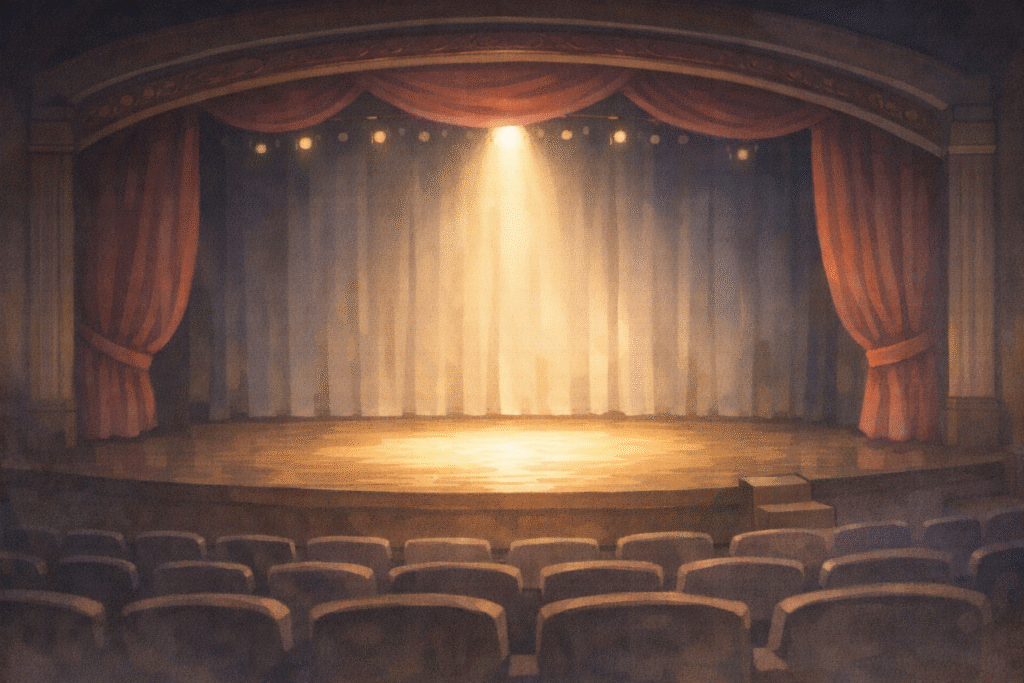
    An empty stage illuminated as a metaphor for historical interpretation

    Human beings have always recorded and interpreted the past in order to understand who they are.

    History is not simply a collection of events that have already happened.
    It is a foundation upon which societies build their present identities and imagine their futures.

    Yet there are fundamentally different ways of understanding what history is.

    One view treats history as a record of human progress—an ongoing movement toward reason, freedom, and moral improvement.
    Another sees history as a narrative shaped by power—constructed, selected, and told by those who dominate political and cultural authority.

    These two perspectives have long confronted one another on the grand stage of historical interpretation.
    Today, they meet again in a renewed trial of ideas.


    1. The Plaintiff: History as a Record of Progress

    The Enlightenment Tradition

    A symbolic path representing gradual human progress through history

    1.1 Reason, Freedom, and Historical Direction

    Enlightenment thinkers understood history as a rational process through which humanity gradually advances.

    In Idea for a Universal History with a Cosmopolitan Purpose, Idea for a Universal History with a Cosmopolitan Purpose by Immanuel Kant presents history as the unfolding of human reason within nature.
    Even war, conflict, and disorder are interpreted as unintended mechanisms through which humanity moves toward a more lawful and moral global order.

    History, from this perspective, is not random.
    It has a direction, even if that direction is only visible in retrospect.

    1.2 Hegel and the Philosophy of Historical Progress

    This claim becomes more explicit in Lectures on the Philosophy of World History by G. W. F. Hegel.
    For Hegel, history is the process by which reason realizes itself in the world.

    Freedom is not given all at once.
    It expands gradually as human consciousness develops—from despotism, to limited liberty, to the recognition that all humans are free.

    In this view, history is not merely descriptive.
    It is the story of humanity coming to understand itself.

    1.3 The Enduring Appeal of Progress

    This narrative remains persuasive today.

    The abolition of slavery, the expansion of women’s rights, the institutionalization of democracy, and the global spread of human rights norms are often cited as evidence that history does move in a better direction.

    From this angle, history offers hope.
    It reassures us that injustice is not permanent and that moral learning is possible.


    2. The Defense: History as a Narrative of Power

    Postmodern Critiques

    2.1 Power, Knowledge, and Historical Construction

    Postmodern thinkers challenge the very idea that history has an inherent direction.

    In The Archaeology of Knowledge and Discipline and Punish, Michel Foucault argues that history is inseparable from power.
    What counts as historical truth is shaped by institutions, discourses, and systems of knowledge that serve particular interests.

    From this perspective, historical facts are never neutral.
    They are selected, organized, and interpreted in ways that legitimize existing power structures.

    2.2 History as Narrative, Not Mirror

    A similar argument appears in Metahistory by Hayden White.
    White treats historical writing as a form of narrative construction, governed by literary tropes and rhetorical choices.

    History, he argues, does not simply reflect reality.
    It tells stories—and those stories could always have been told differently.

    Thus, the story of “progress” may itself be a narrative strategy rather than an objective description.

    2.3 Exclusion, Silence, and Authority

    From this standpoint, the writing of history becomes a political act.

    Colonial histories written from the perspective of imperial powers, the marginalization of subaltern voices, and the selective memory preserved in textbooks all reveal how power shapes historical meaning.

    History, the defense insists, is not a neutral archive—but a contested terrain.


    3. Evidence and Counterarguments

    Supporters of the progress narrative point to concrete transformations:
    expanded political rights, improved living standards, and international legal frameworks.

    Critics respond that these achievements often coexist with new forms of domination.
    Colonialism was justified as “civilization,” and human rights discourse has sometimes been used to legitimize geopolitical intervention.

    The very concept of progress, they argue, may reflect the worldview of those who benefit most from the existing order.


    4. Contemporary Implications: Textbooks and the Politics of Memory

    This debate is not abstract.

    It shapes how history is taught in schools, how nations commemorate past events, and how societies decide what to remember—and what to forget.

    Disputes over history textbooks, debates about monuments, and conflicts over collective memory reveal that history is always written in the present.

    At the same time, few would deny that humanity has achieved genuine moral breakthroughs.
    The challenge lies in acknowledging progress without ignoring power.
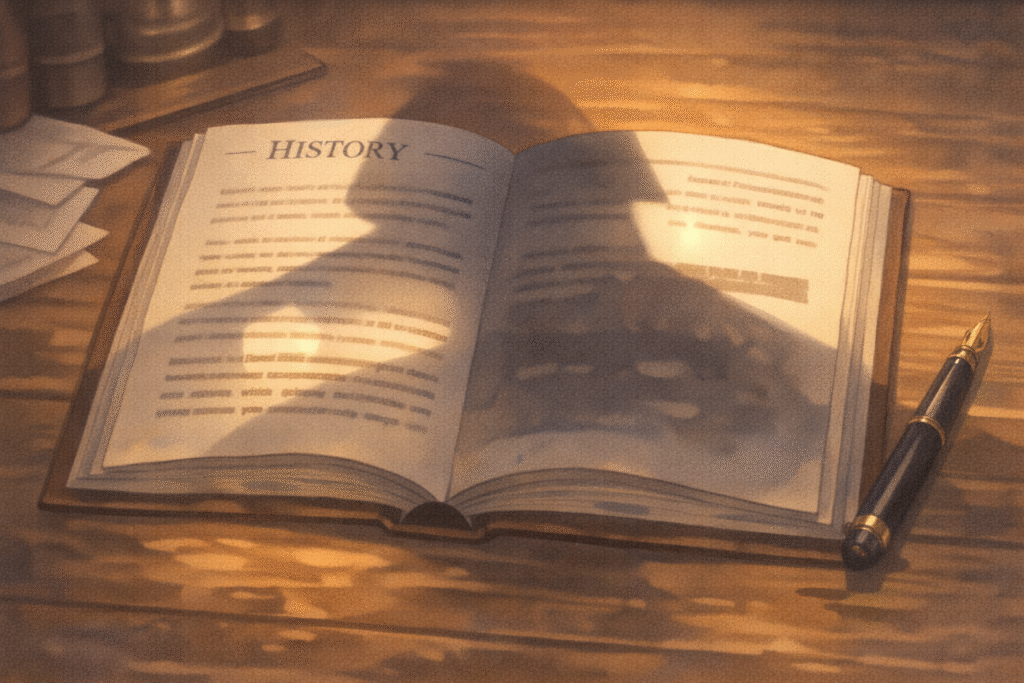
    A shadow over a history book symbolizing power shaping narratives

    Conclusion: An Open Verdict

    Is history a record of progress, or a narrative of power?

    The advocates of progress emphasize humanity’s capacity for reason, learning, and moral growth.
    The critics remind us that history is always told from somewhere, by someone, for some purpose.

    The trial does not end with a final judgment.

    Instead, it leaves us with a question that must remain open:

    Is the history we learn a trace of human advancement—or a reflection of power’s imprint?

    That question, ultimately, is still under deliberation—within each reader’s own interpretive court.

    Related Reading

    The politics of language and interpretation is further developed in The Power of Naming: Is Naming an Act of Control?, where classification becomes an instrument of authority.

    A contemporary reflection on collective perception can be found in Algorithmic Bias: How Recommendation Systems Narrow Our Worldview, which examines how narratives are filtered in the digital age.


    References

    1. Idea for a Universal History with a Cosmopolitan Purpose
      Kant, I. (1784/1991). Idea for a Universal History with a Cosmopolitan Purpose. Cambridge: Cambridge University Press.
      → Kant presents history as the gradual unfolding of human reason toward a cosmopolitan moral order, forming a cornerstone of Enlightenment historical thought.
    2. Lectures on the Philosophy of World History
      Hegel, G. W. F. (1837/1975). Lectures on the Philosophy of World History. Cambridge: Cambridge University Press.
      → Hegel systematizes the idea of historical progress as the realization of freedom through world history.
    3. The Archaeology of Knowledge
      Foucault, M. (1969/2002). The Archaeology of Knowledge. London: Routledge.
      → Foucault demonstrates how historical knowledge is shaped by discourse and power rather than objective truth alone.
    4. Metahistory
      White, H. (1973). Metahistory. Baltimore: Johns Hopkins University Press.
      → White argues that historical writing is fundamentally narrative and rhetorical, challenging claims of neutral historiography.
    5. What Is History?
      Carr, E. H. (1961). What Is History?. London: Macmillan.
      → Carr occupies a middle ground, emphasizing both factual evidence and the historian’s interpretive role.

  • Is Memory a Container of Truth, or a Story Constantly Rewritten?

    Unforgettable memories, returning in unfamiliar forms

    We often treat memory as a reliable archive of facts.
    A childhood scene, a defining relationship, a historical moment—
    we assume these memories are stored somewhere inside us, intact and unchanged, like photographs preserved over time.

    Yet memory behaves strangely.
    With the passing years, details blur. Emotions shift.
    The same event resurfaces with altered meanings, missing pieces, or unexpected additions.
    When two people recall the same moment, their accounts rarely align perfectly.

    So what, then, is memory?
    Is it a container holding the truth of the past,
    or a story that is rewritten each time it is told?

    Memory represented as a container holding fixed moments from the past

    1. The Nature of Memory: Not Recording, but Reconstruction

    Psychological research has long shown that memory is not a passive recording device.
    It is an active, reconstructive process.

    The work of Elizabeth Loftus demonstrated how easily memories can be altered by suggestion.
    Eyewitnesses exposed to subtly different questions recalled different details of the same event.
    Over time, confidence in false memories often increased rather than diminished.

    Memory, then, does not simply retrieve facts.
    It rebuilds the past using fragments, emotions, expectations, and present-day perspectives.
    What we remember is shaped as much by who we are now as by what happened then.

    Human memory shown as a constantly reconstructed narrative rather than a fixed record

    2. Philosophical Perspectives: Truth or Interpretation?

    Philosophically, memory sits at the intersection of truth and interpretation.

    Rather than preserving objective reality, memory interprets the past from the standpoint of the present.
    Friedrich Nietzsche famously suggested that memory depends on forgetting—that selective remembrance is what allows life to continue.

    From this view, memory is not a failure of accuracy but a condition of meaning.
    The past becomes intelligible only when filtered, organized, and narrated.

    Truth in memory is therefore not absolute correspondence with facts,
    but coherence within a lived narrative shaped by time, identity, and perspective.


    3. Collective Memory and History: Who Decides What Is Remembered?

    If individual memory is fragile, collective memory is even more complex.

    Societies remember through monuments, anniversaries, textbooks, and museums.
    Yet remembrance is never neutral. Some events are emphasized, others erased.

    Wars are remembered differently by victors and the defeated.
    What one group calls liberation, another may record as rebellion.
    These narratives do not simply describe the past—they legitimize present identities and power structures.

    Collective memory, then, is not merely shared recollection.
    It is a political and cultural construction shaped by authority, ideology, and selection.


    4. Neuroscience: Memory as a Dynamic Process in the Brain

    Neuroscience reinforces this view of memory as fluid rather than fixed.

    When a memory is recalled, neural networks are reactivated and modified.
    The act of remembering itself changes the memory.

    Rather than retrieving a static file, the brain reconstructs an experience anew,
    strengthening some connections while weakening others.

    This explains why memories can feel vivid yet unreliable—
    they are living processes, not stored objects.


    5. Memory in the Digital Age: Permanent Records vs. Human Forgetting

    The tension between truth and meaning in human memory

    Digital technology introduces a new tension.

    Photos, videos, messages, and social media archives preserve moments indefinitely.
    Unlike human memory, digital memory does not forget.

    Yet forgetting plays a crucial role in psychological healing and growth.
    Human memory softens pain, reshapes meaning, and allows renewal.

    Digital permanence, by contrast, can trap individuals in past versions of themselves.
    This is why debates around the “right to be forgotten” have emerged—
    not as a rejection of truth, but as a defense of human dignity and temporal change.


    Conclusion: Memory as Both Container and Story

    Memory is neither a flawless container of truth nor mere fiction.
    It is both archive and narrative—holding traces of reality while continuously reshaping them.

    Its value lies not in perfect accuracy, but in meaning-making.
    Memory forms identity, connects individuals to communities, and binds past to present.

    Recognizing the fragility of memory does not weaken truth.
    Instead, it invites humility, reflection, and responsibility in how we remember.

    Memory is not simply how we hold on to the past.
    It is how the past continues to speak—through stories we are always, inevitably, rewriting.


    Related Reading

    Questions about memory and truth overlap with cultural interpretations discussed in A Cultural History of Dream Interpretation.

    Everyday experiences of narrative reconstruction are also reflected in The Sociology of Waiting in Line.

    References

    1. Loftus, E. F. (2005). Planting Misinformation in the Human Mind: A 30-Year Investigation of the Malleability of Memory. Learning & Memory, 12(4), 361–366.
    This landmark study demonstrates how easily human memory can be distorted by external information. Loftus shows that memory is highly malleable, challenging the assumption that recollection reliably reflects objective truth.

    2. Schacter, D. L. (2001). The Seven Sins of Memory: How the Mind Forgets and Remembers. Boston: Houghton Mifflin.
    Schacter categorizes common memory errors and explains why forgetting and distortion are not flaws but functional features of human cognition. The book reframes memory as an adaptive, reconstructive system.

    3. Halbwachs, M. (1992). On Collective Memory. Chicago: University of Chicago Press.
    Halbwachs introduces the concept of collective memory, arguing that individual remembrance is always shaped by social frameworks. This work remains foundational for understanding memory as a social and cultural process.

    4. Neisser, U. (1981). John Dean’s Memory: A Case Study. Cognition, 9(1), 1–22.
    By comparing personal testimony with archival records, Neisser illustrates how confident recollection can diverge from documented facts, highlighting the narrative nature of memory.

    5. Conway, M. A. (2009). Episodic Memories. Neuropsychologia, 47(11), 2305–2313.
    Conway explains how episodic memory is continuously reconstructed in relation to the self and current goals. The study bridges cognitive psychology and neuroscience in explaining memory’s dynamic structure.