Tag: cognitive science

  • How Smart Are Animals? The Science Behind Animal Intelligence Tests

    How Smart Are Animals? The Science Behind Animal Intelligence Tests

    Do animals simply follow instinct—or are they capable of thinking, learning, and even understanding themselves?

    Scientists have long been fascinated by this question. Through carefully designed experiments, researchers attempt to measure animal intelligence and uncover how different species perceive the world. From self-recognition to problem-solving, and even connections to artificial intelligence (AI), animal cognition research continues to reshape how we understand intelligence itself.


    1. Mirror Test: Can Animals Recognize Themselves?

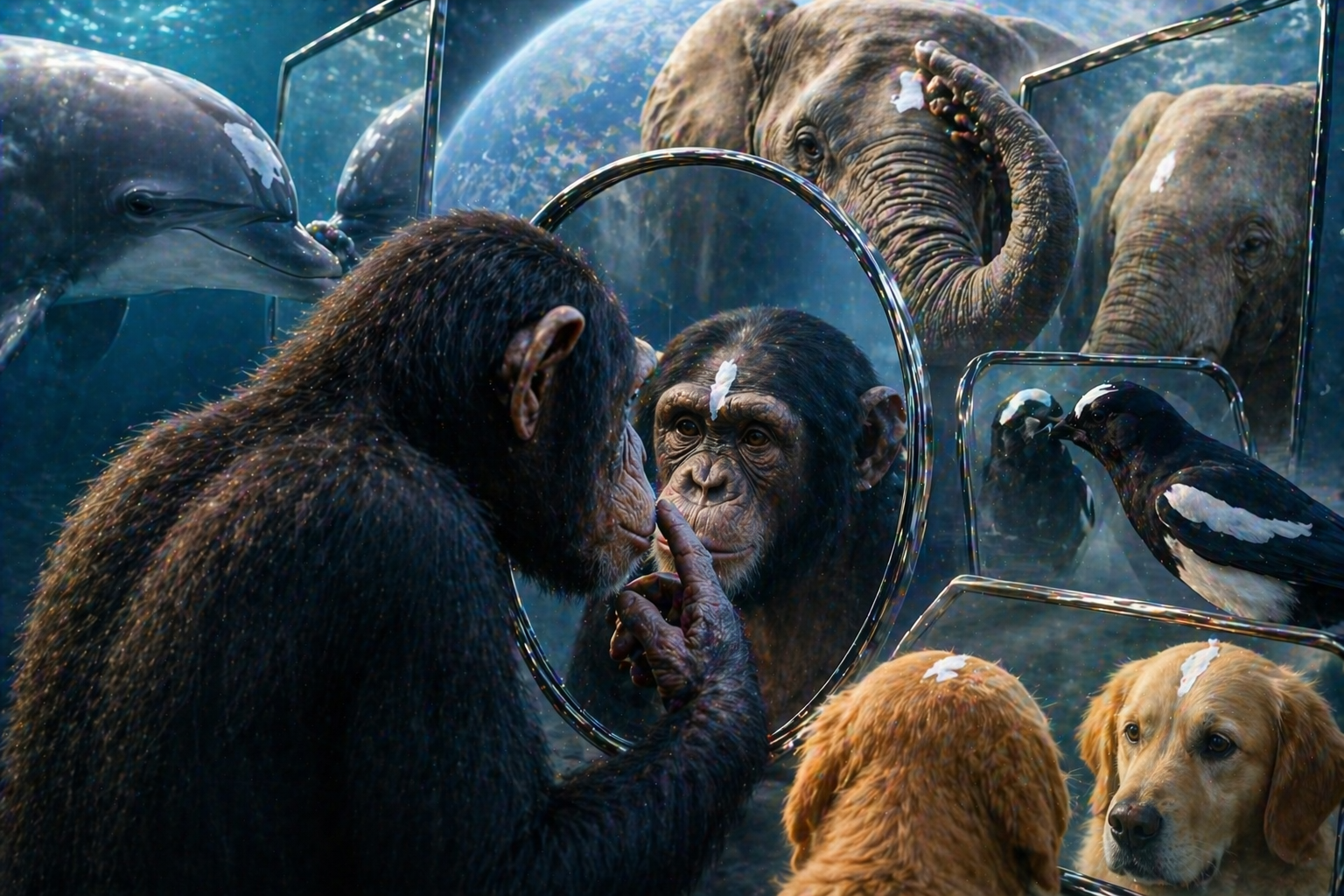
    animal mirror self awareness test

    1.1 What is the Mirror Test?

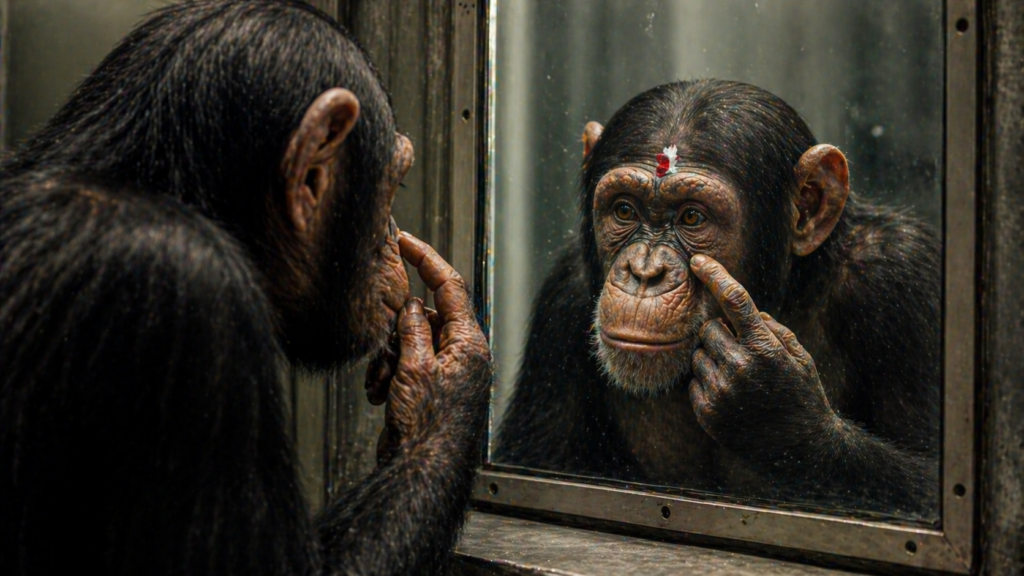
    The mirror test, developed by psychologist Gordon Gallup in 1970, is one of the most famous methods for studying self-awareness in animals.

    In this experiment, a visible mark is placed on an animal’s body without its knowledge. When the animal is placed in front of a mirror, researchers observe whether it attempts to inspect or touch the mark on its own body.

    If it does, this suggests a level of self-recognition—an ability once thought to be uniquely human.


    1.2 Which Animals Pass the Test?

    Only a few species have successfully passed the mirror test:

    • Chimpanzees: The first animals shown to recognize themselves
    • Elephants: Able to touch marks on their own bodies
    • Dolphins: Display self-exploratory behavior in mirrors
    • Magpies: One of the few bird species demonstrating self-awareness

    Interestingly, dogs and cats usually fail the test—not because they are unintelligent, but because they rely more on smell than vision.

    This highlights an important limitation:
    intelligence tests must match the sensory world of the animal being studied.


    2. Maze Experiments and Problem-Solving Skills

    crow problem solving intelligence experiment

    2.1 Learning Through Mazes

    Maze experiments are widely used to study learning and memory.

    In a typical setup:

    • Animals (often rats) navigate a maze
    • Food rewards are placed at the exit
    • Over time, animals learn faster routes

    This demonstrates trial-and-error learning, memory formation, and adaptation.


    2.2 Tool Use and Advanced Problem Solving

    Some animals go far beyond simple learning.

    One of the most famous examples is the New Caledonian crow.

    These birds have been observed:

    • Dropping stones into water to raise the level and access food
    • Using and even shaping tools to solve problems

    Primates such as chimpanzees and orangutans also use sticks and stones strategically.

    These behaviors suggest:

    • Understanding of cause and effect
    • Planning ability
    • Flexible thinking

    In other words, intelligence that goes beyond instinct.


    3. Animal Intelligence and Artificial Intelligence (AI)

    3.1 Learning Like Animals

    Modern AI systems are increasingly inspired by how animals learn.

    One key example is reinforcement learning:

    • Animals learn through rewards and punishments
    • AI systems optimize decisions through similar feedback loops

    3.2 What AI Researchers Learn from Animals

    Animal cognition studies provide valuable insights:

    • Crow problem-solving → robotics navigation systems
    • Animal pattern recognition → computer vision improvements
    • Adaptive behavior → flexible AI decision-making

    The goal is clear:
    to build machines that learn as efficiently and naturally as living beings.


    4. What Animal Intelligence Research Really Means

    Studying animal intelligence is not just about curiosity—it reshapes how we define intelligence itself.

    It challenges assumptions such as:

    • Intelligence is uniquely human
    • Thinking requires language
    • Learning must follow a single model

    Instead, we discover that intelligence is:

    • Diverse
    • Context-dependent
    • Closely tied to environment and survival
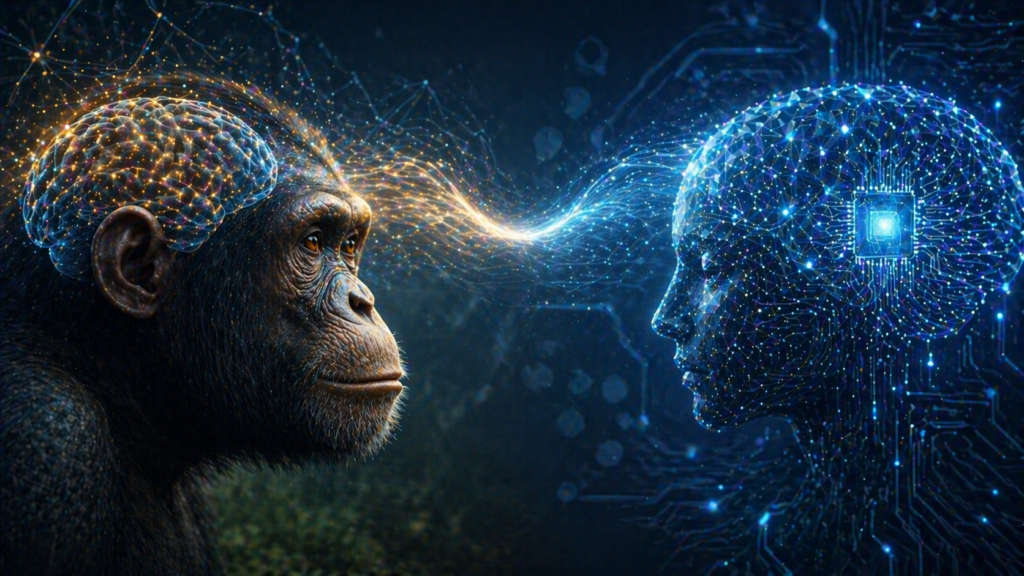
    animal intelligence inspiring AI learning

    Conclusion

    Animals are not simply creatures of instinct.
    They learn, adapt, solve problems, and in some cases, even recognize themselves.

    Through mirror tests, maze experiments, and problem-solving studies, science continues to reveal the complexity of animal minds.

    At the same time, these discoveries are influencing the future of artificial intelligence—bridging biology and technology in unexpected ways.

    Perhaps the real question is not how intelligent animals are—
    but how narrow our definition of intelligence has been.

    Reader Question

    If an animal can solve problems, use tools, and even recognize itself—
    how different is its intelligence from ours?


    Do you think intelligence should be measured the same way for humans and animals?

    If animals think differently—not less—what does that say about our definition of intelligence?

    Related Reading


    If animals can think, learn, and even recognize themselves, where do we draw the line between human and non-human intelligence?
    In Can Humans Be the Moral Standard?, we question whether humans truly have the authority to define intelligence, morality, and value—especially when other species demonstrate forms of cognition we are only beginning to understand.


    If intelligence is not absolute but relative, shaped by environment and perception, are we measuring animals fairly at all?
    In Civilization and the “Savage Mind”: Relative Difference or Absolute Hierarchy?, we explore how intelligence has historically been judged through human-centered standards—and why this perspective may be fundamentally limited.


    References

    1. Griffin, D. R. (2001). Animal Minds: Beyond Cognition to Consciousness. University of Chicago Press.
    This work explores the cognitive and conscious experiences of animals, challenging traditional assumptions that animal behavior is purely instinctive. It provides a foundational framework for understanding self-awareness and intelligence across species.

    2. Pepperberg, I. M. (2008). Alex & Me. HarperCollins.
    Through her research with the African grey parrot Alex, Pepperberg demonstrates advanced language comprehension and reasoning abilities in birds, offering powerful evidence of non-human intelligence.

    3. Lake, B. M., et al. (2017). Building Machines That Learn and Think Like People.
    This study connects human and animal learning processes with artificial intelligence, showing how biological cognition inspires modern machine learning systems.

  • Does Language Shape Thought, or Does Thought Shape Language?

    Does Language Shape Thought, or Does Thought Shape Language?

    The Debate Between Linguistic Relativity and Universal Grammar

    Every day, we think, speak, and interpret the world through language.
    But have you ever wondered—does the language you speak shape how you think?

    Or does your mind already possess a structure that simply finds expression through language?

    This question lies at the heart of one of the most enduring debates in linguistics, philosophy, and cognitive science. From the Sapir–Whorf hypothesis to Chomsky’s theory of universal grammar, scholars have long struggled to determine which comes first: language or thought.


    1. Does Language Shape Thought? — The Sapir–Whorf Hypothesis

    language differences shaping perception of snow

    The Sapir–Whorf hypothesis, also known as linguistic relativity, argues that the structure of a language influences how its speakers perceive and understand the world.

    Edward Sapir and Benjamin Lee Whorf proposed that language is not merely a tool for communication but a framework that actively shapes cognition.

    For instance, some languages contain dozens of words to describe different types of snow, while others use only one. This linguistic richness may lead speakers to notice and differentiate subtle variations that others might overlook.

    Whorf’s analysis of the Hopi language further suggested that speakers perceive time not as a linear flow, but as cyclical or event-based. Such findings imply that language can fundamentally influence how reality itself is experienced.

    From this perspective, language acts as a “map of thought,” guiding perception, attention, and interpretation.


    2. Does Thought Shape Language? — The Theory of Universal Grammar

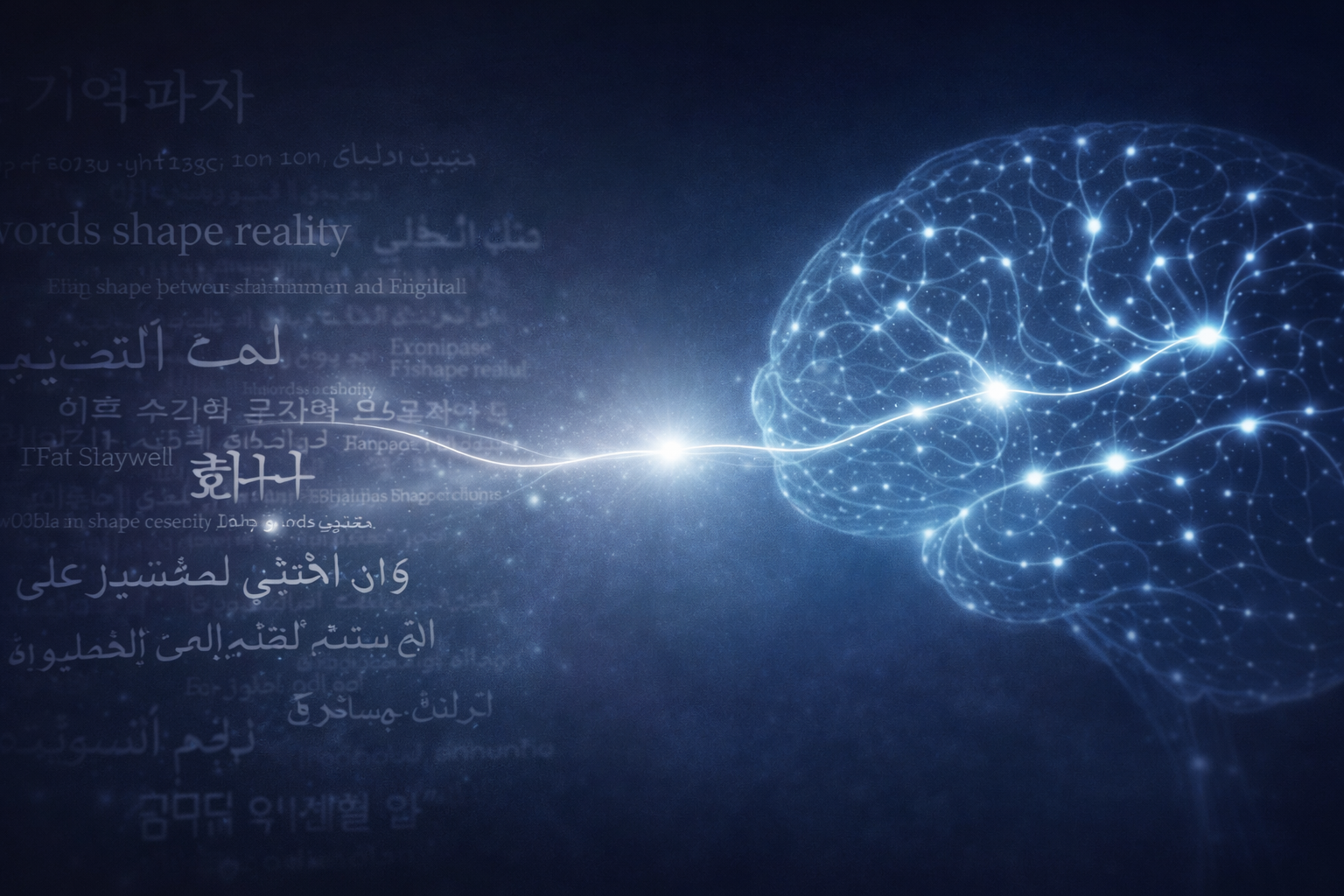
    universal grammar connecting brain and language

    In contrast, Noam Chomsky’s theory of universal grammar argues that language is shaped by innate cognitive structures.

    According to this view, humans are born with a built-in capacity for language—a universal framework that underlies all linguistic systems. While languages may differ on the surface, they share deep structural similarities rooted in the human mind.

    For example, all languages encode relationships between subjects and predicates, suggesting a common cognitive architecture.

    From this perspective, thought precedes language. Language does not define how we think; rather, it expresses thoughts that already exist within a universal mental framework.


    3. Evidence and Counterarguments

    The debate between these perspectives has been tested through numerous experiments and interdisciplinary research.

    Supporters of linguistic relativity often point to color perception studies. In some languages, blue and green are described with the same word. Speakers of such languages have been shown to distinguish these colors less quickly, suggesting that linguistic categories influence perception.

    On the other hand, proponents of universal grammar highlight that infants—before fully acquiring language—can already understand complex concepts. Additionally, people from different linguistic backgrounds often solve logical problems in similar ways, implying that thought can operate independently of language.

    Modern neuroscience adds further complexity. Brain imaging studies reveal that language-processing areas and reasoning areas can function separately, yet linguistic structures still appear to influence attention, memory, and categorization.


    4. Modern Implications: Education, AI, and Multicultural Societies

    This debate is not merely theoretical—it has profound real-world implications.

    In education, if language shapes thought, then learning a new language may open entirely new ways of perceiving the world. Language learning becomes a process of cognitive transformation.

    If thought shapes language, however, language learning is more about expressing pre-existing cognitive structures in different forms.

    The debate is also central to artificial intelligence. Should AI treat language as data to process, or as a reflection of deeper cognitive structures? The answer influences how we design systems capable of “thinking” like humans.

    In multicultural societies, this issue affects how we understand translation, communication, and cultural differences. Are misunderstandings rooted in language, or in deeper cognitive frameworks?

    interaction between language and thought in dialogue

    Conclusion: Judgment Deferred

    It remains difficult to declare a clear winner in this debate.

    Language and thought appear to exist in a dynamic relationship—each shaping and reshaping the other. Language can guide perception, while thought can generate and transform language.

    Perhaps the real question is not which comes first, but how deeply they are intertwined.

    Are we prisoners of the languages we speak, or are we free thinkers who merely wear language as a tool?

    The answer may not lie in theory alone, but in how each of us experiences the world through both thought and language.


    💬 A Question for Readers

    When you learn a new language, do you feel that your way of thinking changes—
    or are you simply expressing the same thoughts differently?

    Related Reading

    The question of who defines human standards is further examined in Can Humans Be the Moral Standard?, where the assumption that human judgment is the ultimate reference point is critically challenged in the context of evolving technological systems.

    From a broader perspective on human identity and transformation, the limits of what it means to remain human are explored in Can Technology Surpass Humanity?, which reflects on how technological advancement may reshape not only our abilities, but the very standards by which we define ourselves.

    References

    1. Whorf, B. L. (1956). Language, Thought, and Reality: Selected Writings. Cambridge, MA: MIT Press.
      This work presents one of the most influential formulations of the Sapir–Whorf hypothesis, illustrating how linguistic structures shape patterns of perception and cognition. It provides essential philosophical and anthropological foundations for understanding linguistic relativity and its implications for how humans interpret reality.

    1. Sapir, E. (1921). Language: An Introduction to the Study of Speech. New York: Harcourt, Brace & Company.
      Sapir’s foundational text explores the deep connections between language, culture, and thought, emphasizing that language is not merely a communication tool but a framework shaping worldview. It offers a classical perspective on how linguistic systems influence human cognition and social understanding.

    1. Chomsky, N. (1965). Aspects of the Theory of Syntax. Cambridge, MA: MIT Press.
      Chomsky introduces the theory of universal grammar, arguing that human language is grounded in innate cognitive structures shared across all individuals. This work provides a central argument for the idea that thought precedes language and that linguistic diversity emerges from a common mental framework.

    1. Vygotsky, L. S. (1986). Thought and Language. Cambridge, MA: MIT Press.
      Vygotsky examines the dynamic interaction between language and thought within a sociocultural context, particularly in child development. His work bridges the gap between the two opposing theories by demonstrating how language both shapes and is shaped by cognitive processes.

    1. Pinker, S. (1994). The Language Instinct: How the Mind Creates Language. New York: William Morrow and Company.
      Pinker argues that language is an innate human capacity shaped by evolutionary processes, supporting the view that cognition plays a primary role in forming language. The book combines insights from psychology, linguistics, and biology to explain how language emerges from the human mind.
  • Why Do We Remember Handwriting Better Than Typing?

    Why Do We Remember Handwriting Better Than Typing?

    The Science Behind Memory, Emotion, and Learning

    During a meeting, you might type notes on your smartphone — only to realize days later that you remember almost nothing.

    Yet strangely, a quick handwritten note on paper often stays vivid in your mind.

    Many people share this experience.
    Why does handwriting seem more memorable?
    The difference between handwriting vs typing memory is not just a matter of preference, but how the brain processes information.

    Is it simply emotional, or does the brain respond differently when we write by hand?


    1. Handwriting Is Not Just Recording — It Is Motor Memory

    hand writing notes with focus and memory

    Typing on a keyboard involves repetitive and uniform movements.
    Your fingers tap in similar patterns with minimal variation.

    Handwriting, however, is far more complex.

    Each letter involves:

    • wrist movement
    • pen pressure
    • stroke direction
    • spatial positioning

    These physical actions activate motor memory and help store information more effectively.
    This explains why handwriting vs typing memory shows clear differences in how we retain information.

    This process helps transfer information from short-term memory into long-term memory.

    Research supports this idea.

    Studies have shown that information written by hand is remembered more effectively than information typed on a keyboard.


    2. Handwriting Creates Meaningful Signals for the Brain

    typing quickly on laptop with less focus

    Handwriting carries a strong personal signature.

    The size, shape, and flow of your writing are unique — almost like a fingerprint.

    This is why a handwritten letter often feels more meaningful than a typed message.

    Handwriting is not just a method of recording information.
    It also conveys emotion and intention.

    These emotional elements activate deeper cognitive processing in the brain, making the information more memorable.


    3. The “Inconvenience” of Analog Creates Focus

    Writing by hand is slower and less convenient.

    There is no auto-correct, no quick deletion, and no predictive text.

    Because of this, we naturally become more intentional and thoughtful when writing.

    We choose words more carefully.
    We process information more deeply.

    This slower pace encourages active thinking, which strengthens memory formation.

    In contrast, typing often leads to passive transcription rather than meaningful understanding.


    4. Handwriting Is Not Disappearing — It Is Returning

    Despite the rise of digital technology, handwriting is making a comeback.

    Digital handwriting tools and note-taking devices are gaining popularity.

    People are rediscovering the value of:

    • physical interaction
    • slower thinking
    • sensory engagement

    Even in the AI era, many students report that handwriting helps them learn and remember better than digital note-taking.

    This suggests that handwriting fulfills a cognitive need that technology alone cannot replace.


    Conclusion

    person reflecting with handwritten notes

    Handwriting is a form of memory that involves both the brain and the body.

    It carries emotional meaning.
    It encourages deeper thinking.
    It slows us down in a way that enhances understanding.

    In a fast digital world, handwriting reminds us that
    sometimes slower processes lead to deeper memory.

    Perhaps the next time you want to remember something important,
    you might try writing it down — by hand.

    Related Reading

    The cognitive and emotional depth of handwriting is further explored in The Psychology of Handwriting, where the act of writing is examined not merely as a mechanical process, but as a meaningful interaction between the mind, body, and memory.

    At a broader cultural and emotional level, the enduring appeal of handwriting connects with Digital Nostalgia – Why Analog Feelings Still Call to Us, where the quiet persistence of analog experience reveals why slower, tactile forms of expression continue to hold emotional power in a digital world.

    Question for Readers

    When you want to remember something important, do you usually type it — or write it by hand?

    Have you ever noticed that handwritten notes feel more personal or easier to recall, even days later?

    In a world increasingly shaped by digital tools, we might ask a deeper question:

    Are we losing something essential in the way we think and remember when we stop writing by hand?


    References

    1. Mueller, P. A., & Oppenheimer, D. M. (2014). The Pen Is Mightier Than the Keyboard: Advantages of Longhand Over Laptop Note Taking. Psychological Science, 25(6), 1159–1168. This study demonstrates that students who take notes by hand show better conceptual understanding and memory retention than those who use laptops, highlighting the cognitive benefits of handwriting.
    2. Smoker, T. J., Murphy, C. E., & Rockwell, A. K. (2009). Comparing Memory for Handwriting versus Typing. Proceedings of the Human Factors and Ergonomics Society Annual Meeting, 53(22), 1744–1747. This research provides experimental evidence that handwriting leads to stronger memory retention compared to typing, offering insights into effective learning strategies.
    3. James, K. H., & Engelhardt, L. (2012). The Effects of Handwriting Experience on Functional Brain Development in Pre-literate Children. Trends in Neuroscience and Education, 1(1), 32–42. This study explores how handwriting contributes to brain development, showing that physical writing enhances visual-motor integration and cognitive processing in learning.
  • If AI Truly Understands Human Language, Can We Share Thought?

    Language as the Boundary of the Human World

    Human figure surrounded by floating fragments of language Insertion Position

    Language has long been considered one of the defining features of humanity.

    Through language, we articulate thoughts, interpret reality, and connect with others.
    Yet language is never complete. Subtle emotions, unconscious impulses, and ineffable inner experiences often remain beyond words.

    Today’s artificial intelligence systems process and generate human language with astonishing fluency.
    They answer questions, compose essays, and simulate dialogue in ways that appear remarkably human.

    This raises a profound question:

    If AI were to perfectly understand human language, could it also share our thoughts?
    Or does something beyond language remain uniquely human?


    1. Language and Thought: Are They the Same?

    1.1 Wittgenstein and the Limits of Expression

    The philosopher Ludwig Wittgenstein famously wrote,
    “The limits of my language mean the limits of my world.”

    This statement suggests that language shapes the boundaries of thought.
    If this is true, then a system that fully understands language might also grasp the structure of thought itself.

    1.2 Thought Beyond Words

    However, not all thinking is propositional or linguistic.
    Intuition, sensory awareness, artistic inspiration, and emotional experience often arise before or beyond verbal formulation.

    Thought may use language—but it is not exhausted by it.


    2. Meaning, Context, and the Depth of Understanding

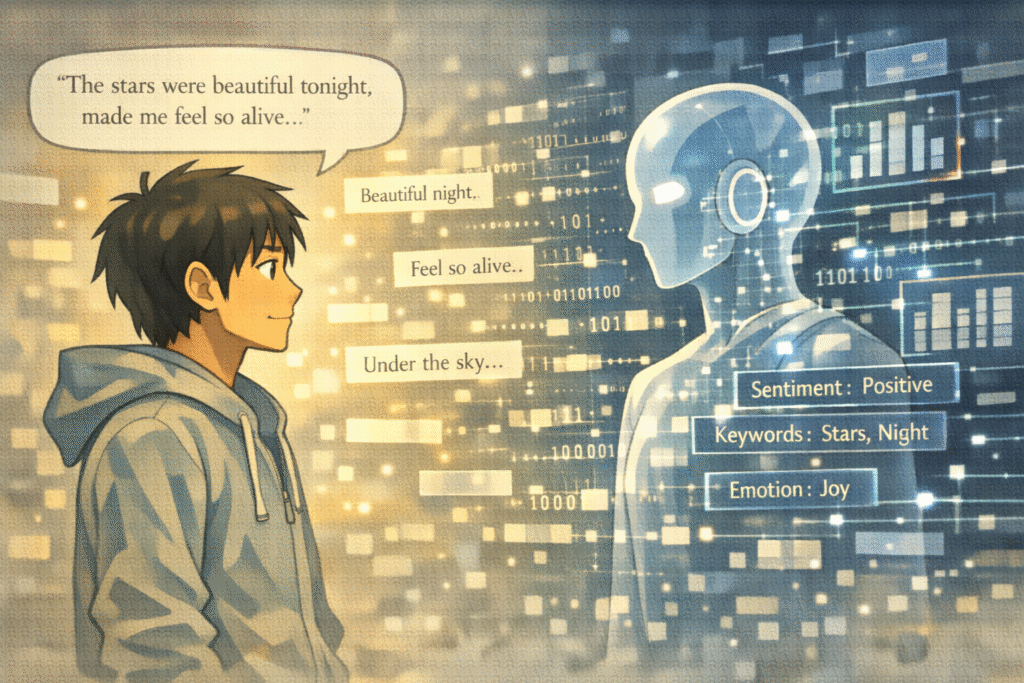
    AI system interpreting human language as structured data Insertion Position

    2.1 Statistical Language vs. Lived Meaning

    AI models interpret language through statistical and probabilistic patterns.
    They analyze correlations, predict likely continuations, and simulate coherence.

    Yet human meaning is shaped by context, culture, memory, and embodied experience.

    Consider the phrase “I’m fine.”
    Depending on tone, situation, and relationship, it may express reassurance, anger, exhaustion, or resignation.

    True understanding requires more than syntactic accuracy—it demands lived context.

    2.2 The Symbol Grounding Problem

    Philosopher Stevan Harnad described the symbol grounding problem:
    Can a system manipulate symbols without ever grounding them in real-world experience?

    An AI system may process the word “pain,” but does it experience pain?
    If understanding is detached from embodiment, can it be called understanding at all?


    3. The Possibility of Shared Thought

    3.1 Language as Translation

    Language functions as a translation tool for thought.

    If AI were to perfectly interpret linguistic structures, humans might gain new ways of expressing inner states with greater precision.
    Combined with technologies such as brain-computer interfaces, even pre-verbal cognitive patterns might someday be decoded.

    This suggests the theoretical possibility of more direct cognitive exchange.

    3.2 The Risk to Subjectivity

    Yet the idea of shared thought carries ethical risks.

    If our most private mental states become interpretable by machines, what happens to autonomy and privacy?
    Does shared cognition enhance freedom—or erode individuality?

    The dream of perfect understanding may also become a tool of surveillance.


    4. Consciousness and the Hard Problem

    Philosopher David Chalmers distinguishes between explaining cognitive functions and explaining conscious experience.

    AI may replicate functional language use.
    But does it possess subjective experience—what philosophers call qualia?

    Understanding language structurally does not necessarily mean sharing inner awareness.

    A system may simulate thought without having a first-person perspective.


    Conclusion: Beyond Language

    Human consciousness represented as inner light beyond language Insertion Position

    Even if AI someday achieves flawless linguistic comprehension, that alone does not guarantee shared consciousness.

    Language is a window into thought—but not the entirety of it.

    As AI deepens its linguistic capabilities, we may be forced to confront a deeper question:

    Perhaps the real issue is not whether AI can understand us.
    Rather, it is whether we are prepared to fully express ourselves through language.

    The more clearly AI mirrors our words, the more urgently we must ask what remains unspoken.

    Related Reading

    The philosophical tension between human agency and algorithmic systems is further examined in Automation of Politics: Can Democracy Survive AI Governance?, where AI’s role in collective decision-making is debated.
    For a more personal and experiential dimension, The Standardization of Experience reflects on how digital mediation reshapes individual autonomy.


    References

    1. Philosophical Investigations
      Wittgenstein, L. (1953/2009). Philosophical Investigations. Wiley-Blackwell.
      → Explores how language shapes meaning and thought, forming the foundation for debates about linguistic limits and cognition.
    2. The Conscious Mind
      Chalmers, D. (1996). The Conscious Mind. Oxford University Press.
      → Introduces the “hard problem” of consciousness, distinguishing between functional explanation and subjective experience.
    3. The Language Instinct
      Pinker, S. (1994). The Language Instinct. HarperCollins.
      → Examines the cognitive structures underlying human language, offering insight into what AI models replicate—and what they may lack.
    4. The Symbol Grounding Problem
      Harnad, S. (1990). “The Symbol Grounding Problem.” Physica D, 42(1–3), 335–346.
      → Argues that symbol manipulation alone does not constitute semantic understanding.
    5. Climbing towards NLU
      Bender, E. M., & Koller, A. (2020). “Climbing towards NLU.” Proceedings of ACL.
      → Critically evaluates claims that language models truly “understand” meaning.
  • If AI Can Imitate Human Intuition, Are We Still Special?

    Intuition as a Human Capacity

    Intuition has long been considered a uniquely human ability.

    Even without complete information or explicit reasoning, we often make important decisions based on a sudden sense of knowing.
    Scientific breakthroughs, artistic inspiration, and life-changing choices have frequently emerged from such intuitive moments.

    Intuition appears to operate beneath conscious thought, guiding us before logic fully catches up.

    But today, artificial intelligence systems—trained on vast amounts of data—are producing remarkably accurate predictions, often in ways that look intuitive.

    If AI can one day perfectly imitate human intuition, what, then, remains uniquely human?

    A person pausing thoughtfully, representing human intuition

    1. The Nature of Intuition: Unconscious Wisdom

    1.1 Fast Thinking and Hidden Knowledge

    Psychologist Daniel Kahneman describes intuition as System 1 thinking: fast, automatic, and largely unconscious.

    This form of thinking allows humans to respond quickly without deliberate calculation.
    It is efficient, adaptive, and deeply rooted in experience.

    1.2 Intuition as Compressed Experience

    Intuition is not a random emotional impulse.
    It is the result of accumulated learning, memory, and pattern recognition operating below awareness.

    In this sense, intuition represents a form of compressed wisdom:
    complex knowledge distilled into immediate judgment.


    2. AI and the Imitation of Intuition

    Abstract visualization of artificial intelligence making predictions

    2.1 Data-Driven Prediction

    Modern AI systems generate instant predictions by processing enormous datasets.

    In medicine, for example, AI can analyze X-ray images and detect diseases faster—and sometimes more accurately—than human experts.
    These outputs resemble intuitive judgments.

    2.2 A Fundamental Difference

    Yet there is a crucial distinction.

    Human intuition integrates perception, emotion, and lived experience within a holistic context.
    AI, by contrast, calculates statistical patterns and outputs probabilities.

    AI may simulate intuition, but it does not experience it.
    Its judgments are produced without awareness, embodiment, or meaning.


    3. Crisis and Opportunity in Human Uniqueness

    3.1 The Threat to Human Specialness

    If AI were to replicate intuition flawlessly, one of humanity’s long-held markers of uniqueness would be challenged.

    Intuition has been central to how we understand creativity, expertise, and insight.
    Its automation raises understandable existential anxiety.

    3.2 Intuition as Collaboration

    Yet this development can also be interpreted differently.

    Rather than replacing human intuition, AI may serve as a complementary tool—handling probabilistic complexity while freeing humans to engage in deeper reflection, creativity, and ethical judgment.

    In this partnership, intuition becomes a bridge rather than a battleground.


    4. Beyond Intuition: What Makes Us Human

    4.1 Meaning, Not Just Judgment

    Even if AI can imitate intuitive decision-making, human intuition is not merely instrumental.

    It is embedded in narrative, emotion, and personal history.
    An artist’s inspiration, a parent’s sudden sense of danger, or a visionary leap into the unknown cannot be reduced to pattern recognition alone.

    4.2 Humans as Meaning-Makers

    AI may calculate intuition.
    Humans, however, assign meaning to it.

    We interpret intuitive insights within ethical frameworks, emotional relationships, and life stories.
    This capacity to care about intuition—to treat it as meaningful rather than functional—marks a fundamental difference.

    A reflective human moment emphasizing meaning and values

    Conclusion: Rethinking Intuition in the Age of AI

    If AI can perfectly imitate human intuition, human uniqueness will no longer rest on intuition alone.

    Instead, it will lie in our ability to interpret, evaluate, and weave intuition into narratives of value and purpose.

    The question, then, shifts:

    If AI can possess intuition, how must humans rethink what intuition truly is?

    Within that question, the distinction between human and machine becomes visible once again.

    Related Reading

    The ethical dimension of artificial cognition is further examined in If AI LIf AI Learns Human Morality, Can It Become an Ethical Agent?earns Human Morality, Can It Become an Ethical Agent?, questioning whether imitation can evolve into responsibility.

    The cultural implications of technological mediation are explored in LiLiving with Virtual Beings: Companionship, Comfort, or Replacement?ving with Virtual Beings: Companionship, Comfort, or Replacement?, where emotional substitution becomes a central theme.


    References

    1. Thinking, Fast and Slow
      Kahneman, D. (2011). Thinking, Fast and Slow. Farrar, Straus and Giroux.
      → Distinguishes intuitive (System 1) and analytical (System 2) thinking, framing intuition as experience-based cognitive efficiency.
    2. Gut Feelings
      Gigerenzer, G. (2007). Gut Feelings: The Intelligence of the Unconscious. Viking.
      → Interprets intuition as an evolved adaptive strategy rather than irrational impulse.
    3. How to Use Intuition Effectively in Decision-Making
      Sadler-Smith, E. (2015). Journal of Management Inquiry, 24(3), 246–255.
      → Examines intuition in organizational decision-making and contrasts it with data-driven systems.
    4. The Tacit Dimension
      Polanyi, M. (1966). The Tacit Dimension. University of Chicago Press.
      → Introduces the idea that humans know more than they can explicitly articulate, grounding intuition philosophically.
    5. What Computers Still Can’t Do
      Dreyfus, H. L. (1992). What Computers Still Can’t Do. MIT Press.
      → A philosophical critique of artificial reason, highlighting limits of machine imitation of human understanding.