Tag: cognitive science

  • If AI Truly Understands Human Language, Can We Share Thought?

    Language as the Boundary of the Human World

    Human figure surrounded by floating fragments of language Insertion Position

    Language has long been considered one of the defining features of humanity.

    Through language, we articulate thoughts, interpret reality, and connect with others.
    Yet language is never complete. Subtle emotions, unconscious impulses, and ineffable inner experiences often remain beyond words.

    Today’s artificial intelligence systems process and generate human language with astonishing fluency.
    They answer questions, compose essays, and simulate dialogue in ways that appear remarkably human.

    This raises a profound question:

    If AI were to perfectly understand human language, could it also share our thoughts?
    Or does something beyond language remain uniquely human?


    1. Language and Thought: Are They the Same?

    1.1 Wittgenstein and the Limits of Expression

    The philosopher Ludwig Wittgenstein famously wrote,
    “The limits of my language mean the limits of my world.”

    This statement suggests that language shapes the boundaries of thought.
    If this is true, then a system that fully understands language might also grasp the structure of thought itself.

    1.2 Thought Beyond Words

    However, not all thinking is propositional or linguistic.
    Intuition, sensory awareness, artistic inspiration, and emotional experience often arise before or beyond verbal formulation.

    Thought may use language—but it is not exhausted by it.


    2. Meaning, Context, and the Depth of Understanding
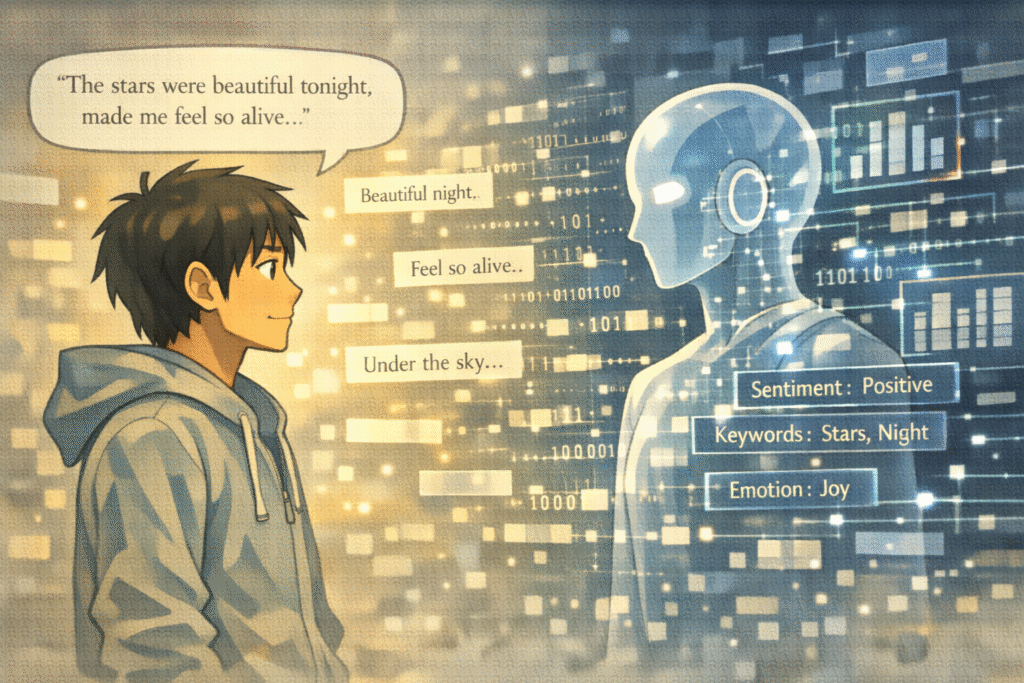
    AI system interpreting human language as structured data Insertion Position

    2.1 Statistical Language vs. Lived Meaning

    AI models interpret language through statistical and probabilistic patterns.
    They analyze correlations, predict likely continuations, and simulate coherence.

    Yet human meaning is shaped by context, culture, memory, and embodied experience.

    Consider the phrase “I’m fine.”
    Depending on tone, situation, and relationship, it may express reassurance, anger, exhaustion, or resignation.

    True understanding requires more than syntactic accuracy—it demands lived context.

    2.2 The Symbol Grounding Problem

    Philosopher Stevan Harnad described the symbol grounding problem:
    Can a system manipulate symbols without ever grounding them in real-world experience?

    An AI system may process the word “pain,” but does it experience pain?
    If understanding is detached from embodiment, can it be called understanding at all?


    3. The Possibility of Shared Thought

    3.1 Language as Translation

    Language functions as a translation tool for thought.

    If AI were to perfectly interpret linguistic structures, humans might gain new ways of expressing inner states with greater precision.
    Combined with technologies such as brain-computer interfaces, even pre-verbal cognitive patterns might someday be decoded.

    This suggests the theoretical possibility of more direct cognitive exchange.

    3.2 The Risk to Subjectivity

    Yet the idea of shared thought carries ethical risks.

    If our most private mental states become interpretable by machines, what happens to autonomy and privacy?
    Does shared cognition enhance freedom—or erode individuality?

    The dream of perfect understanding may also become a tool of surveillance.


    4. Consciousness and the Hard Problem

    Philosopher David Chalmers distinguishes between explaining cognitive functions and explaining conscious experience.

    AI may replicate functional language use.
    But does it possess subjective experience—what philosophers call qualia?

    Understanding language structurally does not necessarily mean sharing inner awareness.

    A system may simulate thought without having a first-person perspective.


    Conclusion: Beyond Language
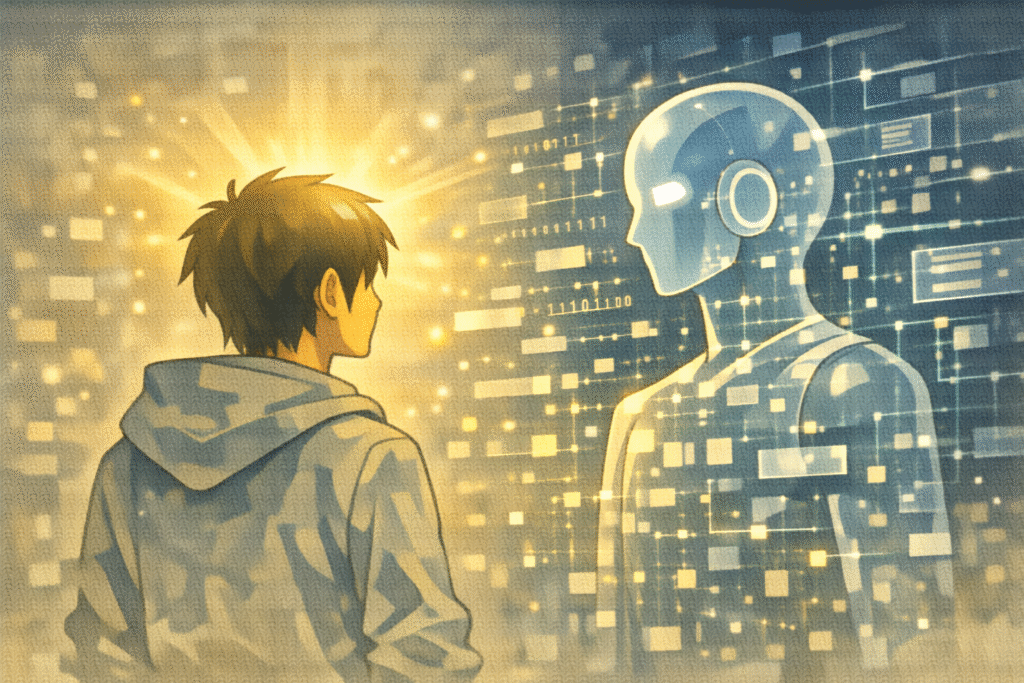
    Human consciousness represented as inner light beyond language Insertion Position

    Even if AI someday achieves flawless linguistic comprehension, that alone does not guarantee shared consciousness.

    Language is a window into thought—but not the entirety of it.

    As AI deepens its linguistic capabilities, we may be forced to confront a deeper question:

    Perhaps the real issue is not whether AI can understand us.
    Rather, it is whether we are prepared to fully express ourselves through language.

    The more clearly AI mirrors our words, the more urgently we must ask what remains unspoken.

    Related Reading

    The philosophical tension between human agency and algorithmic systems is further examined in Automation of Politics: Can Democracy Survive AI Governance?, where AI’s role in collective decision-making is debated.
    For a more personal and experiential dimension, The Standardization of Experience reflects on how digital mediation reshapes individual autonomy.


    References

    1. Philosophical Investigations
      Wittgenstein, L. (1953/2009). Philosophical Investigations. Wiley-Blackwell.
      → Explores how language shapes meaning and thought, forming the foundation for debates about linguistic limits and cognition.
    2. The Conscious Mind
      Chalmers, D. (1996). The Conscious Mind. Oxford University Press.
      → Introduces the “hard problem” of consciousness, distinguishing between functional explanation and subjective experience.
    3. The Language Instinct
      Pinker, S. (1994). The Language Instinct. HarperCollins.
      → Examines the cognitive structures underlying human language, offering insight into what AI models replicate—and what they may lack.
    4. The Symbol Grounding Problem
      Harnad, S. (1990). “The Symbol Grounding Problem.” Physica D, 42(1–3), 335–346.
      → Argues that symbol manipulation alone does not constitute semantic understanding.
    5. Climbing towards NLU
      Bender, E. M., & Koller, A. (2020). “Climbing towards NLU.” Proceedings of ACL.
      → Critically evaluates claims that language models truly “understand” meaning.

  • If AI Can Imitate Human Intuition, Are We Still Special?

    Intuition as a Human Capacity

    Intuition has long been considered a uniquely human ability.

    Even without complete information or explicit reasoning, we often make important decisions based on a sudden sense of knowing.
    Scientific breakthroughs, artistic inspiration, and life-changing choices have frequently emerged from such intuitive moments.

    Intuition appears to operate beneath conscious thought, guiding us before logic fully catches up.

    But today, artificial intelligence systems—trained on vast amounts of data—are producing remarkably accurate predictions, often in ways that look intuitive.

    If AI can one day perfectly imitate human intuition, what, then, remains uniquely human?

    A person pausing thoughtfully, representing human intuition

    1. The Nature of Intuition: Unconscious Wisdom

    1.1 Fast Thinking and Hidden Knowledge

    Psychologist Daniel Kahneman describes intuition as System 1 thinking: fast, automatic, and largely unconscious.

    This form of thinking allows humans to respond quickly without deliberate calculation.
    It is efficient, adaptive, and deeply rooted in experience.

    1.2 Intuition as Compressed Experience

    Intuition is not a random emotional impulse.
    It is the result of accumulated learning, memory, and pattern recognition operating below awareness.

    In this sense, intuition represents a form of compressed wisdom:
    complex knowledge distilled into immediate judgment.


    2. AI and the Imitation of Intuition

    Abstract visualization of artificial intelligence making predictions

    2.1 Data-Driven Prediction

    Modern AI systems generate instant predictions by processing enormous datasets.

    In medicine, for example, AI can analyze X-ray images and detect diseases faster—and sometimes more accurately—than human experts.
    These outputs resemble intuitive judgments.

    2.2 A Fundamental Difference

    Yet there is a crucial distinction.

    Human intuition integrates perception, emotion, and lived experience within a holistic context.
    AI, by contrast, calculates statistical patterns and outputs probabilities.

    AI may simulate intuition, but it does not experience it.
    Its judgments are produced without awareness, embodiment, or meaning.


    3. Crisis and Opportunity in Human Uniqueness

    3.1 The Threat to Human Specialness

    If AI were to replicate intuition flawlessly, one of humanity’s long-held markers of uniqueness would be challenged.

    Intuition has been central to how we understand creativity, expertise, and insight.
    Its automation raises understandable existential anxiety.

    3.2 Intuition as Collaboration

    Yet this development can also be interpreted differently.

    Rather than replacing human intuition, AI may serve as a complementary tool—handling probabilistic complexity while freeing humans to engage in deeper reflection, creativity, and ethical judgment.

    In this partnership, intuition becomes a bridge rather than a battleground.


    4. Beyond Intuition: What Makes Us Human

    4.1 Meaning, Not Just Judgment

    Even if AI can imitate intuitive decision-making, human intuition is not merely instrumental.

    It is embedded in narrative, emotion, and personal history.
    An artist’s inspiration, a parent’s sudden sense of danger, or a visionary leap into the unknown cannot be reduced to pattern recognition alone.

    4.2 Humans as Meaning-Makers

    AI may calculate intuition.
    Humans, however, assign meaning to it.

    We interpret intuitive insights within ethical frameworks, emotional relationships, and life stories.
    This capacity to care about intuition—to treat it as meaningful rather than functional—marks a fundamental difference.

    A reflective human moment emphasizing meaning and values

    Conclusion: Rethinking Intuition in the Age of AI

    If AI can perfectly imitate human intuition, human uniqueness will no longer rest on intuition alone.

    Instead, it will lie in our ability to interpret, evaluate, and weave intuition into narratives of value and purpose.

    The question, then, shifts:

    If AI can possess intuition, how must humans rethink what intuition truly is?

    Within that question, the distinction between human and machine becomes visible once again.

    Related Reading

    The ethical dimension of artificial cognition is further examined in If AI LIf AI Learns Human Morality, Can It Become an Ethical Agent?earns Human Morality, Can It Become an Ethical Agent?, questioning whether imitation can evolve into responsibility.

    The cultural implications of technological mediation are explored in LiLiving with Virtual Beings: Companionship, Comfort, or Replacement?ving with Virtual Beings: Companionship, Comfort, or Replacement?, where emotional substitution becomes a central theme.


    References

    1. Thinking, Fast and Slow
      Kahneman, D. (2011). Thinking, Fast and Slow. Farrar, Straus and Giroux.
      → Distinguishes intuitive (System 1) and analytical (System 2) thinking, framing intuition as experience-based cognitive efficiency.
    2. Gut Feelings
      Gigerenzer, G. (2007). Gut Feelings: The Intelligence of the Unconscious. Viking.
      → Interprets intuition as an evolved adaptive strategy rather than irrational impulse.
    3. How to Use Intuition Effectively in Decision-Making
      Sadler-Smith, E. (2015). Journal of Management Inquiry, 24(3), 246–255.
      → Examines intuition in organizational decision-making and contrasts it with data-driven systems.
    4. The Tacit Dimension
      Polanyi, M. (1966). The Tacit Dimension. University of Chicago Press.
      → Introduces the idea that humans know more than they can explicitly articulate, grounding intuition philosophically.
    5. What Computers Still Can’t Do
      Dreyfus, H. L. (1992). What Computers Still Can’t Do. MIT Press.
      → A philosophical critique of artificial reason, highlighting limits of machine imitation of human understanding.