Tag: cognitive bias

  • Supernatural Phenomena in Pop Culture: Where Reality Meets Imagination

    Supernatural Phenomena in Pop Culture: Where Reality Meets Imagination

    Why are we so fascinated by things we cannot explain?

    Ghosts, haunted houses, UFO sightings, and mysterious forces—
    these ideas have always existed at the edge of human imagination.

    Yet they are not confined to myths or folklore.
    They live vividly in films, books, and television, shaping how we think, fear, and even believe.

    Supernatural phenomena are not just stories.
    They are reflections of how humans interpret the unknown.
    mirror reflection illusion human perception confusion

    1. Supernatural Stories in Film: Between Reality and Fiction

    One of the most famous examples is The Conjuring series.

    Marketed as “based on a true story,” the films follow paranormal investigators Ed and Lorraine Warren as they confront haunted houses and demonic entities.

    However, the real-life cases remain controversial.
    Some view them as genuine supernatural encounters, while others see them as psychological phenomena or exaggerations.

    This ambiguity is the key.

    The film works not because it proves the supernatural—but because it leaves us unsure.

    And that uncertainty is what makes it powerful.


    2. Literature and the Supernatural: Fear as a Psychological Mirror

    Stephen King’s works demonstrate that supernatural horror is rarely about ghosts alone.

    In The Shining, the haunted hotel is not just a place—it becomes a reflection of the protagonist’s inner collapse.

    The “supernatural” often represents:

    • Trauma
    • Fear
    • Isolation

    Rather than external threats, these stories reveal something internal.

    In this sense, supernatural fiction is less about what is “out there”
    and more about what is within us.


    3. Modern Myths: UFOs, Conspiracies, and Collective Imagination

    During the 20th century, UFO sightings and alien encounters became widespread.

    Shows like The X-Files amplified this fascination, blending supernatural mystery with government conspiracy.

    Its famous line—
    “The truth is out there”
    captures something deeper than fiction.

    It reflects a human desire to believe that:

    • There is more than we know
    • Reality is incomplete
    • Mystery still exists

    These stories evolve into modern myths—
    not necessarily because they are true, but because they feel possible.


    4. Why Humans Believe in the Supernatural
    dark corridor shadow fear of unknown

    This is where psychology becomes essential.

    Humans are naturally wired to detect patterns, seek meaning, and fear the unknown. Many supernatural beliefs are connected to how the human brain processes uncertainty (see more on Wikipedia).

    When something cannot be explained, the brain often fills the gap with narrative.

    This leads to three key effects:

    ① Pattern-seeking mind

    We see faces in shadows, sounds in silence.

    ② Emotional amplification

    Fear makes experiences feel more real.

    ③ Cultural reinforcement

    Media repeats and strengthens belief.

    In other words,
    we do not just consume supernatural stories—
    we participate in them.


    5. Supernatural in the Digital Age

    Today, the supernatural has evolved.

    Through social media, YouTube, and streaming platforms:

    • Ghost footage spreads instantly
    • Conspiracy theories gain global attention
    • Fiction and reality blur faster than ever

    Algorithms amplify what captures attention—
    and nothing captures attention like fear and mystery.

    The result:

    The supernatural is no longer just storytelling.
    It has become a shared digital experience.


    6. The Double Edge of Supernatural Culture

    Supernatural content can be meaningful.

    ✔ It sparks imagination
    ✔ It offers psychological release
    ✔ It allows exploration of fear in a safe space

    But it also has risks.

    It can spread misinformation
    It can create irrational fear
    It can distort reality

    The power of the supernatural lies in this balance.


    Conclusion

    human silhouette fading reality imagination boundary

    Supernatural phenomena in pop culture are not simply about ghosts or mysteries.

    They are about how humans understand the unknown.

    They sit at the boundary between:

    • Reality and imagination
    • Fear and curiosity
    • science and belief

    And perhaps that is why they endure.

    Because the real question is not:

    “Are these phenomena real?”

    But rather:

    “Why do they feel real to us?”


    A Question for Readers

    Do you think supernatural stories reveal hidden truths about human psychology—or are they simply powerful illusions created by culture?

    Related Reading


    If what we see and feel can deceive us, how much of reality is truly reliable?
    In If Memory Can Be Manipulated, What Can We Really Trust?, we explore how memory and perception shape our understanding of reality—suggesting that even supernatural experiences may arise from the mind’s attempt to interpret uncertainty.


    What if the boundary between reality and imagination is shaped not by the world—but by the way we think and communicate?
    In Does Language Shape Thought, or Does Thought Shape Language?, we examine how language influences human perception—revealing that what we call “supernatural” may sometimes reflect the limits of how we describe the unknown.


    References


    King, Stephen. (2000). On Writing: A Memoir of the Craft. New York: Scribner.
    This memoir offers insight into Stephen King’s creative process, revealing how supernatural elements are often grounded in psychological realism. It helps explain why fictional horror feels emotionally authentic to readers.


    Guiley, Rosemary Ellen. (2007). The Encyclopedia of Ghosts and Spirits. New York: Facts on File.
    This comprehensive reference explores historical and cultural accounts of supernatural phenomena, demonstrating how beliefs about ghosts and spirits have shaped and been shaped by popular culture.


    Bord, Janet, & Bord, Colin. (2001). The Big Book of UFOs. London: HarperCollins.
    This book documents UFO sightings and their cultural interpretations, illustrating how unexplained events evolve into modern myths and influence collective imagination.


  • Are Emotions a Barrier to Moral Judgment—or Its Foundation?

    Are Emotions a Barrier to Moral Judgment—or Its Foundation?

    Reason, Feeling, and the Ethics of Human Decision-Making

    Imagine seeing someone ignore an elderly person in need.

    You feel anger.

    Then you watch someone offer help to a stranger—
    and you feel something entirely different.

    These reactions come before any deliberate reasoning.

    They raise a fundamental question:

    Are emotions obstacles that distort moral judgment—
    or are they the very source of it?

    person showing empathy helping

    1. Kant: Morality Without Emotion

    Immanuel Kant argued that morality must be grounded in reason alone.

    For him, actions driven by emotion—such as sympathy or compassion—
    lack true moral worth.

    Only actions performed out of duty, guided by rational principles,
    can be considered genuinely moral.

    Emotion, in this view, is unreliable.
    It fluctuates, biases judgment, and risks distorting universal principles.

    A promise should be kept—not because we feel sympathy,
    but because it is rationally right.


    2. Hume and Nussbaum: Emotion as the Core of Morality

    David Hume famously reversed this logic.

    “Reason is the slave of the passions,” he argued.

    According to Hume, moral judgments arise not from abstract reasoning,
    but from feelings—especially empathy.

    Martha Nussbaum extends this idea in modern philosophy.
    She argues that emotions are not irrational forces,
    but forms of intelligent judgment about what matters to us.

    Compassion, in this sense, is not weakness—
    it is a recognition of another’s humanity.


    3. Neuroscience: The Emotional Brain Decides

    person making logical decision

    Contemporary neuroscience offers powerful insight.

    Research by Antonio Damasio shows that individuals with impaired emotional processing
    struggle to make even simple decisions.

    Moral reasoning, too, activates emotional regions of the brain.

    This suggests that emotion is not a disturbance to judgment—
    but a necessary condition for making decisions at all.

    Without emotion, there may be logic—
    but no direction.


    4. When Emotion Distorts—and When It Deepens

    Emotion can both enrich and distort moral judgment.

    A jury overwhelmed by anger may deliver unjust punishment.
    In such cases, emotion undermines fairness.

    But purely emotionless systems—such as algorithmic decision-making—
    can produce outcomes that feel cold, detached, and unjust.

    Justice without empathy risks becoming inhuman.

    The challenge is not to eliminate emotion—
    but to understand and guide it.


    5. Beyond the Dichotomy: Toward Integration

    Modern ethical thought increasingly rejects the strict divide between reason and emotion.

    John Rawls suggests that fairness requires both rational structure
    and sensitivity to others’ experiences.

    Virtue ethics emphasizes the cultivation of emotional character—
    not its suppression.

    Emotion and reason are not enemies.

    They are partners that must be trained to work together.


    Conclusion: Morality Needs Both Mind and Heart

    balance between emotion and reason

    Emotion can mislead—but it can also awaken us.

    It is through emotion that we feel injustice,
    recognize suffering,
    and choose to act.

    Moral judgment may begin in the mind—
    but it does not move forward without the heart.

    So the question remains:

    Can morality exist without emotion—
    or does it only become real when we feel it?

    A Question for Readers

    Think about a moment when you judged something as “right” or “wrong.”

    Was it your reasoning that led you there—
    or your feelings?

    And if the two ever conflicted,
    which one did you choose to trust?

    Related Reading

    Our moral judgments are shaped not only by logic, but also by how we interpret reality itself.
    In Is There a Single Historical Truth—or Many Narratives?, the role of interpretation reveals how perspective and bias influence what we believe to be true and just.

    At the same time, the instability of memory reminds us that our judgments are not fixed.
    In If Memory Can Be Manipulated, What Can We Really Trust?, the reconstructive nature of memory shows how both emotion and reasoning can be influenced—and sometimes distorted—over time.

  • If Memory Can Be Manipulated, What Can We Really Trust?

    If Memory Can Be Manipulated, What Can We Really Trust?

    Truth, Technology, and the Fragility of Human Memory

    Have you ever argued with someone about the same event—
    both of you completely certain, yet remembering it differently?

    “I clearly remember it happening this way.”
    “No, that’s not what happened.”

    What if memory is not a fixed record—
    but something constantly rewritten?

    In the age of AI and deepfake technology,
    memory is no longer shaped only by the human mind.

    If what we remember can be altered or fabricated,
    what can we truly trust?


    1. Memory Is Not Stored—It Is Reconstructed

    overlapping reconstructed memories scene

    Scientific research shows that memory does not function like a recording.
    Each time we recall an event, we reconstruct it.

    Emotions, context, and present beliefs reshape the past.

    This explains why two people can remember the same moment differently.
    Memory is not pure truth—it is a narrative continuously rewritten.


    2. Digital Memory: The Externalization of the Self

    person viewing digital memories floating

    Today, memory is no longer confined to the brain.

    Photos, messages, and videos stored in digital systems act as extensions of ourselves.
    Yet these memories are not fully under our control.

    Algorithms select what we see. Platforms reshape how we remember.

    Even a simple “memory reminder” can reinterpret the past.


    3. Deepfakes and False Memory

    The rise of AI introduces a more dangerous possibility: fabricated memory.

    Deepfake technology can create events that never happened—
    yet appear completely real.

    If people begin to “remember” things that never occurred,
    truth itself becomes unstable.

    Memory is no longer just personal—it becomes a social vulnerability.


    4. Can We Protect Truth?

    Perfect memory may be impossible.
    But we can resist manipulation.

    • Verify sources
    • Practice critical thinking
    • Compare multiple perspectives
    • Demand transparency in AI systems

    Truth may not be absolute—but it must be actively defended.

    face morphing deepfake distortion

    Conclusion

    “I saw it.”
    “I remember it clearly.”

    These statements feel certain—but may be fragile.

    Memory can be altered.
    But that does not mean truth disappears.

    It means we must search for it more carefully.

    Memory is not just about the past—
    it shapes the reality we live in.

    And in a world where memory can be manipulated,
    the responsibility to question, verify, and reflect becomes more important than ever.

    A Question for Readers

    Have you ever been absolutely certain about a memory—
    only to later realize it might not have been true?


    Related Reading

    The fragility of memory becomes even more complex when we consider how truth itself is interpreted.
    In Is There a Single Historical Truth—or Many Narratives?, the tension between objectivity and interpretation reveals how collective memory can shape what we accept as reality.

    At the same time, the limits of human judgment are further explored in Why We Excuse Ourselves but Blame Others, where cognitive biases demonstrate how our perception of events—and fairness—is often influenced more by perspective than by objective truth.

    The way we remember and interpret reality is also shaped by the systems we use to search and filter information (see How Search Boxes Shape Thinking).

    If even our memories can be shaped and reconstructed, then the freedom we believe we exercise through choice may also be more fragile than it seems (see Is Freedom an Expansion of Choice — or an Expansion of Anxiety?).


    References

    1. Loftus, E. F. (2005). Planting misinformation in the human mind: A 30-year investigation of the malleability of memory. Learning & Memory, 12(4), 361–366.
      → This study summarizes decades of research on false memory formation, showing how easily external information can alter personal recollection. It provides strong experimental evidence that memory is reconstructive rather than fixed.
    2. Schacter, D. L. (2001). The Seven Sins of Memory: How the Mind Forgets and Remembers. Boston: Houghton Mifflin.
      → Schacter identifies systematic patterns of memory distortion, including misattribution and suggestibility. The book demonstrates that memory errors are not random but structured features of human cognition.
    3. Hirst, W., & Echterhoff, G. (2012). Remembering in conversations: The social sharing and reshaping of memories. Annual Review of Psychology, 63, 55–79.
      → This research explains how memory is socially constructed through communication and interaction. It highlights how collective memory emerges and changes within groups.
    4. Chesney, R., & Citron, D. K. (2019). Deep Fakes: A Looming Challenge for Privacy, Democracy, and National Security. California Law Review, 107, 1753–1819.
      → This paper examines the societal risks of deepfake technology, including its potential to distort public memory and undermine trust in visual evidence.
    5. Vaccari, C., & Chadwick, A. (2020). Deepfakes and Disinformation: Exploring the Impact on Trust in News. Social Media + Society, 6(1), 1–13.
      → This study investigates how manipulated media affects public trust and perception. It shows how deepfakes can contribute to collective false memories and misinformation.
  • Why Do People Prefer the Right Side Over the Left?

    Why Do People Prefer the Right Side Over the Left?

    The Psychology of Spatial Bias and Human Behavior

    Have you ever noticed which direction you naturally choose?

    When walking down a street, entering a store, or pressing an elevator button, many people unconsciously turn to the right.

    This is not just a coincidence.

    Studies suggest that a large majority of people tend to favor the right side when making quick, unconscious decisions.

    But why does this happen?

    Is it simply because most people are right-handed, or is there something deeper at work within the human mind?


    1. The Subtle Bias in Everyday Life

    people unconsciously moving to the right side

    Right-side preference appears in many aspects of daily life:

    • People often browse the right side of store displays first
    • Queue designs in public spaces frequently guide movement to the right
    • In debates or visual layouts, right-positioned individuals are sometimes perceived more positively

    These patterns suggest that our choices are not always fully conscious.

    Instead, they are influenced by underlying cognitive tendencies.

    This tendency reflects a deeper pattern known as right side bias psychology, where the brain and body shape our unconscious directional preferences.


    2. The Brain and Body Connection

    One explanation lies in the asymmetry of the brain.

    The left hemisphere of the brain controls the right side of the body and is typically associated with:

    • language
    • logic
    • analytical thinking

    Since most people are right-handed, actions on the right side feel more natural, efficient, and comfortable.

    This familiarity reinforces a subtle bias toward the right.


    3. Evolution and Habit

    brain asymmetry influencing right side preference

    From an evolutionary perspective, right-handedness may have provided advantages in tool use and coordination.
    Over time, these tendencies became ingrained in human behavior.

    As a result, cultural systems and environments began to reflect and reinforce this bias.

    What starts as a biological tendency gradually becomes a social norm.


    4. Language and Cultural Symbolism

    Language also plays a powerful role.

    In English, the word “right” means both:

    • a direction
    • something correct or morally good

    In contrast, “left” has historically been associated with less favorable meanings.

    For example, the Latin word sinister originally meant “left” but later came to imply something negative.

    These linguistic patterns subtly influence how we perceive directions.

    Over time, “right” becomes associated with correctness, trust, and preference.


    5. A Surprising Reversal: When Left Feels More Emotional

    Interestingly, the left side is not always disadvantaged.

    In emotional and expressive contexts, the left side may be more powerful.

    Research suggests that:

    • the left side of the face often conveys emotion more vividly
    • visual compositions place emotional elements on the left side for stronger impact

    This indicates a fascinating balance:

    • the right side → associated with action, control, and decision-making
    • the left side → associated with emotion and expression
    person reflecting on left and right choices

    Conclusion: The Invisible Direction of Choice

    The next time you reach for something or choose a direction, pause for a moment.

    Are you choosing consciously, or following a deeply embedded pattern?

    Preferring the right side may not be a simple habit.

    It may reflect a complex interaction between the brain, the body, culture, and language.

    And sometimes, choosing the left
    may be a small but meaningful way to step outside of automatic thinking.


    Question for Readers

    When you make quick, everyday choices, do you notice a preference for one side over the other?

    Is your sense of comfort shaped by habit, or by deeper patterns in your mind and culture?

    If we are influenced by such subtle biases,
    how many of our “free choices” are truly our own?


    Related Reading

    The hidden patterns behind everyday decision-making are further explored in Why Do We Remember Regret Longer Than Failure?, where the role of cognitive processes and imagined possibilities reveals how the mind shapes our perception of past experiences.

    At a deeper level, the structure of human thought itself is examined in 0 and 1 in the Age of Artificial Intelligence, where binary systems reflect not only digital logic but also the way humans simplify complex realities into directional or categorical choices.


    References

    Corballis, M. C. (2014). The Wandering Mind: What the Brain Does When You’re Not Looking. University of Chicago Press. This book explores brain asymmetry and cognitive processes, explaining how lateralization influences attention, behavior, and directional preference in everyday life.

    Kinsbourne, M. (1978). Asymmetries of the Brain. Scientific American, 239(3), 128–139. This classic article examines spatial attention biases and explains why human perception and movement often show directional asymmetry, particularly toward the right.

    Chatterjee, A. (2001). Language and Space: Some Interactions. Trends in Cognitive Sciences, 5(2), 55–61. This paper investigates how language and spatial cognition interact, highlighting how cultural and linguistic structures influence directional preferences and perception.

  • Why We Excuse Ourselves but Blame Others

    — Understanding the Actor–Observer Bias

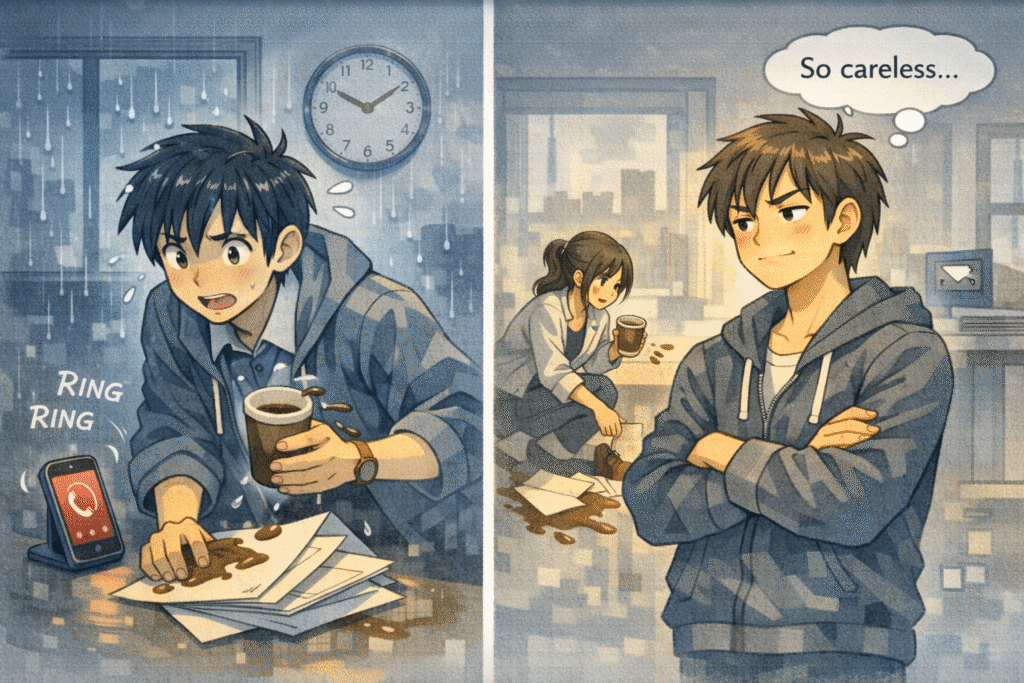
    Different perspectives in judging behavior

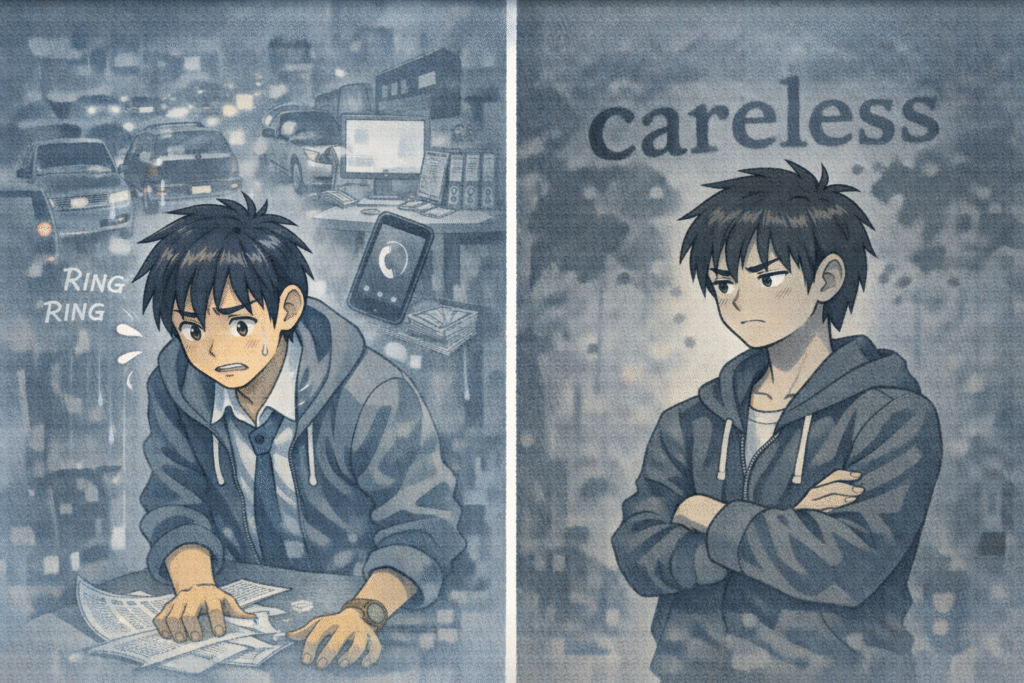
    When I make a mistake,
    “I had a good reason.”

    When someone else makes the same mistake,
    “What’s wrong with them?”

    Have you noticed this pattern?

    If someone cuts in traffic, we feel anger.
    But when we cut in because we are late,
    we expect understanding.

    This common psychological tendency is known as the Actor–Observer Bias.


    1. My Behavior Is Situational. Yours Is Personal.

    Situational versus personal attribution bias

    The concept was introduced by Edward Jones and Richard Nisbett in the 1970s.

    The idea is simple:

    When I fail → It was the situation.
    When you fail → It was your personality.

    If I miss a deadline,
    “I was overwhelmed.”

    If you miss a deadline,
    “You’re irresponsible.”

    As actors in our own lives, we see context.
    As observers of others, we see character.


    2. The Power of Perspective

    This bias stems from point of view.

    When I act, I know what I was feeling,
    what constraints I faced,
    what pressure I experienced.

    When I observe you,
    I see only the visible behavior.

    My inner world is vivid to me.
    Yours is invisible.

    That asymmetry creates distorted judgment.


    3. Why It Damages Relationships

    The bias becomes sharper in close relationships.

    If I respond late:
    “I had a stressful day.”

    If you respond late:
    “You don’t care anymore.”

    We interpret our own behavior through circumstance,
    but others’ behavior through intention.

    Over time, this pattern breeds misunderstanding and resentment.


    4. How to Reduce the Bias

    Awareness is the first step.

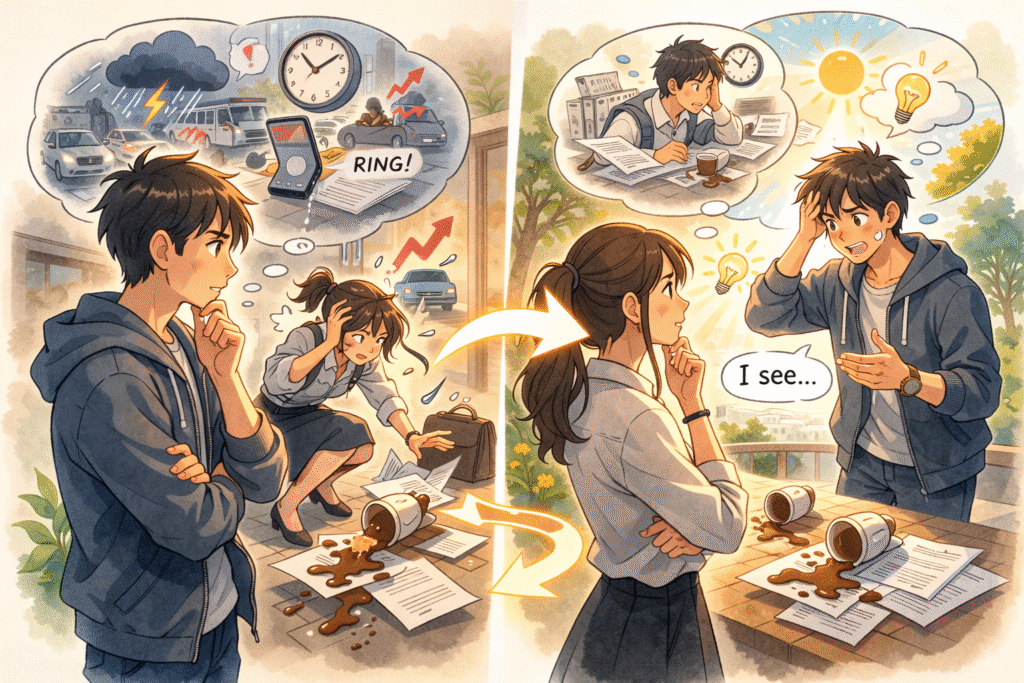
    Before judging, try asking:

    “What situation might they be in?”
    “Would I act differently under the same pressure?”

    Switching perspective softens attribution.

    Replacing
    “Why are they like that?”
    with
    “What might have happened?”

    can transform conflict into understanding.


    Conclusion

    Changing perspective to reduce blame

    We see ourselves in full color and others in outline.

    The Actor–Observer Bias is not a flaw of bad character.
    It is a built-in feature of human cognition.

    But once we recognize it,
    we gain a choice.

    A choice to pause.
    A choice to interpret more gently.
    A choice to understand before blaming.

    Sometimes, empathy begins with changing the angle of view.

    Related Reading

    The psychological roots of self-perception and social comparison are further explored in The Sociology of Selfies, where identity and recognition are analyzed in digital contexts.
    From a structural perspective, The Age of Overexposure: Why Do We Turn Ourselves into Products? expands this discussion by questioning how social systems amplify performative identity.


    References

    1. Jones, E. E., & Nisbett, R. E. (1972). The Actor and the Observer: Divergent Perceptions of the Causes of Behavior. In Attribution: Perceiving the Causes of Behavior.
    → This foundational work formally introduced the actor–observer bias and demonstrated how individuals attribute their own actions to situational factors while attributing others’ actions to personality traits.

    2. Ross, L. (1977). The Intuitive Psychologist and His Shortcomings. In Advances in Experimental Social Psychology.
    → Ross developed the concept of the fundamental attribution error, closely related to the actor–observer bias, highlighting how people underestimate situational influences when judging others.

    3. Gilbert, D. T. (1998). Ordinary Personology. In The Handbook of Social Psychology.
    → Gilbert explains how everyday people form quick judgments about others and why attribution biases persist even when we attempt to be objective.

  • Why It Feels Like Everyone Is Watching You: The Spotlight Effect

    Feeling watched in a public space despite no attention

    You get a new haircut, and suddenly it feels strange.
    You sit alone in a café and become aware of every movement.
    You stumble slightly on the subway and feel as if all eyes are on you.

    Have you ever had that feeling — that people around you are paying unusually close attention to you?

    Psychology has a name for this experience.
    It is called the spotlight effect, also known as self-relevance bias.


    1. We See the World From the Center of Ourselves

    1.1 The Natural Focus on the Self

    From birth, we experience the world from a first-person perspective.
    This makes self-awareness a natural part of being human.

    We constantly monitor how we look, how we sound, and how we appear to others. This sensitivity helps us navigate social life — but it also creates distortions.

    1.2 When Self-Awareness Becomes Overestimation

    Because we are so aware of ourselves, we often assume others are just as focused on us. In reality, this is rarely the case.

    The result is an illusion: we feel as if our actions and appearance stand out far more than they actually do.


    2. A Classic Experiment: “No One Noticed My Shirt”

    Overestimating others’ attention due to self-focus

    2.1 The Harvard T-Shirt Study

    In a well-known study conducted at Harvard University in 2000, participants were asked to wear an unattractive, embarrassing T-shirt into a classroom.

    Afterward, they were asked how many people they thought had noticed the shirt.

    On average, participants believed about 50% of others had noticed.
    In reality, only 10–15% actually did.

    2.2 The Gap Between Feeling and Reality

    This experiment clearly shows the gap between perceived attention and actual attention. We dramatically overestimate how much others notice us.

    What feels like a spotlight is often just a dim light.


    3. How the Bias Fuels Anxiety

    3.1 When the Effect Becomes Stronger

    The spotlight effect intensifies in situations such as:

    • Being in unfamiliar environments
    • Making mistakes
    • Feeling insecure about appearance or behavior
    • Being evaluated (presentations, interviews)

    3.2 From Awareness to Anxiety

    In these moments, excessive self-focus can lead to tension and withdrawal. In some cases, it contributes to social anxiety, making public spaces feel threatening rather than neutral.


    4. The Truth: Everyone Else Is Busy Being Themselves

    4.1 Others Are Not Watching — They Are Thinking

    The irony is simple: just as you are focused on yourself, others are absorbed in their own concerns.

    Your small mistake feels significant to you — but to others, it is often unnoticed or quickly forgotten.

    4.2 We Are All Main Characters in Our Own Stories

    Most people are not observers of your life.
    They are protagonists in their own.


    Conclusion

    People focused on their own thoughts, not others

    Feeling watched, judged, or remembered can be deeply uncomfortable.
    But most of the time, this feeling is not reality — it is the mind’s exaggeration of its own importance.

    People notice you far less than you imagine.
    Your mistakes rarely leave lasting impressions.

    So when that familiar anxiety appears, try this reminder:

    The spotlight is mostly in your head.

    And perhaps, that realization itself can be a quiet relief.

    Related Reading

    The psychology of subtle social perception is expanded in Social Attractiveness and the Psychology of Likeability, where unspoken cues shape interpersonal dynamics.

    The deeper philosophical question of withdrawal and presence is discussed in Is Solitude a Freedom of Self-Reflection, or a Risk of Social Disconnection? exploring the tension between connection and distance.


    References

    1.Gilovich, T., Medvec, V. H., & Savitsky, K. (2000). “The Spotlight Effect in Social Judgment: An Egocentric Bias in Estimates of the Salience of One’s Own Actions and Appearance.” Journal of Personality and Social Psychology, 78(2), 211–222.
    This seminal study introduced the concept of the spotlight effect, demonstrating experimentally that people greatly overestimate how much others notice them.

    2.Baumeister, R. F., & Bushman, B. J. (2021). Social Psychology and Human Nature (5th ed.). Boston: Cengage Learning.
    This textbook provides a comprehensive explanation of self-awareness, self-presentation, and cognitive biases, offering a broader framework for understanding self-relevance bias.

    3.Leary, M. R. (2007). The Curse of the Self: Self-Awareness, Egotism, and the Quality of Human Life. Oxford: Oxford University Press.
    Leary explores how excessive self-focus affects well-being, showing how heightened self-awareness can amplify social sensitivity and unnecessary anxiety.

  • “Opportunity Favors the Prepared”? The Psychology of Hindsight Bias

    “Opportunity favors the prepared.”

    It is one of the most familiar sayings in modern culture.
    We hear it in interviews with successful people, read it in self-help books, and repeat it as practical wisdom about life and effort.

    At first glance, the phrase sounds undeniably true.
    But psychologists suggest that this belief often rests on a subtle cognitive illusion — one known as hindsight bias.

    Why do we find this idea so convincing?
    And what does it reveal about how we interpret success and failure?

    Success reinterpreting the past through hindsight bias

    1. Explaining Success After the Fact

    1.1 The Human Need for Coherent Stories

    People have a strong tendency to explain outcomes after they occur.
    When someone becomes successful, we search their past for clues that make the result seem inevitable.

    A famous inventor, for example, may be described as having loved machines since childhood. That detail then becomes proof that success was always destined — even though countless others shared similar interests and never achieved recognition.

    1.2 What Is Hindsight Bias?

    This tendency is known as hindsight bias: the inclination to believe, after knowing an outcome, that it was predictable all along.

    Seen through this lens, the idea that “opportunity favors the prepared” may not describe how success actually happens. Instead, it reflects how we reinterpret the past once success is already visible.


    2. When Failure Becomes a Personal Fault

    2.1 Shifting Responsibility to the Individual

    One troubling consequence of this belief is how easily it assigns blame.
    If success is proof of preparation, then failure appears to signal personal deficiency.

    “You missed the opportunity because you were not ready.”

    This explanation feels simple — but it ignores reality.

    Feeling self-blame after missing an opportunity

    2.2 The Weight of Structural Inequality

    Opportunities are not distributed fairly.
    Luck, social capital, economic background, and timing all play powerful roles.

    For those who were prepared yet never given a chance, the phrase can turn inward, becoming a source of self-blame and lowered self-worth. In this way, a comforting slogan can quietly reinforce psychological pressure and social inequality.


    3. Why We Find the Phrase So Comforting

    3.1 The Illusion of Control

    If the saying is flawed, why does it remain so appealing?

    Psychologists argue that it offers an illusion of control.
    In an unpredictable world, the belief that effort guarantees opportunity provides emotional relief.

    “If I prepare enough, I can manage the future.”

    3.2 Motivation, Even When It Is Incomplete

    Although this sense of control may be exaggerated, it can still motivate action.
    The belief that preparation matters encourages persistence, learning, and hope — especially in uncertain environments.

    In this sense, the phrase functions less as an objective truth and more as a psychological coping strategy.


    4. Does Preparation Still Matter?

    4.1 Yes — But Not in the Way We Imagine

    None of this suggests that preparation is meaningless.
    Preparation often determines whether an opportunity is noticed or usable when it appears.

    What it does not guarantee is success.

    4.2 Beyond Individual Responsibility

    Equally important is recognizing that preparation alone cannot compensate for unequal access to opportunity.
    Some people lack safe spaces to study. Others benefit from networks and resources long before effort even begins.

    When preparation is emphasized without acknowledging these conditions, the narrative risks hiding structural injustice behind personal virtue.


    Conclusion

    “Opportunity favors the prepared” is a phrase that sounds wise — and sometimes helps us move forward.

    But beneath it lie selective memory, individualized blame, and a deep human desire for control.

    Preparation matters.
    So do chance, context, and fairness.

    By acknowledging the complexity behind success and failure, we may learn to judge ourselves and others with greater accuracy — and greater compassion.


    Related Reading

    The illusion of control and cognitive framing is explored in Clicktivism in Digital Democracy: Participation or Illusion?, where action may not equal impact.

    A broader examination of perfection and self-expectation appears in Why Do Humans Seek Perfection While Knowing Why Do Humans Seek Perfection While Knowing They Are Incomplete?They Are Incomplete?, connecting hindsight bias with identity formation.

    References

    1. Fischhoff, B. (1975). “Hindsight ≠ Foresight: The Effect of Outcome Knowledge on Judgment Under Uncertainty.” Journal of Experimental Psychology: Human Perception and Performance, 1(3), 288–299.
    This classic study empirically demonstrates hindsight bias, showing how knowledge of outcomes distorts our perception of predictability. It provides the theoretical foundation for understanding how success narratives are reconstructed after the fact.

    2.Ross, L., & Nisbett, R. E. (1991). The Person and the Situation: Perspectives of Social Psychology. New York: McGraw-Hill.
    This work explores how people overemphasize individual traits while underestimating situational factors. It is particularly useful for analyzing how opportunity and preparation are often framed as personal responsibility rather than structural conditions.

    3.Gladwell, M. (2008). Outliers: The Story of Success. New York: Little, Brown and Company.
    Gladwell argues that success emerges from cumulative advantages, timing, and social context as much as individual effort. The book effectively challenges the myth of the purely “prepared individual.”

  • How Search Boxes Shape the Way We Think

    The Invisible Influence of Algorithms in the Digital Age

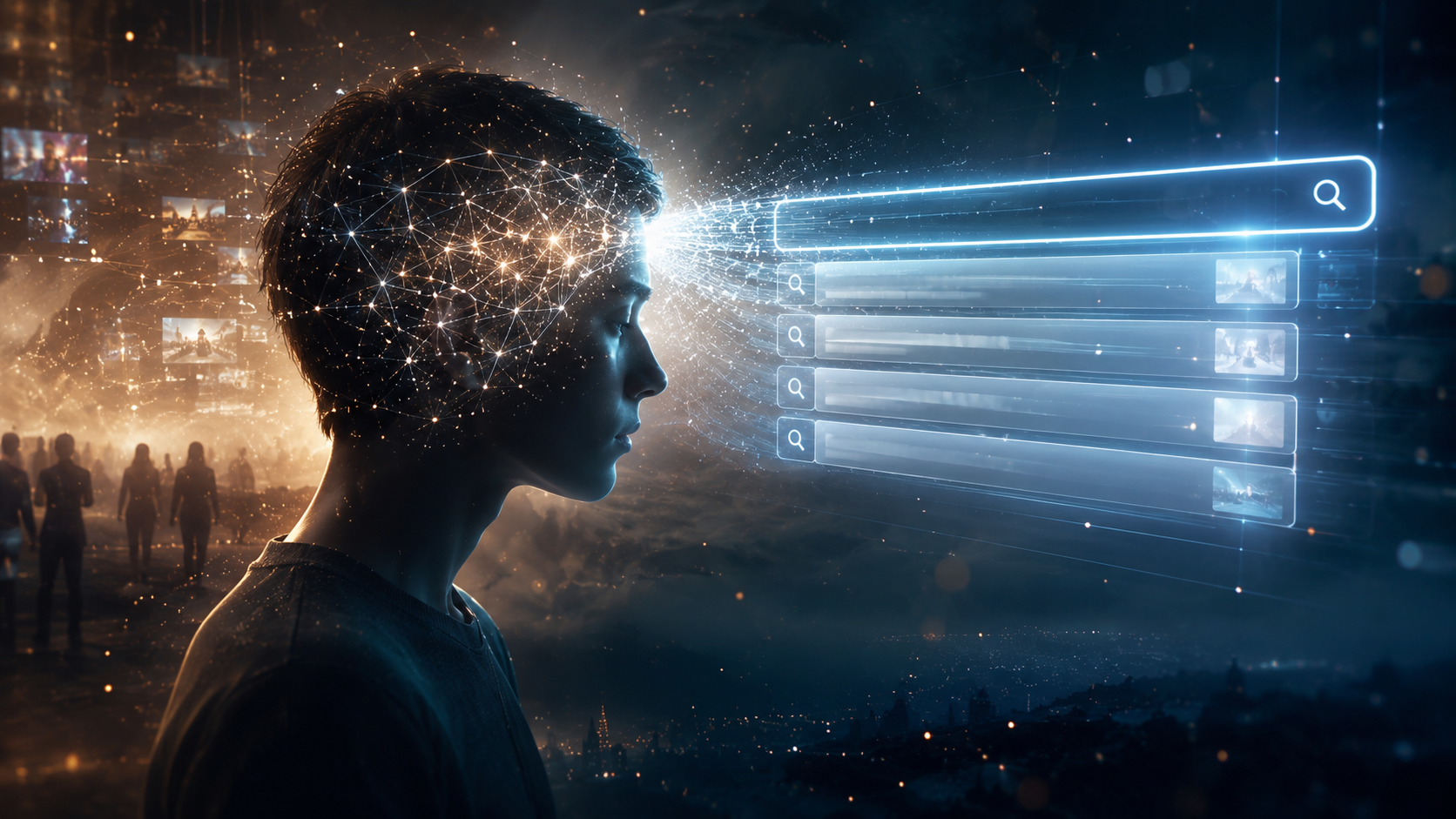
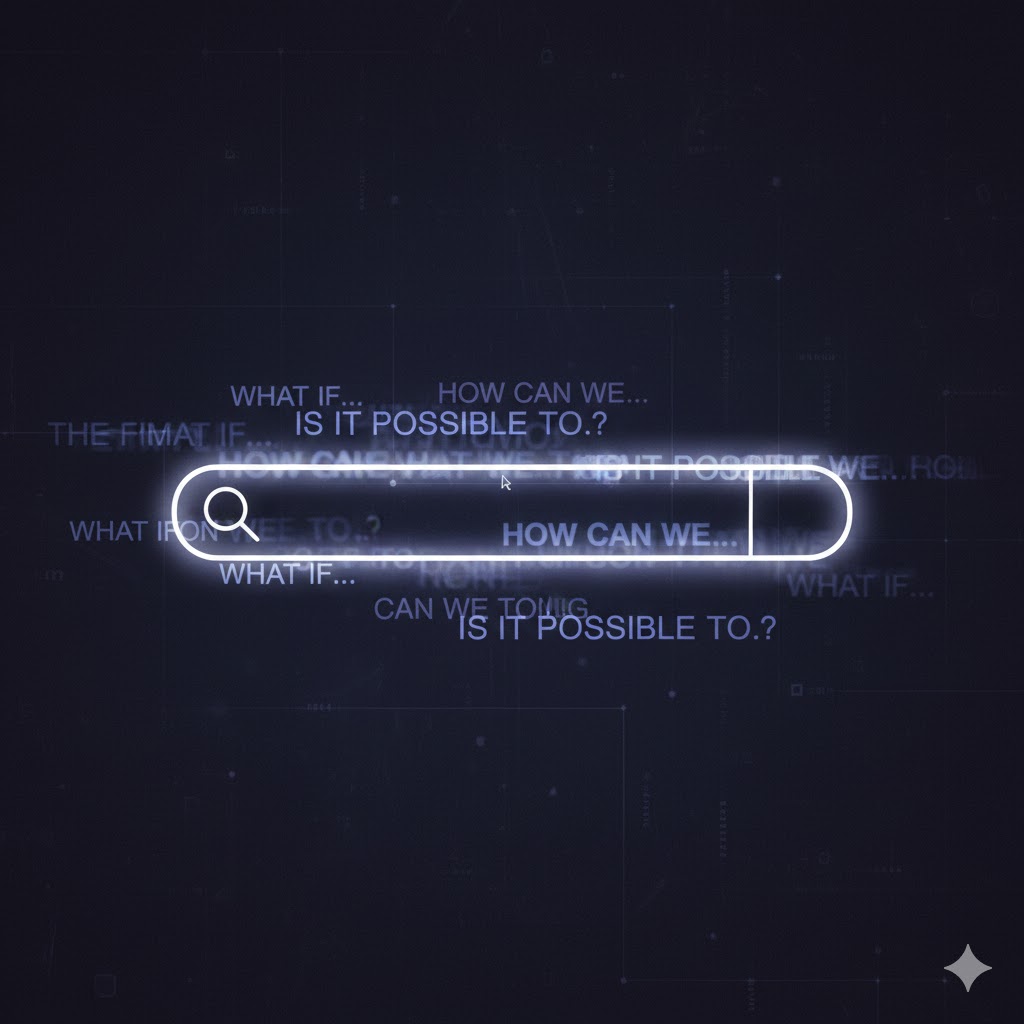
    Search box autocomplete shaping user questions

    1. When Search Boxes Decide the Question

    Search boxes do more than provide answers.
    They subtly change the way we ask questions in the first place.

    Think about autocomplete features.
    You begin typing “today’s weather,” and before finishing, the search box suggests
    “today’s weather air pollution.”

    Without intending to, your attention shifts.
    You were looking for the weather, but now you are thinking about air quality.

    Autocomplete does not simply predict words.
    It redirects thought.
    Questions that once originated in your mind quietly become questions proposed by an algorithm.


    2. How Search Results Shape Our Thinking

    Algorithmic bias in ranked search results

    Search results are not neutral lists.
    They are ranked, ordered, and designed to capture attention.

    Most users focus on the first page—often only the top few results.
    Information placed at the top is easily perceived as more accurate, reliable, or “true.”

    For example, when searching for a diet method, if the top results emphasize dramatic success,
    we tend to accept that narrative, even when contradictory evidence exists elsewhere.

    In this way, search results do not merely reflect opinions.
    They actively guide the direction of our thinking.


    3. The Invisible Power Behind the Search Box

    At first glance, a search box appears to be a simple input field.
    Behind it, however, lie powerful algorithms shaped by commercial and institutional interests.

    Sponsored content often appears at the very top of search results.
    Even when labeled as advertisements, users unconsciously associate higher placement with credibility.

    As a result, companies invest heavily to secure top positions,
    knowing that visibility translates directly into trust and choice.

    Our decisions—what we buy, read, or believe—are often influenced
    long before we realize it.


    4. Search Boxes Across Cultures and Nations

    Search engines differ across countries and cultures.
    Google dominates in the United States, Naver in South Korea, Baidu in China.

    Searching the same topic on different platforms can yield strikingly different narratives,
    frames, and priorities.

    A historical event, for instance, may be presented through contrasting lenses depending on the search environment.

    We do not simply search the world as it is.
    We see the world through the window our search box provides—and each window has its own tint.


    5. Learning to Question the Search Box

    How can we avoid being confined by algorithmic guidance?

    The answer lies in cultivating critical habits:

    • Ask whether an autocomplete suggestion truly reflects your original question
    • Look beyond the top-ranked results
    • Compare information across platforms and languages

    These small practices widen the intellectual space in which we think.

    Critical awareness of algorithmic influence

    Conclusion

    Search boxes are not passive tools for finding answers.
    They shape questions, guide attention, and quietly train our ways of thinking.

    In the digital age, the challenge is not to reject these tools,
    but to use them without surrendering our autonomy.

    True digital literacy begins when we recognize
    that the most powerful influence of a search box
    lies not in the answers it gives,
    but in the questions it encourages us to ask.

    A Question for You

    Have you ever searched for something—and felt the results were guiding your thinking?

    If what you see is filtered,
    how much of your thinking is truly your own?


    Related Reading

    The invisible filtering mechanisms behind everyday searches are explored further in
    Algorithmic Bias: How Recommendation Systems Narrow Our Worldview, where digital systems subtly shape what we see and how we interpret information.

    The fragility of human perception goes even deeper in
    If Memory Can Be Manipulated, What Can We Really Trust?,
    which examines how memory itself can be altered, raising fundamental questions about truth, identity, and reality.

    These systems not only shape how we search, but also how we learn, raising deeper questions about the role of human teachers in AI-driven education (see The Paradox of AI Education).

    References

    Pariser, E. (2011). The Filter Bubble: What the Internet Is Hiding from You. New York: Penguin Press.
    → Explores how personalized algorithms narrow users’ worldviews while shaping perception and judgment.

    Noble, S. U. (2018). Algorithms of Oppression: How Search Engines Reinforce Racism. New York: NYU Press.
    → Critically examines how search engines reflect and amplify social biases rather than remaining neutral tools.

    Beer, D. (2009). Power through the Algorithm? New Media & Society, 11(6), 985–1002.
    → Analyzes algorithms as invisible forms of power that structure everyday cultural practices.

  • The Illusion of “Free”: How Zero Price Changes Our Decisions

    A consumer drawn toward a free offer in a store

    1. The Magic of Free: The Belief That We Lose Nothing

    From an economic perspective, “free” does not necessarily mean beneficial.
    Sometimes, free offers lead people to buy more than they originally intended—resulting in greater loss rather than gain.

    Yet psychologically, humans are strongly drawn to the idea that free equals advantage.
    The word itself triggers an instinctive belief: there is no risk, only reward.

    Behavioral economist Dan Ariely famously demonstrated this through a simple experiment.
    Participants were asked to choose between a premium chocolate priced at 15 cents and a regular chocolate priced at 1 cent.
    Many chose the premium option.

    But when the prices were changed to 14 cents and 0 cents, the majority switched to the free chocolate.
    The difference was only one cent, yet the presence of “free” completely reversed their decisions.


    2. The Psychological Reward Behind Free

    Free offers provide more than financial benefit—they generate emotional satisfaction.
    People experience a sense of gain, relief, and even pride in “getting a good deal.”

    Consider free shipping.
    A delivery fee of $2.50 may cause hesitation, but when stores offer free shipping above a certain purchase amount, consumers often add unnecessary items just to qualify.

    Rationally, paying the shipping fee would cost less.
    Psychologically, however, the reward of avoiding loss outweighs careful calculation.

    Psychological bias triggered by free digital offers

    3. The Hidden Costs of Free

    Free rarely comes without conditions.

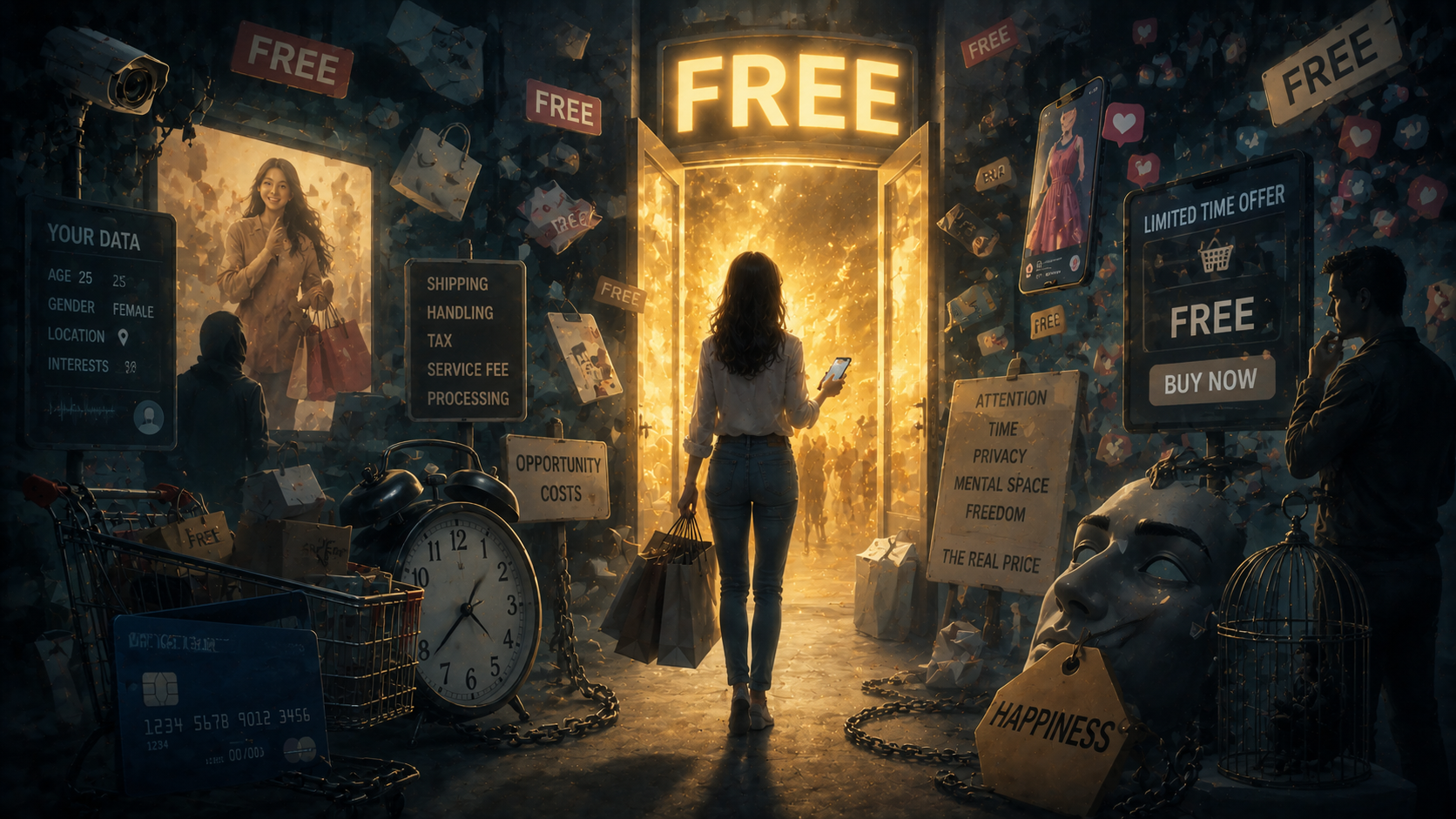
    Free apps often require users to watch advertisements, surrender personal data, or accept future pressure to upgrade to premium services.
    What disappears in monetary cost reappears as attention, privacy, or long-term commitment.

    Free samples work in similar ways.
    They are not acts of generosity but strategic investments—designed to cultivate future paying customers.

    In this sense, “free” is not free at all.
    It is a delayed transaction.


    4. How Free Changes Social Relationships

    The influence of free extends beyond markets into social life.

    When someone says, “I got this for free—take it,” we feel gratitude, but also subtle obligation.
    Psychologists call this the principle of reciprocity: receiving creates pressure to return the favor.

    This is why companies offer free tastings or trial products.
    Even small gifts can significantly increase purchase rates by activating an unconscious desire to reciprocate.


    5. Self-Defense in the Age of Free

    We live surrounded by free offers, free trials, and free content.
    Not all of it is harmful—but not all of it is beneficial either.

    To respond wisely, three habits help:

    • Ask whether you truly needed it before it was free
    • Identify hidden costs behind “zero price”
    • Recognize the psychological bias itself

    Awareness alone weakens the illusion.


    Conclusion

    Mindful decision making beyond free offers

    Free is a powerful psychological trigger.
    It does not merely reduce cost—it reshapes judgment, desire, and choice.

    Understanding the illusion of free allows us to reclaim agency over our decisions,
    ensuring that “no cost” does not quietly become a greater one.


    Related Reading

    Everyday experiences of perceived value, delay, and fairness are also discussed in The Sociology of Waiting in Line.

    At a political level, this economic logic feeds into debates about freedom and responsibility in The Minimal State: An Ideal of Liberty or a Neglect of the Common Good?

    References

    1. Ariely, D. (2008). Predictably Irrational: The Hidden Forces That Shape Our Decisions.
      Explains the “zero price effect” and how free offers distort rational decision-making.
    2. Cialdini, R. B. (2006). Influence: The Psychology of Persuasion.
      Introduces the principle of reciprocity and why people feel compelled to respond to free gifts.
    3. Shampanier, K., Mazar, N., & Ariely, D. (2007).
      Zero as a Special Price: The True Value of Free Products. Marketing Science, 26(6), 742–757.
      Empirically demonstrates why free products trigger emotional rather than rational responses.